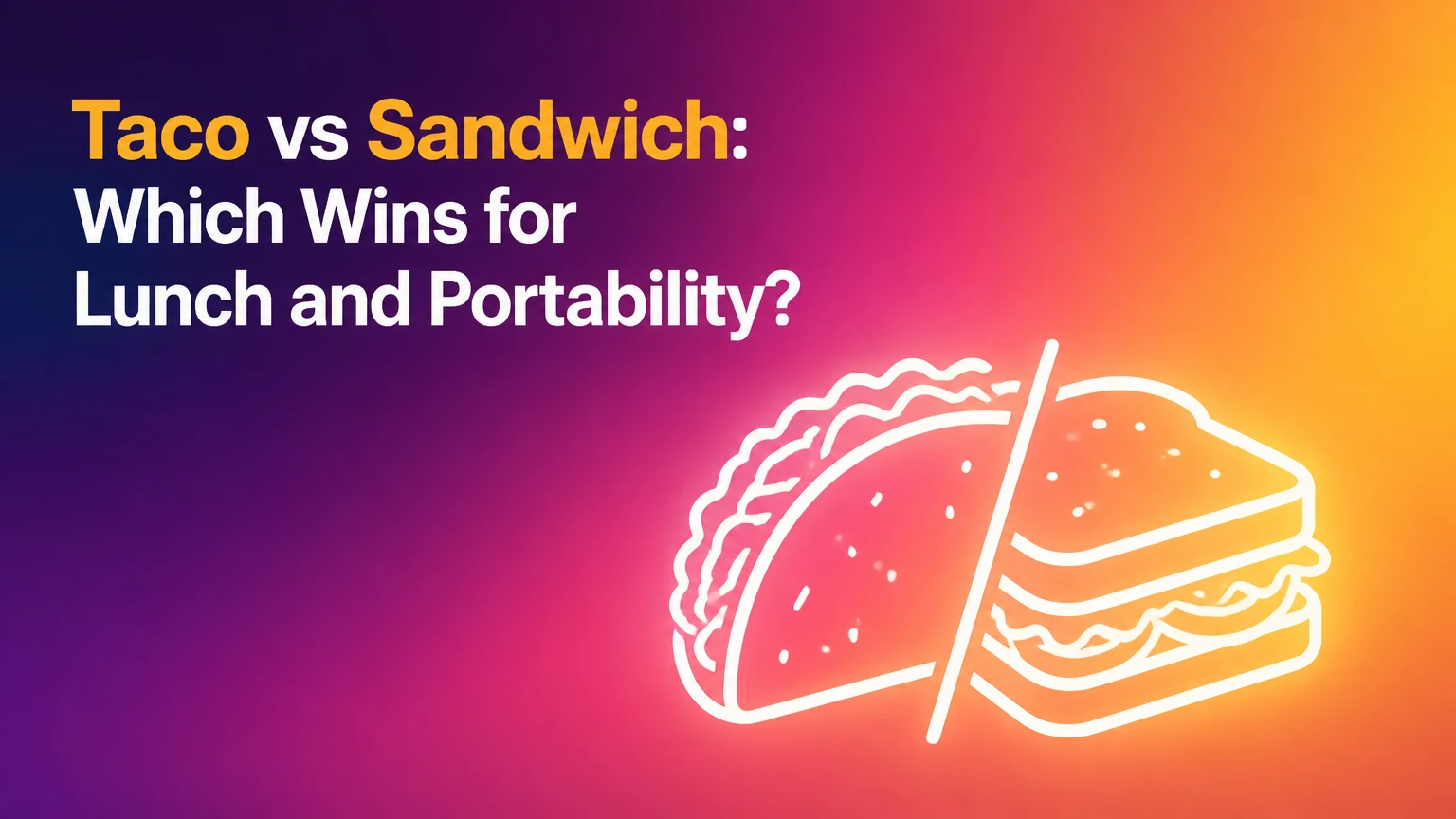
A taco is a filled tortilla folded around ingredients, while a sandwich is a filling enclosed by bread, usually between two slices or inside a split roll. Tacos usually deliver stronger seasoning and easier gluten-free customization; sandwiches generally provide better containment, longer holding time, and greater ingredient flexibility. The better choice depends on portability, diet, moisture, price, and portion size.
Key Facts at a Glance
- A traditional taco uses one folded corn or flour tortilla, while a conventional sandwich uses two bread surfaces or one split roll.
- A taco is usually eaten from an open top, so salsa, oils, and loose toppings can escape during handling.
- A sandwich generally travels better because compression keeps fillings between parallel bread surfaces.
- A corn-tortilla taco can be gluten-free, but flour tortillas and some processed fillings are not.
- A basic taco commonly takes 3-5 minutes to assemble; a composed sandwich commonly takes 5-10 minutes.
- Portion size matters more than the category: two small tacos can contain less food than one loaded sandwich, but four tacos can exceed it.
What Is the Difference Between a Taco and a Sandwich?
The main difference is the enclosing material and the way that material contains the filling. A taco uses a flexible or rigid tortilla folded around a filling, whereas a sandwich uses bread above and below the filling, or a split roll that creates a continuous lower and upper surface.
The distinction becomes less clear with unusual forms. A hot dog has a split roll and fits the structural definition used by many dictionaries, while an open-faced sandwich has only one bread slice. A taco remains culturally and culinarily distinct even when its filling resembles a sandwich filling.
Taco structure and ingredients
A taco normally includes:
- One soft corn or flour tortilla, often 12-15 centimeters across
- A seasoned filling such as beef, chicken, fish, beans, mushrooms, or vegetables
- Fresh toppings such as onion, cilantro, cabbage, tomato, or cheese
- A wet finishing component such as salsa, lime juice, crema, or hot sauce
A hard-shell taco uses a fried or baked U-shaped corn shell rather than a flexible tortilla. The shell changes the failure mode from folding and leakage to cracking and fragmentation.
Sandwich structure and ingredients
A sandwich generally includes:
- Two slices of bread, a bun, a split roll, or a baguette section
- A central filling such as sliced meat, egg, cheese, tuna, vegetables, or legumes
- Moisture-control ingredients such as butter, mayonnaise, cheese, or toasted surfaces
- Optional lettuce, tomato, pickles, sauces, spreads, or cooked vegetables
The sandwich family includes cold deli sandwiches, grilled panini, subs, burgers, tea sandwiches, and open-faced preparations. The category is therefore broader in shape and temperature than the taco category.
Is a Taco a Sandwich?
A taco is not usually treated as a sandwich in culinary practice, although a broad structural definition can place both foods under the larger category of filled handheld meals. The strongest distinction is cultural and material: tacos use tortillas and a folded presentation, while sandwiches use bread and layered or split-bread containment.
Dictionary definitions create the argument because “sandwich” can mean food placed between bread slices, inside a roll, or within a split bread product. That definition may include a sub or hot dog, but it does not automatically make every folded flatbread preparation a sandwich.
| Classification test | Taco result | Sandwich result | Why it matters |
|---|---|---|---|
| Enclosing material | Corn or flour tortilla | Wheat, rye, sourdough, or other bread | Material separates culinary traditions |
| Primary geometry | Folded U-shape or shell | Parallel bread surfaces or split roll | Geometry predicts leakage and grip |
| Cultural origin | Mexican food tradition | Broad international bread tradition | Culinary identity exceeds physical shape |
| Typical eating angle | Tilted toward the eater | Mostly horizontal | Gravity affects sauce movement |
| Standard assembly | Filling centered before folding | Filling layered before closing | Layer order controls stability |
A useful classification rule is this: classify the food by its culinary identity first, then by its physical structure. Under that rule, a taco is a taco, even though a very broad logical definition might call it a type of filled bread-like handheld food.
How Do Tacos and Sandwiches Hold Their Fillings?
Tacos rely on the tortilla’s hinge tension and the eater’s grip, while sandwiches rely on compression, friction, and contact between flat surfaces. A taco becomes unstable when its filling pushes the fold apart; a sandwich becomes unstable when wet layers reduce friction or a tall stack exceeds the bread’s grip.
Taco mechanics
A soft tortilla acts as a flexible hinge. The fold creates sidewalls, but the top remains open, so loose ingredients can move outward. Heavy filling should sit along the center line, with small amounts of wet sauce placed directly over the filling instead of poured along the tortilla edge.
A double-tortilla street taco improves strength because the second tortilla distributes pressure and catches small tears. It also increases the carbohydrate and calorie load, so the second layer is most useful for oily, heavy, or particularly wet fillings.
Sandwich mechanics
A sandwich uses two broad contact surfaces. Bread compresses the filling, and friction between bread, cheese, lettuce, and protein limits movement when the sandwich is carried level.
Condiments introduce a trade-off. Mayonnaise or butter can create a moisture barrier, but excessive sauce lowers friction and makes layers slide. Toasting removes surface moisture and increases stiffness, which helps grilled vegetables and juicy fillings remain contained.
Master Comparison: Taco vs Sandwich
The following figures are typical serving and preparation ranges, not universal standards. Restaurant portions, regional prices, bread type, filling quantity, and cooking method can shift every measurement.
| Criterion | Soft taco | Hard-shell taco | Deli sandwich | Sub or hoagie |
|---|---|---|---|---|
| Typical assembly time | 3-5 minutes | 4-7 minutes | 5-10 minutes | 7-12 minutes |
| Typical serving size | 2-3 tacos | 2-3 tacos | 1 sandwich | 1 sandwich |
| Common base size | 12-15 cm tortilla | 10-13 cm shell | 10-12 cm bread width | 15-30 cm roll |
| Typical price | $2.50-$4.50 each | $2-$4 each | $8-$15 | $9-$18 |
| Typical calorie range | 180-350 each | 200-400 each | 450-800 | 600-1,100 |
| Spill resistance | Low to moderate | Low | Moderate to high | High when wrapped |
| Gluten-free potential | High with corn tortilla | High with verified shell | Low to moderate | Low unless specialty bread is used |
The table reveals why a category-level calorie claim can mislead. One small taco is not nutritionally equivalent to one large sandwich; compare equal amounts of protein, starch, cheese, sauce, and vegetables instead.
Which Is More Portable?
Sandwiches are usually more portable than tacos because their bread surfaces press against the filling and allow tight wrapping. A wrapped sub can remain stable for a commute of 30-60 minutes, while a soft taco is best eaten within roughly 10-20 minutes unless the filling is dry and the tortillas are packed separately.
Taco portability improves when the diner controls moisture and pressure. Pack tortillas in foil, keep salsa in a small container, and add wet toppings immediately before eating. Hard shells are more fragile than soft tortillas because one crack can release the entire filling.
| Travel situation | Better choice | Packing method | Practical limit |
|---|---|---|---|
| 10-minute walk | Soft tacos | Foil with top partially open | 20 minutes |
| 30-minute commute | Wrapped sandwich | Paper, then foil | 60 minutes |
| Desk lunch with refrigerator | Either | Components separated | 4 hours chilled |
| Outdoor meal without utensils | Soft taco | Double tortilla, modest filling | 20 minutes |
| Long car trip | Sub sandwich | Tight wrap, dry produce | 60-90 minutes |
| Backpack with movement | Sandwich | Rigid container, diagonal cut | 2 hours chilled |
Food safety changes the decision. The United States Department of Agriculture recommends keeping perishable foods out of the danger zone, approximately 4-60°C, for no more than two hours, or one hour when the surrounding temperature exceeds 32°C. A durable wrapper does not make a warm meat sandwich safe for an unrestricted day.
Which Has Better Flavor and Texture?
Tacos usually produce higher flavor intensity per bite because seasoned filling, acidic salsa, herbs, onion, and lime occupy a small format. Sandwiches offer more texture range because they can combine crisp toast, soft bread, cool vegetables, melted cheese, pickles, and dense fillings in one compressed portion.
The winner depends on the target eating experience. A taco emphasizes contrast between tortilla, seasoned center, fresh garnish, and sauce. A sandwich emphasizes layering, chew, moisture balance, and sustained flavor across a larger bite.
| Desired quality | Stronger option | Typical ingredients | Reason |
|---|---|---|---|
| Acidic freshness | Soft taco | Lime, salsa, onion, cilantro | Acid reaches the filling directly |
| Toasted texture | Grilled sandwich | Toasted bread, melted cheese | Heat creates crisp exterior |
| Heat tolerance | Either | Warm filling and controlled sauce | Temperature depends on cooking |
| Crunch | Hard-shell taco | Fried shell, cabbage, radish | Shell supplies immediate fracture |
| Creamy texture | Sandwich | Cheese, spread, egg filling | Flat surfaces hold soft mixtures |
| Distinct seasoning | Taco | Marinade, salsa, herbs | Small format concentrates seasoning |
A counterintuitive rule from practical assembly is that more sauce does not necessarily create more flavor. Sauce placed on the tortilla or bread can soften the base before the eater reaches the final bite, while sauce placed over a hot, seasoned filling preserves both flavor and structure.
Which Is Healthier?
Neither tacos nor sandwiches are automatically healthier. A corn-tortilla taco with beans, grilled vegetables, and moderate cheese can provide less energy than a large sandwich, but a fried shell with rich filling can exceed a lean sandwich with whole-grain bread and vegetables.
The relevant variables are portion count, cooking fat, sodium, refined starch, protein amount, fiber, and sauce. The American Heart Association identifies sodium as a major dietary concern, and processed sandwich meats, packaged sauces, cheese, and salted taco fillings can all increase sodium regardless of the food category.
| Nutrition variable | More controllable in tacos | More controllable in sandwiches | Best practical adjustment |
|---|---|---|---|
| Gluten exposure | Corn tortilla selection | Specialty bread selection | Verify labels and shared equipment |
| Fiber | Beans, cabbage, corn tortilla | Whole-grain bread, vegetables | Add 5-10 g fiber-rich ingredients |
| Sodium | Fresh filling and salsa | Low-sodium protein and spreads | Limit processed meats and packaged sauces |
| Portion size | Count tortillas individually | Measure bread and filling | Compare equal protein servings |
| Added fat | Grilled filling, soft tortilla | Lean filling, light spread | Use 1-2 teaspoons of spread |
| Protein | Beans, chicken, fish, eggs | Poultry, eggs, legumes, cheese | Target a defined 20-30 g serving |
Corn tortillas are naturally gluten-free when made from corn and processed without wheat contamination. Restaurant kitchens may share griddles, fryers, cutting boards, or storage surfaces, so people with celiac disease need ingredient and cross-contact confirmation rather than relying on the word “corn.”
Which Costs Less?
A basic taco often costs less per individual unit, but a complete taco meal may cost the same as or more than a sandwich because diners commonly order two or three tacos. Typical restaurant pricing places a single taco around $2.50-$4.50 and a cafe sandwich around $8-$15, although location and ingredient quality change the comparison.
Home preparation narrows the difference. Tortillas, beans, rice, cabbage, and a large batch of cooked filling can produce several inexpensive tacos, while bread, sliced protein, cheese, and fresh produce can produce multiple sandwiches with similarly low per-serving cost.
| Home meal | Typical servings | Typical ingredient cost | Cost per serving |
|---|---|---|---|
| Bean and vegetable tacos | 6 tacos | $8-$14 | $1.33-$2.33 |
| Chicken tacos | 6 tacos | $14-$24 | $2.33-$4.00 |
| Egg and vegetable sandwiches | 4 sandwiches | $10-$18 | $2.50-$4.50 |
| Deli-style sandwiches | 4 sandwiches | $18-$32 | $4.50-$8.00 |
Cost per calorie is a poor decision metric because it rewards large portions. Cost per usable meal is more helpful: count the number of satisfying servings, include sauces and produce, and account for leftovers that remain safe and appealing.
How Do You Assemble Each One Without a Mess?
A successful taco uses a warm tortilla, a restrained filling, and wet toppings added near the center. A successful sandwich uses a dry or protected bread surface, even layers, and enough compression to hold the filling without crushing it.
Taco assembly
- Warm each tortilla on a dry skillet for 20-30 seconds per side. The tortilla should bend without cracking.
- Add 60-90 grams of cooked filling along the center, leaving at least 2 centimeters of exposed edge.
- Add 1-2 tablespoons of salsa or another wet topping over the filling, not beneath it.
- Add 1-2 tablespoons of onion, herbs, cabbage, or another dry garnish.
- Finish with a small squeeze of lime, then fold immediately.
The success checkpoint is a flexible tortilla with a fold that stays closed while the taco is held at a 30-45 degree angle. The common mistake is overfilling; a taco that cannot close halfway is structurally overloaded.
Sandwich assembly
- Spread approximately 1 teaspoon of butter or mayonnaise across each bread surface.
- Place 60-90 grams of dense filling on the lower slice.
- Add cheese or another stable layer above the protein.
- Place dry lettuce between the bread and wetter produce where possible.
- Add tomato, pickles, or sauce in moderate quantities.
- Close, press gently, and cut diagonally if the sandwich is tall.
The success checkpoint is a sandwich that can be lifted from one corner without the filling sliding more than 1 centimeter. The common mistake is placing wet tomato directly against porous bread for prolonged storage.
What Are the Main Types?
Taco varieties differ mainly by tortilla, cooking method, filling, and garnish. Sandwich varieties differ mainly by bread format, temperature, filling density, and whether the bread is pressed or left soft.
| Type | Base | Typical filling | Best use |
|---|---|---|---|
| Street taco | Small corn tortillas | Grilled or stewed seasoned filling, onion, herbs | High-flavor meal eaten immediately |
| Al pastor taco | Corn tortillas | Spit-roasted marinated meat, onion, herbs, fruit garnish | Acidic, sweet, savory contrast |
| Fish taco | Corn or flour tortilla | Fish, cabbage, sauce, lime | Light texture with crisp garnish |
| Hard-shell taco | Fried corn shell | Ground meat or beans, lettuce, cheese | Crunch-focused quick meal |
| Deli sandwich | Rye, wheat, or white bread | Sliced protein, cheese, vegetables | Cold lunch and office meals |
| Panini | Italian-style bread | Cheese, vegetables, cooked protein | Hot pressed meal |
| Sub sandwich | Long split roll | Layered fillings, cheese, vegetables, dressing | Large portable serving |
| Open-faced sandwich | One bread slice | Hot topping, vegetables, or gravy | Fork-and-plate meal |
A torta is a useful neighboring category. It is a Mexican sandwich made with a bread roll and layered fillings, so it shares ingredients with tacos while retaining bread-based construction. A burrito differs from both because the tortilla fully encloses the filling rather than leaving an open top.
Which Should You Choose?
Choose tacos for immediate eating, concentrated seasoning, corn-based gluten avoidance, or a meal built around salsa and fresh garnish. Choose a sandwich for transport, advance assembly, large fillings, clean desk eating, or a meal that must remain contained for an hour.
For the commuter
A wrapped sandwich is the practical winner. Select a firm roll, use a moisture barrier, keep tomatoes moderate, and cut the sandwich diagonally; the structure tolerates movement better than an open taco.
For the gluten-free diner
A corn-tortilla taco is usually the easier choice, provided the tortilla, filling, sauces, and cooking surface are verified. A gluten-free sandwich can work, but specialty bread often costs more and may crumble under wet fillings.
For the meal-prep planner
A sandwich wins when assembled shortly before eating, while tacos win when components are stored separately. Refrigerate filling below 4°C, keep tortillas or bread dry, and pack salsa or dressing in a separate container.
For the high-flavor minimalist
A soft taco is the better choice. A modest portion of seasoned filling with onion, herbs, salsa, and lime creates a sharper flavor profile than a heavily layered sandwich.
For the budget diner
Home-prepared bean tacos often provide the lowest cost per serving, while a simple egg sandwich may be equally economical. Restaurant diners should compare the price of two or three tacos with one sandwich rather than comparing single menu units.
Common Problems and Practical Fixes
| Problem | Likely cause | Immediate fix | Prevention |
|---|---|---|---|
| Tortilla cracks | Cold or overheated tortilla | Warm with a few drops of water nearby | Heat 20-30 seconds per side |
| Taco spills forward | Filling placed too close to edge | Reduce filling and fold tighter | Leave 2 cm edge clearance |
| Shell shatters | Dry, damaged shell or heavy filling | Use a soft tortilla backup | Add filling in 30-gram portions |
| Bread becomes soggy | Wet produce touches bread | Insert cheese or lettuce barrier | Pack sauce separately |
| Sandwich slides apart | Too much spread or tall layers | Compress and cut diagonally | Keep layers under 5-6 cm |
| Filling tastes dry | Lean protein or insufficient moisture | Add 1 tablespoon sauce or broth | Cook protein with controlled moisture |
Expert rule of thumb: moisture should touch a protective layer before it touches the base. In a taco, the seasoned filling can absorb salsa; in a sandwich, cheese, butter, or toasted bread should intercept tomato juice and dressing.
Another practical rule is to match structural strength to filling weight. A 60-gram taco filling suits one small tortilla, while a 100-gram filling usually needs a larger tortilla or a double layer. Sandwiches require firmer bread as the stack grows taller.
The most common category error is comparing unequal servings. Compare two tacos with a half sandwich, or compare the total meal weight, protein, starch, and sauce. Single-item comparisons often make the sandwich appear more substantial simply because sandwich portions are larger.
FAQ
Are tacos better than sandwiches for dinner?
Tacos are often better for a dinner built around fresh toppings, shared components, and adjustable portion sizes. Sandwiches are better when dinner needs a single large serving with minimal assembly. A taco dinner also allows separate choices of beans, vegetables, cheese, and sauce, while a sandwich usually concentrates the meal into one fixed portion.
Can a sandwich use a tortilla?
A tortilla wrap is usually classified separately from a sandwich because the tortilla surrounds or rolls around the filling rather than using bread surfaces. A wrap can perform like a sandwich for portability, but its rolling geometry produces different leakage points and requires tighter closure at the ends.
Are tacos cheaper than sandwiches at restaurants?
A single taco usually costs less, commonly $2.50-$4.50, but diners often need two or three tacos for a complete meal. A cafe sandwich commonly costs $8-$15 and may include a larger bread and filling portion, so total value depends on serving size, side dishes, protein quantity, and local menu pricing.
Which keeps longer in a lunchbox?
A sandwich with firm bread and dry fillings generally keeps its texture longer than a filled taco. For either meal, refrigerate perishable ingredients below 4°C, separate wet components, and follow the USDA’s two-hour limit for unrefrigerated perishable food, reduced to one hour in temperatures above 32°C.
Is a taco healthier than a burger?
A taco is not automatically healthier than a burger. A corn-tortilla taco with beans and vegetables can contain less energy and more produce than a large burger, but fried shells, rich sauces, cheese, and oversized portions can reverse that advantage. Compare protein, sodium, added fat, and total portion size.
What is the cleanest way to eat a taco?
Hold a soft taco at a 30-45 degree angle with both ends supported, keep the filling below the tortilla’s midpoint, and take bites from the folded edge toward the open side. Small tortillas, moderate filling, and salsa added immediately before eating reduce forward spill and side leakage.
The Bottom Line
Taco vs sandwich is a comparison between two different containment systems, not a contest with one universal winner. Tacos offer concentrated seasoning, flexible portions, and strong corn-tortilla options; sandwiches offer superior travel stability, broader bread formats, and easier large-portion assembly. Choose tacos for immediate flavor and sandwiches for durable, organized transport.