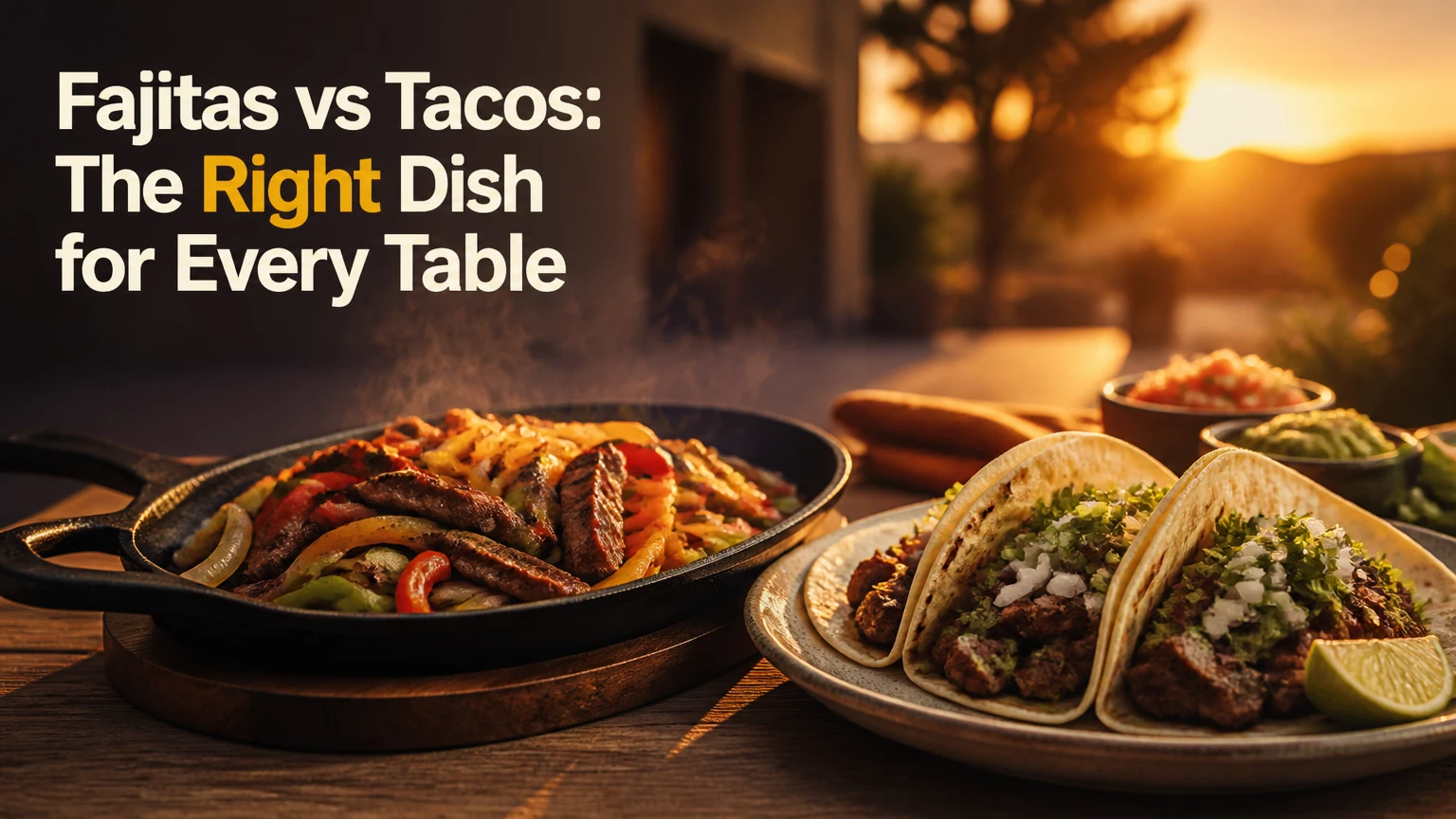
Fajitas and tacos differ mainly in format and service: fajitas present grilled strips of meat or vegetables with tortillas and toppings for diners to assemble, while tacos arrive as individual folded tortillas containing a prepared filling. Fajitas are usually larger, hotter, and more interactive; tacos are generally smaller, more portable, and easier to order one at a time.
Key Facts at a Glance
- Fajitas are typically served as a sizzling platter of grilled strips, vegetables, tortillas, and condiments.
- Tacos are individual portions built around a small corn or flour tortilla and a prepared filling.
- Modern restaurant fajitas are associated with Tex-Mex cuisine and skirt steak, although chicken, shrimp, and vegetables are common.
- Tacos belong to a broad Mexican food tradition with regional forms including grilled beef, braised beef, fish, beans, and stewed fillings.
- A fajita platter usually costs more initially because it feeds multiple diners or creates several assembled portions.
- Tacos provide more variety per person because each taco or order can use a different filling.
How Are Fajitas and Tacos Different?
Fajitas and tacos differ across five practical attributes: presentation, tortilla size, filling shape, assembly, and eating occasion. Fajitas emphasize hot strips and table customization, whereas tacos emphasize a compact, ready-to-eat combination of tortilla, filling, salsa, and garnish.
The distinction is not simply “Tex-Mex versus Mexican.” A taco can contain fajita-style grilled strips, and some restaurants sell “fajita tacos” as a hybrid. The important question is whether the food arrives as a shared platter for assembly or as a completed handheld portion.
| Attribute | Fajitas | Tacos |
|---|---|---|
| Primary format | Shared platter | Individual folded portion |
| Typical filling shape | 2-4 inch grilled strips | Chopped, shredded, sliced, or stewed filling |
| Typical tortilla diameter | 8-10 inches | 4-6 inches |
| Assembly | Diner assembles each serving | Cook or taquero assembles before serving |
| Heat experience | Cast-iron sizzle at the table | Warm tortilla at delivery |
| Typical order size | 1 platter, often 2-4 servings | 2-4 tacos per order |
| Best setting | Group dinner or interactive meal | Fast meal, tasting, or individual order |
A practical rule follows: order fajitas when the cooking presentation and customization matter, and order tacos when you want distinct, ready-to-eat portions with less table work.
Where Did Fajitas and Tacos Come From?
Fajitas developed as a Tex-Mex preparation linked to skirt steak, while tacos have a much older and wider Mexican history. The word fajita comes from faja, meaning belt or strip, and originally referred to the belt-like skirt steak cut rather than every grilled dish sold on a sizzling platter.
Accounts commonly place the rise of modern fajitas among ranch workers and meat markets along the Texas-Mexico border during the twentieth century. The restaurant presentation, including cast-iron platters and flour tortillas, became especially prominent in Texas and broader United States Tex-Mex dining from the 1960s onward.
Tacos cannot be reduced to one origin story or one recipe. Indigenous communities in Mexico used tortillas as a practical way to carry and eat food long before the modern restaurant taco developed. The often-repeated Nahuatl explanation involving tlahco, meaning “half” or “in the middle,” is widely circulated, but the etymology remains debated.
Jeffrey M. Pilcher, a food historian and author of Planet Taco, describes the taco as “the most democratic of foods,” a phrase that captures its defining flexibility: tacos can be regional, inexpensive, elaborate, soft, crisp, grilled, stewed, vegetarian, or seafood-based.
What Goes Into Each Dish?
Fajitas center on grilled strips and aromatic vegetables, while tacos can use almost any prepared filling that fits a small tortilla. Skirt steak remains the classic fajita cut because its loose grain accepts seasoning and develops a strong grilled flavor, but chicken, shrimp, mushrooms, onions, and peppers are equally common restaurant choices.
Taco fillings vary by region and cooking method. Grilled beef may be chopped for carne asada tacos, fish may be battered and topped with cabbage, and braised beef may be shredded and paired with a concentrated cooking broth.
| Dish or style | Main protein or base | Typical cooking method | Common toppings |
|---|---|---|---|
| Beef fajitas | Skirt steak or flank steak | High-heat grilling | Peppers, onions, lime, salsa |
| Chicken fajitas | Breast or thigh strips | Grilling or skillet searing | Peppers, onions, sour cream |
| Shrimp fajitas | Large peeled shrimp | Brief high-heat sautéing | Lime, peppers, avocado |
| Vegetable fajitas | Mushrooms, zucchini, poblano peppers | Grilling or roasting | Beans, salsa, guacamole |
| Carne asada taco | Grilled beef | Direct grilling | Onion, cilantro, salsa |
| Braised beef taco | Chuck, cheek, or short rib | Slow braising | Onion, cilantro, broth |
| Fish taco | White fish | Griddling or frying | Cabbage, crema, lime |
| Bean taco | Pinto, black, or refried beans | Simmering or pan-heating | Cheese, salsa, onion |
Fajita vegetables are functional, not merely decorative. Onions and peppers contribute sweetness, moisture, and contrast against the meat’s char. Taco garnishes are usually more restrained because a small tortilla cannot safely carry the same volume.
How Do Tortillas Change the Dish?
Tortilla size changes portion control, texture, handling, and the amount of filling a diner can add. Fajitas commonly use larger flour tortillas because flour provides flexibility for strips, vegetables, cheese, and sauces; tacos commonly use smaller corn tortillas because corn contributes aroma and a firmer base.
These are conventions, not absolute rules. Flour tacos are common in northern Mexico and the United States, while corn tortillas can accompany some fajita platters. A double tortilla is useful for wet or heavy taco fillings, but it also increases calories and makes the bite more substantial.
| Tortilla choice | Typical size | Strength | Best use |
|---|---|---|---|
| Fajita flour tortilla | 8-10 inches | Flexible and roomy | Strips, vegetables, cheese, sauces |
| Small corn tortilla | 4-5 inches | Distinct roasted corn flavor | Chopped meat and simple garnishes |
| Small flour tortilla | 5-6 inches | Soft and pliable | Breakfast or northern-style tacos |
| Double corn tortilla | 4-5 inches each | Resists tearing | Wet, fatty, or heavily filled tacos |
| Whole-wheat flour tortilla | 8-10 inches | Firm, fiber-containing option | Home fajita assembly |
Heat matters more than brand. Warm a corn tortilla on a dry comal or skillet for approximately 20-30 seconds per side, then hold it in a cloth-lined container. Cold tortillas crack because their starch structure has not softened.
How Are Fajitas Prepared?
Fajitas are prepared by marinating or seasoning the protein, searing it over high heat, cooking the vegetables separately, slicing the meat against the grain, and returning the components briefly to a hot serving vessel. The entire process typically takes 30-45 minutes when a short marinade is used, excluding longer marination.
For skirt steak, use a marinade containing citrus, oil, garlic, salt, and spices for 2-4 hours. Citrus can improve surface flavor, but it does not reliably tenderize the center of a thick cut, so slicing technique and doneness remain decisive.
- Prepare the steak. Pat 450-700 grams of skirt steak dry and season or marinate it.
- Heat the cooking surface. Preheat a grill or cast-iron pan until a drop of water evaporates immediately.
- Sear the meat. Cook approximately 3-5 minutes per side, depending on thickness, until deeply browned.
- Rest and slice. Rest the steak for 5-10 minutes, identify the long muscle fibers, and cut perpendicular to them.
- Cook the vegetables. Sear sliced onions and peppers in a single layer for 5-8 minutes.
- Flash the platter. Heat the serving skillet, combine the strips and vegetables, and serve with warm tortillas.
A food thermometer provides the safest doneness check. For whole beef cuts, the United States Department of Agriculture recommends 145°F with a three-minute rest. Many diners prefer skirt steak less cooked for tenderness, but that preference should be balanced with food-safety practices.
Expert rule: never use the serving skillet as the primary cooking surface for a large batch. Crowding traps steam, softens the vegetables, and prevents the browned crust that defines good fajitas.
How Are Tacos Prepared?
Tacos are prepared by cooking a filling, warming the tortillas, portioning the filling, and adding garnishes immediately before serving. A typical home batch takes 20-35 minutes for grilled or ground fillings, while braised beef can require 3-4 hours because connective tissue needs extended moist heat.
For carne asada-style tacos, season a thin beef cut with salt, garlic, pepper, and citrus, grill it over high heat, rest it briefly, and chop it into pieces small enough to distribute across a 4-5 inch tortilla. Add approximately 40-55 grams of filling per taco, then finish with onion, cilantro, and salsa.
| Taco component | Typical quantity per taco | Purpose | Common failure |
|---|---|---|---|
| Corn tortilla | 1-2 tortillas | Structural base | Cracking or tearing |
| Cooked filling | 40-55 g | Main substance | Overloading the tortilla |
| Salsa | 1-2 teaspoons | Acidity and heat | Making the base soggy |
| Diced onion | 1 teaspoon | Sharp texture | Excess water |
| Cilantro | 1-2 teaspoons | Herbal freshness | Drowning the filling |
| Lime | 1 wedge per 2 tacos | Final acidity | Masking delicate seafood |
Tacos should be assembled as close to serving time as possible. Salsa placed beneath a wet filling softens the tortilla rapidly, so put the filling down first and add liquid toppings sparingly.
Which Is More Filling and Customizable?
Fajitas usually provide more total food per order, while tacos provide more filling variety per person. A fajita platter often includes 450-700 grams of cooked protein and vegetables before tortillas and sides, whereas a taco order commonly contains 2-4 small tacos with approximately 80-220 grams of filling in total.
Fajitas are highly customizable at the assembly stage. One diner can use more vegetables, another can add cheese or beans, and a third can keep the tortilla lightly filled. Tacos shift customization toward ordering: diners choose different fillings, salsas, and toppings before the food arrives.
| Dining need | Better choice | Typical quantity | Reason |
|---|---|---|---|
| Shared meal for four | Fajitas | 1-2 platters | Components divide at the table |
| Sample several fillings | Tacos | 3-5 tacos | Each tortilla can carry a different style |
| Large appetite | Fajitas | 2 tortillas plus sides | More protein and vegetables per order |
| Light individual meal | Tacos | 2 tacos | Smaller controlled portions |
| Picky group | Fajitas | 1 platter plus toppings | Each diner builds a preferred combination |
| Fast takeout | Tacos | 2-3 tacos | No assembly equipment required |
The counterintuitive point is that tacos can feel more varied but less filling, while fajitas can feel less varied but provide a larger complete meal.
Which Is Healthier?
Neither dish is automatically healthier because protein, tortilla size, cooking fat, cheese, cream, salsa, and side dishes determine the final nutrition. Tacos often have a portion advantage because a small corn tortilla contains less food than a large flour tortilla, but three tacos with fried fillings and rich toppings can exceed a modest fajita serving.
A typical home plate with 170 grams of grilled chicken, vegetables, two small corn tortillas, salsa, and no cheese may contain approximately 450-650 calories. A restaurant fajita platter with a large flour tortilla, seasoned meat, vegetables, cheese, cream, guacamole, rice, and beans can exceed 1,000 calories, although the exact total depends on preparation and portion size.
| Choice | Typical portion | Main calorie variable | Practical adjustment |
|---|---|---|---|
| Chicken fajitas | 170-225 g protein | Flour tortilla and cheese | Use two tortillas and extra vegetables |
| Beef fajitas | 170-225 g protein | Fat in steak and toppings | Trim visible fat and limit cream |
| Grilled beef tacos | 2-3 tacos | Tortilla count and salsa | Choose single tortillas |
| Fish tacos | 2-3 tacos | Batter and frying oil | Choose grilled fish |
| Bean tacos | 2-3 tacos | Refried fat and cheese | Use whole beans and fresh salsa |
For gluten avoidance, corn tortillas are usually the simpler choice, but diners should verify shared griddles, seasoning mixes, and sauces with the restaurant. For sodium reduction, request sauces separately and avoid heavily seasoned packaged marinades.
How Much Do Fajitas and Tacos Cost?
At United States restaurants, a typical fajita platter costs approximately $18-$35 or more, while an individual taco commonly costs $2.50-$6. Prices vary by city, protein, service level, and portion size. Comparing menu prices without comparing serving quantity can make tacos appear cheaper than they are.
For a home meal, fajitas for four commonly cost $18-$35 for protein, tortillas, vegetables, and toppings. A home taco spread for four often costs $15-$30, but specialty fillings, fresh seafood, and multiple salsas increase the total.
| Purchase type | Typical price | Servings | Approximate cost per diner |
|---|---|---|---|
| Restaurant beef fajita platter | $22-$35 | 2-3 | $7-$18 |
| Restaurant chicken fajita platter | $18-$30 | 2-3 | $6-$15 |
| Restaurant grilled beef taco | $3-$6 each | 1 | $6-$18 for 2-3 |
| Restaurant fish taco | $4-$7 each | 1 | $8-$21 for 2-3 |
| Home chicken fajitas | $18-$28 | 4 | $4.50-$7 |
| Home bean or beef tacos | $15-$30 | 4 | $3.75-$7.50 |
Tacos are the better choice for budget control when each diner wants a small portion. Fajitas can offer better value for groups if the platter includes enough protein and sides for two or more people.
Are Fajitas and Tacos Interchangeable?
Fajitas and tacos are not fully interchangeable, but fajita filling can become taco filling. Once grilled strips are chopped or folded into a small tortilla with salsa and garnishes, the result is a fajita-style taco rather than a conventional platter of fajitas.
The distinction depends on the complete serving format, not only the protein. A restaurant may label a dish “fajita tacos” because it uses grilled peppers, onions, and seasoned strips inside tacos. That name describes a hybrid, not proof that fajitas and tacos are the same dish.
Fajita components also work in burritos, quesadillas, rice bowls, salads, and nachos. Tacos are more limited by tortilla size, but almost any cooked filling can fit after chopping or shredding.
Which Should You Choose?
Choose fajitas for a shared dinner, visible table presentation, large portions, and diners who want control over toppings. Choose tacos for a quick individual meal, regional variety, lower initial cost, or situations where each person wants a different filling.
Choose Fajitas for Hosting
Fajitas are the stronger party option when guests arrive hungry and preferences differ. A platter can provide beef or chicken, peppers, onions, tortillas, salsa, beans, and guacamole without requiring the host to assemble every portion.
Fajitas are less suitable for formal meals where guests need quiet service. The hot skillet requires a stable heatproof surface, and the sizzling presentation can create smoke, splatter, and a short window of peak quality.
Choose Tacos for a Quick Weeknight Meal
Tacos are better for a 20-30 minute weeknight dinner when the filling is ground beef, grilled chicken, beans, or leftover roast meat. The cook can warm tortillas while the filling heats, then put toppings on the table for immediate serving.
Tacos are less efficient when the menu includes many slow-cooked fillings and separate garnishes. Chopping onions, making salsa, warming tortillas, and preparing several proteins can turn a simple taco meal into a longer kitchen project.
Choose Fajitas for Custom Portions
Fajitas suit diners with different appetites because the protein, vegetables, and tortillas remain separate until serving. A person can make one lightly filled tortilla, while another can make several larger wraps.
Fajitas are a poor fit for packed lunches. Steam from hot meat and vegetables quickly softens flour tortillas, and the cast-iron presentation has no practical advantage once the food travels.
Choose Tacos for Variety
Tacos are the best choice when the goal is to compare fillings in one meal. An order might include grilled beef, braised beef, fish, and beans, each with its own salsa or garnish.
The small format also exposes technique. A tough filling, wet salsa, cold tortilla, or excessive topping is noticeable within one bite, whereas a large fajita wrap can hide some textural problems.
What Are the Most Common Mistakes?
The most common fajita mistake is slicing skirt steak with the grain, which leaves long muscle fibers intact and makes a properly cooked steak difficult to chew. The most common taco mistake is overfilling a cold tortilla, which causes splitting, leaking, and a soggy base.
| Failure mode | Likely cause | Reliable fix | Prevention |
|---|---|---|---|
| Tough fajita steak | Sliced parallel to fibers | Cut perpendicular after resting | Identify grain before slicing |
| Pale fajita vegetables | Crowded cooking surface | Cook in batches | Keep one layer in the pan |
| Torn taco tortilla | Tortilla was cold or dry | Reheat 20-30 seconds per side | Hold warm under cloth |
| Soggy taco base | Excess salsa or wet filling | Drain filling and add salsa last | Use 1-2 teaspoons salsa |
| Dry chicken fajitas | Lean breast overcooked | Use thigh or stop at safe doneness | Slice evenly before cooking |
| Rubbery shrimp fajitas | Excessive cooking time | Remove when opaque and curled | Cook approximately 2-3 minutes |
| Collapsing taco | More than 55 g filling | Reduce portion or double tortilla | Fill the center, not the edges |
Practitioner insight: resting meat before slicing matters more for fajitas than for chopped taco fillings. Fajita strips remain exposed and must retain moisture, while taco filling is dispersed among tortillas, salsa, and garnish.
Practitioner insight: acid belongs at different stages. A fajita marinade can season the surface before grilling, but taco salsa is usually more effective added after cooking because its fresh acidity would otherwise disappear into the heat.
Practitioner insight: the hottest serving vessel is not always the best one. A cast-iron fajita skillet preserves heat, but an overheated skillet can continue cooking lean chicken and turn vegetables soft before diners finish assembling.
How Do You Reheat Leftovers?
Reheat fajita meat and vegetables separately from tortillas and fresh toppings. Warm the filling in a covered skillet over medium heat for 3-5 minutes, refresh tortillas on a dry pan for 15-20 seconds per side, and add salsa only after serving.
Reheat tacos only when the fillings are reasonably dry. A microwave can warm the center quickly, but it softens tortillas; an oven or skillet restores more surface texture, especially for grilled fillings.
| Leftover | Best method | Typical time | Quality result |
|---|---|---|---|
| Fajita steak | Covered skillet, medium heat | 3-5 minutes | Moist if not overcooked |
| Fajita vegetables | Uncovered skillet | 2-4 minutes | Better char retention |
| Corn tortillas | Dry skillet | 15-20 seconds per side | Flexible and warm |
| Filled soft taco | Covered skillet or oven | 5-8 minutes | Warm center, softer shell |
| Salsa and herbs | Serve cold | No reheating | Fresher flavor |
Do not store hot meat inside tortillas for long periods. Separate storage preserves texture and reduces the chance that moisture will turn the tortilla gummy.
Frequently Asked Questions
Are fajitas always made with skirt steak?
No. Skirt steak gives fajitas their historical association, but restaurants commonly use flank steak, chicken, shrimp, or vegetables. The defining feature today is usually the grilled-strip presentation with tortillas and toppings, not one mandatory cut of meat.
Are tacos always made with corn tortillas?
No. Corn tortillas are strongly associated with many traditional Mexican tacos, but flour tortillas are common in northern Mexico, breakfast tacos, and many United States restaurants. Tortilla choice depends on region, filling, texture, and the cook’s preferred handling characteristics.
Which dish is easier for children to eat?
Tacos are often easier for children when served with a modest amount of mild filling, because each portion is small and ready to hold. Fajitas may work better for children who prefer separate foods, since meat, vegetables, tortillas, and toppings remain divided on the plate.
Can vegetarians eat fajitas or tacos?
Yes. Vegetarian fajitas commonly use peppers, onions, mushrooms, zucchini, and beans, while vegetarian tacos can contain beans, roasted squash, mushrooms, potatoes, or grilled vegetables. Diners should confirm that beans, rice, sauces, and cooking surfaces do not contain animal-derived ingredients.
Which dish travels better for takeout?
Tacos travel better when tortillas, fillings, and wet toppings are packaged separately. Fajita platters lose their main presentation advantage in transit, and steam trapped beneath a lid can soften both vegetables and tortillas within 10-20 minutes.
Are fajitas healthier than tacos?
Neither dish wins automatically. Two simple grilled-protein tacos with corn tortillas and salsa may contain fewer calories than a large fajita platter with flour tortillas, cheese, cream, and sides, but fried taco fillings can reverse that comparison.
The Bottom Line
Fajitas vs tacos is a choice between a shared, sizzling assembly meal and a compact, pre-assembled individual meal. Choose fajitas for group dining, customizable portions, grilled strips, and table presentation; choose tacos for speed, variety, portability, and tighter portion control. The best option depends less on the label than on tortilla size, cooking method, filling quantity, and toppings.