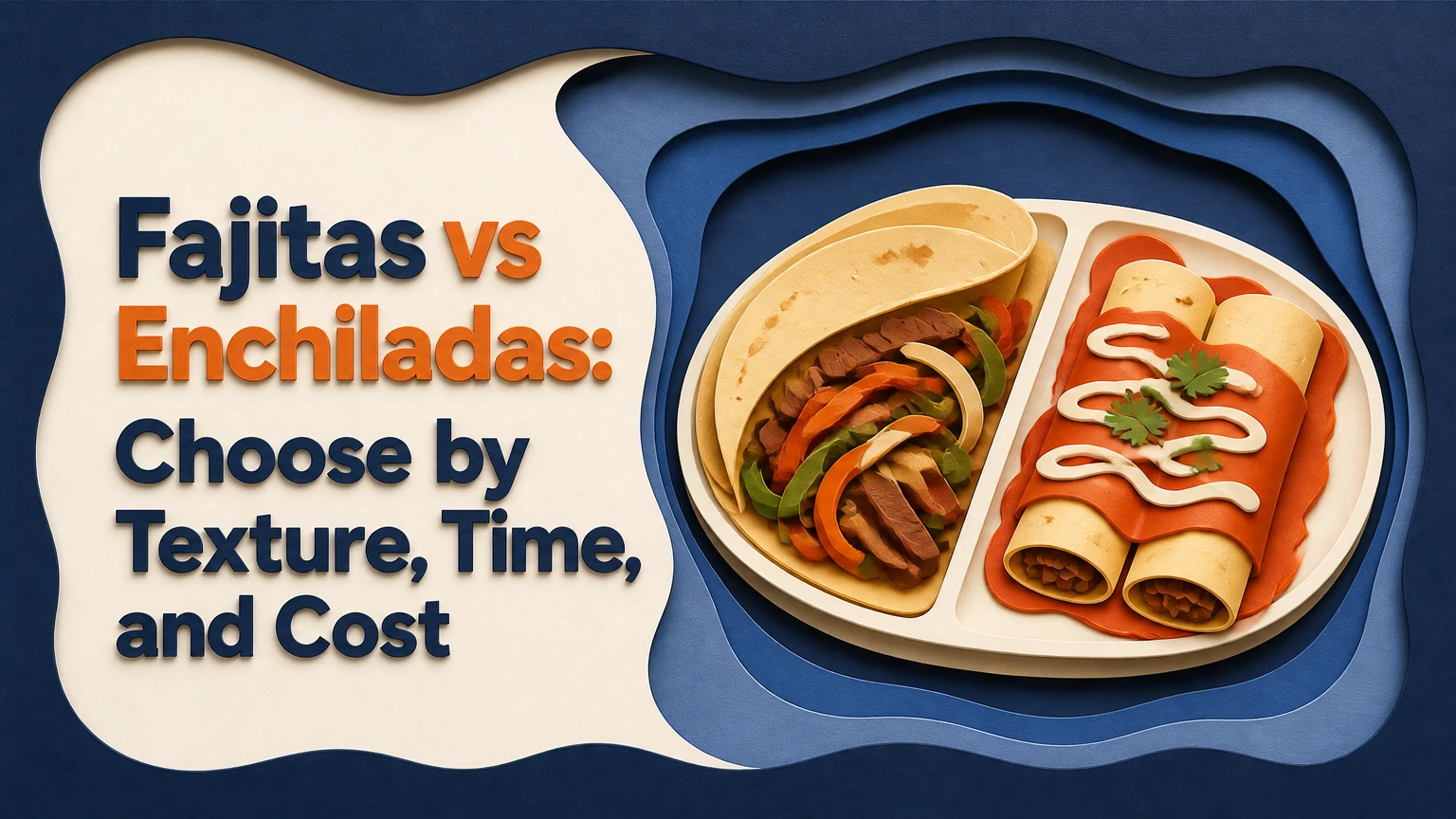
Fajitas and enchiladas differ in construction, cooking method, and eating experience. Fajitas are usually grilled or seared strips of meat and vegetables served with warm tortillas and toppings for individual assembly, while enchiladas are filled corn tortillas coated in sauce and commonly baked until tender. Choose fajitas for char and interaction, or enchiladas for a saucy, make-ahead meal.
Key Facts at a Glance
- Fajitas are assembled at the table from cooked filling, tortillas, and separate toppings.
- Enchiladas are filled tortillas coated in sauce before serving, often with cheese or another finishing garnish.
- Flour tortillas are the standard restaurant pairing for Tex-Mex fajitas, while corn tortillas define most enchilada styles.
- Typical fajitas take 30-45 minutes of active and waiting time, excluding a long marinade; enchiladas take about 75-105 minutes from preparation through baking.
- Fajitas provide smoky, seared edges and crisp vegetables; enchiladas provide soft tortillas, integrated sauce, and a cohesive filling.
- Enchiladas generally reheat better than assembled fajitas, although separate fajita components can be stored successfully.
What Are Fajitas and Enchiladas?
Fajitas are a Tex-Mex preparation built around grilled or high-heat-seared strips of meat, onions, and peppers, served with warm tortillas and condiments. Enchiladas are filled tortillas covered with a seasoned sauce, with fillings and sauces varying widely across Mexican regions and Tex-Mex restaurants.
The word fajita originally refers to a skirt-steak cut, derived from faja, meaning strip or belt. In modern restaurant usage, “fajitas” can describe the complete sizzling platter rather than the specific cut, so chicken, shrimp, vegetables, and other proteins may appear under the same name. The National Cattlemen’s Beef Association identifies skirt steak as a thin, strongly flavored cut that benefits from brief, high-heat cooking and slicing across the grain.
An enchilada is defined by the sauced tortilla technique. A tortilla is filled, folded or rolled, and covered with a chili, tomatillo, tomato, mole, or other seasoned sauce. Baking is common in Tex-Mex versions, but some Mexican preparations are finished on the stovetop or served soon after saucing. Melted cheese is widespread in restaurant enchiladas, yet cheese is not a universal requirement.
| Attribute | Fajitas | Enchiladas | Practical effect |
|---|---|---|---|
| Core structure | Grilled filling plus separate tortilla | Filled tortilla plus integrated sauce | Fajitas allow customization; enchiladas arrive assembled |
| Common tortilla | 8-inch flour tortilla | 6-inch corn tortilla | Flour stays flexible; corn contributes toasted flavor |
| Primary heat | Grill or skillet at 450-500°F | Oven at about 375°F | Fajitas emphasize searing; enchiladas emphasize gentle baking |
| Typical texture | Charred, juicy, crisp-edged | Soft, tender, saucy | The dishes satisfy different texture preferences |
| Serving temperature | Filling served immediately and sizzling | Sauce and filling served hot | Fajitas lose quality if held too long |
| Typical format | 2-3 tortillas per diner | 2-3 enchiladas per plate | Portion size depends on filling and sides |
How Do Fajitas vs Enchiladas Compare?
Fajitas vs enchiladas are most different in assembly: fajitas are a customizable meal kit of hot grilled ingredients, whereas enchiladas are a finished sauced dish. Fajitas win for smoky flavor and social dining; enchiladas win for integrated texture, advance preparation, and cleaner plating.
Tortillas and Assembly
Fajitas usually use flour tortillas because wheat flour creates a flexible, durable wrapper that tolerates hot strips of steak, peppers, onions, guacamole, and salsa. Eight-inch tortillas are practical for a full wrap, while six-inch tortillas create smaller servings with less filling.
Enchiladas usually use corn tortillas because corn pairs naturally with chili sauces and holds its shape after brief frying or warming. Corn tortillas also absorb sauce more readily, which creates the characteristic tender texture. A six-inch tortilla generally holds 2-3 tablespoons of filling without becoming difficult to roll.
Fajita assembly happens after cooking. Enchilada assembly happens before the final heating stage.
Flavor and Texture
Fajita flavor comes from browning, smoke, citrus, garlic, and fresh toppings. A properly cooked skirt steak has deeply browned edges and a juicy center, while peppers and onions retain some bite when cooked in a single layer.
Enchilada flavor depends more heavily on the sauce. A red guajillo sauce can taste earthy and mildly fruity; a tomatillo sauce tends to be tart and herbal; mole brings roasted spice and dark sweetness. The tortilla softens as it absorbs sauce, and the filling becomes less distinct from the surrounding ingredients.
Cooking Effort and Timing
Fajitas require less total cooking time but demand better timing. A typical home batch needs 10-15 minutes for vegetables and protein, plus 10 minutes for slicing and setup. A marinade can add 2-4 hours, but the marinade is optional for chicken and shrimp.
Enchiladas require more assembly work. A tray for four people commonly takes 25-35 minutes to fill and roll, then 20-25 minutes in a 375°F oven. The active labor is greater, but the tray can be assembled before guests arrive.
| Workflow stage | Fajitas | Enchiladas | Typical home quantity |
|---|---|---|---|
| Protein preparation | 10 minutes | 20 minutes | 1.25-1.5 lb protein |
| Vegetable or filling preparation | 10-15 minutes | 15-25 minutes | 2 cups vegetables or filling |
| Tortilla handling | 5 minutes warming | 10-15 minutes softening and rolling | 8-12 tortillas |
| Main cooking | 10-15 minutes | 20-25 minutes | 1 skillet or 9-by-13-inch dish |
| Resting or cooling | 5-10 minutes | 5-10 minutes before serving | Prevents tearing or juice loss |
| Total typical time | 30-45 minutes | 75-105 minutes | Serves 4 people |
Which Dish Has Better Cooking Performance?
Fajitas perform best when a large cooking surface creates direct contact between the food and hot metal. Enchiladas perform best when tortillas are softened, sauce is sufficiently thick, and the baking dish is covered evenly so exposed edges do not dry out.
Preparing Fajitas
- Slice the ingredients. Cut 1.25 pounds of skirt steak, flank steak, chicken thigh, or chicken breast into manageable pieces. Slice two bell peppers and one large onion into strips about 1/4-inch thick.
- Season or marinate. Use 2 tablespoons of lime juice, 1 tablespoon of neutral oil, two minced garlic cloves, 1 teaspoon ground cumin, and 1 teaspoon salt per 1.25 pounds of meat. Marinate beef for 2-4 hours, but keep shrimp in the mixture for no more than 20 minutes.
- Preheat the pan. Heat a cast-iron skillet over high heat until a drop of water evaporates immediately. A surface temperature near 450-500°F encourages browning.
- Cook vegetables in a single layer. Sear peppers and onions for 4-6 minutes, turning once or twice. Remove them when the edges char but the centers retain bite.
- Sear the protein. Cook beef strips for about 2-4 minutes per side, depending on thickness. Chicken requires a fully cooked center, typically 165°F measured with an instant-read thermometer.
- Rest and slice beef. Rest steak for 5-10 minutes, then cut across the visible muscle fibers. Slicing with the grain creates a noticeably chewier bite.
- Warm tortillas and serve immediately. Heat flour tortillas for 15-20 seconds per side, then provide salsa, pico de gallo, sour cream, guacamole, and lime separately.
A practitioner rule matters here: cook vegetables and meat separately when the pan is smaller than 12 inches. Overcrowding traps steam, lowering browning and producing gray, watery filling.
Preparing Enchiladas
- Make the sauce. Prepare about 3 cups of red chili, green tomatillo, tomato-chili, or mole sauce for eight 6-inch tortillas. The sauce should coat a spoon but still pour easily.
- Prepare the filling. Season 3 cups of shredded chicken, cooked beef, beans, vegetables, or cheese. Keep the filling moist but not wet because excess liquid makes rolling difficult.
- Soften the tortillas. Heat 1 teaspoon of oil per tortilla in a skillet, or warm the tortillas in a lightly damp towel. A brief 5-10-second pass per side makes corn tortillas flexible.
- Coat each tortilla lightly. Dip or brush the softened tortilla with warm sauce. Heavy dipping can cause tearing before the roll reaches the baking dish.
- Fill and roll. Place 2-3 tablespoons of filling in the center, roll firmly, and arrange seam-side down in a lightly greased 9-by-13-inch dish.
- Cover completely. Pour the remaining sauce over the rolls, paying special attention to the ends and exposed edges. Add 1-1.5 cups of shredded cheese if using a Tex-Mex version.
- Bake at 375°F. Bake for 20-25 minutes until the center is hot and the sauce bubbles around the edges. Rest for 5-10 minutes before serving.
The common advice to fry tortillas is useful, but the mechanism is more nuanced than a completely waterproof coating. Brief frying adds flexibility, fat, and structural strength; excessive frying makes tortillas rigid and prevents them from absorbing enough sauce.
What Types Should You Choose?
Fajita and enchilada varieties differ mainly by protein, sauce, and texture rather than by a single fixed recipe. The best choice depends on whether the diner wants grilled filling, a particular chili profile, or a plant-based substitute.
| Style | Main ingredients | Sauce or seasoning | Typical texture |
|---|---|---|---|
| Steak fajitas | Skirt steak, peppers, onion | Lime, garlic, cumin, chili | Juicy strips with charred edges |
| Chicken fajitas | Chicken thigh or breast, peppers, onion | Citrus marinade and ground spices | Lean, tender pieces with crisp vegetables |
| Shrimp fajitas | Shrimp, peppers, onion | Garlic, lime, chili powder | Firm, quick-seared seafood |
| Vegetable fajitas | Mushrooms, poblano, zucchini, onion | Lime, cumin, smoked chili | Meaty mushrooms with crisp vegetables |
| Enchiladas rojas | Chicken, beef, beans, or cheese | Red dried-chili sauce | Earthy, tender, lightly spicy |
| Enchiladas verdes | Chicken, cheese, or vegetables | Tomatillo, chile, cilantro | Tart, soft, and herbal |
| Enchiladas suizas | Chicken or cheese | Cream-enriched green sauce | Rich, smooth, and cheese-topped |
| Enmoleadas | Chicken, turkey, beans, or vegetables | Mole sauce | Soft tortillas with roasted spice depth |
Enchiladas suizas are usually richer because cream and cheese soften the acidity of green sauce. Enchiladas verdes are often brighter, although heat level depends on the quantity and type of chile rather than sauce color alone.
Vegetarian fajitas are not a lesser substitute when the ingredients are selected for browning. King oyster mushrooms, portobello caps, poblano peppers, and zucchini all benefit from a dry surface and a hot pan. Tofu works better when pressed, cut into thick strips, and browned separately.
Which Is Faster, Cheaper, and Easier to Scale?
Fajitas are usually faster for a small weeknight meal, while enchiladas are more efficient when cooking several portions in advance. Typical restaurant prices vary by city, protein, portion size, and service style, so the ranges below are practical United States estimates rather than fixed market prices.
| Measure | Fajitas | Enchiladas | Decision meaning |
|---|---|---|---|
| Active preparation | 20-30 minutes | 35-55 minutes | Fajitas require less assembly |
| Waiting time | 0-4 hours for marinade | 5-10 minutes for resting | Enchiladas have no required marinade |
| Cooking temperature | 450-500°F pan or grill | 375°F oven | Fajitas need stronger heat |
| Typical restaurant price | $18-$28 per platter | $14-$22 per plate | Enchiladas commonly cost less |
| Typical home protein or filling cost | $12-$24 for four | $8-$18 for four | Beans and cheese lower enchilada cost |
| Leftover quality | 2-3 days, components stored separately | 3-4 days, covered and refrigerated | Enchiladas are easier to reheat |
For a group, fajitas scale well only when the cook has enough pan or grill space. A 10-inch skillet should handle no more than about 12 ounces of sliced protein per batch if browning is the goal. Two pans or a wide griddle prevent the final servings from becoming steamed.
Enchiladas scale more predictably because a second baking dish adds capacity without changing the cooking technique. The rolling stage remains labor-intensive, but four people can assemble 24 enchiladas quickly if the filling and sauce are prepared first.
Which Should You Choose for Different Situations?
Fajitas are the stronger choice for interactive dinners, smoky flavor, gluten-free flour-tortilla substitutions, and meals finished in one skillet. Enchiladas are the stronger choice for advance preparation, soft textures, economical fillings, and diners who want a plated meal with sauce in every bite.
For a Busy Weeknight
Choose fajitas when dinner must be ready in about 30 minutes. Chicken strips, frozen peppers, and a prepared salsa can produce a complete meal without a long marinade, although fresh vegetables brown more effectively.
Choose enchiladas when the sauce and filling already exist. A prepared tray can move from refrigerator to oven in about 25 minutes, making enchiladas faster on the second day than from-scratch fajitas.
For Meal Preparation
Choose enchiladas for planned leftovers. Refrigerate a covered tray for up to four days at 40°F or below, and reheat individual portions until the center reaches 165°F.
Store fajita components separately. Refrigerate cooked meat, vegetables, tortillas, and toppings in different containers so steam does not soften the tortillas or dilute the salsa.
Freezing assembled enchiladas works, but sauce texture may change slightly after thawing. Freeze the tray tightly covered for up to two months, thaw overnight when possible, and add fresh garnishes after reheating. Freeze cooked fajita meat and vegetables separately for up to two months, but expect softer peppers after thawing.
For a Casual Party
Choose fajitas when the meal should create interaction. A 2-pound batch of protein with 12-16 tortillas can feed six adults when served with beans, rice, salsa, and vegetables.
Choose enchiladas when guests need to serve themselves quickly. A 9-by-13-inch dish containing 12 enchiladas feeds four to six people, depending on side dishes and filling volume.
For Children or Sensitive Palates
Enchiladas allow the cook to keep the filling mild and serve sauce separately, but fully sauced tortillas can be difficult for small children to handle. Fajitas permit plain chicken, rice, cheese, or vegetables to remain separate from spicy salsa.
Neither dish has a fixed heat level. Remove seeds from fresh chiles, use mild dried chiles, and offer hot sauce at the table instead of seasoning the entire batch heavily.
What Are the Most Common Mistakes?
The most damaging fajita mistake is overcrowding the cooking surface, while the most damaging enchilada mistake is using dry tortillas with watery sauce. Both failures come from ignoring moisture and heat management.
| Failure mode | Dish | Observable result | Corrective action |
|---|---|---|---|
| Slicing steak with the grain | Fajitas | Chewy, resistant strips | Rotate the steak and cut across fibers |
| Overcrowding the pan | Fajitas | Gray meat and soft vegetables | Cook 8-12 ounces per batch |
| Holding meat on a hot platter | Fajitas | Dry, overcooked center | Serve within 5 minutes |
| Skipping tortilla softening | Enchiladas | Cracked rolls and exposed filling | Warm or briefly fry each tortilla |
| Using watery sauce | Enchiladas | Loose rolls and diluted flavor | Simmer sauce until it coats a spoon |
| Leaving edges uncovered | Enchiladas | Hard, leathery tortilla corners | Spread sauce over every exposed surface |
An expert correction: do not judge fajita doneness by exterior color alone. Thin beef can develop a dark crust before the center overcooks, so remove it slightly early and use resting time to finish the interior.
A second rule is to sauce enchiladas immediately before baking when possible. Long soaking before the oven produces a softer wrapper, but it also increases the risk of tearing, especially with thin supermarket corn tortillas.
Fajitas are not ideal for long buffet holding. The hot platter looks attractive, but residual heat continues cooking meat and dries the exposed vegetables. Use a warm serving dish rather than an aggressively heated metal platter when diners will eat slowly.
How Do Dietary Needs Change the Choice?
Fajitas are easier to adapt for gluten-free, low-dairy, and high-protein meals because the components remain separate. Enchiladas can also meet those requirements, but tortilla labels, sauce ingredients, cheese, and filling moisture need closer inspection.
For gluten-free fajitas, use certified gluten-free corn tortillas or gluten-free flour tortillas and check seasoning blends for wheat-based fillers. Traditional corn tortillas are naturally gluten-free when produced without cross-contact, but restaurant griddles may also heat flour tortillas.
For gluten-free enchiladas, corn tortillas are usually suitable, while flour tortillas are not. Check canned sauces, bouillon, shredded meat seasonings, and packaged cheese blends because additives can introduce gluten.
For dairy-free meals, omit sour cream and cheese from fajitas or replace them with avocado and salsa. Dairy-free enchiladas require a sauce with enough body to compensate for the missing cheese, such as a reduced tomatillo sauce, bean puree, or nut-free vegetable sauce.
Fajitas generally make calorie control easier because diners can choose tortilla and topping quantities separately. Enchiladas concentrate tortilla, filling, sauce, and cheese in one portion, so serving size is less adjustable after baking.
How Do You Decide Between Fajitas and Enchiladas?
Choose fajitas when the priority is seared flavor, fast cooking, flexible portions, or tableside assembly. Choose enchiladas when the priority is sauce, soft texture, economical filling, make-ahead preparation, or a complete plated meal.
| Priority | Recommended dish | Specific reason | Best supporting choice |
|---|---|---|---|
| Fastest from raw ingredients | Fajitas | 10-15 minutes of high-heat cooking | Chicken strips and prepared salsa |
| Best make-ahead dinner | Enchiladas | Tray reheats in about 25 minutes | Red sauce and shredded chicken |
| Lowest-cost protein | Enchiladas | Beans and cheese stretch filling | 12 tortillas in a 9-by-13-inch dish |
| Strongest grilled flavor | Fajitas | Direct heat creates browning | Skirt steak with peppers |
| Easiest customization | Fajitas | Toppings stay separate | Flour tortillas and individual salsa |
| Cleanest plated service | Enchiladas | Portions are preassembled | Green sauce with rice |
| Best gluten-free default | Enchiladas | Corn tortillas are standard | Verify sauce and kitchen cross-contact |
| Best casual group activity | Fajitas | Guests build each serving | Two proteins and assorted toppings |
Fajitas are not automatically healthier, cheaper, or more authentic. A large platter with cheese, sour cream, oversized flour tortillas, and oil-heavy vegetables can exceed the energy of two modest enchiladas, while a bean-filled enchilada tray can cost less and provide more fiber.
Enchiladas are not automatically more traditional because the dish has deep regional variation. A restaurant version with flour tortillas, heavy cheese, and a thick topping reflects a Tex-Mex interpretation, while Mexican versions may use lightly sauced tortillas, regional chiles, crema, onion, herbs, or no oven at all.
FAQ
Are fajitas spicier than enchiladas?
Neither dish has a fixed heat level. Fajitas often receive mild cumin, garlic, lime, and chile seasoning, while enchiladas obtain most of their heat from the sauce. A green sauce containing serrano chiles can be hotter than mild red fajita seasoning, so compare the actual chile varieties rather than the dish name.
Can you make enchiladas with flour tortillas?
You can make enchiladas with flour tortillas, but corn tortillas are the standard choice because they provide a stronger corn flavor and absorb chili sauce well. Flour tortillas remain softer and more elastic, so they may produce a burrito-like texture rather than the traditional enchilada texture.
Can fajitas be made without a grill?
Fajitas can be made effectively in a cast-iron skillet, carbon-steel pan, or wide stainless-steel skillet. Preheat the pan thoroughly, dry the protein surface, and cook in batches of roughly 8-12 ounces. An oven broiler can also brown vegetables, but direct skillet contact gives better control.
Which dish is better for freezing?
Enchiladas are usually better for freezing because a covered baking dish preserves their sauce and filling together. Freeze assembled enchiladas for up to two months, preferably without delicate garnishes. Fajita components can also be frozen separately, but peppers and onions become softer after thawing.
Are enchiladas always covered with cheese?
Enchiladas are not always covered with cheese. Cheese is common in Tex-Mex and certain restaurant preparations, but many Mexican versions rely on sauce, onion, herbs, crema, sesame, or crumbled cheese used as a garnish. The defining feature is the sauced tortilla, not a mandatory cheese layer.
Which dish is easier for a large dinner?
Fajitas are easier when guests enjoy assembling their own portions and the cook has enough grill or skillet capacity. Enchiladas are easier when the meal must be plated quickly because a prepared tray serves several people at once. For more than eight guests, enchiladas usually require less last-minute cooking.
The Bottom Line
Fajitas vs enchiladas is a choice between interactive searing and integrated saucing. Pick fajitas for grilled meat, crisp vegetables, flexible toppings, and a meal ready soon after cooking. Pick enchiladas for tender corn tortillas, chili sauce, economical fillings, advance preparation, and dependable leftovers. The best dish is the one that matches the meal’s timing, equipment, and desired texture.