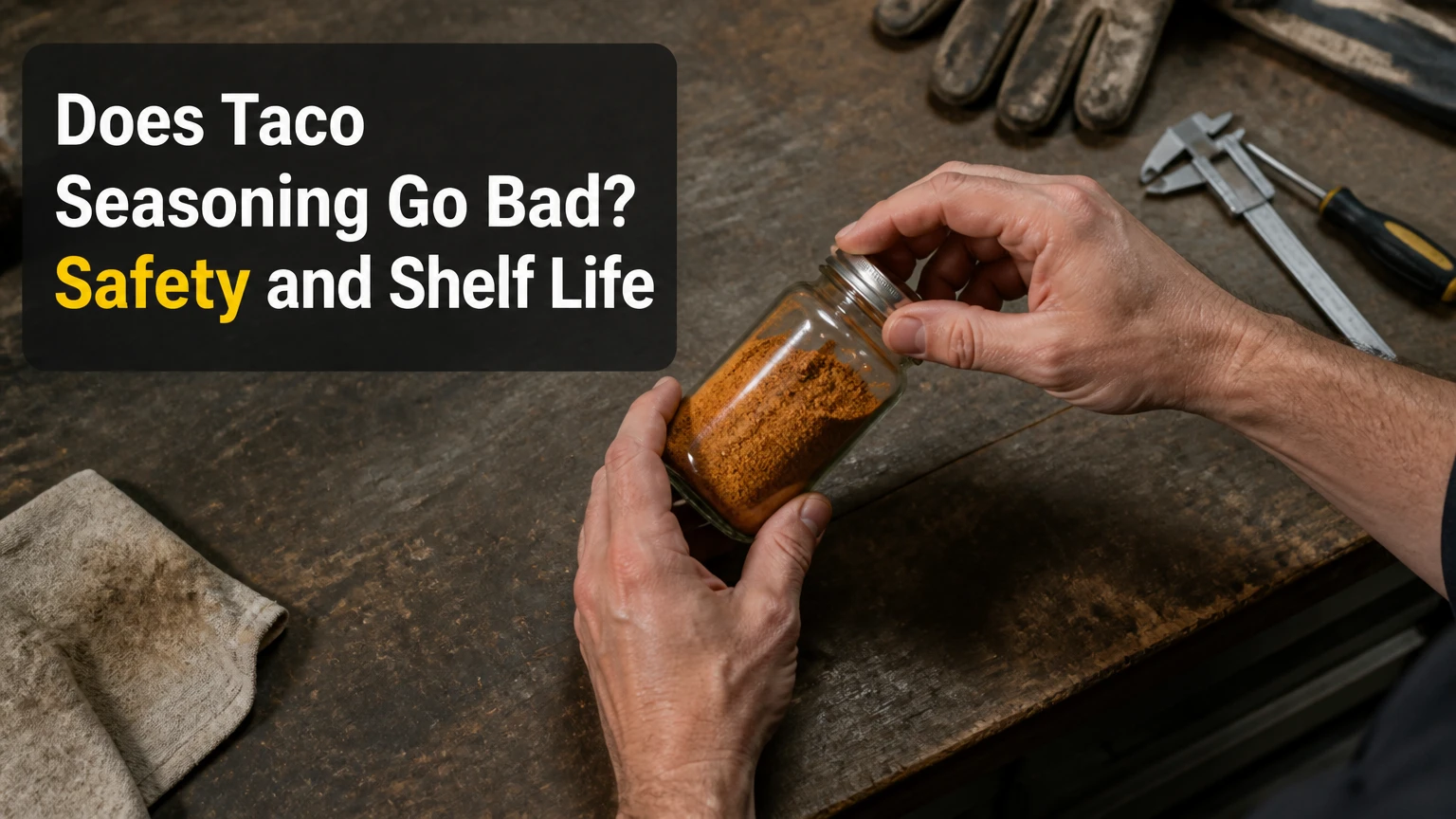
Taco seasoning usually does not become dangerous merely because its best-by date has passed, but the blend can lose flavor, aroma, color, and heat. A dry commercial packet or spice jar remains usable when it stayed sealed, dry, and free from mold, insects, unpleasant odors, and visible contamination; moisture changes that safety assessment.
Key Facts at a Glance
- Taco seasoning dates generally indicate peak quality, not an automatic safety deadline.
- An unopened, dry commercial packet often keeps acceptable flavor for about 2-3 years.
- An opened jar commonly declines faster because repeated air, light, heat, and humidity exposure damage volatile oils.
- Hard caking means moisture entered the seasoning, but dry clumping alone does not prove spoilage.
- Mold, fuzzy growth, a musty smell, insects, dampness, or package damage means taco seasoning should be discarded.
- Homemade taco seasoning is limited by the age and storage history of its oldest ingredient.
Does Taco Seasoning Go Bad in the Refrigerator or Pantry?
Taco seasoning is normally a pantry product, not a refrigerated product. Refrigeration can expose a dry spice blend to condensation when the container moves between cold and warm environments, while a sealed pantry container avoids that moisture cycle.
The most useful distinction is quality deterioration versus food spoilage. Chili powder, cumin, paprika, onion powder, garlic powder, salt, and starch remain low-moisture ingredients. Their aromatic compounds gradually evaporate or oxidize, so an old blend may taste flat without being inherently poisonous.
Moisture creates a different situation. A wet spoon, steam from a skillet, a leaking roof, or a humid cupboard can raise water activity inside the powder. Clumping follows, and mold or microbial growth becomes possible if enough moisture remains.
The Food and Drug Administration explains that a “Best if Used By” date indicates when a product has the best flavor or quality, rather than functioning as a universal safety cutoff. That guidance applies to many shelf-stable foods, but visible spoilage and contamination always override the printed date.
What Makes the Blend Lose Quality?
Taco seasoning contains aromatic compounds from cumin, chili, oregano, coriander, garlic, and other spices. Oxygen, light, and heat accelerate the loss of those compounds, while repeated opening releases aroma into the surrounding air.
Color also changes. Paprika and chili pigments fade under prolonged light exposure, and oxidized oils can give old seasoning a stale or dusty smell. Salt and starch do not evaporate, so an aged blend can taste disproportionately salty even after its spice character weakens.
Can Dry Taco Seasoning Contain Pathogens?
Dry taco seasoning can carry microorganisms at very low moisture levels, although ordinary storage does not usually allow rapid growth. The absence of visible mold does not provide a laboratory guarantee, particularly for products involved in a recall or exposed to flooding, pests, or dirty utensils.
The practical home rule is simple: keep the container dry, use clean utensils, follow recall notices, and discard any blend with evidence of moisture or contamination. Do not taste a visibly moldy or contaminated powder to decide whether it is safe.
How Long Does Taco Seasoning Last?
Unopened commercial taco seasoning typically retains good quality for 2-3 years when stored in a cool, dark, dry pantry. Opened jars often provide their best flavor for roughly 6-12 months, while homemade blends commonly taste strongest for 4-8 months and remain usable longer if the ingredients were fresh.
These are practical quality ranges, not guaranteed safety limits. A sealed packet stored in a dry cupboard may outperform an opened jar kept above a steaming stove, even when the packet is older by calendar date.
| Taco seasoning format | Typical peak-quality period | Practical use after date | Main limiting factor |
|---|---|---|---|
| Sealed foil packet | 2-3 years | Often 6-18 months if dry and intact | Package seal and heat exposure |
| Unopened shaker jar | 1-2 years | Often 6-12 months if properly stored | Oxygen and light |
| Opened shaker jar | 6-12 months | Use condition and aroma as guides | Repeated air and humidity |
| Homemade blend | 4-8 months | Commonly usable for 6-12 months | Oldest ingredient and container seal |
| Bulk food-service container | 6-18 months after opening | Replace when aroma becomes faint | Frequent opening and scoop contamination |
Does the Best-By Date Mean Taco Seasoning Is Unsafe?
The best-by date does not automatically make taco seasoning unsafe. The date tells you when the manufacturer expects the flavor and color to be closest to its intended profile, assuming normal storage.
A date is less informative than the storage history. A packet that stayed sealed and dry can remain acceptable after the date, whereas a newer packet exposed to wet countertops, steam, or a damaged seal should be rejected.
Use the label as a quality prompt. Then inspect the container, assess its smell, and consider whether its ingredients introduce additional risk.
What Happens After Two, Four, or More Years?
A two-year-old blend may still deliver useful flavor if its packet is sealed and the aroma remains strong. Between two and four years, ground spices commonly show noticeable fading, especially when stored in transparent jars or warm cabinets.
After four years, many blends contribute salt, starch, and a muted background flavor rather than a complete taco profile. That does not create a universal discard deadline, but replacement is usually more economical than doubling a weak blend and still producing a dull meal.
| Age and condition | Expected sensory quality | Safety interpretation | Recommended action |
|---|---|---|---|
| Under 2 years, sealed and dry | Strong aroma and normal color | Usually low concern | Use normally |
| 2-4 years, sealed and dry | Moderate fading possible | Age alone is not decisive | Inspect and smell |
| Over 4 years, opened | Often weak or stale | Discard if contamination appears | Replace if aroma is faint |
| Any age, damp or moldy | Musty, clumped, or fuzzy | Possible spoilage | Discard immediately |
| Any age, damaged packet | Unknown exposure | Package failure increases uncertainty | Discard |
How Can You Tell If Taco Seasoning Is Still Good?
A clean container, normal dry texture, recognizable spice aroma, and absence of mold or pests indicate that taco seasoning is probably suitable for quality purposes. Color loss and weak aroma usually signal staleness, while moisture, mustiness, fuzzy growth, or a chemical smell signal disposal.
Inspect the seasoning before adding it to food. A questionable spice blend is easier to evaluate in the container than after it has been mixed with meat, beans, vegetables, or sauce.
Step 1: Inspect the Package and Powder
Check the foil seams, lid, shaker holes, and jar threads for tears, leaks, rust, insects, or residue. The powder should appear dry, even if a few small lumps formed from normal settling.
A solid block is more concerning than a few loose clumps because a block suggests substantial moisture entry. Look for fuzzy white, green, black, or blue growth, webbing, larvae, or unusual wet patches.
Step 2: Rub and Smell a Small Amount
Place a small amount on a dry plate and rub it gently between clean fingers. Friction releases some remaining volatile oils, making cumin, chili, garlic, and oregano easier to identify.
Fresh taco seasoning normally smells savory, earthy, warm, and spicy. A faint smell means the blend may be safe but ineffective; a sour, musty, rancid, chemical, or basement-like odor means discard it.
Step 3: Taste Only a Clean, Dry Sample
Taste testing is optional and appropriate only when the seasoning looks dry and normal and has no suspicious odor. Never taste powder with mold, insect evidence, dampness, or an unknown contamination history.
A stale blend tastes flat, dusty, or mostly salty. A useful blend still has identifiable chili, cumin, garlic, onion, or herb notes.
| Inspection finding | Meaning | Use decision |
|---|---|---|
| Faded color, dry texture | Quality decline from age or light | Usually usable if aroma is normal |
| Small dry clumps | Settling or mild humidity | Break up and reassess |
| Hard damp block | Significant moisture exposure | Discard if odor or texture is abnormal |
| Musty or sour odor | Possible mold or chemical deterioration | Discard |
| Fuzzy spots or webbing | Mold or pests | Discard the entire container |
| Weak but clean aroma | Flavor loss | Use only with adjustment or replace |
Why Does Taco Seasoning Get Hard or Clumpy?
Taco seasoning becomes hard when water vapor or liquid enters the powder and dissolves soluble ingredients such as salt, then dries into a compact mass. Anti-caking agents can slow this process, but they cannot prevent clumping after repeated steam or liquid exposure.
Clumping is not identical to spoilage. A dry, clean lump can be broken apart, but a damp lump with a musty odor should not be rescued.
Do not hold a shaker over a boiling pan. Steam travels through shaker openings and condenses inside the cap, where it gradually migrates into the jar.
Can You Fix Caked Seasoning?
You can break apart a dry, odor-free cake with a clean fork, the back of a spoon, or a short pulse in a completely dry spice grinder. Do not add rice, water, oil, or another ingredient to “restore” the blend, because those additions can create new contamination or alter the recipe.
The repair is worthwhile only when the seasoning still smells strong. A hard block with no aroma is both inconvenient and ineffective.
What Is the Best Way to Store Taco Seasoning?
Store taco seasoning in an airtight container in a cool, dark, dry pantry, away from the stove, dishwasher, sink, and direct sunlight. A typical target is a cupboard below about 75°F (24°C), although preventing humidity and temperature swings matters more than achieving a specific refrigeration temperature.
Keep unopened packets in their original sealed packaging. Transfer homemade seasoning to a clean, dry, labeled jar with a tight lid, and write the mixing date on the label.
Use a dry measuring spoon. Never dip a wet spoon into the container, and never shake a jar directly over steaming food.
| Storage location | Main exposure | Expected effect | Better practice |
|---|---|---|---|
| Cabinet beside stove | Heat and cooking vapor | Faster aroma loss and caking | Move to a cool interior cupboard |
| Shelf above stove | Rising steam and heat | High moisture exposure | Avoid for all dry spice blends |
| Dark pantry shelf | Low light and stable temperature | Best household storage | Keep lid tightly closed |
| Refrigerator door | Condensation and temperature swings | Clumping risk | Store dry in pantry |
| Open countertop jar | Light, air, and spills | Rapid quality decline | Use an opaque airtight container |
How Should a Large Container Be Managed?
Divide a large container into a small working jar and a tightly closed reserve jar. The working jar receives daily exposure, while the reserve stays protected from repeated opening.
This approach reduces oxygen exchange and limits the number of times the entire supply encounters steam or kitchen dust. Label both jars with the opening date.
Do Packets, Jars, and Homemade Blends Age Differently?
Commercial foil packets generally protect taco seasoning better than frequently opened jars because the packet creates a single-use barrier against oxygen and humidity. Homemade blends provide control over salt and ingredients, but their quality depends on the freshness of every spice used.
A packet is convenient for occasional cooking. A jar is practical for frequent use but needs better handling, while a homemade blend makes sense when the cook uses individual spices often enough to rotate them.
| Format | Typical quantity | Typical price range | Best use case | Main drawback |
|---|---|---|---|---|
| Single packet | 0.75-1.25 oz | $0.50-$1.50 | Monthly taco meals | More packaging per serving |
| Small shaker jar | 2-5 oz | $3-$7 | Weekly household use | Repeated air exposure |
| Large jar | 20-25 oz | $8-$20 | High-volume cooking | Flavor loss before consumption |
| Homemade blend | 3-8 oz batch | $0.20-$1.00 per batch, excluding spices already owned | Sodium and ingredient control | Shorter peak freshness |
Is Homemade Taco Seasoning Safer?
Homemade taco seasoning is not automatically safer than a commercial blend. Homemade seasoning can reduce unwanted salt or starch, but it also lacks the manufacturer’s sealed packaging and may be contaminated by old, damp, or poorly stored individual spices.
Make small batches that can be used within several months. Use clean, dry equipment, label the ingredients and date, and avoid storing the mixture in a reused jar that retains oil or moisture.
Can You Use Weak or Expired Taco Seasoning?
You can use clean, dry taco seasoning past its best-by date when the aroma remains acceptable and no spoilage signs are present. The main consequence of old seasoning is a weaker, flatter dish, not a predictable illness risk from age alone.
Add a small amount to the pan and taste the cooked food before adding the entire recommended quantity. This prevents an overly salty result when the blend has lost aromatic spices but retained salt.
Toast the seasoning briefly in oil or with the cooked filling, but do not burn it. Thirty seconds over moderate heat can release aroma, while prolonged high heat can create bitter notes.
| Problem | Safe response | Quantity or timing |
|---|---|---|
| Aroma reduced by about half | Add gradually and taste | Start with 1.25 times the recipe amount |
| Mostly salty flavor | Add fresh cumin, chili powder, garlic, or onion powder | Add 0.25 teaspoon at a time |
| Dry clumping | Crush in a dry bowl | Use immediately after breaking |
| Burnt or bitter smell | Do not mask the flavor | Replace the seasoning |
| Mildly stale blend | Toast with filling or oil | About 20-30 seconds over medium heat |
What Can Replace Old Taco Seasoning?
A quick substitute uses chili powder, ground cumin, paprika, garlic powder, onion powder, oregano, and salt. The exact flavor depends on the chili powder blend, because some commercial chili powders already contain cumin, garlic, salt, or other seasonings.
For approximately 2 tablespoons of replacement seasoning, combine:
- 1 tablespoon chili powder
- 1 teaspoon ground cumin
- 1 teaspoon paprika
- 1/2 teaspoon garlic powder
- 1/2 teaspoon onion powder
- 1/2 teaspoon dried oregano
- 1/4 teaspoon salt, adjusted to taste
The mixture is a flavor substitute, not a direct guarantee of identical sodium, heat, or thickening performance. Commercial packets may contain starch that thickens the cooking liquid, so add 1 teaspoon cornstarch only when the recipe needs that texture and the starch is mixed into cool liquid first.
When Should You Throw Taco Seasoning Away?
Discard taco seasoning when the container shows mold, fuzzy growth, insects, webbing, dampness, leakage, a damaged seal, or a musty, sour, rancid, or chemical odor. Discarding is also sensible when the storage history is unknown after flooding, a spill, or prolonged exposure to steam.
Do not scrape mold from the surface and use the remaining powder. Fine particles can distribute contamination beyond the visible area, and a small packet is not worth the uncertainty.
A stale but clean blend is a quality problem. A wet, moldy, pest-contaminated, or chemically abnormal blend is a disposal problem.
What About Taco Seasoning With Extra Ingredients?
Some taco seasoning products contain more than dry spices, including cheese powder, dairy ingredients, dehydrated meat, oil-based flavorings, or other components. Those products may have different storage instructions and shorter quality windows than a basic chili-and-cumin powder.
Read the package ingredient list and follow its storage directions. A dry seasoning packet containing only powdered spices, salt, and starch should not be judged by the same assumptions as a moist sauce pouch or a taco kit component.
What If the Packet Is Torn?
A torn packet has an unknown exposure history. If the tear allowed humidity, dirt, insects, or other substances inside, discard the packet even if its date is recent.
A small crease without an opening is not the same as a broken seal. Inspect the interior powder and packaging carefully, then transfer nothing from a visibly compromised package into a clean jar.
Which Taco Seasoning Option Fits Your Situation?
Choose sealed packets for occasional cooking, an opaque airtight jar for regular use, and small homemade batches for ingredient control. The best choice depends on consumption speed, storage conditions, sodium preferences, and whether the seasoning contains only dry ingredients.
| User situation | Preferred option | Reason | Replacement interval |
|---|---|---|---|
| Tacos once every 1-2 months | Sealed packets | Minimal repeated exposure | Buy per meal or small pack |
| Tacos every week | Small shaker jar | Frequent use finishes it sooner | Review at 6-12 months |
| Low-sodium cooking | Homemade blend | Salt can be measured separately | Make 2-4 months of supply |
| Restaurant or large family use | Small reserve jars | Limits master-container exposure | Rotate within 6-12 months |
| Humid kitchen | Foil packets in a dry cabinet | Better vapor barrier | Inspect every use |
An experienced pantry rule is to buy the smallest container consumed within a year. A lower unit price on a large jar becomes false economy when the final half loses its aroma and requires replacement ingredients.
Frequently Asked Questions
Can You Use Taco Seasoning That Is Three Years Past the Date?
A taco seasoning packet three years past its date may still be usable if it remained sealed, dry, and free from damage, mold, pests, and unusual odors. Expect weaker flavor, especially from ground cumin, chili, paprika, and herbs. Inspect and smell the blend first, then replace it if the aroma is faint.
Does Taco Seasoning Need to Be Refrigerated After Opening?
Taco seasoning does not normally need refrigeration after opening. Refrigeration can create condensation and clumping, so a tightly closed container in a cool, dark, dry pantry is usually better. Use a clean, dry spoon and keep the jar away from steam, the sink, and direct sunlight.
Can You Get Sick From Old Spice Mix?
Old spice mix can cause problems when it became damp, moldy, pest-contaminated, chemically abnormal, or involved in a product recall. Age alone usually predicts flavor loss more reliably than illness. Do not taste a suspicious blend, and discard taco seasoning with fuzzy growth, musty odor, wetness, or package damage.
Why Does My Taco Seasoning Smell Like Dust?
A dusty smell usually means the volatile oils have faded through age, oxygen exposure, heat, or light. The seasoning may remain dry and usable, but it will produce a weak meal. Replace it or combine a small amount with fresh chili powder, cumin, garlic, and onion powder.
Can I Freeze Taco Seasoning to Make It Last Longer?
Freezing is unnecessary and can expose taco seasoning to condensation during removal and return. A sealed, airtight pantry container provides simpler protection. If a blend was frozen, allow the sealed container to reach room temperature before opening it so moisture does not condense inside the powder.
How Long Does Homemade Taco Seasoning Last?
Homemade taco seasoning usually tastes strongest for about 4-8 months and can remain usable for roughly 6-12 months when made from fresh, dry spices and stored airtight. The oldest ingredient sets the practical quality ceiling, so a blend made with four-year-old cumin will not taste newly mixed.
The Bottom Line
Does taco seasoning go bad? Usually, age makes a dry blend stale before it makes the blend unsafe. Use the date as a quality guide, then inspect the package and powder, smell a clean sample, and consider its storage history. Dry, clean, intact seasoning can often be used after its best-by date, while damp, moldy, pest-contaminated, damaged, or musty seasoning belongs in the trash.