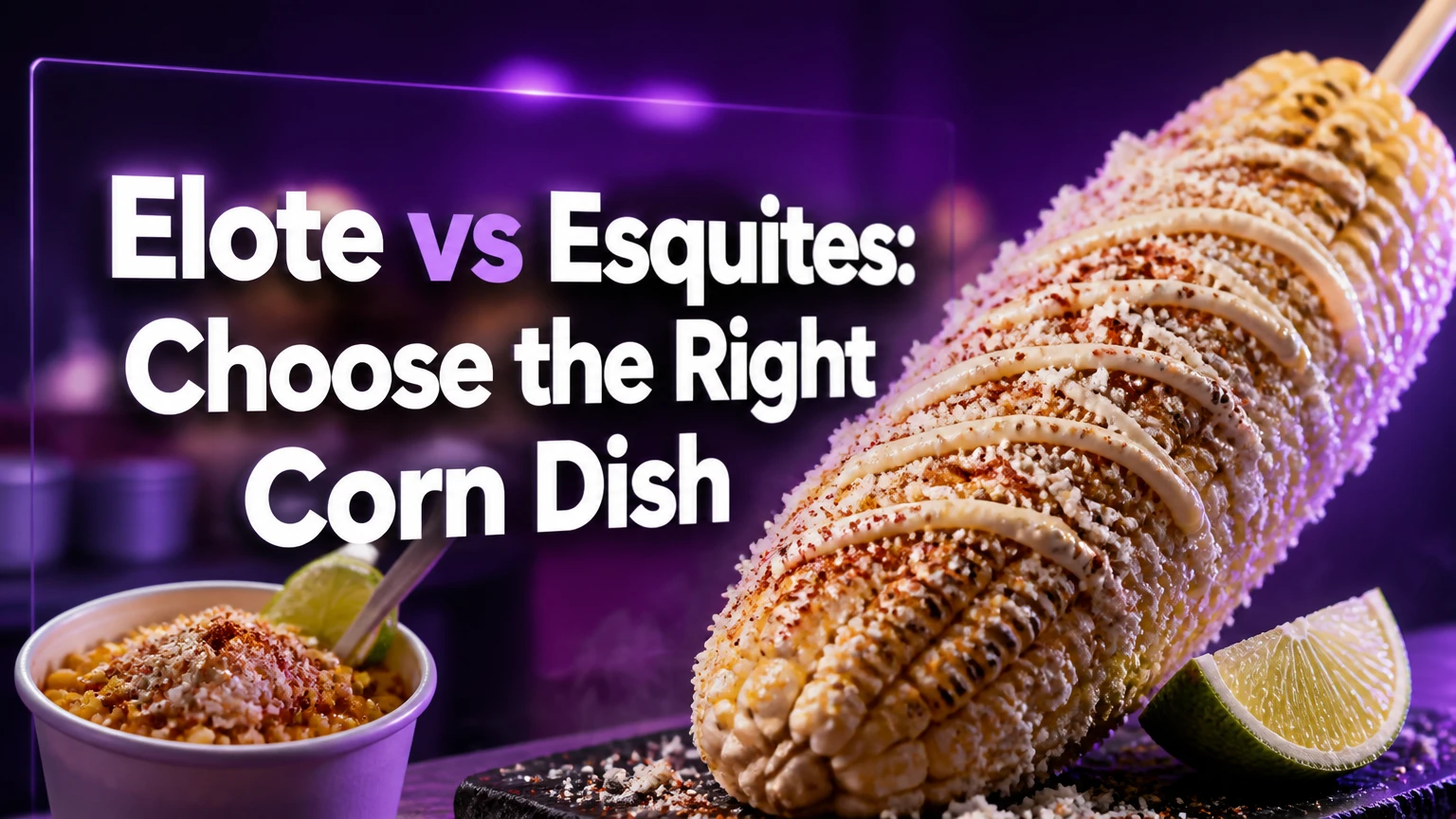
Elote is Mexican street corn served as a whole cooked ear, usually grilled and coated with mayonnaise, crema, cheese, chile, and lime. Esquites are loose corn kernels served in a cup, commonly sautéed or simmered with chile, epazote, and cooking liquid before receiving similar toppings. The main difference is format, texture, moisture, and eating experience.
Key Facts at a Glance
Elote keeps the kernels on the cob; esquites remove the kernels and serve them in a cup.
Grilled elote emphasizes smoky char and firm bites, while simmered esquites emphasize tenderness, broth, and herbal flavor.
Elote usually takes about 20-30 minutes from preparation to serving; esquites take about 25-35 minutes when made from fresh cobs.
Esquites create less mess and are easier to serve at parties, in cars, or to young children.
Typical restaurant or street-vendor prices range from about $1.50-$3 in Mexico and $5-$9 in the United States.
Neither dish has a fixed national recipe; corn variety, chile, cheese, cooking liquid, and regional practice change the result.
What Is the Difference Between Elote and Esquites?
Elote is a whole ear of corn prepared for direct eating, whereas esquites are corn kernels removed from the cob and served by spoon. Both can use mayonnaise or crema, cotija or queso fresco, chile powder, and lime, but elote usually foregrounds grilling and esquites usually foreground simmering or sautéing.
The names come from Indigenous Mexican languages. Elote derives from the Nahuatl élotl, commonly translated as tender ear or corn ear. Esquites is associated with the Nahuatl izquitl, often connected with toasted corn. These etymologies explain the names but do not impose one universal recipe.
Street-vendor practice changes by city and region. Some vendors boil whole ears for elote, while others grill them over charcoal. Some esquites are juicy and cooked with epazote; others are dry, buttery, and heavily charred. “Elote en vaso,” meaning elote in a cup, commonly overlaps with the word esquites, although vendors may use the terms differently.
| Feature | Elote | Esquites | Practical consequence |
|---|---|---|---|
| Corn format | Whole ear, usually 1 cob | Loose kernels, usually 1-1.5 cups | Elote requires biting; esquites require a spoon |
| Primary cooking | Grill, boil, or grill after boiling | Sauté, roast, or simmer | Elote favors surface char; esquites favor seasoning absorption |
| Typical serving vessel | Stick, plate, or tray | Paper, foam, or reusable cup | Esquites travel more easily |
| Moisture level | Coating sits on the surface | Kernels may carry broth | Esquites can taste juicier |
| Eating time | About 5-10 minutes | About 8-15 minutes | Elote gives larger bites; esquites encourage spoonfuls |
| Common challenge | Dripping toppings and kernels between teeth | Overcooked or watery kernels | Each format needs a different cooking strategy |
Which Ingredients Define Each Dish?
Elote and esquites share a topping family, but the cooking base separates them. Elote depends on a hot cob that holds a coating, while esquites depend on kernels that absorb fat, chile, broth, and aromatics.
For elote, use fresh corn with tightly packed kernels, mayonnaise or Mexican crema, crumbled cotija, ground chile, and lime. A 50:50 mixture of mayonnaise and crema spreads more easily than mayonnaise alone. Cotija contributes salty, aged flavor; queso fresco is milder and softer, while Parmesan is a practical but nontraditional substitute.
Esquites benefit from an aromatic cooking base. Butter or lard can brown the kernels, while onion, garlic, jalapeño, serrano, and epazote build flavor. Chicken broth adds savoriness, but vegetable broth or plain water works for a vegetarian version. Add crema and cheese near the end so they remain distinct rather than disappearing into the liquid.
| Ingredient | Typical amount for 4 servings | Elote function | Esquites function |
|---|---|---|---|
| Fresh corn | 4 ears | Stays attached to cob | Produces about 3 cups kernels |
| Mayonnaise | 1/2 cup | Adhesive coating | Creamy finishing layer |
| Mexican crema | 1/2 cup | Thins the coating | Enriches warm kernels |
| Cotija cheese | 3/4 cup crumbled | Clings to mayonnaise | Mixes through the cup |
| Lime juice | 2-3 tablespoons | Cuts surface richness | Brightens broth and toppings |
| Ground chile | 1-2 teaspoons | Dusts the cob | Disperses through each spoonful |
| Epazote | 1-2 sprigs fresh | Optional garnish | Aromatic cooking herb |
| Butter or lard | 2 tablespoons | Optional pre-grill coating | Browns kernels in the pan |
What Corn Should You Use?
Fresh corn on the cob gives both dishes the best structure, but frozen corn is highly effective for esquites. Canned corn works when drained and dried thoroughly, although its softer texture makes it less suitable for intense pan charring.
Mexican native corn varieties, including cacahuazintle in some preparations, can have larger, starchier kernels than common supermarket sweet corn. They may require longer simmering and produce a less candy-sweet result. Yellow sweet corn is common in United States adaptations because it is widely available, but color does not determine authenticity.
| Corn source | Best dish | Preparation adjustment | Typical result |
|---|---|---|---|
| Fresh sweet corn | Elote or esquites | Grill whole or cut raw kernels | Crisp, juicy kernels |
| Fresh cacahuazintle | Esquites or boiled elote | Simmer 10-20 minutes as needed | Starchy, substantial bite |
| Frozen corn | Esquites | Thaw, drain, then sauté 8-10 minutes | Tender kernels with good browning |
| Canned corn | Esquites | Drain and dry before pan cooking | Soft texture, limited char |
| Fire-roasted frozen corn | Esquites | Heat directly, then add broth | Fast smoky flavor |
| Leftover grilled corn | Esquites | Strip kernels and reheat briefly | Charred edges with reduced crunch |
How Do Elote and Esquites Taste Different?
Elote tastes more grilled, creamy, salty, and acidic because the hot cob carries a concentrated coating over a firm bite. Esquites taste more integrated and savory because loose kernels can absorb chile, fat, broth, onion, and epazote during cooking.
Char is the main flavor divider. A grill exposes the cob to dry heat, creating browned spots and smoky aromas. A skillet can produce similar notes for esquites, but the kernels release moisture, so they need enough heat and space to brown rather than steam.
Epazote creates another distinction. The herb has a strong, resinous, slightly medicinal aroma that many people associate with traditional esquites. It is optional in some household versions and absent from many restaurant adaptations, so its absence does not automatically make a cup inauthentic.
| Sensory attribute | Elote | Esquites | Best choice |
|---|---|---|---|
| Smoky aroma | High after charcoal grilling | Medium after skillet charring | Elote |
| Creaminess | Surface-heavy coating | Evenly distributed through kernels | Esquites |
| Herbal character | Low unless garnished | Medium to high with epazote | Esquites |
| Kernel firmness | Firm to crisp | Tender to moderately firm | Elote |
| Brothy moisture | Low | Low to high | Esquites |
| Topping intensity | Concentrated on each bite | Variable across spoonfuls | Elote for stronger coating |
Which Dish Is Easier to Eat?
Esquites are easier to eat because a spoon contains the corn, toppings, and cooking liquid without requiring the diner to hold a coated cob. Elote is more theatrical but usually messier, especially when mayonnaise, crema, cheese, and lime juice move down the ear.
Elote works well at a market stall, outdoor gathering, or meal where diners can stand over a plate. A wooden stick improves grip, but it does not eliminate dripping. A tray catches toppings and allows the diner to rotate the corn without touching the coating.
Esquites fit car cup holders, lunch containers, and buffet service more effectively. A cup also allows toppings to be layered, mixed, or customized. The trade-off is that esquites lose the visual and tactile pleasure of biting directly through a whole ear.
| Situation | Better format | Reason | Serving recommendation |
|---|---|---|---|
| Walking through a market | Elote with a stick | Fast hand-held eating | Use a tray or napkin underneath |
| Eating in a car | Esquites | Spoon and cup contain toppings | Choose a cup with a secure lid |
| Children under close supervision | Esquites | No cob or pointed stick | Reduce chile and serve warm, not hot |
| Large buffet | Esquites | Holds in a warm pan | Add toppings in separate bowls |
| Charcoal cookout | Elote | Grill smoke reaches the whole cob | Coat immediately before serving |
| Formal plated meal | Esquites | Easier portion control | Use small ceramic cups |
How Are Authentic Elote and Esquites Prepared?
Authentic preparation has no single national formula, but the most reliable distinction is this: cook elote as a whole ear and cook esquites as loose kernels with aromatics or liquid. Toppings should balance sweetness with salt, acidity, heat, and fat rather than cover the corn completely.
How to Make Elote
- Prepare four ears of corn. Remove the silk and most husks. Leave a clean cob surface for grilling.
- Grill over medium-high heat. Cook for 10-12 minutes, turning every 2-3 minutes, until several sides show brown or blackened spots.
- Make the coating. Stir together 1/2 cup mayonnaise and 1/2 cup crema. Add a pinch of salt if the cheese is mild.
- Coat the hot corn. Brush each ear while it is still steaming so the mixture spreads and grips the surface.
- Add cheese and chile. Roll the cob in 3/4 cup crumbled cotija, then dust with 1-2 teaspoons chile powder.
- Finish with lime. Apply 2-3 tablespoons fresh lime juice across four ears and serve immediately.
You will know elote is ready when the kernels remain plump, the cob has visible char, and the coating clings without running in a thin stream. The common failure is low heat combined with frequent turning, which cooks the corn but prevents browning. Keep the grill hot and let each side contact the grate long enough to color.
How to Make Esquites
- Remove kernels from four ears. Stand each cob in a wide bowl and cut downward with a sharp knife. Expect about 3 cups kernels.
- Brown the aromatics. Heat 2 tablespoons butter in a large skillet. Cook 1/4 cup diced onion for 2 minutes, then add one minced jalapeño or serrano.
- Sauté the corn. Add the kernels and cook over medium-high heat for 6-8 minutes, stirring occasionally. Brown edges indicate sufficient heat.
- Add liquid and epazote. Pour in 1 cup broth or water and add 1-2 sprigs epazote. Simmer for about 5 minutes.
- Season the cup. Spoon the hot corn and a small amount of liquid into cups. Add mayonnaise or crema, cotija, chile powder, and lime.
- Serve promptly. Esquites can remain warm for about 30-45 minutes, but extended holding softens the kernels.
You will know esquites are ready when the kernels are tender but still hold their shape and the cooking liquid tastes seasoned before toppings are added. The common failure is using a crowded pan, which traps steam and eliminates browning. Use a wide skillet or cook in two batches.
Which Cooking Method Produces the Best Result?
Charcoal grilling produces the deepest smoky flavor for elote, while a two-stage sauté and simmer produces the most balanced esquites. Boiling is efficient but gives less browning, so it works best when followed by a short grill or skillet finish.
| Method | Dish | Time | Texture and flavor |
|---|---|---|---|
| Charcoal grill | Elote | 10-12 minutes | Strong smoke, crisp browned kernels |
| Gas grill | Elote | 12-15 minutes | Moderate char, clean sweetness |
| Boil then grill | Elote | 15-20 minutes | Tender interior, browned exterior |
| Skillet sauté | Esquites | 6-10 minutes | Concentrated char, little liquid |
| Sauté then simmer | Esquites | 12-18 minutes | Browned edges, juicy interior |
| Microwave then finish | Esquites | 8-12 minutes | Fast preparation, limited browning |
A useful practitioner rule is to add the cooking liquid only after the kernels have taken on color. Adding broth at the beginning makes esquites tender, but it prevents the toasted notes that separate a well-made cup from plain boiled corn.
What Are the Main Variations?
Elote and esquites have regional and contemporary variations rather than one fixed ingredient list. Elote may be boiled instead of grilled, and esquites may be dry, brothy, creamy, or topped with additional ingredients such as roasted marrow.
| Variation | Base format | Defining additions | Typical profile |
|---|---|---|---|
| Elote callejero | Whole ear | Mayo, cotija, chile, lime | Classic coated street corn |
| Elote boiled | Whole ear | Crema, cheese, chile | Tender and less smoky |
| Elote chorreado | Whole ear or tray | Liquid cheese, crema, crushed chips | Heavy, messy, highly rich |
| Esquites secos | Loose kernels | Butter, chile, cheese, little liquid | Toasted and spoonable |
| Esquites caldosos | Loose kernels in cup | Broth, epazote, lime | Juicy and aromatic |
| Esquites con tuétano | Loose kernels | Roasted beef marrow | Deeply rich and savory |
| Vegan esquites | Loose kernels | Plant-based crema, lime, chile | Creamy without dairy |
| Tostielote | Corn with snack toppings | Chips, chile sauce, crema | Crunchy, modern street-food style |
The term “elote en vaso” often describes kernels served in a cup and may function as a synonym for esquites. A vendor’s name, city, or recipe may determine whether the kernels are sautéed, boiled, or served with broth.
How Much Do Elote and Esquites Cost?
Typical street prices are about 25-50 Mexican pesos in Mexico and $5-$9 in the United States, although location, toppings, portion size, and vendor type can change the total. Homemade servings generally cost less, especially when frozen corn and supermarket cheese replace specialty ingredients.
| Purchase or preparation | Typical portion | Typical price | Main cost variable |
|---|---|---|---|
| Mexico street elote | 1 whole ear | MX$25-MX$50 | City and topping quantity |
| Mexico street esquites | 1 cup | MX$25-MX$50 | Cup size and added ingredients |
| United States food-truck elote | 1 whole ear | $5-$9 | Event markup and cheese |
| United States food-truck esquites | 1 cup | $5-$9 | Portion and premium toppings |
| Homemade fresh elote | 1 ear | $1.25-$3 | Cotija and crema pricing |
| Homemade frozen esquites | 1 cup | $1-$2.50 | Frozen corn and broth cost |
A typical home batch for four people costs approximately $6-$14 before labor when it uses fresh corn, mayonnaise, crema, cotija, lime, chile, and a small amount of butter. Specialty cheese and fresh epazote raise the cost more than the corn itself.
Are Elote and Esquites Healthy?
Neither dish has a fixed calorie count because mayonnaise, crema, cheese, butter, and portion size determine most of the added energy. A typical serving with moderate toppings often falls around 300-450 calories, but a lightly dressed serving can be lower and an overloaded version can exceed that range.
Corn contributes carbohydrates, fiber, and small amounts of protein. The toppings add fat and sodium, while lime, chile, and herbs add strong flavor without much energy. Esquites can seem lighter because kernels are served in a cup, but a large cup with broth does not necessarily contain fewer calories than a coated cob.
To reduce richness without losing character, use 1 tablespoon of mayonnaise per serving, 2 tablespoons of crema, 3 tablespoons of cotija, and plenty of lime. Vegan mayonnaise and plant-based crema work for dairy-free versions, while nutritional yeast does not reproduce cotija’s salty, crumbly texture.
What Common Mistakes Affect the Final Dish?
The most damaging mistakes are insufficient heat, excessive liquid, overly thin coatings, and unbalanced salt. Each problem has a practical correction, so a disappointing batch does not need to be discarded.
| Failure mode | Likely cause | Recovery | Prevention |
|---|---|---|---|
| Soggy kernels | Long boiling or excess broth | Drain and sauté uncovered 3-5 minutes | Add liquid after browning |
| Cheese slides off elote | Cold or thin coating | Recoat the hot cob with thicker crema mixture | Apply coating immediately after cooking |
| Bland esquites | Liquid was not seasoned | Add salt, chile, lime, and cotija gradually | Season broth before simmering |
| Burnt kernels | Pan too hot or no stirring | Remove black pieces and mix with fresh kernels | Use medium-high heat and stir every 60-90 seconds |
| Watery topping | Excess lime or crema | Add cheese or a small amount of mayonnaise | Add acidic ingredients at the end |
| Tough corn | Old corn or undercooking | Simmer covered with broth 5-10 minutes | Choose plump kernels and test before serving |
Do not rely on Miracle Whip or other sweet sandwich spreads when a savory result is intended. Their sweetness changes the balance. Use plain mayonnaise, Mexican crema, or a mixture of both.
Fresh epazote has a stronger aroma than dried epazote. If neither is available, a small amount of cilantro with oregano can provide herbal complexity, although the flavor will not be identical. Avoid adding large amounts of oregano because it can dominate the corn.
Which Should You Choose?
Elote is the better choice for smoke, visual appeal, and a firm bite; esquites are better for clean eating, customization, and batch service. The right decision depends mainly on whether the meal prioritizes grilling theater or convenient spoon eating.
Choose Elote for Charcoal Flavor
Choose elote when a grill is already hot and diners want the strongest smoky character. Whole ears also make sense for a street-market experience, outdoor cookout, or meal where toppings can be applied immediately before serving.
Elote is less suitable for a seated meal with light clothing, a moving vehicle, or guests who dislike eating from a cob. The format also makes portion adjustment less precise because each ear receives a full coating.
Choose Esquites for Parties and Families
Choose esquites when serving at least six people, because a large skillet or slow cooker can keep the corn warm while guests add toppings. Esquites also suit children and anyone who prefers utensils, provided the serving temperature is checked before eating.
Esquites are less suitable when smoky grill flavor is the central goal. A skillet can brown kernels, but it rarely reproduces the aroma of corn grilled over charcoal.
Choose Esquites for Ingredient Flexibility
Frozen, canned, leftover, and fresh corn can all become esquites after appropriate draining and seasoning. The cup format also supports vegan, dairy-free, low-spice, and broth-heavy versions without preparing separate whole ears.
Choose Elote for the Classic Visual
Elote communicates the dish immediately through its whole ear, white cheese, chile dust, and lime. For photographs or a market-style presentation, the cob has greater visual impact than a cup of kernels.
| Persona or occasion | Recommended dish | Why | Adjustment |
|---|---|---|---|
| Charcoal-grill enthusiast | Elote | Maximizes smoke and surface char | Use cotija and chile piquín |
| Party host serving 10+ guests | Esquites | Easier batch cooking and portioning | Hold warm and offer toppings separately |
| Parent serving young children | Esquites | Spoonable and free of cob handling | Use mild chile and test temperature |
| Person eating while walking | Elote | Portable with a stick | Serve over a paper tray |
| Person using frozen corn | Esquites | Kernels cook evenly from frozen | Thaw and dry before sautéing |
| Diners seeking less mess | Esquites | Cup contains sauce and broth | Use a wide cup and sturdy spoon |
| Guest wanting strongest char | Elote | Whole ear contacts the grill | Grill until browned, not uniformly black |
Can You Prepare Them Ahead?
Esquites are better for advance preparation because cooked kernels can be refrigerated for up to three days in a sealed container and reheated gently with a splash of broth. Elote is best assembled immediately because refrigerated cobs lose texture and the coating becomes cold and uneven.
For advance esquites, cook the corn and aromatics, cool the mixture within two hours, and refrigerate it separately from mayonnaise, crema, cheese, and lime. Reheat the kernels to steaming hot, then add the fresh toppings. This preserves brightness and prevents the dairy components from breaking during storage.
Cooked corn should not sit at room temperature for prolonged periods. For a buffet, keep esquites hot in a covered pan and monitor texture; repeated reheating makes the kernels soft.
Is Elote or Esquites Better for Dietary Adjustments?
Esquites are easier to adapt because ingredients can be mixed individually and the corn base can remain separate from dairy toppings. Elote can also be modified, but removing or reducing the coating is more noticeable because the toppings cover the entire cob.
For dairy-free esquites, use plant-based crema and a salty seed topping, or serve the cheese separately. For lower sodium, reduce cotija and chile seasoning, then increase lime, onion, cilantro, or epazote. For lower fat, use less mayonnaise and crema rather than replacing them with sweet sauces.
Cross-contact matters at shared food stalls and buffets. Guests with allergies should ask about mayonnaise, cheese, broth, butter, and shared cooking surfaces, because recipes and vendor practices vary.
Frequently Asked Questions
Are esquites just elote removed from the cob?
Esquites are related to elote but are not always simply stripped elote. Esquites usually involve loose kernels cooked with aromatics, chile, epazote, butter, or broth, while elote is prepared and dressed as a whole ear. Some vendors use “elote en vaso” for a stripped-corn cup, creating regional naming overlap.
Can I use Tajín on either dish?
Tajín can be used on both elote and esquites, although ground chile, including chile piquín, is also common. Tajín contains chile, lime, and salt, so add it gradually and reduce extra salt or lime until the flavor is balanced.
Do esquites need epazote?
Esquites do not universally require epazote, but the herb gives many traditional versions their recognizable aroma. Fresh epazote is strongest, dried epazote is more concentrated and earthy, and a small cilantro-oregano mixture is a practical substitute when the herb is unavailable.
Can I make elote without mayonnaise?
Elote can be made without mayonnaise by using Mexican crema, plain yogurt, olive oil, or a thin layer of butter as the coating base. The substitute must remain moist enough for cotija and chile to adhere, and lime should be added after cooking to prevent a watery surface.
Which dish has more corn per serving?
A whole elote generally contains the kernels from one medium ear, while an esquites cup may contain the kernels from one ear or more. Portion size determines the comparison, so a large cup can contain more corn and toppings than a single cob.
Why is my esquites mixture watery?
Watery esquites usually contain too much broth or were covered after cooking, which traps steam and prevents evaporation. Remove the lid and simmer the kernels uncovered for 3-5 minutes, then add mayonnaise, crema, cheese, and lime after the liquid has concentrated.
The Bottom Line
Elote vs esquites is fundamentally a choice between a coated whole ear and a seasoned cup of kernels. Choose elote for charcoal smoke, firm texture, and the classic hand-held experience; choose esquites for broth, epazote, customization, low mess, and efficient serving. Both use the same flavor architecture, but their cooking methods create distinctly different dishes.