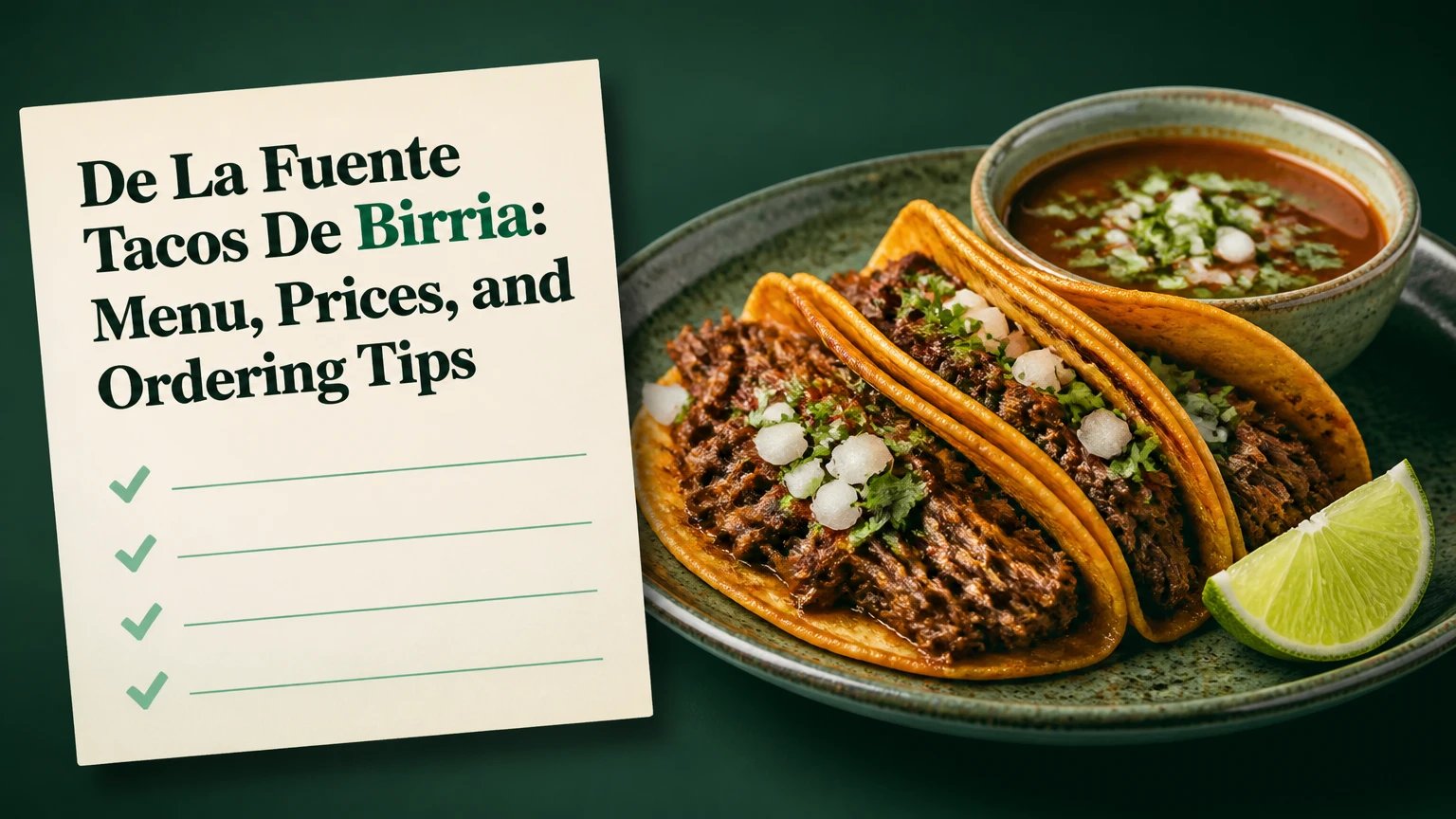
De La Fuente Tacos De Birria is a Texas restaurant group associated with birria-focused Mexican food in Garland and Plano. Its signature format is slow-braised beef served in tacos, quesabirria, noodles, burritos, or consomé, with the red cooking fat used to crisp tortillas and a broth served for dipping.
Key Facts at a Glance
- De La Fuente Tacos De Birria is associated with restaurant locations in Garland and Plano, Texas.
- Birria is a slow-braised Mexican stew traditionally linked with Jalisco and commonly prepared today with beef.
- Quesabirria combines chile-fried tortillas, melted cheese, shredded beef, onion, cilantro, and consomé.
- A typical stovetop birria braise takes 3.5-5 hours, while a slow cooker usually takes about 8 hours.
- A published delivery-menu snapshot lists a four-taco combo at $14.98, the El Fortachón Burrito at $12.48, and a Toro Quesadilla at $18.73.
- Corn tortillas produce a thinner, crisper shell; flour tortillas provide more flexibility for large fillings and takeout.
What Is De La Fuente Tacos De Birria?
De La Fuente Tacos De Birria refers to a Texas restaurant concept built around birria de res, the beef version of a Mexican braised stew. The restaurant name also appears in searches alongside quesabirria, consomé, birria noodles, burritos, and other dishes that reuse the same chile-seasoned beef.
Birria originated in Jalisco, where goat and lamb have long been traditional choices. Beef became especially prominent in northern Mexican and Tijuana-style taco preparations because beef chuck, short ribs, and related cuts braise effectively and suit high-volume taco service. The regional history matters because a crispy cheese taco is a modern presentation of birria, not the full definition of birria itself.
De La Fuente’s likely signature eating pattern is simple: order a crisp taco, add onion and cilantro, then dip each bite into hot consomé. The red exterior comes from chile-seasoned cooking fat, while the broth gains body from rendered fat, collagen, meat juices, and strained adobo.
How Does Birria Become a Crispy Taco?
Birria becomes a crispy taco when a tortilla is lightly coated with the red fat from the stew, placed on a hot griddle, filled with cheese and shredded beef, folded, and cooked until the surface firms. The fat creates browning, while the cheese helps bind the filling and forms crisp edges.
A tortilla dipped into the liquid broth becomes fragile. A tortilla touched mainly to the fat layer gains color and flavor without absorbing excessive water. That distinction explains the most common home mistake: dipping too deeply into the pot.
The finished taco should remain moist inside but hold its shape outside. Consomé is a separate dipping component, not a substitute for soaking the entire tortilla before cooking.
Which Menu Item Should You Order?
The best first order is usually a quesabirria or a four-taco combo with consomé, because those options reveal the restaurant’s core beef, tortilla, cheese, and broth system in one meal. Diners seeking less fried texture may prefer tacos blandos or birria en caldo.
Menu names and prices can change, especially across restaurant locations and delivery platforms. The table below reflects the menu structure and published price snapshot associated with De La Fuente listings, not a guaranteed current register total.
| Menu item | Published or typical price | Main components | Best use |
|---|---|---|---|
| Four-taco combo | $14.98 snapshot | Four cheese birria tacos, consomé | First visit or full meal |
| Toro Quesadilla | $18.73 snapshot | Large tortilla, birria, melted cheese | Maximum cheese and portion |
| El Fortachón Burrito | $12.48 snapshot | Birria, rice, beans, cheese, sour cream, pico | Portable, filling meal |
| Birria noodles | Often platform-dependent | Noodles, consomé, beef, onion, cilantro | Broth-heavy comfort meal |
| Tacos blandos | Location-dependent | Soft tortillas, beef, onion, cilantro | Lower-crispness preference |
| Birria en caldo | Location-dependent | Beef, consomé, tortillas on side | Soup-focused order |
What Comes With Birria Tacos?
A standard birria taco order commonly includes shredded beef, onion, cilantro, and a cup of consomé, while a quesabirria adds melted cheese and a crisped tortilla. Lime, salsa, and extra toppings vary by location and ordering platform, so the printed menu or online checkout remains the final authority.
For delivery, check whether consomé is packed in a sealed cup and whether tortillas arrive crisp or partially softened by steam. A separate broth container gives the best texture. If the order includes salsa, taste the consomé first, because additional chile can change the perceived heat and salt balance.
How Does De La Fuente Style Birria Work?
De La Fuente-style birria follows a three-stage structure: build a strained chile adobo, braise beef until collagen softens, then assemble tacos on a griddle using the fat separated from the broth. Each stage controls a different quality: adobo controls aroma, braising controls tenderness, and griddling controls crispness.
Dried guajillo chiles provide color and mild fruitiness. Ancho chile adds deeper sweetness, while chile de árbol increases heat. Garlic, vinegar, Mexican oregano, cumin, black pepper, cloves, and cinnamon create the recognizable savory-spiced profile.
The Chopping Block describes birria as meat cooked in an adobo of dried chiles and spices, while Serious Eats emphasizes straining the blended chile mixture and cooking the beef until tender. Those techniques explain why a smooth consomé usually requires more work than simply blending ingredients into stock.
What Makes Consomé Taste Rich?
Consomé tastes rich because beef collagen converts to gelatin during prolonged moist cooking, while rendered fat carries chile pigments and fat-soluble aromatics. Bone-in short ribs or oxtail increase gelatin potential, whereas very lean cuts can produce a thin broth and dry shreds.
Rest the finished pot for approximately 10 minutes before skimming. As the liquid settles, the red fat gathers at the surface and becomes easier to separate. Keep enough fat for griddling, but remove excess from individual broth portions if the flavor feels heavy.
Food safety still applies to a long braise. Refrigerate leftovers in shallow containers within two hours, cool them quickly, and reheat broth until steaming throughout before serving.
How Can You Recreate the Tacos at Home?
A home batch typically requires 4-5 hours on the stovetop, about 8 hours in a slow cooker, or a shorter pressure-cooker cycle followed by natural pressure release. The main success factor is not chile quantity; it is using sufficiently fatty, collagen-rich beef and cooking until the meat separates easily.
Before You Start
| Requirement | Typical specification | Why it matters |
|---|---|---|
| Beef chuck roast | 2-3 pounds | Provides shreddable muscle fibers |
| Bone-in short ribs | 1-2 pounds | Adds fat, collagen, and broth body |
| Dried guajillo chiles | 4-6 pods | Supplies red color and mild fruit notes |
| Dried ancho chiles | 2-3 pods | Adds depth and sweetness |
| Chile de árbol | 1-4 pods | Adjusts heat level |
| Corn tortillas | 12-16 tortillas | Provides a crisp traditional shell |
| Oaxaca or mozzarella cheese | 8-12 ounces | Melts smoothly and binds filling |
| Braising liquid | 5-7 cups | Keeps beef mostly submerged |
Step 1: Build and Strain the Adobo
Remove stems and seeds from the dried chiles, then toast them briefly in a dry skillet until fragrant. Thirty to forty-five seconds is usually enough. Blackened chiles taste bitter and should be discarded rather than blended into the batch.
Soften the chiles with Roma tomatoes and white onion in hot water, then blend them with garlic, apple cider vinegar, Mexican oregano, cumin, peppercorns, cloves, and a small amount of Mexican cinnamon. Strain the sauce through a fine sieve.
You will know the adobo is ready when it pours smoothly and leaves only fibrous chile skins in the sieve. Do not add large quantities of vinegar to compensate for a weak chile flavor, because excessive acidity can dominate the broth.
Step 2: Sear and Braise the Beef
Brown the beef in batches inside a heavy Dutch oven, then add the strained adobo and enough beef stock to nearly cover the meat. Bring the pot to a gentle simmer, cover it, and cook at low heat for 3.5-5 hours.
The beef is finished when a fork enters the chuck without resistance and the short-rib meat pulls away from the bone. A clock is only a guide. Tough meat after four hours needs more cooking, not immediate seasoning or higher heat.
| Cooking method | Temperature or setting | Typical time | Completion test |
|---|---|---|---|
| Dutch oven | Low simmer, about 185-205°F | 3.5-5 hours | Beef separates with a fork |
| Slow cooker | Low setting | About 8 hours | Chuck shreds without pressure |
| Pressure cooker | High pressure | About 60-75 minutes, plus release | Meat loosens from bone |
| Reheating cooked beef | Gentle simmer | 10-20 minutes | Center reaches steaming heat |
Step 3: Separate Fat and Assemble
Let the pot settle, then skim the red surface fat into a heat-safe bowl. Heat a cast-iron skillet or plancha to approximately 325-350°F. Touch one side of a tortilla to the fat, place it on the griddle, add cheese and beef, fold it, and cook both sides until crisp.
The taco is ready when the tortilla bends without tearing, the cheese has melted, and the edges show browned spots rather than black chile residue. Serve immediately with hot strained consomé, finely chopped onion, cilantro, and lime if available.
Use medium heat. High heat burns chile particles before the tortilla develops an even crust, while low heat leaves the shell soft and greasy.
Corn or Flour Tortillas: Which Is Better?
Corn tortillas are the better choice for a traditional crisp birria taco, while flour tortillas are better for oversized fillings, burritos, and delivery. The decision depends on whether texture, structural strength, or portability matters most.
| Criterion | Corn tortilla | Flour tortilla | Practical winner |
|---|---|---|---|
| Crispness | Thin, brittle, lacy edge | Thicker, chewier crust | Corn |
| Broth tolerance | Tears when oversoaked | Holds moisture longer | Flour |
| Chile-fat absorption | Moderate, fast browning | Higher, heavier texture | Corn |
| Large filling capacity | Limited at 5-6 inches | Strong at 8-12 inches | Flour |
| Traditional taco profile | Common Mexican standard | Modern adaptation | Corn |
| Takeout stability | Softens quickly from steam | Retains shape longer | Flour |
Corn tortillas need careful handling. Dip only the surface fat and griddle immediately. Flour tortillas tolerate heavier fillings, but their higher absorption can make the finished taco feel oily if the pan contains too much rendered fat.
Quesabirria, Tacos Dorados, or Tacos Blandos?
Quesabirria is the richest and most texturally complex option because melted cheese joins crisp chile-fried tortilla and juicy beef. Tacos dorados emphasize the shell, while tacos blandos minimize griddling and let the meat and consomé dominate.
| Style | Cheese | Tortilla treatment | Texture | Best for |
|---|---|---|---|---|
| Quesabirria | Usually included | Fat-dipped and griddled | Crisp outside, molten inside | First-time order |
| Tacos dorados | Optional or limited | Fried until deeply browned | Crunch-forward | Texture seekers |
| Tacos blandos | Usually limited | Warmed, not deeply fried | Soft and flexible | Less-greasy preference |
| Birria en caldo | Not central | Tortillas served separately | Brothy and tender | Soup-focused diners |
| Burrito | Included with fillings | Flour tortilla, folded | Dense and portable | Large appetite |
Restaurant terminology is not perfectly standardized. One location may use “dorados” for a cheese-free crisp taco, while another may use the word for any fried birria taco. The filling and cooking method matter more than the label.
How Much Does De La Fuente Birria Cost?
The available published price snapshot lists a four-taco combo at $14.98, an El Fortachón Burrito at $12.48, and a Toro Quesadilla at $18.73. Actual totals can differ because restaurant menus, delivery fees, taxes, promotions, and location-specific pricing change over time.
| Order scenario | Food subtotal from listed prices | Likely added cost | Decision note |
|---|---|---|---|
| Four-taco combo | $14.98 | Tax and optional fee | Strong first-order value |
| El Fortachón Burrito | $12.48 | Tax and optional fee | Lowest listed large meal |
| Toro Quesadilla | $18.73 | Tax and optional fee | Highest listed item |
| Two four-taco combos | $29.96 | Tax and delivery if applicable | Shareable for two diners |
| Combo plus burrito | $27.46 | Tax and optional fee | Different textures in one order |
For an in-person visit, confirm the current price at checkout. Delivery marketplaces may add service, small-order, and delivery charges that do not appear on the restaurant’s direct menu.
What Should First-Time Customers Order?
First-time customers should choose the four-taco combo with consomé, preferably on corn tortillas, because it tests the restaurant’s central preparation without committing to a very large specialty item. Ask for extra crisping if the kitchen accepts texture requests.
Food-focused diners who prioritize cheese should select quesabirria or a Toro Quesadilla. Diners who dislike heavy fried food should choose tacos blandos or birria en caldo, then add salsa gradually.
Best Choices by Situation
| Diner situation | Recommended order | Customization | Reason |
|---|---|---|---|
| First visit | Four-taco combo | Corn, regular crisp | Shows the core format |
| Maximum crunch | Tacos dorados | Extra crisp | Prioritizes shell texture |
| Cheese preference | Quesabirria | Oaxaca-style cheese if available | Adds stretch and browning |
| Large appetite | El Fortachón Burrito | Extra consomé on side | Combines rice, beans, and beef |
| Broth craving | Birria en caldo | Onion and cilantro | Keeps consomé central |
| Takeout meal | Burrito or flour tacos | Pack broth separately | Travels with less breakage |
De La Fuente Tacos De Birria is not the right choice for diners seeking a mild, low-fat meal by default. Birria relies on rendered fat and concentrated broth for much of its flavor, although soft corn tacos and skimmed consomé can reduce the richest elements.
Why Do Birria Tacos Turn Soggy or Bitter?
Soggy birria tacos usually result from dipping into liquid broth instead of surface fat, while bitter tacos usually result from scorched dried chiles or excessive griddle heat. Correcting the specific failure produces better results than simply adding more cheese or seasoning.
| Failure | Primary cause | Recovery | Prevention |
|---|---|---|---|
| Tortilla tears | Too much broth absorbed | Use fresh tortillas and less dip | Touch fat only |
| Exterior burns | Pan above 350°F | Lower heat and replace scorched tortilla | Use medium heat |
| Consomé tastes bitter | Chiles blackened during toasting | Dilute with unsalted stock if mild | Toast briefly |
| Meat stays tough | Braise ended too early | Continue low cooking in liquid | Test with a fork |
| Meat tastes dry | Lean cut or uncovered pot | Add broth and reheat gently | Use chuck plus ribs |
| Taco feels greasy | Excess surface fat | Blot shell briefly and skim broth | Use a thin fat coating |
One practitioner rule matters more than most recipes: never judge beef tenderness by elapsed time alone. Collagen conversion varies with cut size, simmer temperature, bone content, and pot shape.
Another counterintuitive point is that straining the adobo improves both texture and perceived flavor. Removing chile skins and spice fragments prevents gritty broth, allowing the aromatic liquid and gelatinous body to register more clearly.
How Should You Store and Reheat Birria?
Store beef, consomé, and tortillas separately for up to three to four days under proper refrigeration, or freeze the beef and broth in sealed portions for longer storage. Reheat the consomé gently on the stovetop, then crisp freshly assembled tacos in a skillet.
| Component | Refrigerator window | Freezer guidance | Reheating method |
|---|---|---|---|
| Shredded beef | 3-4 days | 2-3 months for best quality | Covered skillet with broth |
| Consomé | 3-4 days | 2-3 months | Gentle saucepan simmer |
| Assembled tacos | Same day preferred | Not recommended | Skillet, never sealed steam |
| Corn tortillas | 3-5 days | Freeze in layers | Warm, then fat-dip |
| Chopped toppings | 1-2 days | Do not freeze | Add cold after cooking |
Restaurant tacos often soften during delivery because steam condenses inside the container. Re-crisp them in a dry or lightly greased skillet for 2-4 minutes per side, then serve the consomé separately rather than pouring it over the shell.
Frequently Asked Questions
Is Birria Always Spicy?
Birria is usually chile-seasoned but does not have to be extremely hot. Guajillo and ancho chiles contribute color and flavor with moderate heat, while chile de árbol raises the heat level. At a restaurant, request salsa separately and taste the broth before adding it.
Can You Order Birria Without Cheese?
Yes, you can usually request tacos without cheese, although menu customization depends on the location and ordering platform. Tacos blandos or birria en caldo are the simplest choices when avoiding dairy, while quesabirria specifically depends on melted cheese for its structure and texture.
Is Birria Gluten-Free?
Birria meat and consomé can be gluten-free when prepared with gluten-free stock and seasonings, but restaurant kitchens may share surfaces or use flour tortillas. Corn tortillas are the safer default, yet diners with celiac disease should confirm ingredients and cross-contact practices directly with the restaurant.
Can You Make Birria With Goat or Lamb?
Yes, goat and lamb are traditional birria proteins, while beef is common in modern taco-focused preparations. Goat produces a more distinct flavor and often benefits from a longer braise; beef chuck and short ribs offer a familiar texture and easier access for home cooks.
How Do You Eat Birria Tacos Properly?
Hold the taco from the folded edge, dip one corner into consomé, and take a bite before the shell absorbs too much liquid. Add onion, cilantro, lime, or salsa to taste. Dipping each bite preserves more crispness than soaking the entire taco.
The Bottom Line
De La Fuente Tacos De Birria is best understood as a Texas birria restaurant concept centered on slow-braised beef, red chile cooking fat, crisp tortillas, melted cheese, and dipping consomé. Order the four-taco combo for the clearest first taste, choose corn for crispness or flour for strength, and verify current menu prices before checkout.