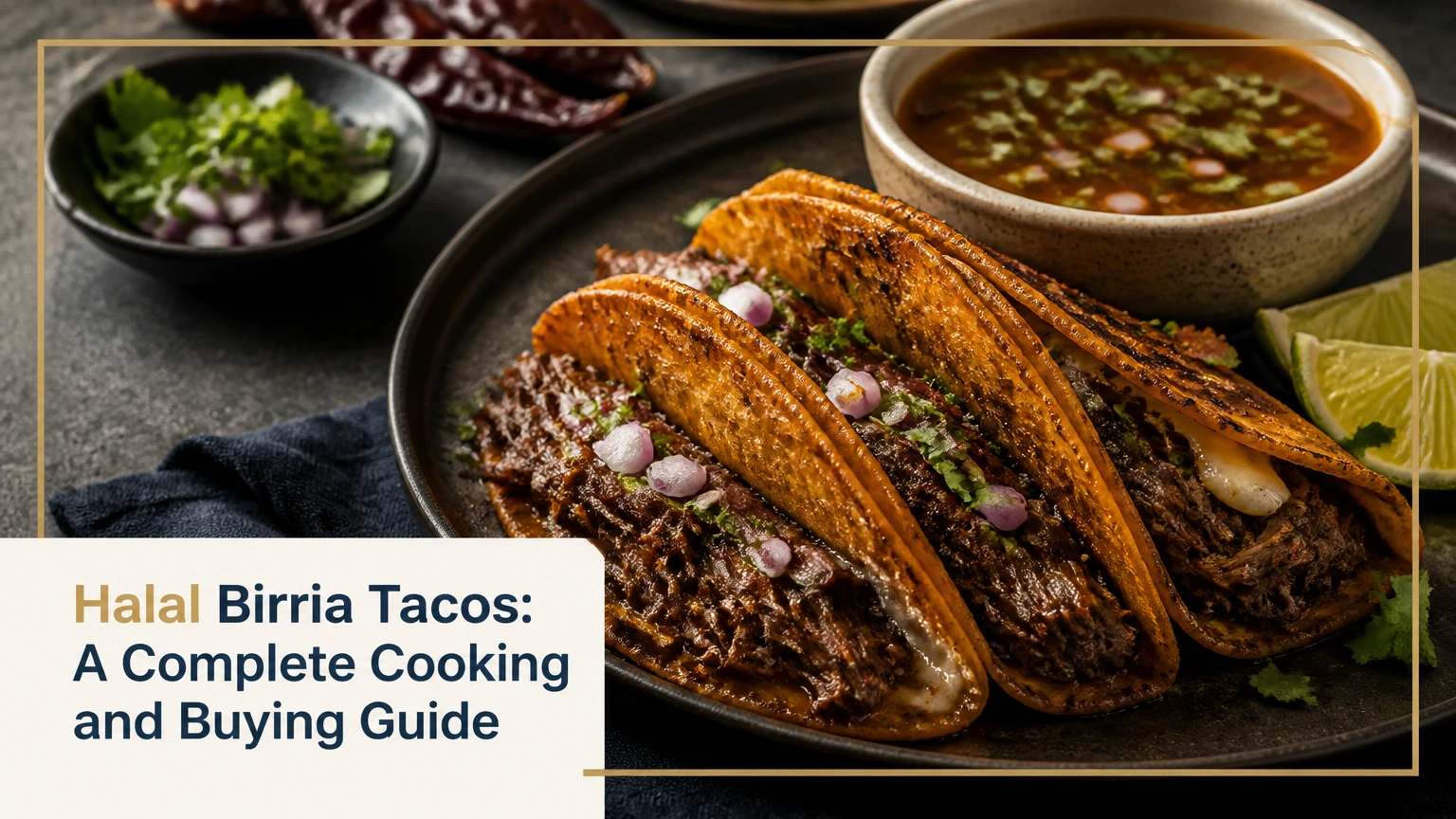
Halal birria tacos are Mexican-style braised-meat tacos prepared with halal-certified beef, goat, lamb, or chicken and ingredients that meet Islamic dietary requirements. The most recognizable version is quesabirria: a corn tortilla coated with seasoned consomé fat, griddled with cheese and shredded meat, then served with hot broth for dipping.
Key Facts at a Glance
- Halal birria tacos require halal meat and a broth made without prohibited animal ingredients or unsuitable flavorings.
- Beef chuck, short ribs, and shank produce the richest consomé because collagen converts into gelatin during slow cooking.
- Traditional stovetop or oven birria usually takes 3-4 hours, while a pressure cooker can finish beef in about 60-90 minutes.
- Quesabirria tacos become crisp when tortillas are coated with the red surface fat, not saturated with watery broth.
- Dried guajillo and ancho chiles provide the main flavor; arbol chiles add heat and should be adjusted to taste.
- Typical restaurant pricing is about $4-$6 per taco or $14-$22 for three tacos with consomé, depending on location and portion size.
What Are Halal Birria Tacos?
Halal birria tacos are a halal adaptation of birria, a Mexican braised dish associated with Jalisco and traditionally prepared with goat or other meats. The stew combines dried chiles, aromatics, spices, and a long cooking process, while the taco version uses the resulting meat and consomé as both filling and dipping broth.
Birria and quesabirria are related but different terms. Birria is the braised meat and broth. Quesabirria is the griddled taco style that generally includes melted cheese, shredded birria, and a crisp tortilla.
The halal designation applies to the meat and the full preparation environment. A halal diner may reasonably ask whether the meat came from a certified halal supplier, whether the stock contains suitable ingredients, whether cheese uses acceptable enzymes, and whether the griddle or fryer is shared with unsuitable foods.
What Makes the Dish Halal?
Halal birria tacos use meat slaughtered and handled according to Islamic dietary requirements, with no prohibited animal derivatives in the recipe. The safest restaurant choice is a venue that identifies its halal supplier or displays credible certification rather than relying only on a menu label.
Ingredient checks matter because halal status can involve more than the main meat. Inspect stock, bouillon, cheese enzymes, tortillas, marinades, and cooking surfaces. Plain dried chiles, vegetables, spices, corn tortillas, and most plant oils are generally straightforward, but packaged ingredients require label verification.
How Does a Quesabirria Taco Work?
A quesabirria taco uses the separated red fat from the consomé to color and fry a corn tortilla, then combines melted cheese, shredded braised meat, and garnishes. The taco is folded only after the tortilla softens and the cheese begins to bind the filling.
The surface fat carries concentrated chile flavor. The watery broth supplies salt, gelatin, aromatics, and acidity, so each component has a separate job. Dipping the tortilla briefly transfers color and flavor without adding enough liquid to make it collapse.
A practical assembly sequence is:
- Warm a corn tortilla for 10-15 seconds.
- Dip one side quickly into the red fat.
- Place the coated side down on a hot griddle.
- Add 25-35 g shredded meat and 15-20 g cheese.
- Fold when the tortilla bends easily and the cheese softens.
- Cook each side for 60-90 seconds until crisp.
- Serve with 120-180 ml hot consomé.
Which Cheese Works Best?
Oaxaca cheese gives the most traditional-style stretch, while low-moisture Monterey Jack melts reliably and is easier to find. Mild mozzarella can work, but high-moisture fresh mozzarella may release water and soften the tortilla.
| Cheese | Melting time | Moisture behavior | Best use |
|---|---|---|---|
| Oaxaca | 2-3 minutes | Moderate, stringy melt | Classic quesabirria texture |
| Monterey Jack | 2-3 minutes | Moderate, even melt | Reliable home cooking |
| Low-moisture mozzarella | 2-4 minutes | Low, strong stretch | Mild flavor and crisp shell |
| Cheddar blend | 2-3 minutes | Low to moderate | Sharper flavor, less traditional |
Which Meat Is Best for Halal Birria Tacos?
Halal beef is the best starting point for most cooks because chuck roast is widely available, forgiving, and rich enough to produce tender shredded meat. Goat gives the strongest traditional connection, lamb offers a rich middle ground, and chicken provides the fastest cooking time with a lighter broth.
Beef benefits from combining a lean shreddable cut with collagen-rich bones or connective tissue. A practical batch uses 1.5 kg beef chuck plus 500 g bone-in short rib or shank. Goat shoulder and lamb shoulder can be cooked as whole sections, while chicken should use bone-in thighs for better moisture retention.
| Meat | Recommended cut | Braising time | Flavor and texture |
|---|---|---|---|
| Beef | Chuck plus shank or short rib | 3-4 hours | Deep, gelatinous, broadly appealing |
| Goat | Bone-in shoulder or leg | 4-6 hours | Bold, rustic, distinctly gamey |
| Lamb | Shoulder or neck | 3-4 hours | Rich, fatty, milder than goat |
| Chicken | Bone-in thighs and drumsticks | 45-75 minutes | Leaner, softer, lighter consomé |
Beef, Goat, Lamb, or Chicken: Which Should You Choose?
Choose beef for a first attempt or a large gathering, goat for a traditional flavor profile, lamb for a rich alternative with a softer aroma, and chicken for a weeknight meal. Chicken cannot fully reproduce the gelatinous body of beef or goat because poultry contributes less connective tissue.
Halal beef chuck is also the easiest meat to troubleshoot. If the meat remains firm after the planned time, continue braising until collagen breaks down. Chicken has a narrower margin because prolonged cooking can dry the meat even while the broth improves.
What Ingredients Do You Need?
A balanced beef batch makes approximately 18-24 tacos and requires 2 kg meat, 12-14 corn tortillas, or more depending on portion size. The adobo needs dried chiles, garlic, onion, vinegar or citrus, warm spices, and a suitable stock.
Ingredients for 18-24 Tacos
- 1.5 kg halal beef chuck, cut into 7-8 cm pieces
- 500 g halal beef shank or bone-in short rib
- 6 guajillo chiles
- 3 ancho chiles
- 2-4 arbol chiles, according to heat preference
- 1 large white onion, halved
- 8 garlic cloves
- 2 teaspoons ground cumin
- 2 teaspoons dried Mexican oregano
- 1 small cinnamon stick
- 3 whole cloves
- 2 bay leaves
- 30 ml apple cider vinegar
- 1.5 litres halal beef stock
- 18-24 corn tortillas
- 350-450 g Oaxaca or Monterey Jack cheese
- Salt, approximately 18-22 g for the full batch
- White onion, cilantro, and lime for serving
Apple cider vinegar supplies brightness without changing the dish into a sweet sauce. Lime juice can replace part of the vinegar, but add it near the end because prolonged boiling can flatten its fresh aroma.
How Do You Make Halal Birria Tacos?
The complete home process takes about 4-5 hours, including 30-45 minutes of preparation, 3-4 hours of braising, and 20-30 minutes of shredding and griddling. The main success factor is gentle cooking until the collagen-rich meat separates easily, rather than stopping at a fixed clock time.
Step 1: Prepare and Toast the Chiles
Remove stems and most seeds from the guajillo, ancho, and arbol chiles. Toast them in a dry skillet over medium heat for 20-30 seconds per side, stopping when they smell fragrant but before the skins darken.
Cover the toasted chiles with hot water for 15 minutes. Drain them before blending. Soaking water can carry bitterness or charred flavors, so use fresh stock or plain water for controlled seasoning.
You will know the chiles are ready when they bend easily and show no brittle interior. A common mistake is prolonged toasting, which creates bitterness that later simmering cannot remove.
Step 2: Blend the Adobo
Blend the softened chiles with garlic, half the onion, cumin, oregano, cloves, cinnamon, vinegar, and 250 ml stock until smooth. Strain the paste through a fine sieve if the blender leaves tough chile skin.
Straining improves the consomé texture, especially with older dried chiles. Add the remaining stock gradually so the blender forms a pourable sauce rather than a thick paste that overheats the motor.
The adobo should taste concentrated, slightly acidic, and moderately salty before it meets the meat. Do not chase final seasoning at this stage because the stock reduces during braising.
Step 3: Sear and Braise the Meat
Pat the halal meat dry, season it with salt, and sear it in 2 tablespoons of neutral oil in a heavy Dutch oven. Brown the pieces in batches for 2-3 minutes per broad side, then transfer them to a plate.
Add the remaining onion, pour in the strained adobo, and scrape the browned fond from the pot. Return the meat, add the bay leaves and remaining stock, cover, and cook at a gentle simmer.
Use one of these settings:
| Method | Temperature or setting | Typical time | Liquid requirement |
|---|---|---|---|
| Dutch oven, stovetop | Low simmer, 90-96°C | 3-4 hours | Meat nearly covered |
| Covered oven | 160°C | 3.5-4.5 hours | 1.2-1.5 litres stock |
| Slow cooker | Low setting | 6-8 hours | 750 ml-1 litre stock |
| Pressure cooker | High pressure | 60-90 minutes | 750 ml-1 litre stock |
The meat is ready when a fork enters with little resistance and a piece pulls apart into strands. Internal temperature alone does not determine birria tenderness; collagen conversion and texture are better indicators.
Step 4: Shred and Strain the Consomé
Remove the meat and bones, then shred the meat while it is warm. Strain the liquid into a heatproof bowl, remove the bay leaves and whole spices, and let the broth rest for 5-10 minutes.
A red-orange fat layer should rise to the surface. Use a spoon to collect some of that fat for griddling, while keeping the broth underneath for dipping. If the meat is dry, moisten it with several tablespoons of consomé before filling the tacos.
Do not discard every soft piece of connective tissue. Gelatin-rich portions help the meat stay moist, but remove hard gristle, loose bone fragments, and any unpleasantly chewy sections.
Step 5: Dip, Fill, Fold, and Crisp
Heat a cast-iron skillet or flat griddle over medium-high heat. Dip each tortilla into the surface fat for about 1 second per side, then place it on the hot cooking surface.
Add cheese first, followed by shredded meat, because the cheese creates a barrier that helps hold the filling. Fold the tortilla after 60-90 seconds, then cook both sides until the shell is crisp and the cheese has melted.
Serve two or three tacos with 120-180 ml hot consomé, finely diced white onion, cilantro, and lime. Keep the broth above 60°C during service and reheat leftovers to 74°C, the reheating temperature recommended by the United States Department of Agriculture.
How Much Time and Money Do Halal Birria Tacos Require?
A home batch typically costs $35-$65 for 18-24 tacos, excluding specialty cookware, while a restaurant order commonly costs $14-$22 for three tacos with consomé. Meat price, bone-in cuts, local halal availability, cheese quantity, and city pricing create the largest differences.
| Scenario | Quantity | Typical time | Typical cost |
|---|---|---|---|
| Home beef batch | 2 kg meat, 18-24 tacos | 4-5 hours | $35-$65 |
| Home chicken batch | 1.5 kg chicken, 16-20 tacos | 1.5-2 hours | $25-$45 |
| Restaurant order | 3 tacos plus consomé | 10-25 minutes service | $14-$22 |
| Family platter | 10-15 tacos plus broth | 15-30 minutes service | $45-$60 |
Restaurant prices are typical United States ranges, not fixed market rates. A food truck in a high-rent city may charge more, while a family restaurant may offer larger portions at a lower price.
How Can You Buy Authentic Halal Birria Tacos?
Buy from a restaurant that can answer specific questions about meat certification, stock ingredients, cheese, and shared cooking equipment. A menu label alone does not reveal whether the consomé, griddle, or garnish preparation follows the same standard.
Ask the restaurant:
- Which halal supplier provides the meat?
- Is the consomé made from halal stock?
- Does the cheese use a suitable microbial or halal-certified enzyme?
- Is the tortilla griddle shared with other menu items?
- Are the tacos fried in the same oil as unrelated foods?
- Can the restaurant serve the broth separately if needed?
Restaurant birria may be beef, goat, lamb, or chicken, and the menu should identify the meat rather than leaving the customer to infer it. A kitchen that answers clearly is more useful than one that relies on a generic dietary claim.
What Should You Look for in a Good Taco?
A well-made taco has a crisp but flexible tortilla, moist shredded meat, a broth with chile aroma and balanced acidity, and enough consomé to dip without tasting diluted. Excess oil, a watery broth, or a tortilla that breaks before the first bite indicates a process problem.
The filling should remain cohesive after dipping. Strong cinnamon or clove notes should support the chile base rather than dominate it, and the meat should contain enough gelatin or broth to stay moist without becoming soupy.
What Are the Best Alternatives to Beef?
Goat, lamb, and chicken are the main practical alternatives to halal beef. Goat is the closest choice for a traditional birria direction, lamb offers a fuller fat profile with a gentler aroma, and chicken reduces cooking time but produces a lighter consomé.
| Alternative | Substitution amount | Cooking adjustment | Main trade-off |
|---|---|---|---|
| Goat shoulder | 2 kg bone-in | Add 1-2 hours | More traditional, stronger aroma |
| Lamb shoulder | 1.8-2 kg bone-in | Use 3-4 hours | Rich texture, higher fat |
| Chicken thighs | 1.5 kg bone-in | Cook 45-75 minutes | Faster, less gelatin |
| Lean beef round | 2 kg | Add extra stock and fat | Lower fat, drier texture risk |
Lean beef round is workable but less forgiving than chuck. If using it, shorten the cooking time once tender and add more broth when shredding; otherwise, the meat can become stringy even though the consomé remains flavorful.
Are Chicken Birria Tacos Healthier?
Chicken birria tacos are usually lighter than beef or lamb versions when made with skinless thighs and less cheese, but the tortilla, frying fat, cheese, and portion size still determine much of the meal’s energy. Chicken changes the nutrient profile; it does not make the dish automatically low-calorie.
For a lighter plate, use skinless bone-in thighs, collect excess surface fat, use 10-15 g cheese per taco, and serve two tacos with extra onion, cilantro, lime, and broth. These changes reduce richness but also reduce the crispness and mouthfeel associated with classic quesabirria.
This dish is not ideal for diners seeking a very low-fat meal. The defining technique uses rendered fat to fry the tortillas, and removing all fat produces a different taco rather than a faithful lighter version.
Why Do Birria Tacos Become Soggy?
Halal birria tacos become soggy when tortillas absorb watery broth, the griddle is too cool, or the filling contains excess liquid. The solution is to separate the consomé fat, dip briefly, cook on a fully heated surface, and drain shredded meat before assembly.
| Problem | Likely cause | Correction | Prevention |
|---|---|---|---|
| Tortilla tears | Dip exceeds 2 seconds | Add a dry warmed tortilla beneath it | Use sturdy corn tortillas |
| Taco turns soggy | Watery broth on tortilla | Use surface fat only | Rest broth 5-10 minutes |
| Consomé tastes bitter | Chiles scorched | Dilute with stock and add lime | Toast 20-30 seconds per side |
| Meat tastes dry | Cut too lean or overcooked | Mix with 60-90 ml broth | Use chuck plus bone-in cut |
| Cheese leaks out | Overfilled tortilla | Reduce filling to 40-55 g | Add cheese before meat |
| Shell will not crisp | Griddle below medium-high | Increase heat and wait 3 minutes | Preheat before dipping |
A tortilla should bend immediately after dipping but should not look saturated. That visual checkpoint is more reliable than a fixed dipping time because tortilla thickness and fat separation vary.
How Do You Fix Bitter Consomé?
Bitter consomé usually results from burned dried chiles, scorched garlic, or excessive clove and cinnamon. Strain the broth, dilute it with unsalted stock, add a small amount of lime juice, and correct salt gradually rather than masking the bitterness with excessive sweetness.
If the bitterness is severe, make a small fresh adobo without the damaged chiles and combine it with the strained broth. Burnt chile flavor cannot be fully removed, so prevention is more effective than correction.
How Should You Store and Reheat Birria?
Store shredded meat and consomé separately in shallow airtight containers within 2 hours of cooking. Refrigerated birria keeps for 3-4 days, while frozen meat and broth retain useful quality for approximately 2-3 months.
Cool the broth quickly, then refrigerate it until the fat solidifies. The chilled fat can be removed, portioned, and used for later griddling, while the broth reheats separately.
| Storage method | Container | Maximum typical period | Reheating method |
|---|---|---|---|
| Refrigerator, meat | Shallow sealed container | 3-4 days | Covered skillet, 74°C |
| Refrigerator, consomé | Sealed heatproof container | 3-4 days | Saucepan, simmering |
| Freezer, meat | Freezer bag, air removed | 2-3 months | Thaw overnight |
| Freezer, broth | Rigid container with headspace | 2-3 months | Saucepan, low heat |
Reheat meat with a few tablespoons of consomé, then assemble fresh tacos on the griddle. Microwaving assembled tacos softens the shell and removes the principal textural contrast.
Expert Rules for Better Results
- Use two meat textures in one batch. Chuck supplies strands, while shank or short rib supplies gelatin and body.
- Strain the adobo before braising when a smooth restaurant-style broth matters. Unstrained chile skin can create a rough finish.
- Season the broth after reduction. Early salting can make the final consomé too concentrated, especially in a pressure cooker.
- Preheat the griddle for at least 3 minutes. A tortilla placed on a lukewarm surface steams instead of searing.
- Keep the filling compact. A 40-55 g total filling produces a taco that folds cleanly and survives dipping.
- Add fresh lime at service, not during the entire braise. Bright acidity fades with prolonged heat.
Frequently Asked Questions
Are halal birria tacos always made with beef?
No. Halal birria tacos can use beef, goat, lamb, or chicken, provided the meat and other ingredients meet halal requirements. Beef is the most common restaurant choice in many regions because chuck and short rib are accessible, while goat remains closely associated with traditional birria.
Can I make halal birria tacos without cheese?
Yes. Without cheese, the dish is closer to a crisp birria taco than a quesabirria. Use a well-heated corn tortilla, dip it briefly in the consomé fat, and add shredded meat with onion and cilantro. The taco will have less binding and may need a lighter filling.
Why is my consomé thin?
Thin consomé usually comes from too much stock, insufficient reduction, or meat with little connective tissue. Simmer the strained broth uncovered for 15-30 minutes, then adjust salt. Shank, short rib, goat shoulder, or lamb neck can add more body in the next batch.
Can I use fresh chiles instead of dried chiles?
Fresh chiles create a different sauce and do not provide the concentrated raisin-like, earthy flavor associated with dried guajillo and ancho chiles. Use dried chiles for the core adobo, then add fresh lime, cilantro, or sliced onion after cooking for brightness.
What is the fastest reliable cooking method?
A pressure cooker is the fastest reliable method for beef birria, usually requiring 60-90 minutes at high pressure plus natural pressure release. The meat becomes tender quickly, although a stovetop or oven braise can produce more reduction and a slightly deeper roasted flavor.
Can I prepare the consomé one day early?
Yes. Preparing the consomé one day early improves convenience and makes the fat easy to separate after refrigeration. Chill the broth promptly, store it covered, reheat it thoroughly, and use the solidified fat to griddle the tortillas when assembling the tacos.
The Bottom Line
Halal birria tacos combine chile-braised halal meat, gelatin-rich consomé, corn tortillas, melted cheese, and a crisp griddled finish. Beef chuck with shank is the most dependable choice, while goat offers a more traditional direction and chicken reduces the cooking time. For the best result, separate the consomé fat, dip tortillas briefly, and serve each taco immediately with hot broth. When choosing restaurant halal birria tacos, verify the meat, stock, cheese, and shared cooking equipment rather than relying on the menu label alone.