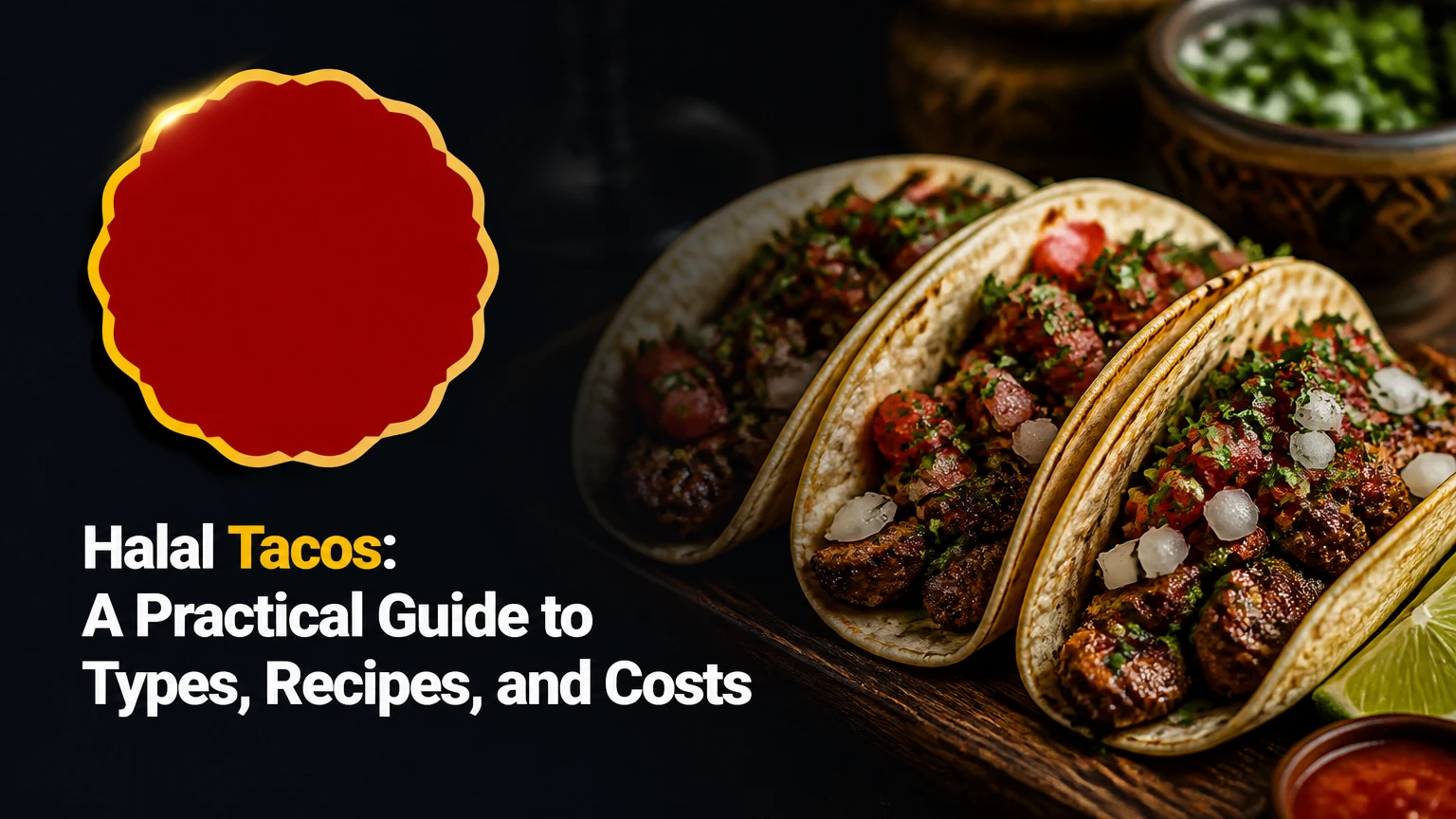
Halal tacos are Mexican-style tacos prepared with permissible ingredients, halal-qualified meat where meat is used, and controls that prevent contact with non-halal substances. A halal taco may contain beef, lamb, goat, chicken, seafood, vegetables, corn or flour tortillas, cheese, salsa, and sauces, but every processed ingredient and preparation surface must meet the diner’s halal standard.
Key Facts at a Glance
- Halal tacos require more than halal meat; tortillas, cheese, stock, marinades, sauces, and cooking equipment also matter.
- A home cook can prepare approximately 10 ground-beef tacos in 25-30 minutes, excluding optional marination.
- Typical taco filling uses 450-500 grams of meat for 10 small tacos, or about 45-50 grams per taco.
- Quesabirria needs the longest preparation because the meat and broth commonly require 2.5-4 hours.
- Seafood and vegetarian tacos can be halal, but sauces, frying oil, cheese, and shared equipment still require checking.
- Restaurant prices vary by country, portion, certification, labor, and delivery fees; Bangladesh examples commonly range from 212-380 BDT per taco.
What Are Halal Tacos?
Halal tacos are tacos whose ingredients, meat supply, and preparation process conform to Islamic dietary requirements. The Mexican format remains recognizable through tortillas, salsa, onion, cilantro, lime, grilled fillings, and regional spice profiles, while the protein and production controls follow halal requirements.
The Arabic word halal means permissible. For meat, many diners look for halal certification or a trusted supplier that confirms the slaughter and handling method. Certification rules differ among countries and authorities, so a restaurant’s “halal” label may require a follow-up question when a diner follows a particular interpretation.
A taco is therefore a complete preparation, not merely a piece of certified meat. A halal beef taco can lose that status for a customer if its sauce contains a questionable flavoring, its cheese uses a non-permissible enzyme, or its tortilla is cooked on a surface shared with unsuitable ingredients.
When Is a Taco Halal?
A taco is halal when its meat, plant ingredients, processed additions, cooking medium, and handling process satisfy the relevant halal standard. Vegetarian fillings remove the meat question, but they do not automatically resolve issues involving cheese cultures, sauces, frying oil, or shared cooking surfaces.
Ask five direct questions when buying prepared tacos:
- Is the meat certified halal, and which certifier or supplier verifies it?
- Are the tortillas and cheese free from non-permissible animal derivatives?
- Does the stock, marinade, crema, or sauce contain an unsuitable flavor extract?
- Is the grill, fryer, pan, and preparation board shared?
- Are cooked fillings stored separately from unsuitable foods?
A restaurant may answer these questions confidently without holding formal certification, or it may display certification from a recognized local body. Formal certification offers stronger traceability, while a small operator may rely on documented suppliers and separated preparation.
How Does Halal Preparation Work?
Halal taco preparation works through three linked controls: ingredient eligibility, meat provenance, and physical separation. Each control addresses a different failure point, so certified beef alone does not verify the finished taco.
Ingredient Control
Fresh vegetables, dried herbs, salt, spices, lime, tomatoes, beans, rice, and plain corn are usually straightforward ingredients. Processed products need closer inspection because labels may include animal-derived enzymes, emulsifiers, flavor carriers, gelatin, or cooking stock.
Cheese is a frequent checkpoint. Vegetarian rennet, microbial enzymes, or a halal-certified cheese can reduce uncertainty, while an unlabeled imported cheese may require supplier confirmation. Flour tortillas may contain shortening, whey, or dough conditioners, so corn tortillas are often the simpler choice when their ingredients are clear.
Meat and Seafood Control
Beef, lamb, goat, and chicken can be used when sourced and slaughtered according to the applicable halal standard. Seafood is widely accepted as halal by many Islamic authorities, but diners may still need to check preparation because a seafood taco can share a fryer, pan, or sauce with unsuitable foods.
Halal certification normally concerns traceability as well as slaughter. A reliable supplier should identify the processor, product category, certification body, and storage controls. “Muslim-owned” and “halal-certified” are related signals, but they are not identical claims.
Separation During Cooking
Use separate knives, cutting boards, tongs, storage containers, and pans when a kitchen handles both halal and non-halal foods. In a restaurant, ask whether the flat-top grill is dedicated, whether the fryer oil is shared, and whether cooked meat is held in the same tray.
Shared equipment creates a practical distinction between a fully dedicated halal kitchen and a menu that merely uses halal meat. Diners who require strict separation should choose a dedicated facility or request clear confirmation before ordering.
Which Taco Styles Are Most Common?
The best halal taco style depends on the desired texture, cooking time, and tolerance for fusion flavors. Carne asada is the most direct grilled option, quesabirria is the richest and slowest, while shawarma and tandoori fillings create stronger cross-cultural profiles.
| Taco style | Typical protein | Cooking time | Texture and flavor | Typical use |
|---|---|---|---|---|
| Carne asada | Halal beef steak | 20-35 minutes | Charred, juicy, citrus-spiced | Fast dinner or grill service |
| Quesabirria | Beef, goat, or lamb | 2.5-4 hours | Crisp cheese shell, soft braised meat | Weekend meal or premium order |
| Halal al pastor | Chicken, beef, or lamb | 45-90 minutes | Sweet-savory, pineapple-forward | Street-food fusion |
| Shawarma taco | Chicken or beef | 40-75 minutes | Spiced, shaved, garlicky | Fast-casual fusion |
| Tandoori taco | Chicken | 50-70 minutes | Smoky, yogurt-spiced, firm | Charcoal or oven cooking |
| Seafood taco | Prawns, white fish, or similar seafood | 20-35 minutes | Light, crisp, acidic | Quick meal and warm climates |
Quesabirria and Brothy Tacos
Halal quesabirria uses halal beef, goat, or lamb braised with dried chilies, onion, garlic, spices, and a verified stock. The tortilla is dipped in the seasoned cooking fat or broth, filled with meat and suitable cheese, then griddled until crisp and served with broth for dipping.
The dish is labor-intensive because tough cuts need time to soften. A 1.5-kilogram batch may produce roughly 20-30 small tacos, depending on trimming and portion size, but yield changes substantially with bone weight and moisture loss.
Carne Asada and Grilled Tacos
Carne asada uses thinly sliced or chopped halal beef, often marinated with citrus, garlic, salt, cumin, and chili. Skirt steak, flank steak, and sirloin offer different trade-offs: skirt steak cooks quickly, flank steak slices cleanly, and sirloin is often easier to source.
High heat matters more than a long marinade. Pat the meat dry before grilling, cook in small batches, and rest it for five minutes before chopping so the surface browning remains distinct.
Fusion Options
Shawarma tacos pair shaved chicken or beef with garlic sauce, pickles, cucumber, and herbs. Tandoori tacos use yogurt, ginger, garlic, chili, and spices, then add mint chutney or fresh radish. Halal al pastor may use layered chicken or beef with pineapple, onion, and coriander.
Fusion tacos are not automatically traditional Mexican tacos, and they should not be judged by a single authenticity test. They are strongest when the tortilla, acid, heat, and garnish remain balanced rather than combining every available sauce.
How to Make Halal Beef Tacos in 25 Minutes
Halal beef tacos require one skillet, 500 grams of verified halal ground beef, 10 small tortillas, and approximately 25-30 minutes. The factor that most affects the result is moisture control: simmer the filling until cohesive, then assemble immediately with warm tortillas and restrained toppings.
Before You Start
| Item | Typical requirement | Practical specification |
|---|---|---|
| Yield | 10 tacos | 2 tacos per person for 5 light servings |
| Total time | 25-30 minutes | Add 30 minutes for optional marination |
| Main protein | 500 g ground beef | 80/20 fat ratio gives a juicier filling |
| Tortillas | 10 small tortillas | 12-15 cm corn or flour tortillas |
| Cooking equipment | 1 skillet and 1 pan | Use dedicated utensils where required |
| Cost | Typical home range | About $15-$25, excluding pantry staples |
Step 1: Prepare the Pico de Gallo
Dice 2 medium tomatoes, half a white onion, 1 jalapeño, and a small handful of cilantro. Mix with 1 tablespoon lime juice and 1/2 teaspoon salt, then rest for 10 minutes.
The resting period lets the salt draw out tomato moisture and softens the onion. You will know the salsa is ready when it is juicy but not watery. Drain excess liquid if it would soak the tortilla.
Step 2: Warm the Tortillas
Heat a dry cast-iron skillet or flat pan over medium-high heat. Warm each tortilla for 30-45 seconds per side, then place the tortillas inside a clean towel or covered container.
A flexible tortilla bends without splitting at the fold. Cold tortillas crack because their moisture and structure are less pliable. Do not stack tortillas on a hot burner, because the lower layers can dry out.
Step 3: Brown the Beef
Heat 1 tablespoon olive oil, then cook half a diced onion and 2 minced garlic cloves for 2 minutes. Add 500 grams of ground halal beef and break it into small pieces; cook for 5-6 minutes until browned.
The beef should reach 71°C internally for ground meat, according to the United States Department of Agriculture’s consumer cooking guidance. You will know the step worked when no raw center remains and the pan contains browned particles rather than pale steamed clumps.
Step 4: Season and Simmer
Add 2 teaspoons chili powder, 1 teaspoon ground cumin, 1 teaspoon smoked paprika, 1/2 teaspoon coriander, 1/2 teaspoon black pepper, and 3/4 teaspoon salt. Stir in 120 grams tomato passata and 60 milliliters verified halal stock or water, then simmer for 3-4 minutes.
The filling should hold together on a spoon without pooling liquid. Excess broth produces soggy tacos, while no liquid leaves the spices harsh and dry. Taste before adding more salt because stock and cheese can contribute additional sodium.
Step 5: Assemble and Serve
Add approximately 45-50 grams of beef to each warm tortilla. Finish with pico de gallo, shredded lettuce, suitable cheese, lime, and a small spoonful of verified crema or yogurt sauce.
A properly assembled taco has enough filling to support the tortilla without forcing it open. Serve within five minutes, especially when using soft corn tortillas. Crisp shells should be filled immediately after frying.
What Ingredients Need the Closest Checking?
Processed sauces, cheese, stock, tortillas, and cooking fats create more uncertainty than fresh produce. Read the complete label, check manufacturer information, and ask the restaurant about preparation rather than assuming a familiar food is automatically permissible.
| Ingredient | Main uncertainty | Safer selection | Practical check |
|---|---|---|---|
| Cheese | Enzyme or rennet source | Microbial or halal-certified cheese | Ask for the enzyme source |
| Flour tortilla | Shortening, whey, conditioners | Clearly labeled vegetable-fat tortilla | Review the full ingredient list |
| Stock | Meat source and processing | Halal-certified beef or chicken stock | Confirm supplier and certification |
| Salsa | Flavor extracts and shared utensils | Fresh tomato, lime, onion, cilantro salsa | Ask whether it is made in-house |
| Crema | Cultures, stabilizers, shared tools | Plain yogurt or verified crema | Check cultures and preparation |
| Frying oil | Shared fryer and filtration | Dedicated vegetable-oil fryer | Ask what else is fried |
| Marinade | Flavor carriers and stock | Citrus, spices, garlic, oil | Verify every bottled component |
Fresh corn tortillas made from masa, water, and lime treatment are often easier to assess than highly processed flour tortillas. That does not make every corn tortilla compliant, because restaurant equipment and packaged additives still matter.
How Much Time and Money Do Halal Tacos Need?
Simple ground-beef or seafood tacos usually take 25-35 minutes, while marinated chicken and shawarma-style tacos take 45-75 minutes. Typical restaurant pricing ranges from approximately $2-$8 per taco in many markets, with local wages, ingredients, certification, and delivery accounting for major differences.
| Format | Typical preparation time | Typical serving size | Typical price range |
|---|---|---|---|
| Home ground-beef tacos | 25-30 minutes | 10 tacos per 500 g beef | $15-$25 total |
| Home marinated chicken tacos | 45-75 minutes | 8-12 tacos per 700 g chicken | $18-$30 total |
| Restaurant single taco | 5-12 minutes service time | 1 taco, 50-90 g filling | $2-$8 |
| Restaurant platter | 10-20 minutes service time | 3-5 tacos with sides | $10-$30 |
| Bangladesh individual taco | 5-15 minutes service time | 1 taco | 212-380 BDT |
| Bangladesh party box | 20-40 minutes order time | 10 pieces | About 999-1,799 BDT |
Marinate chicken for at least 30 minutes when time allows, with 2-3 hours producing deeper seasoning. Acid-heavy marinades should not sit indefinitely because lime or vinegar can make the exterior soft and mealy.
Prices from a Bangladesh menu cannot be transferred directly to London, Toronto, Dubai, or New York. Compare portion weight, meat type, cheese, side dishes, delivery charges, and certification practices before treating one menu as a market benchmark.
Halal Tacos Compared With Other Taco Choices
Halal tacos offer dietary assurance for customers who need it, but they do not guarantee a particular level of authenticity, nutrition, price, or taste. The meaningful comparison is between the complete preparation systems, not between a halal label and an assumed quality standard.
| Choice | Meat or filling control | Cross-contact risk | Typical flavor profile | Best fit |
|---|---|---|---|---|
| Dedicated halal taco kitchen | Documented halal supply | Low when equipment is separated | Mexican or fusion | Strict dietary requirements |
| Halal meat at mixed kitchen | Halal protein only | Medium to high | Standard menu flavor | Flexible diners after verification |
| Vegetarian taco | No meat requirement | Medium | Bean, mushroom, cheese, or vegetable | Meat-free meals |
| Seafood taco | Seafood generally accepted | Medium in shared fryer | Citrus, chili, slaw | Light, quick meals |
| Homemade taco | Full ingredient control | Low with separate tools | Custom seasoning | Families and careful cooks |
Are Halal Tacos More Authentic?
Halal status and Mexican authenticity answer different questions. A taco can use a traditional Mexican tortilla, garnish, cooking method, and regional salsa while replacing or adapting a protein, and a fusion taco can be delicious without representing a specific Mexican regional style.
Traditional al pastor, for example, developed around a distinct preparation and seasoning history. A chicken or beef version may preserve the pineapple, chile, onion, and vertical-roasting idea while changing the protein. Menus should describe that variation honestly.
Are Halal Tacos Healthier?
Halal certification does not automatically make tacos lower in calories, sodium, saturated fat, or portion size. A cheese-heavy fried quesabirria taco can contain more energy than a grilled chicken taco, regardless of certification.
For a lighter plate, choose grilled chicken, fish, beans, cabbage, fresh salsa, and one measured sauce. Typical home portions of two tacos plus beans or salad provide more control than oversized restaurant platters.
What Are Common Problems and Fixes?
Most halal taco failures come from texture, seasoning, or unclear preparation controls rather than the tortilla style itself. The fastest fixes are to reduce liquid, warm tortillas immediately before serving, and verify sauces before cooking.
| Problem | Likely cause | Immediate fix | Prevention |
|---|---|---|---|
| Taco shell breaks | Cold or dry tortilla | Steam or rewarm 30 seconds | Hold warm tortillas in a towel |
| Filling turns watery | Excess stock or salsa | Simmer uncovered 2-4 minutes | Add liquid gradually |
| Beef tastes dry | Lean meat or overcooking | Add 1-2 tablespoons stock | Use 80/20 beef and stop at doneness |
| Flavor tastes flat | Insufficient acid or salt | Add lime and 1/8 teaspoon salt | Taste after simmering |
| Cheese will not melt | Low heat or unsuitable cheese | Cover briefly on the griddle | Use a melting cheese with verified ingredients |
| Certification is unclear | Vague menu language | Ask supplier and equipment questions | Choose a documented kitchen |
A common practitioner rule is to keep the finished filling drier than the desired eating texture because salsa, lime, and crema add moisture after assembly. This single adjustment prevents many soft tortillas.
Another useful rule is to limit each taco to two or three principal toppings. Onion, cilantro, and salsa usually support the protein; adding cheese, crema, pickles, slaw, guacamole, and several hot sauces can hide the main flavor and overload the fold.
How Should You Choose Halal Tacos Away From Home?
Choose a restaurant that can identify its halal meat source and explain its grill, fryer, storage, and sauce practices. A dedicated halal kitchen provides the clearest process, while a mixed kitchen may still suit diners who accept separated ingredients but not those requiring complete equipment separation.
Look for a current certification display, a specific supplier statement, or staff who answer with operational detail. “Everything is halal” is less useful than “the beef comes from a named certified supplier, the grill is dedicated, and the sauce is made without shared stock.”
For travel, inspect the menu before arriving and call during a quiet period. Ask about the exact taco, because one restaurant may use compliant beef for tacos while frying side items in shared oil or using a separate sauce with uncertain ingredients.
What Should Families Order?
Families often get the best balance from grilled beef or chicken, soft corn tortillas, fresh salsa, beans, and rice. Order sauces on the side for children, and choose a taco bar when several diners need different spice levels or fillings.
For 10 people, plan 20-30 tacos, 1.5-2 kilograms of cooked or ready-to-cook filling, 30 tortillas, and 600-900 grams of toppings. These quantities allow two tacos per guest plus a margin for larger appetites.
What Should Strictly Observant Diners Order?
Strictly observant diners should prefer a dedicated certified kitchen or a home preparation with fully verified ingredients. Seafood and vegetable tacos can reduce meat uncertainty, but diners should still confirm fryer oil, cheese, sauces, and preparation surfaces.
When staff cannot answer basic sourcing questions, select a simpler item with sealed, labeled ingredients or choose another restaurant. Uncertainty is a valid reason not to order.
What Are Vegetarian and Seafood Alternatives?
Vegetarian and seafood tacos are practical halal alternatives when meat certification is unavailable, but preparation controls remain important. Black beans, pinto beans, mushrooms, cauliflower, grilled vegetables, prawns, and white fish all work with corn tortillas and fresh salsa.
| Filling | Typical cook time | Texture | Strong pairings | Key check |
|---|---|---|---|---|
| Black beans | 10-15 minutes | Creamy and dense | Pickled onion, avocado | Stock and seasoning |
| Oyster mushrooms | 12-18 minutes | Meaty and crisp-edged | Chipotle-style salsa, lime | Cooking surface |
| Cauliflower | 20-30 minutes | Tender with roasted edges | Cabbage, yogurt sauce | Marinade ingredients |
| White fish | 8-12 minutes | Flaky and delicate | Slaw, lime, pico | Shared fryer or grill |
| Prawns | 5-8 minutes | Firm and juicy | Garlic, chili, cucumber | Sauce and cooking oil |
Seafood tacos need careful timing because fish dries quickly and prawns become rubbery after prolonged heat. Cook seafood close to service, keep acidic salsa separate, and add sauce at the table.
Frequently Asked Questions
Are corn tortillas always halal?
Corn tortillas are not automatically halal, although simple masa tortillas often contain only corn, water, and lime treatment. Check packaged ingredients, confirm that the restaurant uses suitable cooking surfaces, and ask whether the tortilla is warmed on a shared grill or cooked with added fat.
Can halal tacos contain cheese?
Halal tacos can contain cheese when the cheese ingredients and enzyme or rennet source meet the diner’s standard. Microbial enzymes and halal-certified cheese reduce uncertainty, while an unlabeled cheese product requires a supplier or manufacturer check before serving.
Can flour tortillas be halal?
Flour tortillas can be halal when their flour, shortening, whey, conditioners, and other additives are permissible. Vegetable oil tortillas are often easier to verify than tortillas containing unspecified shortening, but preparation equipment still needs consideration in a restaurant.
Are quesabirria tacos suitable for children?
Quesabirria tacos can suit children when the chili heat is mild, the broth is served separately, and the meat is tender enough to chew safely. The dish is rich and messy, so grilled chicken or bean tacos may be easier for younger diners.
How many halal tacos should one person order?
Two or three small tacos usually provide a typical main-meal portion, depending on filling weight and side dishes. Plan 45-50 grams of cooked filling per small taco, then add rice, beans, or salad when serving a group.
Can halal tacos be made without dairy?
Halal tacos can be made dairy-free with corn tortillas, grilled meat or beans, salsa, guacamole, cabbage, lime, and dairy-free sauces. Verify that the marinade, stock, tortilla treatment, and cooking surface remain suitable, because removing cheese alone does not resolve every ingredient issue.
The Bottom Line
Halal tacos are permissible taco preparations built from verified ingredients, suitable meat or seafood, and controlled handling. Carne asada offers the fastest traditional-style route, shawarma and tandoori fillings suit fusion menus, and quesabirria rewards a longer braise. At home, use 500 grams of halal beef for 10 tacos, warm the tortillas, control moisture, and verify every processed ingredient. When dining out, ask about certification, sauces, shared equipment, and storage before ordering. Properly prepared halal tacos can preserve the structure and pleasure of taco cuisine while meeting the diner’s dietary requirements.