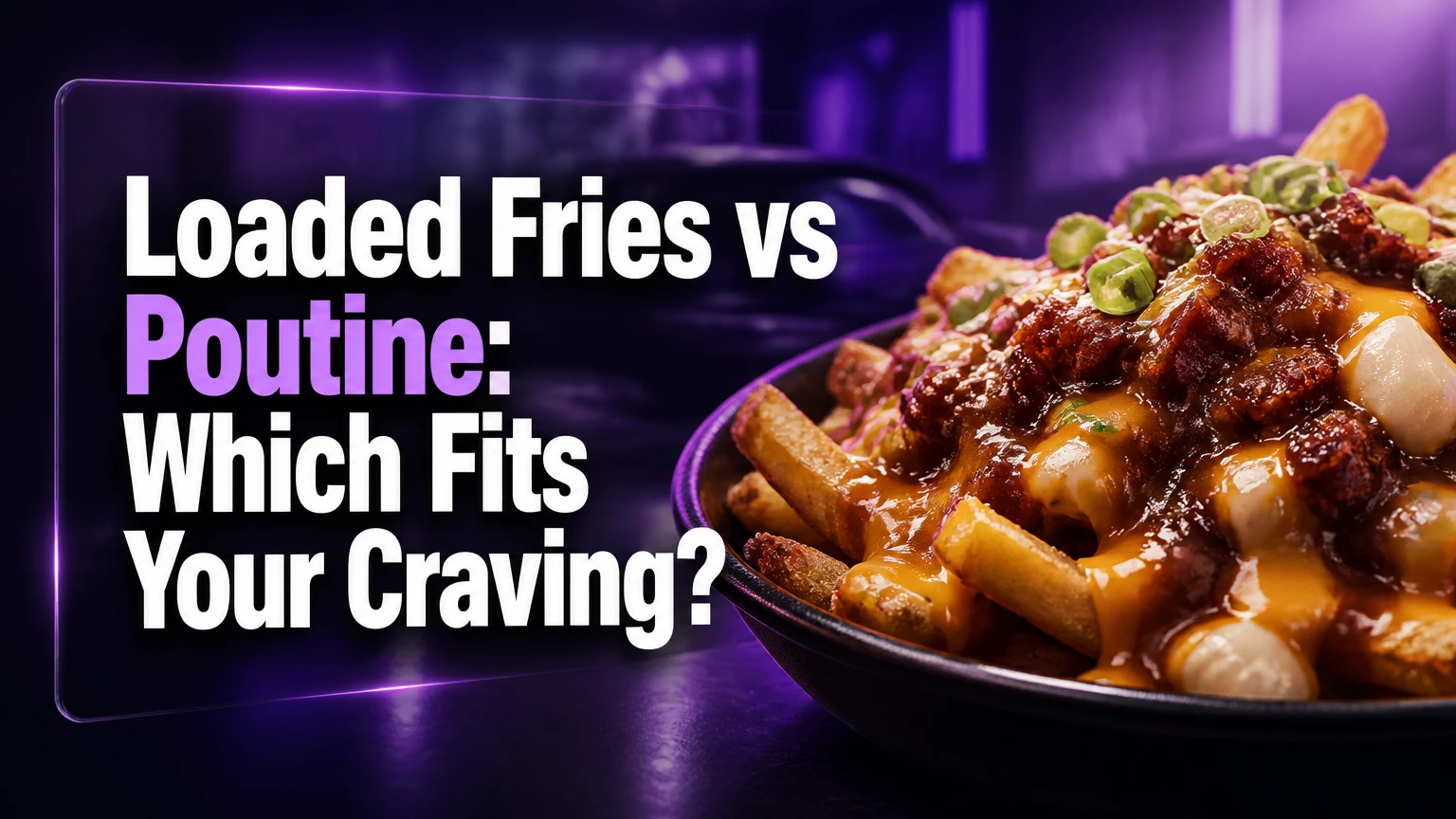
Loaded fries are a flexible category of fries covered with ingredients such as melted cheese, meat, vegetables, and finishing sauces. Poutine is a specific Quebec dish built around fries, fresh cheese curds, and hot brown gravy. Choose poutine for curds and gravy; choose loaded fries for stronger customization, layered toppings, or sharing.
Key Facts at a Glance
Poutine’s defining combination is french fries, fresh cheese curds, and hot gravy.
Loaded fries have no fixed ingredient list or single country of origin.
Poutine uses hot gravy to soften cheese curds while preserving their shape.
Loaded fries usually use melted shredded cheese or cheese sauce, often with meat and fresh garnishes.
Typical restaurant poutine costs about $8-$14, while fully loaded fries cost about $10-$18.
Both dishes lose texture quickly, but wet toppings usually damage loaded fries faster.
The Core Difference Between Loaded Fries and Poutine
Poutine is a named dish with a traditional culinary identity, whereas loaded fries are a broad serving style. The distinction depends primarily on the cheese and sauce: fresh curds plus hot gravy point toward poutine, while melted cheese, multiple toppings, and finishing sauces point toward loaded fries.
The distinction is structural as well as cultural. Classic poutine is assembled so the gravy reaches the fries and warms the curds without dissolving them. Loaded fries use fries as a platform for a larger topping system, usually with a melted layer that binds ingredients together.
Poutine originated in rural Quebec during the late 1950s, although Warwick, Drummondville, and other Quebec communities have competing claims about its precise birthplace. The Canadian Encyclopedia describes the dish as a Quebec creation whose early history is disputed, so a single definitive inventor should not be presented as settled fact.
Loaded fries developed through restaurant, takeaway, diner, food-truck, and gastropub cooking rather than one protected regional tradition. “Dirty fries,” “cheesy chips,” and “topped chips” can describe similar dishes, although local menus use those terms inconsistently.
Master Comparison Table
| Criterion | Classic poutine | Loaded fries | Practical consequence |
|---|---|---|---|
| Defining base | Thick-cut french fries | Thin, crinkle, waffle, or steak fries | Loaded fries offer more fry-shape choices |
| Cheese | Fresh cheddar cheese curds | Cheddar, Jack, mozzarella, American cheese, or sauce | Poutine depends on curd texture |
| Sauce | Hot brown gravy | Cheese sauce, ranch, barbecue sauce, sour cream, or salsa | Poutine has one central sauce |
| Protein | Usually absent in the classic version | Chili, beef, chicken, bacon, or vegetables | Loaded fries carry heavier toppings |
| Assembly temperature | Hot fries, warm curds, boiling gravy | Hot fries, melted cheese, cold garnishes | Loaded fries use more temperature contrasts |
| Customization | Low in the classic form | High, with regional and dietary adaptations | Loaded fries suit mixed preferences |
| Typical price | $8-$14 per restaurant serving | $10-$18 per restaurant serving | Protein and cheese raise loaded-fries prices |
| Best setting | Individual comfort-food meal | Shareable snack, bar food, or casual meal | Pan size changes the ideal use case |
What Is Traditional Poutine Made Of?
Traditional poutine contains three core components: french fries, fresh cheese curds, and gravy. The fries should be sturdy enough to support sauce, the curds should remain identifiable, and the gravy should be hot and thick enough to coat rather than flood the plate.
Fries
Poutine commonly uses medium or thick-cut fries, often around 9-12 millimeters wide. Russet potatoes work well because their high starch content creates a crisp exterior and fluffy interior after frying.
Double-frying is conventional. A first fry around 150°C, or 300°F, softens the potato; a second fry around 185-190°C, or 365-375°F, develops the crust. Restaurant equipment varies, so those figures are practical targets rather than a legal definition of poutine.
Cheese Curds
Fresh cheddar curds provide poutine’s signature squeak. The curds are unripened pieces of cheese that retain a springy protein structure, so hot gravy softens their exterior without turning them into a smooth cheese coating.
Freshness matters more than color. Curds stored for several days or chilled too aggressively may lose their squeak, although they can still produce a satisfying plate. Shredded cheddar changes the dish because shredded cheese melts into a layer rather than remaining in separate pieces.
Gravy
Poutine gravy is usually a brown, savory sauce based on beef stock, chicken stock, or a blend of both. A roux-thickened gravy gives reliable coating power, while a reduced stock or demi-glace creates a darker, more concentrated flavor.
The gravy should be hot when poured. Poutine served with cool gravy leaves the curds firm and greasy, while gravy that is too thin penetrates the fries rapidly and produces a watery base.
How Do Loaded Fries Work as a Dish?
Loaded fries use a layered architecture: crisp fries form the base, a binding ingredient such as melted cheese connects the toppings, and fresh or acidic garnishes add contrast. The format has no mandatory cheese, protein, sauce, or regional recipe.
A successful tray balances weight and moisture. Dry cheese and cooked toppings can go onto the fries before a short broil, while sour cream, salsa, ranch, herbs, or pickled vegetables should usually go on after heating.
Waffle and crinkle fries often hold toppings longer than very thin fries because their ridges create more surface area and mechanical support. However, a thicker fry does not prevent sogginess if a large amount of chili, gravy, or salsa sits directly on the base.
Common Loaded-Fry Components
| Component | Typical examples | Usual quantity per serving | Main function |
|---|---|---|---|
| Fry base | Thin, waffle, crinkle, steak fries | 250-350 g | Provides crisp structure |
| Melt layer | Cheddar, Monterey Jack, mozzarella | 75-125 g | Binds toppings to fries |
| Protein | Beef chili, grilled beef, chicken, bacon | 90-150 g | Adds savory weight and chew |
| Fresh garnish | Scallions, jalapeños, cilantro, tomato | 30-75 g | Adds acidity, heat, or freshness |
| Finishing sauce | Ranch, barbecue sauce, sour cream | 30-60 ml | Adds richness and moisture |
| Acidic element | Pickles, lime, vinegar peppers | 15-40 g | Cuts fat and salt |
Why Do Cheese Curds Matter in Poutine?
Cheese curds matter because poutine is defined by their separate, springy texture rather than by a fully melted cheese layer. Hot gravy warms and softens the curds, creating a combination of crisp-soft fries, smooth sauce, and resistant cheese pieces.
The famous squeak comes from the curds’ elastic protein network. Refrigeration gradually changes that texture, which explains why a fresh curd from a Quebec dairy or local cheese counter behaves differently from an aged cheddar or packaged shredded cheese.
A practical serving temperature is room-temperature curds with gravy around 80-95°C, or 175-203°F, immediately before serving. The gravy should be hot enough to warm the curds, but the curds should not be submerged in a long simmer.
Expert insight: Poutine is often damaged by trying to make it cheesier. More melted cheese can reduce the contrast that makes the dish recognizable, while moderate curd coverage preserves separate bites across the plate.
How Are the Two Dishes Prepared?
Poutine generally takes about 35-60 minutes from raw potatoes when using a double-fry method and homemade gravy. Loaded fries usually take 20-35 minutes with frozen fries and prepared toppings, because the main cooking task is crisping and melting rather than making a sauce from scratch.
Preparation Comparison
| Stage | Poutine method | Loaded-fries method | Typical time |
|---|---|---|---|
| Potato preparation | Cut, rinse, soak, dry | Use frozen or prepared fries | 10-60 minutes |
| First cooking stage | Fry at 150°C or 300°F | Bake or air-fry at 205°C or 400°F | 5-15 minutes |
| Sauce preparation | Simmer brown gravy | Prepare or portion finishing sauces | 5-25 minutes |
| Final cooking stage | Fry at 185-190°C or 365-375°F | Broil cheese at 200°C or 400°F plus | 2-5 minutes |
| Assembly | Curds, fries, hot gravy | Fries, dry toppings, melted cheese, garnish | 1-3 minutes |
| Best serving window | Within 1 minute of gravy pour | Within 5 minutes of broiling | Immediate |
A Reliable Poutine Workflow
- Cut 1 kilogram of russet potatoes into 9-12 millimeter batons.
- Soak the batons in cold water for 30-60 minutes, then dry them thoroughly.
- Fry at approximately 150°C for 4-6 minutes, until soft and pale.
- Cool the fries for at least 10 minutes.
- Fry again at 185-190°C for 2-4 minutes, until golden and firm.
- Place 100-150 grams of fresh curds over each 250-300 gram portion.
- Pour 150-200 milliliters of hot gravy across the plate.
- Eat immediately, because the texture declines rapidly after assembly.
The success checkpoint is a fry that bends slightly under gravy but does not collapse. A common mistake is salting heavily before the gravy arrives, since brown gravy and curds already contribute substantial sodium.
A Reliable Loaded-Fries Workflow
- Cook 300-400 grams of fries until darker and firmer than a normal side portion.
- Spread the fries in one layer on a metal tray or oven-safe skillet.
- Add 90-150 grams of cooked, relatively dry protein.
- Scatter 75-125 grams of shredded cheese across the surface.
- Broil at 200°C or 400°F plus for 2-3 minutes.
- Add 30-60 milliliters of cold sauce and 30-75 grams of fresh garnish.
- Serve within 5 minutes.
The success checkpoint is melted cheese with visible gaps between some fries. A complete cheese blanket traps steam, and steam softens the fries beneath it.
Which Dish Is More Customizable?
Loaded fries are substantially more customizable because the format accepts different cheeses, proteins, sauces, cuisines, and fry cuts. Poutine variations can add toppings, but a plate becomes less recognizably classic when gravy and curds stop controlling the flavor and texture.
Popular Variations
| Variation | Core toppings | Cheese or sauce | Regional association |
|---|---|---|---|
| Classic poutine | Fries and gravy | Fresh cheddar curds | Quebec, Canada |
| Italian-style poutine | Fries and meat sauce | Curds or shredded cheese | Quebec pizza counters |
| Galvaude | Chicken and green peas | Curds with brown gravy | Quebec |
| Smoked-meat poutine | Smoked beef and mustard | Curds with gravy | Montreal |
| Chili cheese fries | Beef chili and onions | Cheddar or cheese sauce | United States |
| Animal-style fries | Grilled onions and spread | American cheese | California |
| Carne asada fries | Grilled beef, pico de gallo, guacamole | Cotija and sour cream | Southern California |
| Kimchi fries | Kimchi, scallions, sesame | Gochujang mayonnaise | Korean-influenced menus |
Poutine can accommodate vegetarian gravy, mushroom gravy, chicken, peas, and regional meats. Those adaptations remain poutine when the fries, curds, and gravy relationship remains central.
Loaded fries can move across flavor systems more freely. A tray can use curry sauce, falafel, roasted vegetables, buffalo-style chicken, or Mediterranean herbs without needing to preserve a traditional Quebec structure.
Which Has the Better Texture?
Poutine offers the more coherent texture, while loaded fries offer the wider range of textures. Poutine balances fry crust, gravy softness, curd resistance, and sauce smoothness; loaded fries can add crunch, chew, creaminess, acidity, and heat in a single bite.
Texture depends on timing more than on the ingredient list. Poutine needs the gravy poured immediately before eating, whereas loaded fries need wet sauces held until after broiling.
Texture Failure Points
| Failure | Poutine cause | Loaded-fries cause | Practical correction |
|---|---|---|---|
| Soggy fries | Thin gravy or delayed serving | Wet chili, salsa, or ranch added early | Drain toppings and sauce at the end |
| Hard cheese | Cold curds or insufficient gravy heat | Cheese cooled after broiling | Serve immediately and use a shallow layer |
| Greasy plate | Excess oil or fatty gravy | Too much cheese sauce or meat fat | Drain fried toppings before assembly |
| Uneven bites | Curds concentrated on top | Toppings piled in one central mound | Toss or layer across the full surface |
| Collapsed base | Overcooked fries | Heavy toppings on thin fries | Use sturdy waffle or crinkle fries |
| Bland center | Underseasoned potatoes | Cheese and protein isolated on top | Season each component separately |
Expert insight: The bottom fries are the real quality test. A loaded tray with crisp top fries and a wet center has failed its load distribution, even if the cheese looks attractive when it leaves the kitchen.
Which Is Easier to Prepare at Home?
Loaded fries are easier for most home cooks because frozen fries, prepared cheese, and leftovers remove the need for fresh curds and scratch gravy. Poutine is still straightforward, but its narrow ingredient profile makes substitutions more noticeable.
Home-Cooking Requirements
| Requirement | Poutine | Loaded fries | Home implication |
|---|---|---|---|
| Essential cheese | 150-200 g fresh curds per kilogram fries | 75-125 g shredded cheese | Curds may require specialty shopping |
| Sauce | 600-800 ml gravy for four portions | 120-240 ml finishing sauce | Poutine requires more sauce volume |
| Equipment | Fryer or heavy pot, thermometer | Oven, air fryer, or sheet pan | Loaded fries need less frying equipment |
| Active cooking | 25-40 minutes | 15-25 minutes | Leftovers favor loaded fries |
| Ingredient substitutions | Limited for classic identity | Broad and forgiving | Loaded fries tolerate pantry changes |
| Serving vessel | Shallow bowls or plates | Sheet pan, skillet, or tray | Loaded fries suit group service |
Poutine becomes easier when using frozen fries, packaged gravy, and fresh curds from a nearby supermarket. The trade-off is lower control over salt, fat, and fry texture.
Loaded fries are especially useful for leftovers, but wet leftovers should be reheated separately. Warm the protein in a pan, crisp the fries alone, then assemble and broil the cheese before adding cold garnishes.
What Do They Cost and How Filling Are They?
Typical restaurant poutine costs $8-$14 for a standard serving, while fully loaded fries cost $10-$18 because proteins, multiple sauces, and specialty cheeses increase food and labor costs. Calories commonly range from 700-1,100 for poutine and 900-1,600 or more for loaded fries.
These figures are typical menu and recipe ranges, not universal nutrition values. Restaurant portions, frying oil absorption, cheese quantities, and protein choices can shift the final total substantially.
Typical Cost and Nutrition Ranges
| Measure | Classic poutine | Loaded fries | Main variable |
|---|---|---|---|
| Restaurant price | $8-$14 | $10-$18 | Protein and venue |
| Home ingredient cost | $2.50-$5 per portion | $3-$7 per portion | Curds and prepared toppings |
| Calories | 700-1,100 | 900-1,600+ | Cheese, sauce, and portion size |
| Sodium | 1,200-2,500 mg | 1,500-3,500+ mg | Gravy, processed cheese, and cured toppings |
| Protein | 15-30 g | 25-60 g | Amount and type of topping |
| Typical portion | 450-650 g | 500-800 g | Pan size and topping load |
Neither dish is naturally low in sodium or energy density. A smaller fry portion, unsalted potatoes, reduced-sodium gravy, and measured cheese provide the most reliable reductions.
Which Should You Choose?
Choose poutine when the deciding feature is fresh curds, hot gravy, and a traditional Quebec flavor profile. Choose loaded fries when you want customization, substantial toppings, a shareable tray, or a meal built around ingredients already available at home.
Choose Poutine for Traditional Comfort
Poutine suits diners who value a focused recipe and a soft, savory plate. The dish rewards fresh curds and properly seasoned gravy more than elaborate toppings.
Poutine is a poor choice when you need a crisp meal that will sit for 20 minutes. Takeaway poutine declines quickly, especially when the container traps steam.
Choose Loaded Fries for Sharing
Loaded fries work better for groups because a sheet pan can support separate zones of toppings. A host can place sauces, herbs, pickled vegetables, and extra cheese at the side, allowing guests to customize portions.
The format becomes messy when the pan is overloaded. Two medium trays usually produce better distribution than one deep tray holding 1.5 kilograms of fries.
Choose Loaded Fries for Leftovers
Loaded fries provide the best use for cooked beef, chicken, vegetables, beans, and cheese. Reheat the fries separately and add high-moisture ingredients after the oven stage.
Do not reheat a fully assembled loaded-fries tray in the microwave. Microwave steam softens the fries and turns melted cheese into a dense, chewy coating.
Choose Poutine for the Curds and Gravy Experience
Poutine is the correct choice when cheese curds are available and the gravy is ready to serve immediately. Shredded cheddar can create a tasty cheese-fries dish, but it does not recreate the defining curd texture.
Choose a Vegetarian Version Carefully
Vegetarian poutine works when the gravy uses mushroom, onion, vegetable, or roasted-garlic stock and the cheese curds remain present. Loaded fries offer more vegetarian options because beans, roasted vegetables, avocado, and plant-based sauces can replace meat without changing the category.
Can Poutine and Loaded Fries Use the Same Fries?
Poutine and loaded fries can use the same potato base, but the ideal fry characteristics differ. Poutine commonly uses medium or thick fries that remain substantial under gravy, while loaded fries often benefit from extra-crisp waffle, crinkle, or coated fries that support heavier toppings.
A shared batch can work for a mixed meal. Fry or bake the potatoes until firm, serve one portion with curds and gravy, and reserve the other for cheese, protein, and garnishes.
The main mistake is choosing a very thin fry for a wet preparation. Thin fries maximize surface crispness at first, but they have less interior structure and soften quickly under sauce.
Common Mistakes and How to Fix Them
Using Shredded Cheese for Classic Poutine
Shredded cheddar melts into a continuous layer and removes the curd’s squeak. Use fresh curds for traditional poutine, or label the result cheese fries when curds are unavailable.
Serving Lukewarm Gravy
Cool gravy leaves curds firm and creates a greasy, disconnected bite. Reheat gravy to steaming temperature, then pour it over fries immediately before serving.
Making the Gravy Too Thin
Thin gravy penetrates the potato quickly and collects at the bottom. Simmer longer or use a small roux adjustment, then test whether the sauce coats the back of a spoon.
Pouring Wet Toppings First
Chili, salsa, sour cream, and ranch should not sit beneath the cheese or directly against the fries for several minutes. Add them after broiling, and drain excess liquid from beans, vegetables, and cooked proteins.
Creating a Cheese Blanket
A thick top layer traps steam and produces a soggy center. Spread cheese across the tray in a moderate layer, leaving small gaps that allow heat to escape.
Serving From a Deep Bowl
Deep vessels compress the fries and concentrate sauce at the bottom. Use shallow bowls for poutine and broad trays for loaded fries so each portion receives balanced coverage.
How Long Do They Hold Their Texture?
Poutine usually has its best texture for about 5-10 minutes after gravy is added, while loaded fries generally hold for 5-15 minutes depending on fry shape and topping moisture. Neither dish improves with waiting, and sealed takeaway containers accelerate softening through trapped steam.
For takeaway poutine, ask for gravy in a separate container if the restaurant permits it. For loaded fries, request wet sauces on the side and keep cold garnishes separate until serving.
Reheat leftovers in a 220°C, or 425°F, oven for 8-12 minutes. Poutine fries may regain some crust, but curds and gravy will not return fully to their original texture. Loaded fries should be separated when possible, with sauces added after reheating.
FAQ
Is poutine healthier than loaded fries?
Poutine is often lower in calories than fully loaded fries because the classic version has no large protein portion or multiple finishing sauces. Both dishes can contain roughly 1,200-3,500 milligrams of sodium per serving, so portion size and gravy or cheese quantity matter more than the name.
Can you make poutine with mozzarella?
Mozzarella can make a pleasant gravy-and-cheese fry dish, but mozzarella does not provide the same springy curd texture as fresh cheddar curds. For a closer substitute, use small pieces of mild, fresh cheese curd and serve them with hot gravy rather than melting them completely.
Are loaded fries the same as cheesy chips?
Loaded fries and cheesy chips overlap, but loaded fries usually include a broader combination of protein, sauces, vegetables, or garnishes. Cheesy chips may contain only fries and melted cheese. Regional menu language determines the label, so the ingredient list matters more than the name.
What gravy is best for poutine?
A moderately thick brown gravy made with beef stock, chicken stock, or mushroom stock works well for poutine. The sauce should be savory and pourable, with enough body to coat the fries. A very thick sauce clings unevenly, while a thin stock-based liquid creates rapid sogginess.
Can loaded fries become poutine?
Loaded fries become recognizably poutine when fries are paired with fresh cheese curds and hot gravy as the central components. Additional toppings such as chicken, peas, or smoked beef can create a poutine variation, but melted cheese and several finishing sauces move the dish back toward loaded fries.
Which dish is better for a party?
Loaded fries are better for most parties because a large tray supports multiple proteins, sauces, and garnishes. Poutine works best when served in individual shallow bowls immediately after assembly. For either dish, keep wet toppings separate until guests are ready to eat.
The Bottom Line
Loaded fries vs poutine is a choice between an open-ended topping format and a specific Quebec dish. Poutine wins for fresh curds, hot brown gravy, and a focused textural identity. Loaded fries win for customization, group service, leftovers, and heavier toppings. Choose according to the experience you want, then protect the fries from excess moisture and serve immediately.