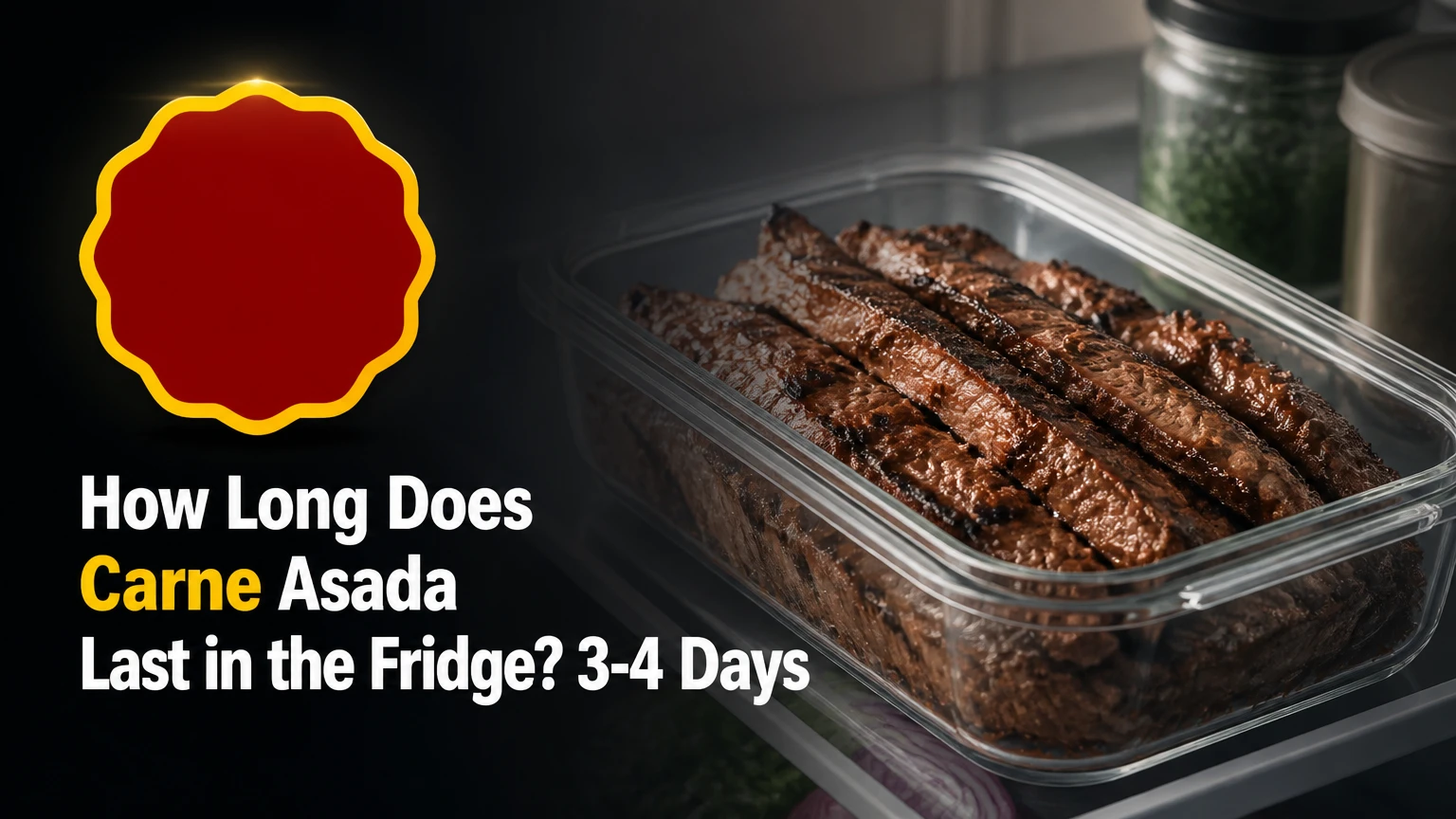
Cooked carne asada lasts 3-4 days in a refrigerator kept at 40°F or below, provided it was chilled within 2 hours and stored in a sealed container. Raw beef for carne asada generally lasts 1-2 days refrigerated, whether or not it is marinated. If the meat sat out too long, smells abnormal, or feels slimy, discard it rather than tasting it.
Key Facts at a Glance
Cooked carne asada should be eaten within 3-4 days when refrigerated at 40°F or below.
Raw flank or skirt steak should be cooked within 1-2 days of refrigeration.
Citrus marinade does not extend the safe storage period for raw beef.
Perishable leftovers should be refrigerated within 2 hours, or within 1 hour when temperatures exceed 90°F.
Frozen carne asada remains safest when used within 2-3 months for best quality, although continuously frozen food remains safe indefinitely at 0°F.
USDA recommends cooking whole beef steaks to 145°F and resting them for 3 minutes.
How Long Does Carne Asada Last in the Fridge?
Cooked carne asada lasts 3-4 days in a refrigerator maintained at 40°F or below. The count begins when the meat was cooked, not when the container was placed into the refrigerator, so leftovers prepared on Monday should normally be finished by Thursday or Friday.
The 3-4-day rule comes from the United States Department of Agriculture guidance for cooked meat and poultry leftovers. Refrigeration slows bacterial multiplication, but it does not sterilize food or stop all growth. A refrigerator door display can also be inaccurate, so an appliance thermometer provides a more reliable check.
| Carne asada condition | Refrigerator limit | Required condition |
|---|---|---|
| Cooked leftovers | 3-4 days | Refrigerated within 2 hours |
| Raw, unmarinated steak | 1-2 days | Refrigerator at 40°F or below |
| Raw, marinated steak | 1-2 days | Covered and kept cold |
| Partially cooked beef | Discard or cook immediately | Do not store as finished food |
| Frozen cooked leftovers | Best quality within 2-3 months | Freezer at 0°F or below |
The safest practical rule is simple: label the container with the cooking date, then use or freeze the meat by day four. Freezing after the safe refrigeration period does not reverse bacterial growth.
How Long Does Raw Carne Asada Last?
Raw carne asada beef lasts 1-2 days in the refrigerator, whether the steak is plain, seasoned, or sitting in a citrus-based marinade. Flank steak, skirt steak, flap meat, and other beef cuts should remain covered, leakproof, and separated from ready-to-eat foods during that period.
USDA guidance treats raw beef steaks as a short-term refrigerator item. A marinade changes flavor and texture, but it does not create a new preservation category. If raw steak has already spent two days refrigerated, cooking it on the third day is outside the standard recommendation.
| Raw beef preparation | Safe planning window | Best handling method |
|---|---|---|
| Plain flank steak | 1-2 days | Keep in original package or sealed tray |
| Plain skirt steak | 1-2 days | Store on the lowest refrigerator shelf |
| Dry-rubbed steak | 1-2 days | Cover tightly and prevent leakage |
| Lime-marinated steak | 1-2 days | Use a covered glass or food-safe container |
| Thawed steak from frozen | 1-2 days after thawing | Thaw in the refrigerator |
A package date is not a substitute for temperature control. “Sell by” dates help stores manage inventory, while the time in your refrigerator depends on when the beef was purchased, opened, thawed, and exposed to unsafe temperatures.
Does Lime Marinade Extend Carne Asada’s Shelf Life?
Lime, lemon, vinegar, garlic, and cilantro marinade does not safely extend carne asada’s refrigerator life. Acid can change surface proteins and suppress some organisms temporarily, but the marinade cannot replace refrigeration, reduce all pathogens to a safe level, or convert raw beef into a shelf-stable food.
Acid also affects quality. Thin skirt or flank steak can become soft, chalky, or mushy when left in strong citrus marinade for too long. Many recipes produce better texture after roughly 2-12 hours of marination, although a less acidic mixture may tolerate longer preparation.
Marinade timing versus storage safety
| Preparation choice | Typical result | Safety interpretation |
|---|---|---|
| 30 minutes in citrus marinade | Light surface flavor | Still raw beef, use within 1-2 days |
| 2-12 hours in marinade | Strong flavor and tender surface | Refrigerate continuously |
| 12-24 hours in strong lime marinade | Deeper acidic flavor | Safe only if continuously cold, texture may decline |
| More than 24 hours in strong acid | Soft or grainy surface | Do not treat as preserved meat |
| Room-temperature marination | Uneven warming | Unsafe practice, discard if time exceeds limits |
Marinate beef in the refrigerator, never on the counter. If marinade touched raw beef, do not use it as a finishing sauce unless it is brought to a full boil first; using a separate portion for serving is safer and easier.
What Temperature Keeps Carne Asada Safe?
A refrigerator must remain at 40°F or below, and a freezer must remain at 0°F or below, according to USDA food-safety guidance. The commonly cited 34-40°F range is narrower than necessary, but 40°F is the upper safety boundary rather than a target for every shelf.
Cold air distribution varies inside an appliance. The back of a lower shelf is often colder than the door, while frequent opening, overpacking, or a failing seal can raise temperatures. Place an inexpensive appliance thermometer inside the refrigerator and verify it after several hours.
| Temperature reading | Meaning | Action for carne asada |
|---|---|---|
| 34-38°F | Strong refrigerator control | Store normally |
| 39-40°F | At the safe upper boundary | Use the standard timeframe |
| 41-49°F | Above the recommended limit | Assess exposure time conservatively |
| Above 90°F ambient | Faster bacterial growth risk | Apply the 1-hour counter limit |
| 0°F freezer | Safe long-term frozen storage | Package against freezer burn |
Temperature matters more than the marinade, container brand, or amount of garlic. A sealed container in a warm refrigerator is still unsafe.
How Should Carne Asada Be Cooled and Packed?
Cool cooked carne asada in shallow portions and refrigerate it within 2 hours of cooking, or within 1 hour when the surrounding temperature is above 90°F. The best routine is to divide large amounts into shallow containers, leave enough space for cooling, and seal them once chilled or securely covered during refrigeration.
Do not place a very deep, steaming pile of meat into one large container. The center can remain warm while the surface cools, creating a slow-cooling pocket. Small portions cool faster and make later reheating easier.
Safe storage steps
- Record the cooking time. Write the date on the container before storing it.
- Divide large portions. Spread sliced carne asada into shallow containers no deeper than about 2 inches.
- Refrigerate promptly. Put the portions into a refrigerator within the two-hour limit.
- Prevent drips. Keep raw beef on the lowest shelf in a leakproof tray.
- Seal the food. Use a tight lid, food-safe wrap, or a freezer bag with excess air pressed out.
- Use a first-in, first-out order. Eat older portions before newly prepared food.
- Freeze surplus early. Freeze portions on day one or two rather than waiting until the fourth day.
The container does not need to be expensive. A clean, intact, food-safe vessel that prevents leakage and limits air exposure is sufficient for the refrigerator timeframe.
Which Storage Method Fits the Situation?
Airtight glass containers are the most practical choice for refrigerator leftovers because they resist staining, contain strong marinade odors, and support portion control. Plastic containers are lighter, while freezer bags save space and work well for flat portions, but none of these options extends the USDA 3-4-day limit.
Vacuum sealing removes air and helps prevent freezer burn. It does not make refrigerated cooked beef safe for 14 days at home. Low-oxygen packaging can create special hazards if temperature control fails, so vacuum-sealed leftovers still need prompt refrigeration and the same conservative storage schedule.
| Storage method | Typical cost | Best use | Main limitation |
|---|---|---|---|
| Glass container with lid | $4-$12 each | Refrigerator meal portions | Heavy and breakable |
| BPA-free plastic container | $1-$5 each | Lunches and transport | Can stain or retain odor |
| Resealable freezer bag | $0.10-$0.40 each | Flat freezer portions | Can puncture or leak |
| Vacuum-seal bag | $0.30-$1.00 each | Freezing with less air | Requires a sealing machine |
| Original butcher or retail wrap | Included with purchase | Raw beef for 1-2 days | Often leaks after opening |
Expert rule of thumb: choose packaging based on the next use, not on a promise of extra refrigerator days. Flat bags freeze and thaw quickly; rigid containers protect sliced meat during transport.
How Long Can Carne Asada Sit Out?
Carne asada can remain at room temperature for no more than 2 hours, or 1 hour when the air temperature is above 90°F. The same limits apply to raw beef, cooked leftovers, tacos, burrito fillings, and other perishable foods containing the meat.
The food-safety “danger zone” is commonly defined as 40-140°F. Meat held in that range supports faster bacterial growth, and reheating may not eliminate toxins produced during prolonged abuse. When the time is uncertain, discard the meat.
| Situation | Maximum unrefrigerated time | Decision |
|---|---|---|
| Indoor room near 70°F | 2 hours | Refrigerate or discard |
| Outdoor gathering at 85°F | 2 hours | Protect from heat and refrigerate |
| Outdoor temperature above 90°F | 1 hour | Refrigerate immediately or discard |
| Insulated cooler at 40°F or below | Not counted as room-temperature time | Monitor with a thermometer |
| Chafing dish at 140°F or above | Hold hot, within equipment limits | Serve promptly and cool leftovers |
For parties, place small serving dishes out in rotation instead of exposing the entire batch. Keep hot meat at 140°F or above, or keep cold portions at 40°F or below.
Can Carne Asada Be Frozen?
Carne asada can be frozen safely when it is packaged promptly and the freezer stays at 0°F or below. Cooked leftovers retain their best texture for about 2-3 months, while raw marinated steak is also best used within a few months because citrus and ice crystals gradually damage the surface.
Freezer time is mainly a quality limit. Food held continuously at 0°F remains safe indefinitely, but flavor, moisture, and texture decline as storage continues. Freeze in meal-sized portions, remove excess air, and label the package with the freeze date.
| Frozen item | Best-quality window | Packaging recommendation |
|---|---|---|
| Cooked sliced carne asada | 2-3 months | Flat freezer bag or vacuum-sealed pouch |
| Cooked whole steak | 2-3 months | Double wrap, then place in freezer bag |
| Raw unmarinated steak | 6-12 months | Original wrap plus freezer overwrap |
| Raw marinated steak | 1-3 months | Leakproof freezer bag |
| Thawed cooked leftovers | 3-4 refrigerator days | Reheat once and serve |
Thaw carne asada in the refrigerator, in cold water changed every 30 minutes, or in a microwave followed by immediate cooking or reheating. Never thaw meat on the counter.
How Do You Reheat Carne Asada Safely?
Reheat refrigerated carne asada until the thickest portion reaches 165°F, the USDA recommendation for reheated leftovers. Thin slices dry quickly, so add a tablespoon of water or broth per serving, cover the food, and heat only the portion needed for that meal.
A skillet gives the best texture for sliced steak. Use medium heat, cover briefly, and turn the slices once they are hot. Microwave reheating is faster but can create cold spots, so arrange the pieces evenly, cover them, stir or turn halfway through, and check several locations.
| Reheating method | Typical serving time | Technique | Best result |
|---|---|---|---|
| Covered skillet | 3-6 minutes | Medium heat, 1 tablespoon liquid | Better browning and moisture |
| Microwave | 60-120 seconds | Covered, turn halfway | Fastest single serving |
| Oven | 10-15 minutes | Covered at 300°F | Useful for several portions |
| Air fryer | 3-5 minutes | 300-325°F, avoid overcooking | Crisp edges, drier surface |
Do not repeatedly warm and cool the entire batch. Portioning before storage reduces both food waste and temperature abuse.
How Can You Tell if Carne Asada Is Bad?
Spoiled carne asada may develop a sour, ammonia-like, rancid, or putrid odor, a sticky or slimy surface, and unusual green, yellow, or gray discoloration. These signs justify disposal, but the absence of an odor or visible defect does not prove that meat is safe.
Do not taste carne asada to test it. Pathogenic bacteria can be present without producing a noticeable smell, color change, or texture change. Time, temperature, and handling history are more dependable safety criteria than a sensory inspection.
| Observation | Possible explanation | Safe response |
|---|---|---|
| Brown raw steak surface | Reduced oxygen and metmyoglobin | Assess time, smell, and texture |
| Gray or green patches with slime | Spoilage activity | Discard |
| Sour or ammonia-like odor | Microbial spoilage | Discard |
| Dry dark freezer patches | Freezer burn | Trim for quality if continuously frozen |
| Normal smell after six days | No guarantee of safety | Discard beyond the timeframe |
Raw beef can turn brown inside a sealed package because oxygen availability changes the myoglobin pigment. Brown alone is not conclusive, but brown combined with slime, leakage, or an unpleasant smell is a strong discard signal.
What Changes for Meal Prep and Parties?
Meal-prep carne asada should be divided into portions, refrigerated within 2 hours, and scheduled for consumption during the next 3-4 days. Freeze any servings that will not be eaten by the fourth day, preferably on the first or second day when quality remains higher.
For a party, estimate smaller serving quantities and replenish the table from a covered, temperature-controlled reserve. A large tray left at room temperature can pass the safety limit while the food still looks and smells normal.
Three practical scenarios
- Two-day meal prep: Refrigerate two portions and freeze the rest immediately. Thaw frozen portions in the refrigerator before reheating.
- Late dinner cleanup: If cooked meat has been out for 90 minutes indoors, refrigerate it now in shallow containers. If the same meat sat out for three hours, discard it.
- Long drive home: Carry leftovers in an insulated cooler with ice packs and keep the food at 40°F or below. The cooler must be cold, not merely closed.
The most common planning error is counting four days from the storage date rather than from the cooking date. Labeling prevents that mistake.
What If Someone Eating It Is High Risk?
Pregnant people, adults over 65, young children, and people with weakened immune systems should receive more conservative food handling and fully reheated leftovers. For these diners, avoid questionable meat, uncertain refrigeration histories, and undercooked beef.
The Food and Drug Administration identifies these groups as more vulnerable to severe foodborne illness. Cook whole beef steaks to at least 145°F and rest them for 3 minutes, then reheat leftovers to 165°F.
Medium-rare carne asada may be a culinary preference, but 130-135°F is below the USDA minimum for whole beef steaks. A thermometer is more reliable than judging doneness by color, especially with thin cuts that cook quickly.
Common Storage Mistakes and Their Fixes
| Mistake | Why it fails | Corrective action |
|---|---|---|
| Leaving meat out while cleaning | Time accumulates in the danger zone | Refrigerate within 2 hours |
| Storing a deep hot pile | The center cools slowly | Divide into shallow portions |
| Trusting the refrigerator dial | Displays may not show shelf temperature | Use an appliance thermometer |
| Treating lime as preservation | Acid does not replace temperature control | Apply the raw-beef timeframe |
| Sealing questionable leftovers | Packaging cannot restore safety | Discard the food |
| Reheating the whole batch repeatedly | Repeated warming increases handling risk | Heat one serving at a time |
A practical professional rule is to treat uncertain time as elapsed time. If a dish was served at noon and returned to the refrigerator at an unknown time, do not assume the shortest possible exposure.
Frequently Asked Questions
Can I eat carne asada after five days in the refrigerator?
USDA guidance limits cooked meat leftovers to 3-4 refrigerated days at 40°F or below. Carne asada stored for five days should be discarded, even if the appearance and smell seem normal, because harmful bacteria may not create obvious sensory warning signs.
Is carne asada safe if it was refrigerated while still warm?
Carne asada can be refrigerated while warm when divided into shallow portions and placed in the refrigerator within 2 hours. Do not leave it on the counter to cool completely. A deep, tightly packed container can cool slowly, so portioning is the safer approach.
Can I cook marinated carne asada after two days?
Raw marinated carne asada should be cooked within 1-2 refrigerated days. Cooking it after two days is only within the standard window if the beef stayed at 40°F or below and was handled cleanly. Citrus marinade does not provide extra storage time.
Can I refreeze thawed carne asada?
Carne asada thawed in the refrigerator can be refrozen, although texture may decline because of moisture loss. Meat thawed in cold water or a microwave should be cooked before refreezing. Never refreeze beef that thawed on the counter or warmed above safe limits.
How long does carne asada last in the fridge after thawing?
Raw carne asada thawed in the refrigerator generally lasts another 1-2 days before cooking. Cooked carne asada made from that thawed beef then follows the separate 3-4-day leftover timeframe, assuming prompt cooling and a refrigerator at 40°F or below.
Should I throw away carne asada that smells normal?
Carne asada should be discarded when it exceeds the safe storage timeframe, even if it smells normal. Odor, slime, and discoloration can identify some spoilage, but sensory checks cannot detect every pathogen. Time and temperature history provide the safer decision.
The Bottom Line
How long does carne asada last in the fridge? Cooked carne asada lasts 3-4 days at 40°F or below, while raw carne asada lasts 1-2 days. Refrigerate it within 2 hours, keep raw beef below ready-to-eat food, and freeze portions that will miss the deadline. When the time or temperature history is uncertain, discard the meat.