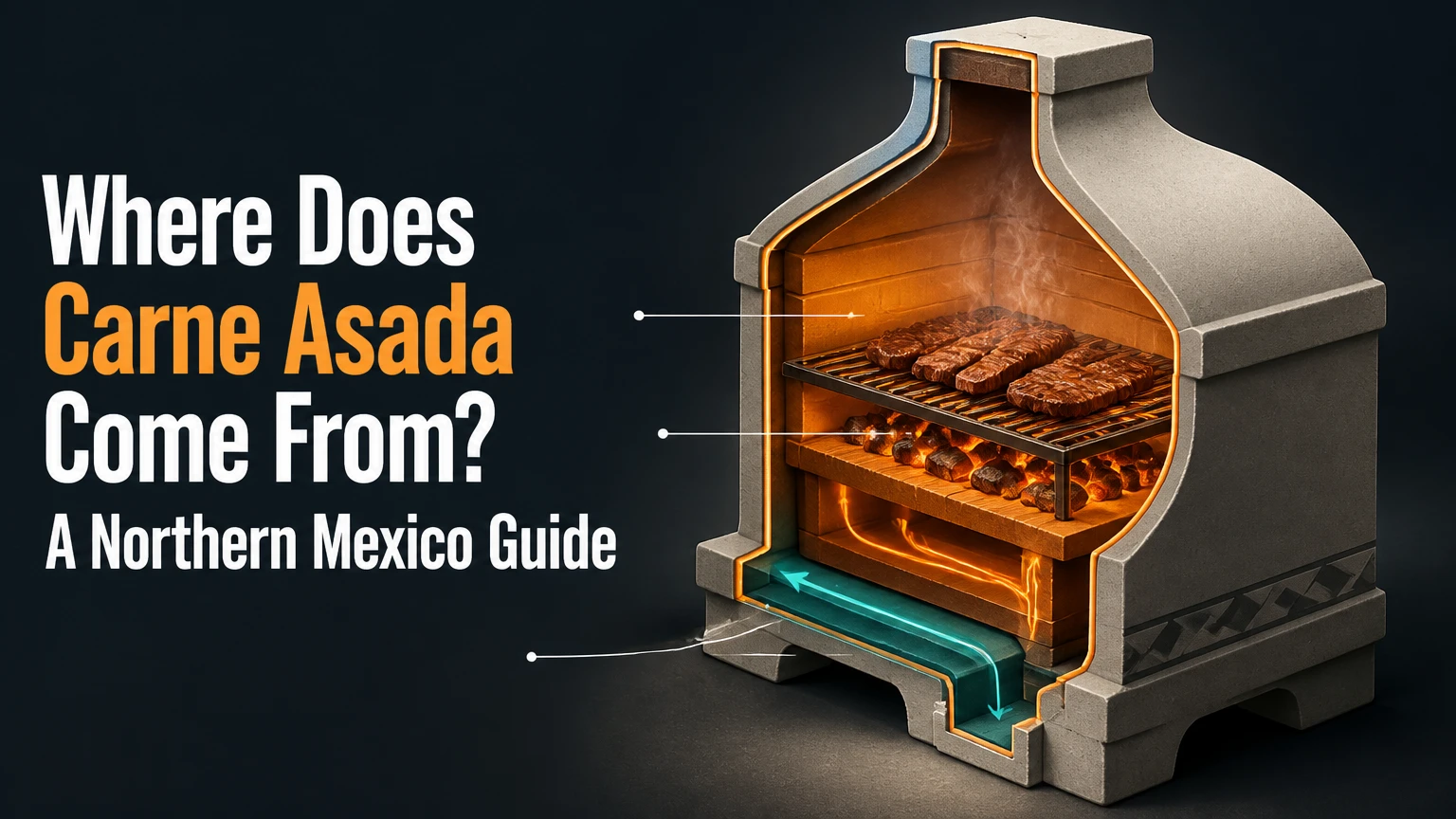
Carne asada comes from northern Mexico, especially Sonora, Nuevo León, Coahuila, and Chihuahua, where Spanish-introduced cattle and semi-arid ranching shaped a strong grilled-beef tradition. The phrase means “grilled” or “roasted meat,” but carne asada also describes the communal gathering built around cooking beef over intense direct heat.
What Does Carne Asada Mean?
Carne asada means beef cooked by grilling or roasting over direct heat. Merriam-Webster translates the culinary phrase as “grilled beef,” while Spanish usage allows asada to describe meat cooked over fire rather than one fixed recipe.
Modern carne asada usually involves a thin, relatively quick-cooking cut such as skirt steak, flank steak, flap meat, or thin top sirloin. The beef may receive only salt, or it may be seasoned with citrus, garlic, pepper, herbs, and other local ingredients before grilling.
The phrase therefore has two related meanings:
- A cooking method: beef grilled over direct heat.
- A social event: friends or relatives gathering around a grill, serving tortillas, salsa, onions, and other accompaniments.
Carne asada is not one nationally standardized recipe. A Sonoran cook may favor simple seasoning and flour tortillas, while a family in Southern California may use a more acidic marinade and serve the beef in tacos. Both can reasonably call the result carne asada.
Key Facts at a Glance
- Carne asada originated in northern Mexico, with Sonora often receiving particular recognition for its beef-grilling culture.
- Spanish cattle arrived in Mexico during the 16th century and helped establish northern ranching economies.
- The term carne asada literally refers to grilled or roasted meat, not a single mandatory marinade.
- Skirt steak, flank steak, flap meat, and thin sirloin are common choices, but regional practice varies.
- Carne asada is both a dish and a social gathering, especially in northern Mexico and the American Southwest.
- Correct slicing against the grain affects tenderness more reliably than adding extra marinade.
Where Does Carne Asada Come From?
Carne asada comes from northern Mexico, where cattle ranching, open-fire cooking, and borderland exchange developed together. Sonora, Nuevo León, Coahuila, and Chihuahua are central to the tradition, although neighboring states and communities across the United States have created their own versions.
No surviving document identifies one person, town, or restaurant as the inventor of carne asada. The more defensible explanation is gradual development: cattle arrived with Spanish colonization, herding expanded in northern Mexico, and ranch cooks adapted available beef to wood or charcoal fires.
The northern environment mattered. Large distances, dry grasslands, ranch work, and limited refrigeration favored durable livestock and straightforward fire cooking. Thinly cut beef also cooked quickly, which made it practical for ranch households and gatherings.
A Brief Historical Timeline
| Period | Development | Geographic importance | Culinary consequence |
|---|---|---|---|
| 1500s | Spanish cattle enter New Spain | Northern missions and ranches gain livestock | Beef becomes more available |
| 1600s-1700s | Ranching expands across frontier zones | Sonora and Chihuahua support cattle production | Open-fire beef cooking becomes practical |
| 1800s | Trade and migration connect northern Mexico with Texas and New Mexico | Border cuisines exchange techniques | Grilled beef traditions overlap |
| Early 1900s | Urban markets distribute butchered beef | Monterrey and other cities develop strong meat cultures | Cuts become more specialized |
| Late 1900s | Mexican restaurants and taquerias popularize the dish | California, Arizona, and Texas become major audiences | Marinades and taco formats diversify |
| 2000s-present | Carne asada becomes globally recognizable | Restaurants and home cooks reinterpret it | The name covers many regional preparations |
The timeline does not prove a single birthplace. It shows why northern Mexico is the strongest historical answer while recognizing that culinary traditions rarely follow modern state borders.
How Did Northern Mexico Shape Carne Asada?
Northern Mexico shaped carne asada through cattle availability, ranch labor, wood-fire cooking, and cross-border food exchange. The region’s beef tradition grew from practical conditions rather than from a recipe designed in one commercial kitchen.
Sonora is especially associated with mesquite grilling and high-quality beef. Monterrey, in Nuevo León, has a powerful meat-centered identity connected with northern ranching and large outdoor gatherings. Coahuila and Chihuahua also contribute cattle, fire-cooking practices, and local serving customs.
The American Southwest continued this development. Mexican and Mexican American communities in California, Arizona, New Mexico, and Texas adapted carne asada to local butcher shops, tortillas, restaurant kitchens, and taco stands. Contemporary American versions are therefore related to northern Mexican traditions, not separate inventions with no historical connection.
Regional Expressions of Carne Asada
| Region | Common beef approach | Typical seasoning profile | Common accompaniment |
|---|---|---|---|
| Sonora | Thin skirt, flap, or sirloin | Salt, pepper, garlic, citrus, or minimal seasoning | Flour tortillas, grilled green onions |
| Nuevo León | Thick or thin beef cuts | Salt-forward seasoning with regional salsa | Tortillas, onions, roasted peppers |
| Coahuila | Ranch-style grilled beef | Garlic, pepper, herbs, occasional acidic marinade | Salsa, beans, tortillas |
| Chihuahua | Beef from cattle-producing areas | Simple rubs or family marinades | Corn or flour tortillas, chile salsa |
| Northern Mexico broadly | Skirt, flank, flap, or sirloin | Method varies by household | Cebollitas, radishes, guacamole |
| U.S. Southwest | Thin marinated steak | Citrus, garlic, chile, cumin, pepper | Tacos, pico de gallo, avocado |
Regional labels are useful but not absolute. A family recipe can cross state lines, and restaurant menus often combine several northern and central Mexican influences.
How Is Carne Asada Traditionally Cooked?
Traditional carne asada is cooked quickly over very hot direct heat, usually from charcoal or wood. The cook seasons or marinates relatively thin beef, places it close to the heat, turns it once or more depending on thickness, rests it briefly, and slices it across the muscle grain.
A hot grate creates browning through the Maillard reaction, a group of chemical reactions between amino acids and reducing sugars. Surface temperatures above roughly 300°F can brown food, while a grill producing approximately 450-650°F at the cooking surface can sear thin steak effectively.
Practical Cooking Targets
| Beef thickness | Heat level | Approximate cooking time | Pull temperature |
|---|---|---|---|
| 1/4 inch | 500-650°F direct heat | 60-120 seconds per side | 125-135°F |
| 1/2 inch | 450-600°F direct heat | 2-3 minutes per side | 125-140°F |
| 3/4 inch | 425-550°F direct heat | 3-5 minutes per side | 130-145°F |
| 1 inch | 400-500°F direct heat | 4-6 minutes per side | 130-150°F |
| Uneven flap steak | 400-550°F, two-zone fire | 3-7 minutes per side | 130-145°F |
The listed temperatures are practical targets for medium-rare through medium beef, not historical requirements. Food safety guidance from the United States Department of Agriculture recommends 145°F for whole cuts of beef followed by a three-minute rest. Cooks using lower temperatures accept a different safety and texture trade-off.
Patting marinated beef dry improves browning, but it does not make the meat safer or automatically more tender. A wet surface must first evaporate water, which delays crust formation and can produce gray, steamed edges.
Expert Insight: Slicing Often Matters More Than Marinating
A well-marinated steak can remain chewy if the knife follows its muscle fibers. Cutting perpendicular to the grain shortens those fibers, reducing the distance teeth must break down during chewing.
Look for the long visible lines in the cooked steak. Rotate the meat so the knife crosses those lines at approximately 90 degrees, then cut slices 1/8- to 1/4-inch thick. Thin diagonal cuts increase surface area, but the direction across the grain matters more than the angle.
Which Cut Works Best for Carne Asada?
Outside skirt steak provides the richest beef flavor and marbling, while flap meat offers excellent marinade absorption and flank steak gives uniform slices. The best cut depends on budget, availability, cooking control, and whether the beef will be served alone or inside tacos.
| Cut | Typical thickness | Texture and flavor | Best use | Main limitation |
|---|---|---|---|---|
| Outside skirt | 1/4-1/2 inch | Rich, beefy, well marbled | Purist grilling and tacos | Often expensive and difficult to source |
| Inside skirt | 1/4-1/2 inch | Strong flavor, firmer texture | Large gatherings | Needs careful cooking and slicing |
| Flank steak | 1/2-1 inch | Lean, uniform, pronounced grain | Neat slices and plated meals | Dries quickly when overcooked |
| Flap meat | 1/2-1 inch | Open grain, juicy, marinade-friendly | Tacos and family gatherings | Uneven thickness complicates timing |
| Top sirloin | 1/2-1 inch | Leaner, mild, accessible | Budget-conscious grilling | Less connective texture and marbling |
| Thin chuck steak | 1/4-1/2 inch | Beefy, variable tenderness | Low-cost preparations | Requires close attention to grain |
Outside skirt comes from the plate section and has a loose, highly flavorful structure. Inside skirt is similar in shape but can be less tender. Flank steak has a clearly visible grain, making slicing technique especially important.
Flap meat is sometimes associated with vacio in South American contexts, but butcher terminology varies by country and market. A butcher should confirm the exact cut rather than relying on the name alone.
What Cut Should a First-Time Cook Buy?
A first-time cook should choose flap meat or a 1/2-inch inside skirt steak if available. Both offer strong beef flavor, cook rapidly, and work well in tacos, while flap meat is more forgiving when a marinade is used.
Choose flank steak when uniform presentation matters. Choose outside skirt when flavor is the priority and the price is acceptable. Avoid very thin pre-sliced beef if the grill runs extremely hot, because the meat can pass from browned to dry in less than two minutes.
Does Carne Asada Require a Marinade?
Carne asada does not require a marinade. Salt, high heat, and proper slicing can produce excellent grilled beef, while a marinade adds flavor and can modestly improve the surface texture of lean or firm cuts.
A practical marinade usually combines an acidic ingredient, oil, aromatics, chile, and salt. Citrus juice contributes flavor but does not deeply tenderize a thick steak; the acid acts mainly near the surface and can make the exterior soft if exposure lasts too long.
For skirt or flap steak, marinating for 2-8 hours is a typical home-cooking window. Twelve hours is a reasonable upper limit for many acidic mixtures, but the ideal duration depends on acidity, salt concentration, cut thickness, and the presence of tenderizing enzymes.
Use a dry seasoning when the beef has excellent marbling or when a pronounced seared crust matters more than marinade flavor. Salt the steak 30-60 minutes before grilling, or season immediately before it reaches the grate.
Common Seasoning Approaches
| Style | Main ingredients | Typical time | Best result |
|---|---|---|---|
| Salt-forward | Kosher salt, black pepper | 30-60 minutes | Beef flavor and strong crust |
| Citrus-garlic | Lime or orange juice, garlic, oil, pepper | 2-8 hours | Bright taco filling |
| Chile-herb | Dried chile, oregano, garlic, salt | 2-8 hours | Spiced northern-style variation |
| Minimal ranch style | Salt, pepper, optional garlic | 0-60 minutes | Clean flavor over mesquite |
| Wet commercial marinade | Acid, oil, spices, sweetener | 1-6 hours | Consistent large-batch seasoning |
Never reuse raw-beef marinade as a sauce unless it is boiled thoroughly. Better practice is to reserve a clean portion before adding the meat.
Is Carne Asada Always Served in Tacos?
Carne asada is not always served in tacos. Grilled beef may be sliced onto a plate, folded into tortillas, placed over rice or beans, or served with grilled onions, salsa, and vegetables at a communal gathering.
Tacos are the most internationally familiar format because thin slices fit easily into corn or flour tortillas. The taco itself does not define the dish’s origin, however. The defining elements are grilled beef, direct heat, seasoning, and the surrounding meal tradition.
Common accompaniments include:
- Corn or flour tortillas
- Salsa roja, salsa verde, or fresh tomato salsa
- Grilled scallions, often called cebollitas
- Radishes, cucumber, or lime
- Guacamole or sliced avocado
- Refried or stewed beans
- Rice and grilled peppers
Sonoran food culture is strongly associated with flour tortillas, while corn tortillas remain widespread across Mexico. Neither tortilla type makes carne asada more authentic by itself.
Planning Quantities and Typical Costs
| Gathering type | Raw beef per person | Beef for 10 people | Typical U.S. retail range |
|---|---|---|---|
| Taco meal with beans and sides | 6-8 ounces | 3.75-5 pounds | $8-$22 per pound |
| Meat-forward gathering | 10-12 ounces | 6.25-7.5 pounds | $50-$165 total |
| Children and light eaters included | 4-6 ounces | 2.5-3.75 pounds | $20-$83 total |
| Leftovers planned | 12-16 ounces | 7.5-10 pounds | $60-$220 total |
These are typical planning ranges, not fixed market prices. Outside skirt and premium beef can exceed the upper range, while top sirloin or thin chuck can cost less.
What Is the Difference Between Carne Asada and Asado?
Carne asada is a Mexican grilled-beef tradition centered on thin, quickly cooked meat, while asado is a broader Spanish and South American term for roasted or grilled meat and the gathering around it. The words overlap, but they do not identify identical methods.
Argentine and Uruguayan asado commonly feature larger portions, slower cooking, and cuts such as short ribs or other bone-in beef. Mexican carne asada more often uses thin steaks cooked directly over intense heat and sliced for tortillas.
| Feature | Carne asada | Argentine or Uruguayan asado | American barbecue |
|---|---|---|---|
| Core region | Northern Mexico and Southwest | Argentina and Uruguay | United States |
| Common cut size | 1/4-1 inch steaks | Large cuts or ribs | Ribs, shoulder, brisket, steaks |
| Heat pattern | Direct, high heat | Low to moderate, often extended | Low smoke or direct grilling |
| Typical duration | 2-15 minutes | 1-4 hours for large cuts | 30 minutes to 16 hours |
| Serving format | Tacos, plates, tortillas | Platter, bread, salads | Plates, sandwiches, sides |
| Main texture goal | Seared exterior, sliceable center | Tender, slowly cooked meat | Smoke-developed tenderness or crust |
The comparison is about dominant practice, not strict rules. Northern Mexican cooks may grill larger cuts, and South American cooks may sear smaller steaks.
Can Carne Asada Be Made Indoors?
Carne asada can be made indoors with a cast-iron skillet, broiler, or electric grill, although indoor cooking lacks the smoke and live-fire character of charcoal. The most reliable substitute is a very hot cast-iron pan paired with a dry surface and adequate ventilation.
Heat the skillet for 5-8 minutes, add a thin film of high-heat cooking oil, and cook a 1/2-inch steak for approximately 2-3 minutes per side. A broiler can work for 1/2- to 3/4-inch cuts placed close to the heat, but the timing varies sharply by appliance.
An indoor method is not inferior for every situation. It gives better control in cold weather, reduces flare-ups, and makes temperature monitoring easier. It is less suitable when the goal is pronounced wood smoke or cooking for a large crowd.
Indoor Method Comparison
| Method | Preheat time | Typical steak time | Smoke level | Best situation |
|---|---|---|---|---|
| Cast-iron skillet | 5-8 minutes | 4-6 minutes total | Medium-high | One or two steaks |
| Broiler | 5 minutes | 5-10 minutes total | Medium | Fast cooking without a pan |
| Electric grill | 5-10 minutes | 6-10 minutes total | Low | Apartment cooking |
| Outdoor charcoal | 20-30 minutes | 4-8 minutes total | High | Traditional gathering |
Why Does Carne Asada Turn Out Tough?
Carne asada becomes tough when the cut is overcooked, the grain is followed during slicing, or the meat contains thick connective tissue that rapid grilling cannot soften. Marinade duration is a secondary factor, not a solution for every texture problem.
| Problem | Likely cause | Diagnostic clue | Correction |
|---|---|---|---|
| Rubbery slices | Cut with the grain | Fibers run lengthwise through each slice | Rotate and cut perpendicular |
| Dry center | Overcooking or very lean beef | Internal temperature exceeds target | Use thicker meat and a thermometer |
| Gray exterior | Wet surface or weak heat | Little browning after several minutes | Pat dry and preheat longer |
| Burned outside, raw inside | Steak too thick for direct heat | Dark crust with cool center | Use two-zone cooking |
| Mushy surface | Excessively acidic marinade | Exterior feels soft or pasty | Reduce time and acidity |
| Flare-ups | Dripping oil or fat | Flames contact the steak | Move beef to a cooler zone |
Expert Insight: Do Not Use Acidity as a Substitute for Heat Control
Lime juice can flavor the surface, but it cannot turn every tough cut into tender steak. A thin skirt steak benefits from rapid cooking, while a thick, connective-tissue-heavy cut may need a slower method designed for collagen conversion.
Expert Insight: Resting Has a Practical Limit
Resting for 5-8 minutes is usually enough for thin carne asada. A 1/4-inch steak does not need the 20-minute rest commonly recommended for a large roast, and excessive resting can cool the tortillas and reduce the pleasure of a freshly grilled meal.
Expert Insight: Charcoal Flavor Does Not Equal Authenticity
Charcoal or wood adds smoke and supports the northern grilling image, but a gas grill, skillet, or broiler can still produce carne asada. Authenticity comes from the culinary context and preparation, not from claiming that one fuel is mandatory.
What Is Carne Asada Not?
Carne asada is not a single protected recipe, a specific beef breed, or an automatic synonym for every Mexican beef dish. It is also not the same as carne guisada, which is stewed beef, or steak ranchero, which commonly includes beef cooked with a tomato-chile sauce.
The distinction matters when reading menus. “Carne asada” may describe grilled strips, taco filling, a plated steak, or an entire gathering. The surrounding ingredients reveal the local interpretation.
Carne asada is also not necessarily spicy. Heat level depends on the salsa, chile seasoning, and household preference. The beef can remain mild while the accompanying salsa supplies most of the heat.
Frequently Asked Questions
Is carne asada from Mexico or the United States?
Carne asada is rooted in Mexico, particularly northern Mexico, where cattle ranching and direct-fire beef cooking developed over several centuries. The American Southwest helped popularize and adapt the tradition, especially through Mexican American communities and taquerias, but that later expansion does not replace its Mexican origin.
Which Mexican state is most famous for carne asada?
Sonora is especially famous for carne asada because of its cattle-producing ranches, mesquite grilling traditions, beef quality, and flour-tortilla culture. Nuevo León, Coahuila, and Chihuahua also have strong carne asada traditions, so Sonora should be treated as a prominent regional center rather than the only valid birthplace.
Can chicken be called carne asada?
In ordinary Spanish, carne asada can refer broadly to grilled meat, but in Mexican restaurant usage the phrase usually means grilled beef. Chicken prepared on a grill is more clearly labeled pollo asado, while pork may receive a different regional name depending on its seasoning and cooking method.
What does carne asada taste like?
Carne asada tastes beefy, smoky, savory, and lightly charred, with additional flavors determined by the seasoning. Salt-only versions emphasize the meat and fire, while citrus-garlic marinades add acidity and aroma. Salsa, grilled onions, tortillas, and avocado can change the perceived flavor more than the marinade itself.
How long should carne asada rest?
Thin carne asada should rest for approximately 5-8 minutes after grilling. The rest gives surface juices time to redistribute without allowing the steak to become cold, and it provides enough time to warm tortillas or prepare the serving board.
What is the best way to reheat carne asada?
Reheat sliced carne asada briefly in a hot skillet with a teaspoon of water or cooking liquid, usually for 30-60 seconds. Long microwave heating dries thin slices quickly. Store leftovers chilled within two hours and use them within three to four days under standard food-safety guidance.
The Bottom Line
Carne asada comes from northern Mexico, especially the cattle-producing regions of Sonora, Nuevo León, Coahuila, and Chihuahua. Spanish cattle, frontier ranching, wood or charcoal fires, and communal meals produced the tradition over time rather than through one documented invention. The modern dish can be minimally seasoned or marinated, cooked outdoors or indoors, and served as tacos or a plated meal.
The most reliable preparation uses a suitable thin cut, high direct heat, a short rest, and slicing across the grain. Understanding that history explains why carne asada remains flexible: the phrase identifies a northern Mexican grilled-beef tradition, while each family, region, and restaurant gives the gathering its own details.