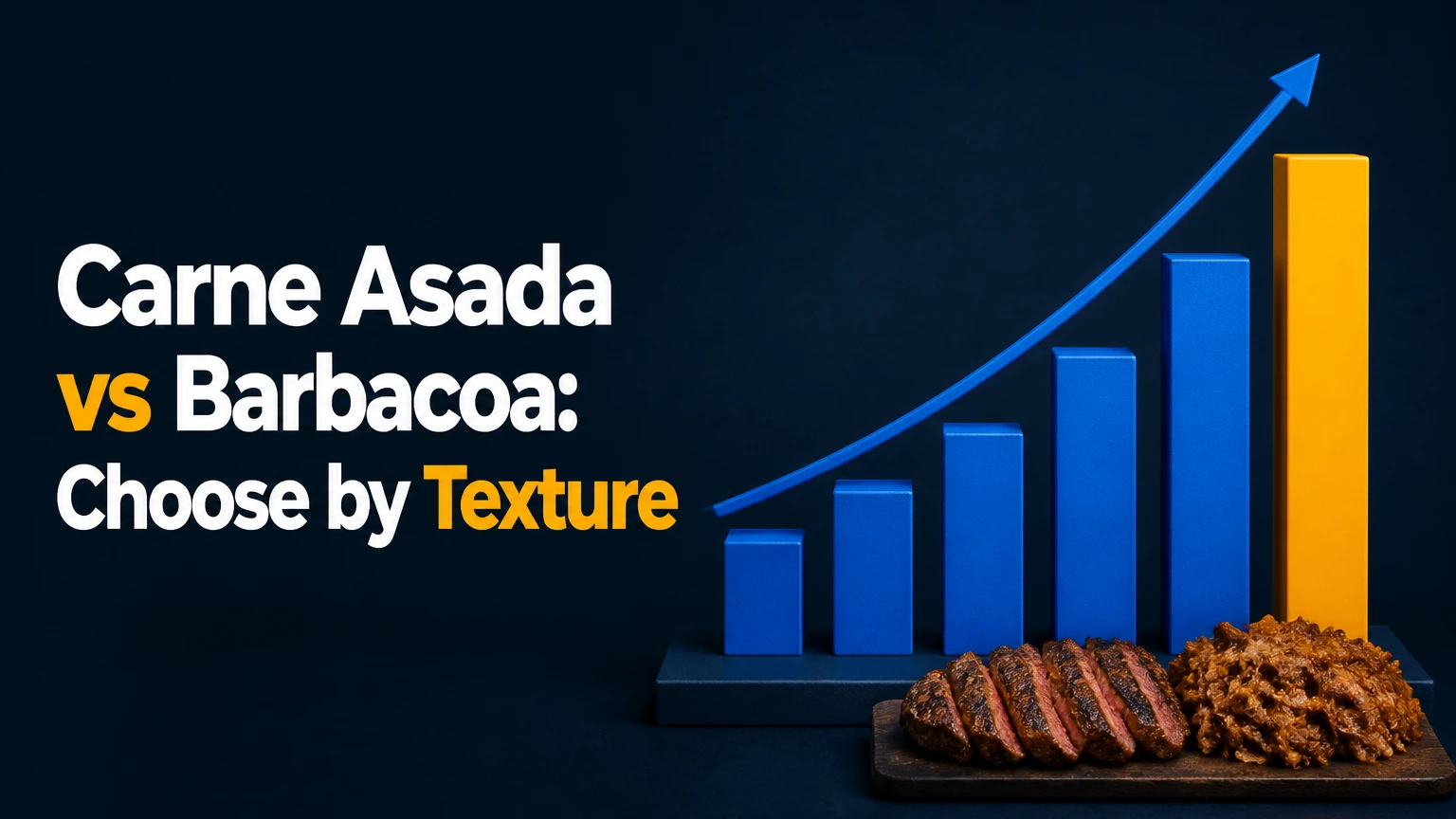
Carne asada is thin beef grilled quickly over high heat, while barbacoa is collagen-rich meat cooked slowly with moisture until it shreds. Choose carne asada for charred steak texture, speed, and live-fire flavor; choose barbacoa for deeply seasoned, juicy fibers, batch cooking, and cuts that need prolonged cooking.
Key Facts at a Glance
- Carne asada usually uses skirt steak, flank steak, flap meat, or another thin beef cut cooked over direct heat.
- Barbacoa may use beef cheeks, chuck, lamb shoulder, or goat, and the meat is traditionally cooked slowly in a covered, humid environment.
- A typical carne asada dinner takes 20-35 minutes of active and resting time, plus 2-4 hours of marinating.
- A typical barbacoa batch takes 6-10 hours in a slow cooker or covered oven, although pressure cooking can reduce the cooking stage substantially.
- Carne asada produces sliced pieces with charred edges; barbacoa produces moist strands with concentrated cooking juices.
- The best choice depends primarily on texture, available time, equipment, meat cut, and whether the meal is cooked to order or prepared in advance.
Carne Asada vs Barbacoa: What Is the Difference?
Carne asada means grilled or roasted meat, but in modern Mexican and Mexican American cooking it usually refers to marinated beef grilled over high heat and sliced thinly. Barbacoa describes a slow-cooked meat preparation whose defining feature is prolonged moist heat, traditionally associated with an underground pit, wrapped leaves, or another enclosed cooking environment.
The names describe different cooking systems. Carne asada depends on rapid browning and careful doneness control, while barbacoa depends on collagen breakdown and retained moisture. A skirt steak cooked slowly is no longer functioning as typical carne asada, and a chuck roast grilled briefly will not become conventional barbacoa.
| Attribute | Carne asada | Barbacoa |
|---|---|---|
| Core preparation | Marinated, grilled beef | Slow-cooked beef, lamb, or goat |
| Heat method | Direct heat, typically 450-550°F | Covered moist heat, typically 200-325°F oven setting |
| Common cuts | Skirt, flank, flap, sirloin | Beef cheek, chuck, lamb shoulder, goat |
| Texture | Sliced, springy, steak-like | Shredded, gelatinous, yielding |
| Main flavor | Char, smoke, citrus, garlic | Chiles, aromatics, broth, rendered fat |
| Typical home time | 2-4 hours marinade, 6-10 minutes grill | 6-10 hours braise or slow cooker |
| Best service style | Cooked to order | Batch-cooked and held in juices |
Which Flavor Profile Is Stronger?
Carne asada tastes more strongly of fire and browned beef, while barbacoa usually carries more chile, spice, broth, and rendered-fat flavor. Marinade ingredients can make carne asada bright and acidic, whereas barbacoa’s enclosed cooking liquid penetrates the exterior and concentrates during reduction.
Carne asada seasoning ranges from salt and black pepper to garlic, citrus, herbs, ground spices, and fruit-based marinades. The marinade adds surface flavor, but it does not deeply season a thick steak in a few hours. Barbacoa seasoning often includes dried chiles, garlic, cumin, oregano, cloves, vinegar, and stock, although regional recipes vary widely.
Which Texture Do You Get?
Carne asada gives a defined bite that can be tender or chewy depending on the cut, doneness, and slicing direction. Barbacoa gives loose, moist strands because extended heat converts connective-tissue collagen into gelatin.
Texture is the most reliable deciding factor. People who prefer a steak-like chew and crisp edges generally prefer carne asada. People who want meat that collapses under a fork, absorbs sauce, and stays moist during reheating generally prefer barbacoa.
Which Cuts and Meats Are Used?
Carne asada most often uses thin, relatively quick-cooking beef cuts, while barbacoa performs best with fatty, collagen-rich cuts that benefit from many hours of moist heat. The preparation determines the useful cut: grilling rewards thinness and surface area, while braising rewards connective tissue.
| Meat or cut | Best preparation | Typical portion yield | Main cooking concern |
|---|---|---|---|
| Skirt steak | Carne asada | 65-75% cooked yield | Overcooking causes chewiness |
| Flank steak | Carne asada | 70-80% cooked yield | Must be sliced across grain |
| Sirloin flap | Carne asada | 65-75% cooked yield | Can dry if too lean |
| Beef cheek | Barbacoa | 45-60% trimmed yield | Requires fat trimming and time |
| Chuck roast | Barbacoa | 55-70% cooked yield | Needs collagen conversion |
| Lamb shoulder | Barbacoa | 50-65% cooked yield | Strong flavor and rendered fat |
| Young goat | Barbacoa | 45-60% cooked yield | Smaller bones reduce usable meat |
Beef cheek contains abundant connective tissue and can become exceptionally soft after slow cooking, but its raw weight overstates the final serving yield because trimming and rendered fat remove part of the purchase. Chuck roast is easier to find and gives more predictable results in a home kitchen.
Traditional barbacoa may use sheep or goat rather than beef. Restaurant terminology in the United States often uses “barbacoa” for seasoned shredded beef, so the menu label alone does not identify the animal, cut, or cooking method.
How Do the Cooking Methods Differ?
Carne asada uses high heat to brown a thin surface quickly, while barbacoa uses sustained moist heat to dissolve collagen over several hours. The difference is chemical as well as procedural: browning develops roasted surface compounds, while collagen conversion creates gelatin and a lubricating mouthfeel.
| Cooking stage | Carne asada specification | Barbacoa specification |
|---|---|---|
| Preparation | Trim silver skin; pat dry | Trim excess surface fat; cut into 2-4 inch pieces |
| Seasoning time | 2-4 hours with acidic marinade | 15-30 minutes or overnight dry seasoning |
| Heat | Grill at 450-550°F | Covered oven at 275-325°F or slow cooker on low |
| Cooking duration | About 3-5 minutes per side | About 6-10 hours for chuck or cheek |
| Doneness target | 130-145°F depending preference | Fork-tender, commonly above 195°F internal |
| Finishing action | Rest 5-10 minutes; slice thinly | Skim fat; shred; moisten with reduced juices |
High heat does not “seal” juices inside meat. The United States Department of Agriculture recommends whole beef cuts reach 145°F with a three-minute rest, and ground beef reaches 160°F; a thermometer is more dependable than color or timing alone.
Barbacoa does not become tender at one universal temperature. Time, cut thickness, collagen content, moisture, and cooking vessel all matter. If a roast has reached a high internal temperature but still resists shredding, the practical fix is usually more covered cooking time, not immediate removal.
How Should You Cook Carne Asada?
Cook carne asada by marinating a 1/2 to 3/4-inch steak for 2-4 hours, grilling it over very high heat for roughly 3-5 minutes per side, resting it for 5-10 minutes, and slicing across the grain. The strongest results come from a dry surface, a fully heated grate, and a thermometer.
Step 1: Prepare the steak
Remove obvious silver skin and thick, hard seams of surface fat, then pat the steak dry. A typical 1 1/2-pound batch serves four to six people when used in tacos with beans, vegetables, or tortillas.
Step 2: Marinate briefly
Use citrus juice, garlic, oil, salt, and optional herbs or ground spices. Keep an acidic marinade to about 2-4 hours; extended exposure can soften the outer layer excessively, especially on a thin skirt steak.
Step 3: Heat the grill
Preheat gas burners or charcoal until the cooking surface reaches approximately 450-550°F. Clean and lightly oil the grate, then place the steak only after the fire produces strong radiant heat.
Step 4: Grill and check
Grill a thin steak for about 3-5 minutes per side, adjusting for thickness and heat. The surface should develop dark brown grill marks without black, bitter crusts, and the thickest section should be checked with an instant-read thermometer.
Step 5: Rest and slice
Rest the cooked steak for 5-10 minutes, then identify the grain and cut perpendicular to it into thin strips. Grain direction can change across a skirt steak, so rotate the meat during slicing rather than assuming one angle works for the entire piece.
You will know the method worked when the slices have browned edges, a moist center, and short muscle fibers that break easily while chewing. A common failure is slicing immediately after grilling, which releases hot juices onto the cutting board before the meat has had time to stabilize.
How Should You Cook Barbacoa?
Cook barbacoa by browning 3-5 pounds of beef cheek or chuck, covering it with seasoned chile broth, and cooking it until the meat shreds without resistance. A covered oven usually takes 6-10 hours at 275-325°F, while a slow cooker on low commonly takes 8-10 hours.
- Trim and portion the meat. Remove hard exterior fat and cut large pieces into manageable sections. Leave soft marbling because it contributes moisture and flavor during the long cook.
- Brown the pieces. Sear the meat in a heavy pot in batches. Browning adds roasted flavor, although barbacoa can still succeed without this step when time is limited.
- Build the seasoning liquid. Blend rehydrated dried chiles, garlic, vinegar, cumin, oregano, cloves, salt, and stock. Keep the liquid deep enough to cover roughly one-half to two-thirds of the meat.
- Cover and cook slowly. Use a tightly covered Dutch oven at 275-325°F, a slow cooker on low, or a pressure cooker according to its meat and poultry instructions.
- Test for collagen conversion. Insert a fork into the thickest piece and twist. The meat is ready when it separates easily; a roast that bends but does not pull apart needs more time.
- Shred and finish. Remove bones and large connective pieces, skim surface fat from the liquid, shred the meat, and return it to enough reduced juice to stay moist without becoming soupy.
A pressure cooker can shorten the cooking stage to roughly 60-90 minutes for many chuck-roast preparations, followed by natural pressure release and a tenderness check. Beef cheeks, large bone-in pieces, and crowded pots may require additional time.
What Equipment Works?
A grill is the natural tool for carne asada, while a Dutch oven, slow cooker, or pressure cooker suits barbacoa. A broiler can approximate direct grilling for carne asada, but a shallow pan cannot replace the enclosed moisture needed for a proper barbacoa texture.
| Equipment | Best dish | Typical active work | Typical total cook |
|---|---|---|---|
| Charcoal grill | Carne asada | 20-30 minutes | 30-45 minutes after marinade |
| Gas grill | Carne asada | 15-25 minutes | 25-40 minutes after marinade |
| Dutch oven | Barbacoa | 35-50 minutes | 6-10 hours |
| Slow cooker | Barbacoa | 25-40 minutes | 8-10 hours on low |
| Pressure cooker | Barbacoa | 35-50 minutes | 1.5-2.5 hours including release |
How Do Regional Styles Vary?
Regional carne asada varies from lightly seasoned Sonoran grilling to more elaborate marinades associated with other parts of Mexico, while barbacoa varies by animal, pit tradition, leaf wrapping, and regional chile blend. No single seasoning formula defines either dish across Mexico.
Sonoran-style carne asada often keeps the seasoning restrained so beef, salt, smoke, and char remain prominent. Other preparations may add citrus, garlic, cilantro, ground spices, and fruit juice. These variations change flavor without changing the central high-heat method.
Central Mexican barbacoa is strongly associated with lamb in many traditional contexts, while northern Mexican and Mexican American menus frequently feature beef barbacoa. Goat barbacoa has particular importance in northeastern regions, including Nuevo León and neighboring areas.
Traditional pit barbacoa and a slow-cooker beef recipe share a name and a texture, but they are not identical foods. Pit cooking can add leaf, earth, smoke, and steam effects that a covered indoor pot cannot fully reproduce.
How Do Time, Cost, and Yield Compare?
Carne asada usually costs more per usable pound but reaches the plate in minutes, while barbacoa often starts with less expensive collagen-rich cuts and demands far more cooking time. Typical home costs range from $8-$18 for a carne asada batch and $18-$35 for a barbacoa batch, excluding pantry staples and regional meat prices.
| Decision factor | Carne asada | Barbacoa |
|---|---|---|
| Typical raw meat quantity | 1.5-2 lb | 3-5 lb |
| Typical servings | 4-6 | 6-10 |
| Typical home meat cost | $7-$14 per pound | $5-$11 per pound |
| Active preparation | 20-35 minutes | 30-50 minutes |
| Total cooking window | 30-45 minutes after marinade | 6-10 hours |
| Cooked usable yield | 65-80% | 45-70% |
| Leftover quality | Best within 2-3 days | Best within 3-4 days |
| Primary labor demand | Grill attention | Planning and holding time |
Prices are typical United States grocery ranges, not fixed restaurant prices. Beef cheek can cost more than chuck, and a restaurant’s barbacoa price may reflect labor, rent, tortillas, garnishes, and service rather than raw meat value.
Barbacoa’s budget advantage is strongest when the cook buys chuck roast or another reasonably priced collagen-rich cut. A lean roast can appear economical but produce dry, stringy meat if the recipe lacks sufficient moisture or the cooking vessel loses steam.
Which Is Better for Tacos and Other Meals?
Carne asada is better for tacos served immediately after grilling, while barbacoa is better for batch-filled tacos, burritos, bowls, quesadillas, and meal prep. Carne asada contributes chew and char, whereas barbacoa contributes moisture and sauce that can season the surrounding tortilla or rice.
| Meal use | Better choice | Reason | Useful garnish or partner |
|---|---|---|---|
| Charred street-style tacos | Carne asada | Thin slices and grilled edges | Onion, cilantro, lime |
| Batch taco service | Barbacoa | Holds well in cooking juices | Pickled onion, salsa |
| Burritos | Barbacoa | Shredded meat packs evenly | Beans, rice, cabbage |
| Quesadillas | Carne asada | Sliced beef gives defined pieces | Melting cheese, salsa |
| Rice bowls | Barbacoa | Juices season grains | Beans, avocado |
| Salad topping | Carne asada | Lean slices remain distinct | Lettuce, radish |
| Make-ahead lunches | Barbacoa | Reheats with less drying | Tortillas, vegetables |
Carne asada can work in burritos and bowls when sliced thinly, and barbacoa can fill quesadillas when drained well. The table describes the more natural match, not a strict culinary rule.
What Are the Best Alternatives?
Use flap meat or sirloin flap when skirt steak is unavailable for carne asada, and use chuck roast when beef cheek is unavailable for barbacoa. The substitute must match the cooking method: thin grilling cuts need quick heat, while barbacoa substitutes need enough connective tissue to remain moist after prolonged cooking.
Carne asada substitutions
Flap meat offers a broad, beefy surface and accepts marinades well. Flank steak is leaner and has a pronounced grain, so slicing matters more. Sirloin can work when a milder, leaner result is acceptable, but it becomes less forgiving on a very hot grill.
Barbacoa substitutions
Chuck roast is the most practical substitute for beef cheek because it combines marbling and connective tissue. Lamb shoulder gives a richer, more distinctive flavor, while goat provides a leaner, more pronounced meat flavor and may need careful moisture management.
Do not substitute chicken breast or a very lean beef roast in a six-hour barbacoa method without changing the cooking plan. Those meats can become dry and fibrous because they do not supply the collagen and fat that the original method expects.
What Can Go Wrong?
The most common carne asada failures are overcooking, excess marinade moisture, and incorrect slicing, while the most common barbacoa failures are insufficient time, excessive liquid fat, and weak seasoning. Each problem has a different remedy, so adding more cooking time is not a universal fix.
| Failure | Likely cause | Immediate fix | Prevention |
|---|---|---|---|
| Chewy carne asada | Overcooked steak or grainwise slicing | Slice thinner across grain | Use thermometer and map grain |
| Pale carne asada | Wet surface or weak heat | Pat dry and reheat grate | Drain marinade before grilling |
| Mushy exterior | Acidic marinade held too long | Trim softened surface | Limit acidic marinade to 2-4 hours |
| Tough barbacoa | Collagen not fully converted | Cover and cook 60-90 minutes longer | Test with a fork, not only a clock |
| Greasy barbacoa | Fat-rich cut and unskimmed broth | Chill or skim surface fat | Trim hard fat before cooking |
| Dry barbacoa | Lean meat or uncovered vessel | Add hot broth and cover | Keep liquid and steam inside |
| Bland barbacoa | Under-salted cooking liquid | Reduce seasoned juices | Taste broth before final shredding |
A practitioner rule of thumb is to treat the grain as a cutting map, not a fixed steak direction. Skirt steak fibers can shift or run diagonally, and a single straight slicing angle may leave some strips long and chewy.
Another useful rule is to separate tenderness from internal temperature. Barbacoa is finished when connective tissue has converted enough for easy shredding; a numerical temperature reading without a texture check can produce an undercooked-feeling roast.
How Should You Store and Reheat Them?
Store cooked carne asada and barbacoa in shallow, sealed containers within two hours, refrigerate them at 40°F or below, and reheat leftovers until hot throughout. Barbacoa generally reheats better because its cooking juices protect shredded fibers, while sliced carne asada can dry quickly.
Refrigerate carne asada in its own juices or a small amount of broth and use it within 3-4 days for best quality. Reheat gently in a covered skillet, adding a teaspoon or two of water per serving, then stop as soon as the slices are hot.
Store barbacoa submerged partly in skimmed cooking liquid. Reheat it in a covered saucepan or microwave container, stirring once so the center does not remain cold while the edges dry out.
Freeze either preparation for approximately 2-3 months in airtight portions. Freeze barbacoa with its juices; freeze carne asada in meal-sized portions and thaw it in the refrigerator rather than repeatedly heating and cooling it.
How Do Nutrition and Portion Size Differ?
Carne asada is often leaner per serving when made from flank or sirloin, while barbacoa can contain more fat because cheeks, chuck, lamb shoulder, and goat preparations retain or release substantial rendered fat. Nutrition changes more from cut, trimming, portion, tortillas, cheese, and sauces than from the dish name alone.
A 3-ounce portion is a more useful comparison than a full restaurant plate, which may include several tortillas, rice, beans, cheese, and creamy toppings. Skimming barbacoa broth and trimming visible fat can reduce richness without removing the gelatinous texture created by collagen.
People managing sodium intake should inspect the seasoning liquid and prepared salsas. People monitoring calories should compare the complete meal, because a lean carne asada taco plate with large toppings may exceed a modest barbacoa bowl with vegetables.
Which Should You Choose?
Choose carne asada for speed, char, sliced beef, and a meal cooked directly before serving. Choose barbacoa for tender shredded meat, advance preparation, inexpensive collagen-rich cuts, and leftovers that can be reheated in their juices.
Choose carne asada for a weeknight
Carne asada fits a cook who can marinate during the day and grill for less than 15 minutes at dinner. It also suits diners who dislike soft shredded textures or want visible char on every portion.
Choose barbacoa for meal prep
Barbacoa fits a cook who can start early or use a slow cooker overnight. A 4-pound chuck roast can supply several meals, and the seasoned juices reduce the drying that commonly affects reheated sliced steak.
Choose carne asada for outdoor entertaining
Carne asada creates a short, visible cooking event and allows guests to receive slices at different doneness levels. The limitation is attention: a hot grill can overcook thin steaks within a few minutes.
Choose barbacoa for a forgiving dinner
Barbacoa gives a wider serving window once the meat is tender because the shredded meat can remain covered in its juices. The limitation is planning, since an apparently simple recipe still requires several hours of heat.
Choose by budget
Choose chuck-based barbacoa when raw price and servings matter more than cooking time. Choose carne asada when you are serving fewer people and value a short preparation window over maximum yield.
The Bottom Line
Carne asada vs barbacoa is primarily a choice between grilled slices and slow-cooked shreds. Carne asada wins for smoky char, quick service, and steak-like texture; barbacoa wins for collagen-rich tenderness, batch cooking, and reheated meals. Match the cut to the method, monitor temperature for grilled beef, and judge barbacoa by fork tenderness.
Frequently Asked Questions
Is barbacoa always beef?
No. Barbacoa can be made with beef, lamb, or goat, depending on regional tradition and restaurant practice. Beef cheek and chuck are common modern choices in the United States, while lamb and goat remain important in traditional regional preparations. Ask the restaurant which animal and cut it uses.
Is carne asada spicy?
Carne asada is not inherently spicy. The base preparation may use salt, garlic, citrus, and smoke without hot chiles, while a marinade or salsa can add heat. The spiciness comes from the seasoning system, not from the term carne asada itself.
Can I make barbacoa on a grill?
You can approximate barbacoa on a grill with indirect heat, a covered roasting pan, and a stable temperature around 275-325°F. The meat must remain enclosed with liquid or steam for several hours. Direct grilling alone produces roasted meat, not the shreddable texture associated with barbacoa.
Which dish has more protein?
Both dishes can provide substantial protein, but the exact amount depends on the cut, cooked weight, fat content, and serving size. Compare equal portions of unadorned meat rather than restaurant plates, because tortillas, cheese, rice, beans, and sauces can change the nutritional balance.
Can I use the same marinade for both dishes?
You can use similar ingredients, such as garlic, citrus, salt, and chiles, but the quantities and timing should differ. Carne asada benefits from a short surface marinade, while barbacoa gets most of its flavor from a seasoned cooking liquid that remains with the meat for many hours.