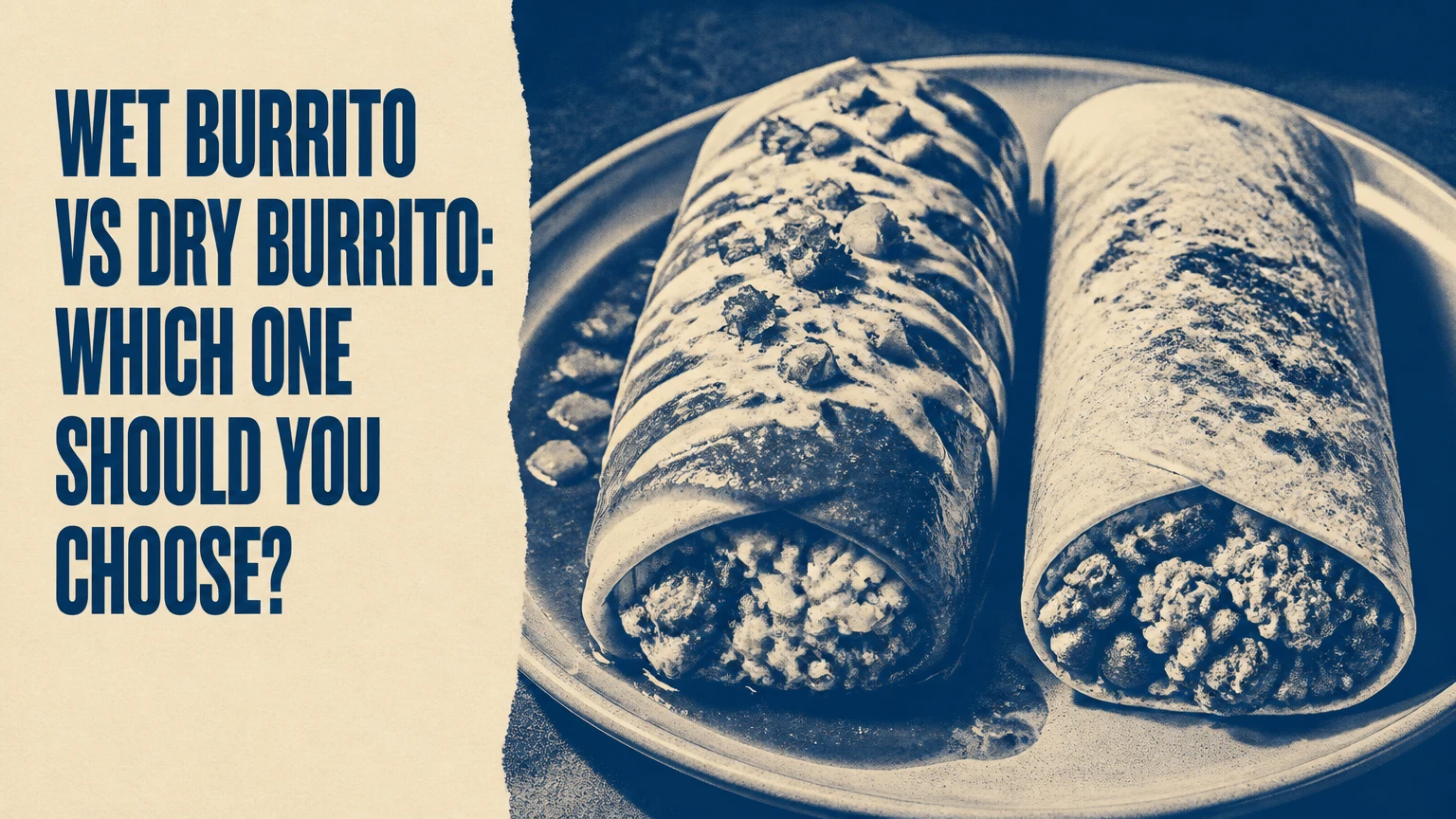
A dry burrito is a tightly rolled, hand-held flour-tortilla meal, while a wet burrito is that rolled burrito covered with warm sauce and usually melted cheese on a plate. Choose dry for portability, speed, and cleaner eating; choose wet for a saucier, richer, fork-and-knife meal served immediately.
Key Facts at a Glance
- A wet burrito begins with the same rolled structure as a dry burrito, then receives sauce and commonly melted cheese.
- A dry burrito is portable because the tortilla remains relatively intact and is usually wrapped in paper or foil.
- A wet burrito requires a plate and utensils because sauce softens the tortilla and spreads beyond the wrapper.
- Typical restaurant prices range from $9-$14 for a dry burrito and $13-$19 for a wet burrito.
- Red chile, green tomatillo, creamy suizo, and split red-green sauces are common wet-burrito finishes.
- The most important preparation rule is to use hot fillings before rolling, because broiling melts the topping but does not reliably heat the center.
What Is the Difference Between a Wet Burrito and a Dry Burrito?
The defining difference is the final treatment, not the filling. A dry burrito is rolled, sealed, and served in a wrapper; a wet burrito is rolled first, placed on a plate, covered with sauce, and finished with cheese or other toppings.
The same flour tortilla can hold rice, beans, grilled steak, shredded chicken, roasted vegetables, salsa, and dairy toppings in either version. Restaurants vary widely, so “dry” does not mean flavorless or moisture-free. It means the outside is not deliberately flooded with sauce.
“Burrito mojado” translates roughly to “wet burrito.” The term describes a serving style rather than one universally fixed recipe. Some restaurants bake the sauced burrito briefly, while others simply warm the sauce, pour it over the roll, and melt cheese under a broiler.
Is a Wet Burrito an Enchilada?
A wet burrito is not automatically an enchilada. Both dishes use sauce and may be topped with cheese, but a wet burrito normally retains a large flour tortilla wrapped around substantial fillings, whereas enchiladas are commonly made with individual corn tortillas rolled around a smaller filling.
The distinction is practical rather than absolute. A restaurant may use enchilada-style sauce on a burrito, but the larger flour tortilla, rice-and-bean filling, and burrito shape remain identifying features.
How Are Dry and Wet Burritos Made?
Both styles share four construction stages: heat a large flour tortilla, add hot fillings, fold the sides inward, and roll from the bottom into a closed cylinder. The styles separate only after the burrito has been formed.
A typical 10-12-inch tortilla holds enough food for a substantial meal, but overfilling makes either version split. Experienced cooks leave about 2 inches of clear tortilla at the edges and position wetter ingredients away from the seam.
Shared Construction
| Stage | Typical specification | Purpose |
|---|---|---|
| Tortilla | 10-12 inches, flour | Provides flexibility and surface area |
| Rice | 1/3-1/2 cup cooked | Adds starch and structure |
| Beans | 1/3-1/2 cup | Supplies moisture and protein |
| Main filling | 3-5 ounces | Provides the primary savory flavor |
| Cheese or salsa | 1-2 tablespoons | Adds seasoning without overloading the seam |
For a dry burrito, the rolled seam can be placed against a hot skillet for 1-2 minutes. A brief sear firms the exterior and helps the tortilla hold its shape. Foil or paper then preserves heat and makes transport easier.
For a wet burrito, place the rolled burrito seam-side down on an oven-safe plate. Add approximately 4-6 ounces of warm sauce, cover the top with 1-2 ounces of shredded cheese, and broil until the cheese melts, generally 2-4 minutes.
The filling must already be hot. A broiler heats the sauce and cheese quickly, but the short exposure usually cannot raise a cold center to a safe or pleasant serving temperature.
How Does a Wet Burrito Stay Intact?
A wet burrito stays intact when the tortilla is warm, the roll is tight, the filling is hot, and the sauce is added immediately before serving. A light skillet sear can delay liquid penetration, although no flour tortilla remains crisp under sauce indefinitely.
Sauce viscosity also matters. A thick chile or tomatillo sauce clings to the surface and penetrates more slowly than a thin, watery sauce. Excess salsa inside the burrito creates the same failure from the center outward.
Wet Burrito vs Dry Burrito: Master Comparison
The dry burrito wins for portability and speed, while the wet burrito wins for sauce coverage, plated presentation, and immediate comfort-food appeal. Neither style is inherently more authentic or nutritionally superior because fillings, portion sizes, cheese, and sauce vary by restaurant.
| Decision factor | Dry burrito | Wet burrito |
|---|---|---|
| Serving vessel | Foil, paper, or hand | Plate, typically 10-12 inches |
| Utensils | Usually none | Knife and fork required |
| Typical service time | 2-5 minutes after assembly | 6-10 minutes with broiling |
| Typical price | $9-$14 | $13-$19 |
| Sauce on exterior | None or minimal | 4-6 ounces, usually full coverage |
| Cheese finish | 0-1 ounce, optional | 1-2 ounces, commonly melted |
| Best holding window | 20-40 minutes wrapped | 5-15 minutes after saucing |
| Delivery performance | Usually reliable | Quality declines as sauce absorbs |
Which Burrito Is Easier to Eat?
A dry burrito is easier to eat because the wrapper contains the fillings and allows one-handed handling. A wet burrito requires a plate, knife, and fork, and the sauce can spread across the dish before the first bite.
Dry burritos work well in cars, at desks, on construction sites, and during short lunch breaks. Wet burritos suit a seated meal where the diner can cut through the softened tortilla and combine sauce with each forkful.
Winner for convenience: dry burrito.
Which Has Better Texture and Flavor?
A dry burrito offers tortilla chew, distinct filling layers, and occasional exterior crispness. A wet burrito provides a softer tortilla, melted cheese, warm sauce, and a more blended flavor profile that becomes richer as the components combine.
Texture depends on timing. A wet burrito served within several minutes of broiling can retain some resistance at the edges, while one held for 20 minutes may become difficult to cut cleanly. Dry burritos can also become unpleasant when overfilled with dry rice or lean, under-sauced meat.
| Sensory attribute | Dry burrito | Wet burrito |
|---|---|---|
| Exterior texture | Soft or lightly crisp | Soft, sauced, and cheese-covered |
| Filling separation | High, distinct layers | Lower, sauce integrates layers |
| Main flavor driver | Seasoned filling and salsa | Sauce, cheese, and filling together |
| Best serving temperature | Hot or warm | Very hot, immediately plated |
| Texture after 20 minutes | Usually stable when wrapped | Often noticeably softer |
Winner for layered texture: dry burrito. Winner for sauce-driven richness: wet burrito.
Which Option Is More Portable?
The dry burrito is the practical choice for travel, lunchboxes, and delivery. Foil limits heat loss and catches small leaks, while a wet burrito’s sauce rapidly softens the tortilla and requires separate packaging to preserve quality.
A wet burrito can travel successfully only if the restaurant packages the sauce, cheese, and burrito separately. Reassemble the meal at home, then heat the sauce and melt the cheese immediately before eating.
Winner for portability: dry burrito.
Which One Costs More?
A wet burrito typically costs $4-$6 more because the restaurant adds sauce, cheese, plate service, broiling time, and sometimes extra garnishes. Menu prices depend more on the protein and portion size than on the word “wet” alone.
The price difference may be smaller when a restaurant treats sauce as a free modification. Ask whether the wet preparation includes additional cheese or a separate surcharge before ordering.
| Cost component | Dry burrito, typical | Wet burrito, typical |
|---|---|---|
| Base menu price | $9-$14 | $13-$19 |
| Added cheese | $0-$1.50 | Often included or $0.50-$2 |
| Sauce charge | Usually $0 | $0-$2 |
| Packaging or plating | $0-$1 | Included in dine-in service |
| Practical total | $9-$16.50 | $13-$23 |
Winner for lower price: dry burrito.
Which Sauces Work Best on a Wet Burrito?
Red chile sauce gives a dry burrito the deepest earthy flavor, green tomatillo sauce supplies acidity and brightness, and creamy suizo sauce adds dairy richness. Sauce choice should balance the filling rather than overwhelm it.
Red sauce pairs well with beef, beans, and roasted vegetables. Green sauce cuts through rich grilled meats and works particularly well with chicken. Creamy sauces suit mild fillings but can make a large burrito feel heavy.
| Sauce style | Core ingredients | Flavor profile | Strong filling match |
|---|---|---|---|
| Rojo | Guajillo, ancho, tomato, garlic | Earthy, mildly sweet, warm | Beef, beans, roasted vegetables |
| Verde | Tomatillo, jalapeño, garlic, cilantro | Tangy, fresh, moderately sharp | Chicken, grilled steak, beans |
| Suizo | Green or red sauce, crema, white cheese | Creamy, mild, rich | Chicken, vegetables, mild beans |
| Red-green split | Rojo on one side, verde on the other | Two contrasting profiles | Mixed fillings and tasting meals |
A sauce should coat the burrito rather than form a deep pool around it. Four ounces is often enough for a 10-inch roll; six ounces creates full coverage but increases the risk of rapid softening.
How Should You Order One?
Ask for a “wet burrito with red sauce” or “wet burrito with green sauce,” then confirm whether cheese is included. For a crisper result, request sauce on the side and add it immediately before eating.
Useful ordering details include:
- Specify the sauce color or style.
- Ask whether the burrito is broiled after saucing.
- Request sour cream, lettuce, or fresh herbs on the side if you dislike warm, wilted toppings.
- Ask for sauce and cheese separately for delivery.
- Request less rice or extra beans if the filling feels too dry or starch-heavy.
Are Wet Burritos Less Healthy?
Neither style has a fixed calorie count. A typical restaurant dry burrito may contain 800-1,200 calories, while a fully sauced and cheesed version may reach 1,200-1,800 calories, but these are practical estimates rather than universal nutrition standards.
The added sauce may contribute modest calories if it is chile-based, while cheese, crema, rice, and large portions account for much of the increase. Sodium can rise in either style because tortillas, seasoned beans, meat, cheese, and prepared sauces may all contain salt.
| Component | Typical portion | Approximate calorie range | Main nutritional effect |
|---|---|---|---|
| Large flour tortilla | 1 tortilla, 10-12 inches | 250-350 | Carbohydrate and sodium |
| Cooked rice | 1/2 cup | 100-150 | Starch and energy |
| Beans | 1/2 cup | 100-180 | Fiber and plant protein |
| Cooked meat or chicken | 4 ounces | 180-320 | Protein and fat |
| Shredded cheese | 1-2 ounces | 110-220 | Fat, protein, sodium |
| Chile or tomatillo sauce | 4-6 ounces | 40-180 | Flavor, sodium, variable fat |
For a lighter order, choose beans, vegetables, salsa, and a moderate rice portion, then request sauce on the side. A dry burrito is easier to portion-control because the exterior cheese blanket and sauce are absent.
The wet version is not automatically unhealthy, and the dry version is not automatically light. A large dry burrito with extra cheese and rice can exceed a smaller wet burrito with beans, vegetables, and a thin chile sauce.
Which Should You Choose?
Choose a dry burrito when portability, speed, budget, or structural stability matters most. Choose a wet burrito when you are eating at a table and want sauce, melted cheese, and a softer, richer presentation.
For Commuters and Desk Lunches
The dry burrito is the clear choice for commuters, students, and office workers. Wrap it tightly in foil, keep it upright, and eat it within 30-40 minutes for the best tortilla texture.
For a Sit-Down Comfort Meal
The wet burrito fits a relaxed dinner because plating, broiling, and sauce distribution become part of the experience. Order it when you can eat immediately rather than letting it sit through a long conversation.
For Delivery
The dry burrito is more dependable for delivery. If ordering wet, request the burrito, sauce, cheese, and cold garnishes in separate containers, then assemble the dish at home.
For Calorie and Portion Control
A dry burrito gives you more control over cheese and sauce, but ingredient selection matters more than the label. Ask for half rice, beans instead of extra cheese, and salsa on the side.
How Do You Prevent a Wet Burrito From Becoming Soggy?
Prevent sogginess by starting with hot fillings, searing the rolled tortilla briefly, using thick warm sauce, and serving within 5-15 minutes of saucing. A wet burrito will soften eventually, so the goal is controlled absorption rather than permanent crispness.
A common professional rule is to keep highly wet ingredients away from the tortilla. Drain beans, reduce loose salsa, and avoid placing sour cream inside the roll unless a very soft texture is intentional.
| Failure mode | Likely cause | Immediate fix | Prevention |
|---|---|---|---|
| Soggy bottom | Cold plate or excessive thin sauce | Move to a warm plate and reduce sauce | Use 4 ounces of thick sauce |
| Split seam | Overfilled or loose roll | Cut and serve as a plated bowl | Leave 2 inches at each edge |
| Cold center | Fillings were cold before broiling | Microwave or skillet-warm before saucing | Heat fillings to serving temperature |
| Burned cheese | Broiler too close or unattended | Remove browned cheese promptly | Broil 2-4 minutes while watching |
| Bland filling | Sauce expected to provide all seasoning | Add salt, acid, or salsa before rolling | Season each filling separately |
The counterintuitive point is that more sauce does not necessarily create more flavor. Excess liquid dilutes the filling’s seasoning and turns the tortilla into a structural weakness.
Can You Store, Freeze, or Reheat Each Style?
A dry burrito stores better because the tortilla is not already saturated with sauce. Refrigerate either style within two hours, but store wet-burrito sauce separately whenever possible.
For a dry burrito, wrap it tightly, refrigerate for up to three days, and reheat in foil at 325°F for approximately 15-20 minutes. A skillet can restore exterior firmness after the center is hot.
For a wet burrito, refrigerate the roll and sauce separately for up to three days. Warm the burrito covered, heat the sauce independently, pour it over the roll, and add cheese during the final broiling stage.
Freezing is most successful with an assembled but unsauced burrito. Sauce, lettuce, sour cream, and fresh herbs should be added after thawing because freezing damages their texture.
What Are the Best Alternatives?
Enchiladas are the closest sauced alternative, but they use smaller rolled tortillas and generally offer less rice and fewer portable fillings. Chimichangas provide a crisp fried exterior, while burrito bowls remove the tortilla and work better for meal preparation.
| Alternative | Wrapper or base | Sauce timing | Utensils | Best use |
|---|---|---|---|---|
| Enchilada | Usually corn tortilla | Added before baking | Fork required | Smaller sauced portions |
| Chimichanga | Flour tortilla, fried | Optional after frying | Fork or hands | Crisp exterior |
| Burrito bowl | Rice or beans as base | Added at serving | Bowl and fork | Meal prep and portion control |
| Quesadilla | Folded flour tortilla | Usually side sauce | Hands or fork | Cheese-forward snack or meal |
An enchilada is not a direct substitute when you want a large hand-held meal. A burrito bowl is the better substitute when portability does not matter and you want to control rice, beans, vegetables, and sauce separately.
Common Questions About Wet and Dry Burritos
Does “dry burrito” mean the filling has no sauce?
No. A dry burrito can contain salsa, beans, seasoned meat, or a small amount of sour cream inside. “Dry” refers mainly to the absence of sauce poured over the outside, not to a completely moisture-free filling.
Can a wet burrito use a corn tortilla?
Yes, but a large flour tortilla is more common because flour tortillas flex around heavier fillings and tolerate rolling better. A corn tortilla is more likely to crack unless softened first, and its flavor moves the dish closer to an enchilada.
Is a burrito bowl healthier than either burrito style?
A burrito bowl can be lighter because it removes the flour tortilla, but rice, cheese, creamy toppings, and large protein portions can replace those calories. Ask for measured rice, extra vegetables, and sauce on the side when portion control matters.
Why does restaurant wet-burrito sauce taste different from salsa?
Wet-burrito sauce is usually cooked, blended, and served warm, while table salsa is often fresher, chunkier, and intended as a condiment. Chile sauces may contain stock, roasted vegetables, spices, or dairy that produce a smoother coating.
Can you eat a wet burrito with your hands?
You can, but the softened tortilla and loose sauce make hand-held eating impractical. Cutting the burrito into sections with a knife keeps the filling contained and distributes sauce more evenly across each bite.
Which protein works best in each style?
Dry burritos benefit from moist fillings such as braised beef, beans, or grilled chicken because the interior has no exterior sauce. Wet burritos can use the same proteins, but strongly seasoned beef or chicken should be paired with a sauce that adds acidity or contrast.
The Bottom Line
Wet burrito vs dry burrito is primarily a choice between a portable wrapped meal and a plated sauced meal. Pick dry for commuting, delivery, lower typical cost, and firmer texture; pick wet for immediate dine-in service, melted cheese, warm chile sauce, and a richer fork-and-knife experience. The filling determines nutrition and much of the flavor, while the finishing method determines how the burrito is eaten.