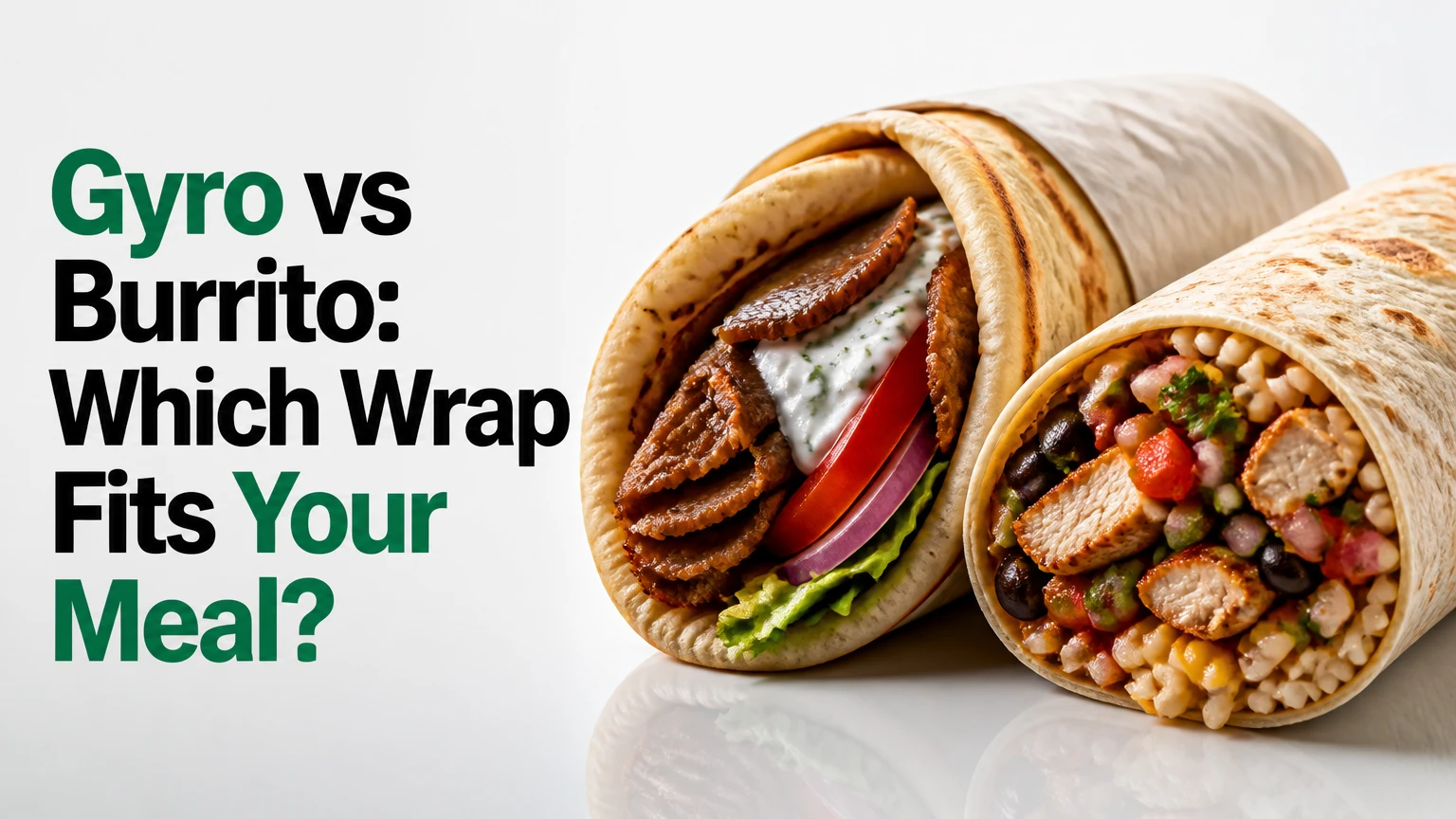
A gyro is a Greek handheld meal built around spit-roasted meat, pita, vegetables, and tzatziki, while a burrito is a Mexican or Mexican American flour-tortilla package filled with combinations such as beans, rice, meat, salsa, and cheese. Choose a gyro for crisp, fresh contrast; choose a burrito for sealed portability, volume, and customization.
Key Facts at a Glance
A typical gyro uses a 7-8-inch pocketless pita; a burrito commonly uses a 10-12-inch flour tortilla.
Gyro meat is shaved from a rotating vertical spit, while burrito fillings are cooked separately and assembled to order.
Traditional gyros often contain fries, tomatoes, onions, and tzatziki; rice and beans are not standard Greek gyro fillings.
Burritos are usually fully sealed at both ends, making them easier to transport than an open-ended gyro.
Typical USA menu prices range from $8-$13 for a gyro and $9-$16 for a burrito.
Calories depend more on portion size, sauces, cheese, and fries than on the name of the dish.
What Is the Difference Between a Gyro and a Burrito?
The defining difference is culinary architecture: a gyro is an open-ended pita wrap centered on spit-roasted meat, while a burrito is a sealed flour-tortilla cylinder built from separately prepared fillings. That distinction affects flavor, portability, portion size, texture, customization, and reheating.
A Greek gyro traditionally combines shaved meat with tzatziki, tomato, onion, and fries inside warm pita. Depending on the region and restaurant, the meat may be chicken or a seasoned pressed meat mixture. In Greece, whole-muscle cuts on a vertical spit are also common.
A burrito begins with a large flour tortilla. A cook adds a selected filling, folds the sides inward, tucks the bottom, and rolls the package closed. Rice, beans, meat, salsa, cheese, sour cream, and guacamole are common in large American formats, but northern Mexican burritos can be much smaller and contain only one main stew or filling.
The comparison becomes misleading when “gyro” means a specific American diner style and “burrito” means a fully loaded Mission burrito. A small bean burrito and a 900-gram restaurant burrito do not represent the same portion or tradition.
Master Comparison: Gyro vs Burrito
| Criterion | Gyro | Burrito |
|---|---|---|
| Culinary base | Greek street food | Mexican and Mexican American wrapped meal |
| Wrapper | 7-8-inch pocketless wheat pita | 10-12-inch flour tortilla |
| Main cooking method | Vertical spit, shaved to order | Separate griddle, pot, oven, or grill cooking |
| Typical core filling | Spit-roasted meat, tomato, onion, fries | Beans, rice, meat, salsa, cheese, or vegetables |
| Signature sauce | Tzatziki with yogurt, cucumber, garlic | Salsa, hot sauce, sour cream, or guacamole |
| Closure | Bottom tuck with open top | Side folds and tucked, sealed ends |
| Typical weight | 300-450 grams | 400-900 grams |
| Typical USA price | $8-$13 | $9-$16 |
| Customization | Low to medium | Medium to very high |
| Best portability | 2-3 hours when wrapped carefully | 3-5 hours when foil-wrapped and kept warm |
These figures are typical restaurant ranges, not universal standards. A California burrito can be larger than a small Mission burrito, and a platter-style gyro can exceed the weight of either handheld format.
How Do the Fillings and Flavors Differ?
Gyros emphasize roasted meat, cooling dairy, raw vegetables, and salty fries, whereas burritos emphasize layered starches, beans, cooked proteins, cheese, and salsa. Gyro flavor is usually herbaceous, garlicky, tangy, and savory; burrito flavor can range from smoky and chile-forward to creamy, earthy, or acidic.
Gyro Flavor Profile
Tzatziki supplies yogurt acidity, cucumber freshness, garlic, and herbs. Tomato adds moisture and sweetness, onion adds sharpness, and fries introduce hot fat and a soft-crisp texture. The meat contributes browned edges from the spit and a concentrated seasoning profile that may include oregano, garlic, marjoram, cumin, or paprika.
The strongest gyro bite contains several temperatures at once: warm pita, hot meat, fresh vegetables, cool sauce, and fries. That contrast is the dish’s practical identity.
Burrito Flavor Profile
Burrito fillings create a broader range of textures. Rice provides a neutral, absorbent base; beans add creaminess and plant protein; meat adds roasted or braised depth; salsa brings acidity and heat; cheese adds salt and fat.
A sealed burrito also distributes moisture differently. Salsa and beans soften the tortilla over time, while rice absorbs some liquid. A well-made burrito balances wet ingredients with enough dry structure to keep the wrapper intact.
| Component | Gyro example | Burrito example | Eating consequence |
|---|---|---|---|
| Protein | Shaved chicken or beef-lamb blend | Carne asada, shredded chicken, beans, or chorizo-style filling | Gyro gives concentrated roasted flavor; burrito offers broader choices |
| Starch | Fries inside pita | Rice, beans, or potatoes | Fries add crisp-fat contrast; rice and beans increase volume |
| Sauce | Tzatziki, 30-60 grams | Salsa, sour cream, guacamole, 15-80 grams | Tzatziki cools; salsa adds acidity or heat |
| Fresh element | Tomato, onion, cucumber in sauce | Pico de gallo, lettuce, onion, cilantro | Gyro freshness is more consistent; burrito freshness varies by build |
| Dairy | Yogurt-based tzatziki | Cheese or sour cream | Burrito dairy often increases calories and salt |
| Wrapper | Leavened pita | Thin flour tortilla | Pita feels bready; tortilla folds into a denser seal |
How Are Gyro and Burrito Assembled?
A gyro is assembled around meat shaved from a hot vertical spit, while a burrito is assembled by layering cooked fillings on a warmed tortilla and rolling it closed. The most important technical variables are surface crispness for gyro meat and tortilla flexibility for burritos.
Typical Gyro Assembly
- The cook warms an oiled pita on a griddle for roughly 15-30 seconds.
- Tzatziki is spread down the center rather than poured across the entire bread.
- About 100-160 grams of shaved meat is placed over the sauce.
- Tomato, onion, and 50-100 grams of fries are added.
- The bottom edge folds upward, and the sides form a cone around the filling.
- Paper or foil supports the lower half while the top remains open.
A gyro succeeds when the outer meat is browned before shaving. Cutting too early produces soft, dense pieces because the exposed layer has not developed enough crust.
Typical Burrito Assembly
- A 10-12-inch flour tortilla is steamed or heated on a plancha for 5-15 seconds.
- Rice and beans are placed in a compact horizontal line, usually below the tortilla’s midpoint.
- Meat or another protein is added in a portion of approximately 100-170 grams.
- Cheese, salsa, sour cream, guacamole, and vegetables follow.
- The side edges fold inward, the near edge covers the filling, and the burrito rolls forward into a cylinder.
- The seam may be grilled for 15-30 seconds to improve closure.
A burrito fails when the cook adds more filling than the tortilla can stretch around. For a 12-inch tortilla, keeping the filling line near 5-7 centimeters wide usually improves structural reliability.
Which Provides More Food?
A loaded burrito usually provides more total food, but a gyro can feel equally satisfying because meat and fries occupy more of its limited interior. Typical gyros weigh 300-450 grams, while large Mission-style burritos often weigh 500-900 grams.
| Format | Typical weight | Main volume source | Typical calorie range |
|---|---|---|---|
| Greek-style gyro | 300-450 g | Meat, pita, fries, sauce | 600-900 |
| Small norteño burrito | 180-300 g | One stew or bean filling | 350-650 |
| Standard taqueria burrito | 350-600 g | Protein, beans, rice, tortilla | 650-1,100 |
| Mission burrito | 500-900 g | Rice, beans, protein, dairy, salsa | 800-1,500+ |
| California burrito | 450-750 g | Meat, fries, cheese, creamy toppings | 900-1,500+ |
| Breakfast burrito | 350-650 g | Eggs, potatoes, protein, cheese | 650-1,200 |
Calories are menu-dependent estimates rather than fixed properties. A chicken gyro without fries may be lighter than a beef gyro with extra sauce, while a bean burrito can be lighter than a meat-heavy version with cheese and guacamole.
Which Has the Better Nutrition Profile?
Neither dish is automatically healthier. A gyro often offers a smaller portion and yogurt-based sauce, while a burrito can provide more fiber and protein when built with beans, vegetables, lean meat, and a moderate amount of rice.
The USDA FoodData Central database lists plain cooked rice, beans, meats, dairy, and tortillas as separate ingredients rather than assigning one universal “burrito” value. That matters because restaurant nutrition changes sharply with serving size. Cheese, creamy sauces, fries, and refined flour increase energy density; beans and vegetables increase fiber and micronutrient density.
For a lighter gyro, choose chicken, request fewer fries, keep tzatziki, and add tomato and onion. Tzatziki is often lower in calories than a large serving of sour cream, but recipes differ in yogurt fat and oil.
For a lighter burrito, choose beans, grilled chicken, vegetables, salsa, and a smaller rice portion. Skipping cheese and sour cream can remove roughly 150-300 calories, depending on the restaurant’s serving spoon.
Nutrition by Common Modification
| Order choice | Typical calorie effect | Protein effect | Main trade-off |
|---|---|---|---|
| Gyro, chicken instead of red meat | -50 to -150 kcal | 25-40 g total | Often less rich flavor |
| Gyro, no fries | -120 to -250 kcal | 0 g change | Less crispness and starch |
| Burrito, beans plus chicken | 700-1,000 kcal | 35-60 g | More fiber, larger portion |
| Burrito, no cheese or sour cream | -150 to -300 kcal | -5 to -12 g | Less richness and moisture |
| Burrito, extra vegetables | +20 to +80 kcal | +1 to +4 g | More volume, possible moisture |
| Burrito, double protein | +150 to +300 kcal | +20 to +35 g | Higher cost and sodium |
People monitoring sodium should inspect the whole meal rather than focus on the wrapper. Seasoned meat, canned beans, cheese, sauces, and pickled ingredients can make either format sodium-dense.
How Do Regional Styles Change the Comparison?
Regional style changes the result more than the label alone. Greek gyros commonly use chicken or layered meat on a spit, while American restaurant versions may use a compressed seasoned meat loaf; northern Mexican burritos can be compact and simple, whereas Mission burritos are large and highly layered.
| Style | Region associated with style | Signature contents | Typical format |
|---|---|---|---|
| Greek gyro | Greece | Spit meat, tzatziki, tomato, onion, fries | Open pita cone |
| American gyro | United States | Seasoned beef-lamb loaf, lettuce, tomato, sauce | Pita wrap or plate |
| Vegetarian gyro | Greece and international restaurants | Falafel, grilled cheese, mushrooms, vegetables | Open pita cone |
| Norteño burrito | Northern Mexico | One stew, beans, or machaca-style filling | Small sealed tortilla |
| Mission burrito | San Francisco, United States | Rice, beans, meat, salsa, cheese, sour cream | Large foil-wrapped cylinder |
| California burrito | Southern California, United States | Carne asada, fries, cheese, guacamole, sour cream | Large sealed tortilla |
| Breakfast burrito | United States and northern Mexico | Eggs, potatoes, cheese, beans, breakfast meat | Sealed tortilla |
The popular claim that every burrito originated in one precisely documented city is too certain. Food historians commonly associate the modern burrito with northern Mexico and Ciudad Juárez, while the origin story involving donkeys and bedrolls is widely repeated but not proven as a single definitive explanation.
Similarly, describing gyro as simply “derived from döner” misses the regional development. Gyro, döner, and shawarma share the rotating vertical-spit technique, but their seasoning, meat preparation, bread, sauces, and service traditions differ.
Which Travels and Reheats Better?
A burrito is the better travel food because its folded ends contain liquid and loose fillings more effectively than a gyro’s open top. A gyro is best eaten immediately, while a burrito can remain practical for several hours when wrapped in foil and kept below safe food-temperature limits.
A gyro’s raw tomato, onion, and yogurt sauce lose texture during reheating. If reheated in a microwave, the pita can become chewy while the vegetables release water. For storage, refrigerate it promptly and reheat the meat and pita separately when possible.
A burrito can also become soggy, especially when beans, salsa, and meat juices collect at the bottom. Rice placed near the lower fold can absorb some moisture, but rice does not make a wet burrito indefinitely stable.
For a commute of 30-60 minutes, wrap either meal tightly. For a longer trip, choose a burrito with drained beans, limited sour cream, and salsa served separately.
Which Fits Dietary Restrictions?
A burrito generally offers more control over gluten-free, vegetarian, vegan, and high-protein modifications, but neither format is automatically suitable for every restriction. Gyro pita and flour tortillas usually contain wheat, while tzatziki contains dairy and many burrito builds contain cheese or sour cream.
| Dietary need | Gyro approach | Burrito approach | Verification needed |
|---|---|---|---|
| Vegetarian | Falafel, grilled cheese, or mushrooms | Beans, vegetables, rice, cheese, or tofu | Shared grill and fryer |
| Vegan | Falafel with no yogurt sauce | Beans, rice, vegetables, salsa, no dairy | Lard in tortilla, cross-contact |
| Gluten-free | Gluten-free pita only, if available | Corn tortilla bowl or certified gluten-free tortilla | Flour dust and shared prep surfaces |
| Dairy-free | Omit tzatziki, confirm meat marinade | Omit cheese and sour cream | Sauces, beans, and tortilla ingredients |
| High-protein | Extra chicken or meat, fewer fries | Double chicken, beans, moderate rice | Portion size and sodium |
| Lower calorie | Chicken, fewer fries, standard sauce | Beans, lean protein, salsa, vegetables | Oil and serving size |
Vegetarians should ask whether fries share a fryer with breaded foods. Vegans should verify that refried beans do not contain animal fat and that the tortilla does not contain lard. Restaurants vary significantly.
How Do Price and Value Compare?
A gyro commonly costs $8-$13 in the United States, while a burrito commonly costs $9-$16; the burrito often delivers more total weight, but the gyro may offer a better value for a moderate meal with a defined portion.
| Purchase factor | Gyro | Burrito |
|---|---|---|
| Typical handheld price | $8-$13 | $9-$16 |
| Common serving weight | 300-450 g | 350-900 g |
| Typical protein portion | 100-160 g | 100-200 g |
| Typical order time | 2-4 minutes | 2-6 minutes |
| Main labor bottleneck | Spit cooking and shaving | Multiple fillings and assembly |
| Common add-on cost | $1-$3 for extra sauce or fries | $1.50-$4 for extra protein or guacamole |
A gyro’s vertical spit requires advance preparation and holding management, even though final assembly is fast. A burrito line may prepare rice, beans, salsa, and protein in separate batches, then assemble each order quickly.
Price-per-gram favors a large burrito, but price-per-protein can vary. A small burrito with mostly rice may cost nearly as much as a meat-centered gyro while providing less protein.
Which Should You Choose?
Choose a gyro for a compact, meat-forward meal with cool sauce, fresh vegetables, and fries. Choose a burrito for a larger, sealed meal that you can customize around protein, beans, rice, vegetables, dairy, and spice.
Choose a Gyro for Fresh Contrast
A gyro suits diners who want hot shaved meat against cold tzatziki and crisp vegetables. The format works especially well for a quick lunch when a large rice-based meal would feel excessive.
Order a chicken gyro when you want a leaner option, or choose a traditional meat version when browned, salty spit flavor matters more than calorie control. Keep the fries if texture contrast is part of the appeal.
Choose a Burrito for Maximum Portability
A burrito is the practical winner for driving, commuting, outdoor meals, and leftovers. The sealed cylinder protects the filling, and foil wrapping helps retain heat without requiring a plate.
Ask for salsa on the side if the burrito will sit longer than 30 minutes. Avoid overfilling, because a large package is not automatically a better package when the tortilla splits before the meal is finished.
Choose a Burrito for Custom Nutrition
A burrito gives the clearest control over protein, fiber, dairy, starch, and vegetables. A useful high-protein build is chicken, black beans, moderate rice, vegetables, and salsa, with cheese or sour cream chosen according to calorie needs.
The trade-off is sodium and portion size. Doubling meat while keeping rice and dairy unchanged can produce a protein-dense meal, but it can also push cost and total calories substantially higher.
Choose a Gyro for the Signature Texture
A gyro is the stronger choice when you want crisp meat edges, soft pita, cooling sauce, raw onion, and fries in one bite. A California burrito can also provide meat and fries, but cheese, guacamole, and sour cream create a heavier profile.
The gyro is less suitable for slow eating or long storage. Its best qualities decline quickly once the sauce saturates the pita.
Common Problems and Ordering Fixes
The most common gyro problem is a wet, collapsing pita; the most common burrito problem is a split tortilla caused by excess filling or liquid. Both failures are preventable through portion control, moisture management, and immediate service.
| Failure mode | Likely cause | Practical fix | Best timing |
|---|---|---|---|
| Gyro pita tears | Cold or dry pita | Warm it 15-30 seconds before filling | Before assembly |
| Gyro becomes soggy | Excess watery sauce or tomato juice | Request moderate sauce and drain vegetables | At ordering |
| Gyro meat feels rubbery | Undershaved or insufficiently browned spit surface | Wait for a browned outer layer | During cooking |
| Burrito bursts | Filling line too wide | Limit filling to 5-7 cm on a 12-inch tortilla | During assembly |
| Burrito leaks at bottom | Watery beans, salsa, or meat juices | Drain wet fillings and place rice near the fold | During assembly |
| Burrito turns cold | Cold tortilla or oversized filling mass | Steam tortilla and use hot fillings | Before rolling |
A practitioner rule is to control moisture before adding more seasoning. A dry burrito can receive salsa at the table, but a saturated burrito cannot be structurally repaired.
Another useful rule concerns fries. Fries inside a gyro should be added immediately before folding, because five extra minutes inside sauce can erase their texture. The same principle applies to fries in a California-style burrito.
Frequently Asked Questions
Can a gyro contain rice?
A gyro can contain rice in a restaurant-created variation, but rice is not a standard filling in the classic Greek handheld format. Rice is more commonly served beside gyro meat on a plate. A pita gyro usually relies on meat, sauce, vegetables, and sometimes fries for bulk.
Is a burrito always Mexican food?
A burrito is associated with Mexican cuisine, especially northern Mexican food, but many large restaurant versions are Mexican American or Tex-Mex adaptations. A small northern Mexican burrito with one stew differs substantially from a Mission burrito filled with rice, beans, meat, cheese, salsa, and sour cream.
Which one has more protein?
A burrito has more protein when it contains double meat or a combination of meat and beans, but a standard gyro can provide a higher protein percentage because it contains fewer starch-heavy fillings. Typical handheld servings may provide about 25-45 grams of protein, depending on the meat portion.
Are gyros and shawarma the same food?
Gyros and shawarma are related vertical-spit foods, not identical dishes. Gyros commonly use Greek-style seasoning, pita, tzatziki, tomato, onion, and fries, while shawarma uses its own spice blends, sauces, pickles, and regional breads. The shared spit technique does not make the recipes interchangeable.
Can you make either dish gluten-free?
A burrito is easier to adapt as a bowl or with a certified gluten-free tortilla, while a gyro requires a suitable gluten-free pita or a plated serving. Cross-contact from shared grills, prep surfaces, fryers, and sauces must be checked for medically necessary avoidance.
The Bottom Line
Gyro vs burrito is a choice between two different meal systems, not two versions of the same wrap. Pick a gyro for spit-roasted meat, tzatziki, vegetables, fries, and immediate eating; pick a burrito for a larger sealed package, stronger customization, easier transport, and more control over beans, rice, protein, and toppings.