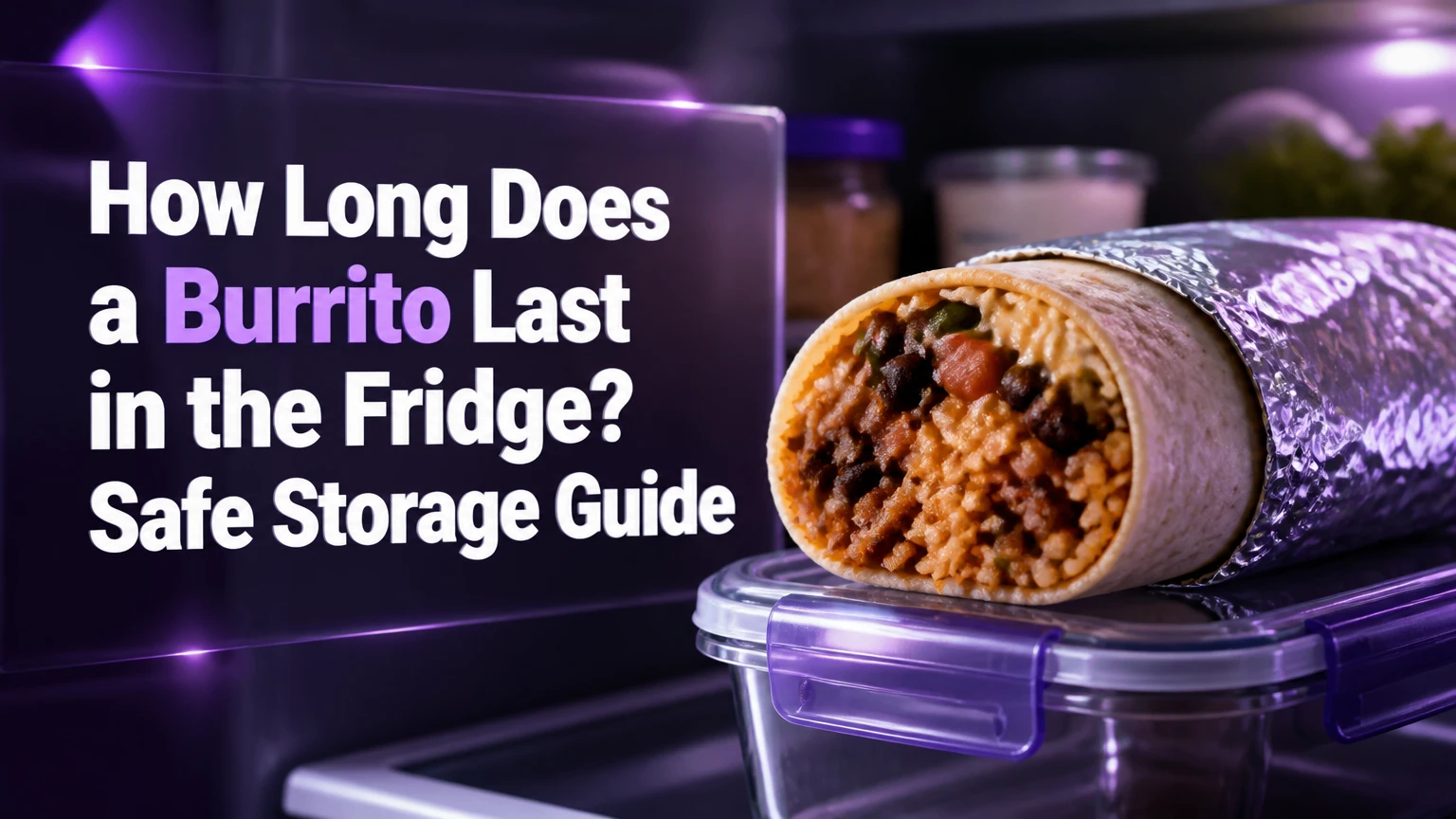
A cooked burrito lasts 3-4 days in the refrigerator when it is refrigerated within 2 hours and kept at 40°F (4°C) or below. The same USDA leftover rule applies to homemade and restaurant burritos, including burritos containing meat, beans, eggs, rice, cheese, or cooked vegetables. Discard a burrito that stayed above refrigeration temperature too long, even if it smells normal.
Key Facts
A refrigerated burrito is generally safe for 3-4 days at 40°F (4°C) or below.
Refrigerate a burrito within 2 hours, or within 1 hour when the surrounding temperature exceeds 90°F (32°C).
A normal smell cannot prove that a burrito is safe because disease-causing bacteria may not change its odor or appearance.
Store burritos in shallow containers or tightly wrapped portions, and place them inside the refrigerator promptly.
Reheat leftovers to 165°F (74°C), measured at the center with a food thermometer.
Freezing pauses bacterial growth but does not make an unsafe burrito safe.
How Long Does a Burrito Last in the Fridge?
A burrito lasts 3-4 refrigerator days, counted from the day it was cooked or purchased, if the burrito was handled correctly. Day four is the end of the standard USDA window, not a guarantee that every burrito remains safe until a particular hour.
The United States Department of Agriculture Food Safety and Inspection Service states that leftovers should be refrigerated within two hours and used within three to four days. USDA also advises keeping the refrigerator at 40°F or below. That guidance applies to mixed foods such as burritos because their cooked fillings are perishable leftovers.
Food safety and eating quality follow different clocks. A burrito can become wet, tough, or unpleasant on day two while still remaining within the safe storage window. Conversely, a burrito can look and smell acceptable after sitting on a counter overnight but still be unsafe.
Does the burrito filling change the time limit?
Most cooked burritos retain the same 3-4-day safety limit, regardless of whether the filling contains chicken, ground beef, eggs, beans, rice, or vegetables. The ingredient that spoils fastest does not automatically create a different USDA refrigerator rule for a properly handled mixed leftover.
| Burrito type | Typical quality after refrigeration | Standard safety window | Best storage action |
|---|---|---|---|
| Breakfast, eggs and cheese | 2-3 days | 3-4 days | Wrap tightly; reheat center fully |
| Chicken or beef | 2-4 days | 3-4 days | Refrigerate within 2 hours |
| Bean and cheese | 3-4 days | 3-4 days | Separate wet salsa when possible |
| Seafood-filled | 1-3 days quality | 3-4 days | Freeze early if not eating soon |
| Vegetable or sauce-heavy | 1-2 days quality | 3-4 days | Drain excess sauce and moisture |
| Rice and bean | 2-4 days quality | 3-4 days | Reheat with a small amount of water |
Seafood burritos often lose quality sooner because fish, shrimp, crema, and fresh toppings react poorly to storage. That shorter quality period is a practical preference, not a universal replacement for the USDA 3-4-day rule. A seafood burrito with an uncertain handling history should be discarded rather than judged by smell.
Why Does a Refrigerated Burrito Spoil?
A burrito spoils through two separate processes: pathogen growth that can cause illness and quality deterioration caused by enzymes, yeast, mold, moisture, and temperature changes. Refrigeration slows both processes, but it does not stop them permanently.
Cooked rice, beans, meat, eggs, cheese, sauces, and vegetables create a moist, nutrient-rich package. The tortilla also traps humidity, so water moves from salsa, tomatoes, sour cream, and cooked fillings into the drier tortilla. That moisture migration makes the wrap limp before it necessarily indicates dangerous bacterial growth.
Listeria monocytogenes can grow slowly at refrigeration temperatures, which is one reason the cold chain and the four-day limit matter. Salmonella and pathogenic strains of Escherichia coli may cause illness without producing a detectable odor. Mold and spoilage bacteria can produce visible or sensory changes, but the absence of those changes is not a safety test.
What is the difference between safety and quality?
Safety asks whether the burrito may contain enough harmful microorganisms to cause illness. Quality asks whether the tortilla, rice, fillings, and toppings still have an acceptable taste and texture. A soggy tortilla is a quality problem; a burrito left at room temperature overnight is a safety problem.
| Condition | Main concern | Can appearance confirm safety? | Recommended decision |
|---|---|---|---|
| Soggy tortilla after 1 day | Texture and moisture | No | Reheat only if time and temperature were safe |
| Dry rice after 3 days | Quality loss | No | Add moisture during reheating |
| Sour smell or slime | Spoilage | Strong discard signal | Discard without tasting |
| Normal smell after 5 days | Pathogen risk | No | Discard |
| Mold on tortilla or filling | Visible spoilage | Yes, discard signal | Discard the whole burrito |
| Warm center after delivery | Time-temperature abuse | No | Use the elapsed-time rule |
How Should You Store a Burrito in the Refrigerator?
Store a burrito in a shallow, covered container or wrap it tightly and refrigerate it promptly. The safe method takes about 3-5 minutes of handling, requires no special equipment beyond clean wrapping or a container, and depends more on limiting time in the temperature danger zone than on achieving perfect packaging.
- Mark the storage time. Write the cooking or purchase date on the container. Counting days accurately prevents the common mistake of treating the refrigeration date as day one.
- Refrigerate promptly. Put the burrito in the refrigerator within 2 hours. Use the 1-hour limit when the surrounding temperature is above 90°F (32°C), such as during a hot outdoor meal or an uncooled vehicle trip.
- Use a shallow container. A single burrito or a small number of portions should sit in a shallow, food-safe container rather than a deep, tightly packed stack. Shallow storage releases heat more effectively.
- Wrap for quality. Use plastic wrap, parchment, or a covered container to reduce drying and odor transfer. Do not depend on foil alone if the burrito can leak.
- Separate wet toppings when practical. Remove lettuce, fresh salsa, guacamole, and sour cream before storage if texture matters. Keep those ingredients in a clean, covered container.
- Place the container on a stable shelf. The back portion of a middle or lower shelf is usually more stable than the refrigerator door. Keep the burrito away from raw meat and leaking containers.
- Set a discard date. Plan to eat the burrito by day three or four. Freeze it earlier if you will not eat it within that period.
The USDA does not require cooling cooked food to room temperature before refrigeration. In fact, waiting on the counter can extend the time bacteria spend in the danger zone, which the FDA Food Code defines as 41°F-135°F for food-service controls. Divide several burritos into smaller containers and refrigerate them promptly instead of stacking them while hot.
Can a hot burrito go straight into the refrigerator?
A hot burrito can go into the refrigerator, provided it is not packed in a large, deep mass that prevents rapid cooling. For several burritos, separate portions into shallow containers, leave enough space for cold air to circulate, and keep the refrigerator door closed.
| Storage situation | Safer method | Typical handling limit | Quality result |
|---|---|---|---|
| One warm burrito | Covered shallow container | Refrigerate within 2 hours | Moderate moisture |
| Six meal-prep burritos | Separate shallow portions | Refrigerate immediately | More even cooling |
| Large foil-wrapped stack | Divide before chilling | Avoid prolonged counter cooling | Higher warm-center risk |
| Half-eaten burrito | Clean wrap and container | Refrigerate within 2 hours | More exposed filling |
| Burrito with fresh toppings | Remove toppings first | Refrigerate both portions promptly | Less soggy tortilla |
How Should You Reheat a Refrigerated Burrito?
Reheat a refrigerated burrito until the center reaches 165°F (74°C), the USDA target for reheated leftovers. A microwave is fastest, an oven gives a firmer tortilla, and a covered skillet offers controlled browning; all methods require turning or checking because dense fillings can remain cold in the middle.
Microwave method
Remove all aluminum foil before microwaving. Place the burrito on a microwave-safe plate, cover it with a damp paper towel, and heat at medium power for 60-90 seconds. Turn it, heat in 30-second intervals, and let it stand for 1 minute before checking the center.
A large burrito may require 2-3 minutes total, depending on its mass and microwave power. The damp towel limits tortilla hardening, while the rest period allows heat to distribute. A thermometer inserted into the thickest filling is more reliable than a fixed time.
Oven method
Heat an oven to 350°F (177°C). Wrap the burrito in parchment or place it in a covered oven-safe dish, heat for 15-25 minutes, and verify that the center reaches 165°F. Open the wrapping for the final 3-5 minutes if a drier tortilla is preferred.
Skillet method
Place the burrito seam-side down in a covered skillet over low to medium heat. Warm it for 4-6 minutes per side, adding 1-2 teaspoons of water to the pan if the tortilla is dry. Check the center before eating, because browning the outside does not prove that the filling is hot.
Never microwave aluminum foil. Do not use a slow cooker to reheat one refrigerated burrito because the appliance may hold the filling in the bacterial growth range for too long.
Can You Freeze a Burrito Instead?
Freezing is the best alternative when a burrito will not be eaten within 3-4 refrigerator days. Freeze a properly handled burrito as soon as possible, ideally on the day it is prepared, and use it within 1-3 months for better tortilla and filling quality.
Freezing at 0°F (-18°C) stops active microbial growth, but it does not sterilize food or reverse time-temperature abuse. A burrito that sat out for six hours remains unsafe after freezing because freezing preserves the prior condition.
| Storage method | Temperature | Recommended duration | Main benefit | Main limitation |
|---|---|---|---|---|
| Refrigerator | 40°F or below | 3-4 days | Ready to reheat | Short safety window |
| Freezer | 0°F or below | 1-3 months quality | Long-term storage | Texture changes |
| Room temperature | Above 40°F | 2 hours maximum | None | Rapid safety risk |
| Hot environment | Above 90°F | 1 hour maximum | None | Faster bacterial growth |
Wrap each burrito individually in parchment or plastic wrap, then place portions in a freezer bag with the date. Remove excess air, flatten bulky fillings where possible, and avoid freezing lettuce, fresh tomato, sour cream, or guacamole inside the wrap.
Thaw frozen burritos overnight in the refrigerator, or reheat them directly from frozen using a microwave followed by an oven or skillet. Direct reheating generally takes longer and needs several turns to prevent an icy center.
When Should You Throw a Burrito Away?
Throw away a burrito when it remained unrefrigerated beyond the two-hour limit, exceeded four refrigerator days, reached an unknown temperature history, or shows mold, slime, swelling, leakage, or an abnormal sour or rotten odor. Do not taste a questionable burrito to test it.
Foodborne pathogens may not change the smell, flavor, or appearance of a burrito. Sensory inspection can identify obvious spoilage, but it cannot clear a burrito that has exceeded a safe time or temperature limit.
| Warning sign | What it may indicate | Is reheating a reliable fix? | Action |
|---|---|---|---|
| Fuzzy mold | Fungal spoilage | No | Discard entire burrito |
| Slimy tortilla | Microbial or moisture deterioration | No | Discard |
| Sour, sulfur, or ammonia odor | Spoilage | No | Discard |
| Bulging sealed package | Gas production | No | Discard |
| Warm for over 2 hours | Pathogen growth risk | No | Discard |
| Five or more refrigerator days | Exceeded standard window | No | Discard |
Discard the complete burrito rather than cutting around mold. Its porous tortilla and layered fillings allow contamination to extend beyond the visible spot. Also discard leftovers that contacted a used fork, dirty hands, or raw-food juices when cross-contamination cannot be ruled out.
What Happens in Common Burrito Storage Situations?
A restaurant burrito and a homemade burrito follow the same basic 3-4-day refrigerator rule, but the starting time can be less certain for takeout. The decisive variable is the total time between preparation, purchase, transport, serving, and refrigeration.
Restaurant or delivery burrito
Refrigerate a takeout burrito as soon as the meal ends. If delivery took 90 minutes and the burrito remained on the table for another 45 minutes, only 15 minutes of the two-hour allowance remains. Use an insulated bag for transport, not a warm car interior.
Half-eaten burrito
Treat a half-eaten burrito as a leftover, not as a fresh item. Put it into clean wrapping and a covered container within two hours, and do not return it to a communal container where saliva or used utensils can contaminate other portions.
Burrito left out overnight
A burrito left at room temperature overnight should be discarded. Refrigerating it in the morning does not restore safety, and reheating to 165°F may not eliminate every hazard created during prolonged warm storage.
Power outage
Keep the refrigerator door closed during an outage. The USDA advises discarding perishable food held above 40°F for 2 hours or more, and food that has remained above 40°F for 4 hours should not be eaten. A refrigerator thermometer helps establish the actual temperature.
High-risk individuals
Pregnant people, adults over 65, young children, and people with weakened immune systems face more severe consequences from some foodborne infections. USDA guidance still uses the 3-4-day leftover window, but a conservative household rule is to eat burritos within 1-2 days or freeze them immediately, especially when the handling history is uncertain.
Which Storage Choice Is Best for Your Burrito?
Refrigeration is best for burritos you will eat within four days, while freezing is better for planned meal preparation and uncertain schedules. Discarding is the only safe choice after excessive room-temperature exposure, an unknown cold chain, or visible spoilage.
| User situation | Best choice | Maximum practical plan | Why |
|---|---|---|---|
| Lunch tomorrow | Refrigerator | Eat within 24 hours | Best texture with little effort |
| Takeout for two days | Refrigerator | Eat by day two or three | Wet toppings remain more acceptable |
| Weekly meal preparation | Freeze most portions | Refrigerate up to 3, freeze the rest | Prevents day-five leftovers |
| High-risk household | Eat early or freeze | Prefer 1-2 refrigerated days | Reduces uncertainty |
| Delivery delayed over 2 hours | Discard | No recovery method | Time-temperature abuse |
| Soggy sauce-heavy burrito | Refrigerator short-term | Eat within 24 hours | Freezing may worsen texture |
An expert meal-preparation rule is simple: refrigerate only the portions you expect to eat in the next three days and freeze the rest on preparation day. That rule protects the safety margin without asking the tortilla to remain fresh for the entire week.
FAQ
Does a burrito last longer if it contains only beans and cheese?
A bean-and-cheese burrito does not automatically receive a longer safety period than other cooked leftovers. When refrigerated within two hours at 40°F or below, use the standard 3-4-day window. Beans and cheese may retain acceptable texture longer than fresh vegetables, but quality does not override the safety limit.
Can I eat a burrito cold from the refrigerator?
You can eat a properly handled burrito cold if it stayed refrigerated at 40°F or below and remains within the 3-4-day window. Reheating is not required for safety in every situation, although heating the center to 165°F improves palatability and reduces viable bacteria present after storage.
How long does a breakfast burrito last in the fridge?
A breakfast burrito containing eggs, cheese, potatoes, or breakfast meat lasts 3-4 days in the refrigerator under USDA leftover guidance. Its best texture usually lasts about 2-3 days because eggs dry out and potatoes become firm. Freeze breakfast burritos on preparation day when they will not be eaten soon.
Can I refreeze a thawed burrito?
You can refreeze a burrito thawed in the refrigerator if it remained at 40°F or below, although the tortilla and fillings may lose quality. Do not refreeze a burrito thawed on the counter or held warm for more than two hours. Reheat leftovers to 165°F before eating.
Is a burrito safe if it smells fine after four days?
A normal smell does not establish that a burrito is safe after four refrigerator days. Pathogenic bacteria can remain undetectable by smell, taste, and appearance. Once the burrito exceeds the standard 3-4-day period, discard it rather than relying on sensory inspection.
How long can a burrito sit in a car?
A burrito should not remain in a car for more than two hours, or more than one hour when the surrounding temperature exceeds 90°F (32°C). Vehicle interiors can become much hotter than outdoor air, so an insulated cooler with ice packs is safer for longer transport. Do not refrigerate a warm, time-abused burrito to save it.
The Bottom Line
A cooked burrito lasts 3-4 days in the fridge when refrigerated within two hours and held at 40°F (4°C) or below. The exact filling mainly affects texture, not the standard safety window. Freeze burritos you will not eat within four days, reheat safe leftovers to 165°F, and discard any burrito with an unsafe time-temperature history, even if the burrito smells normal.