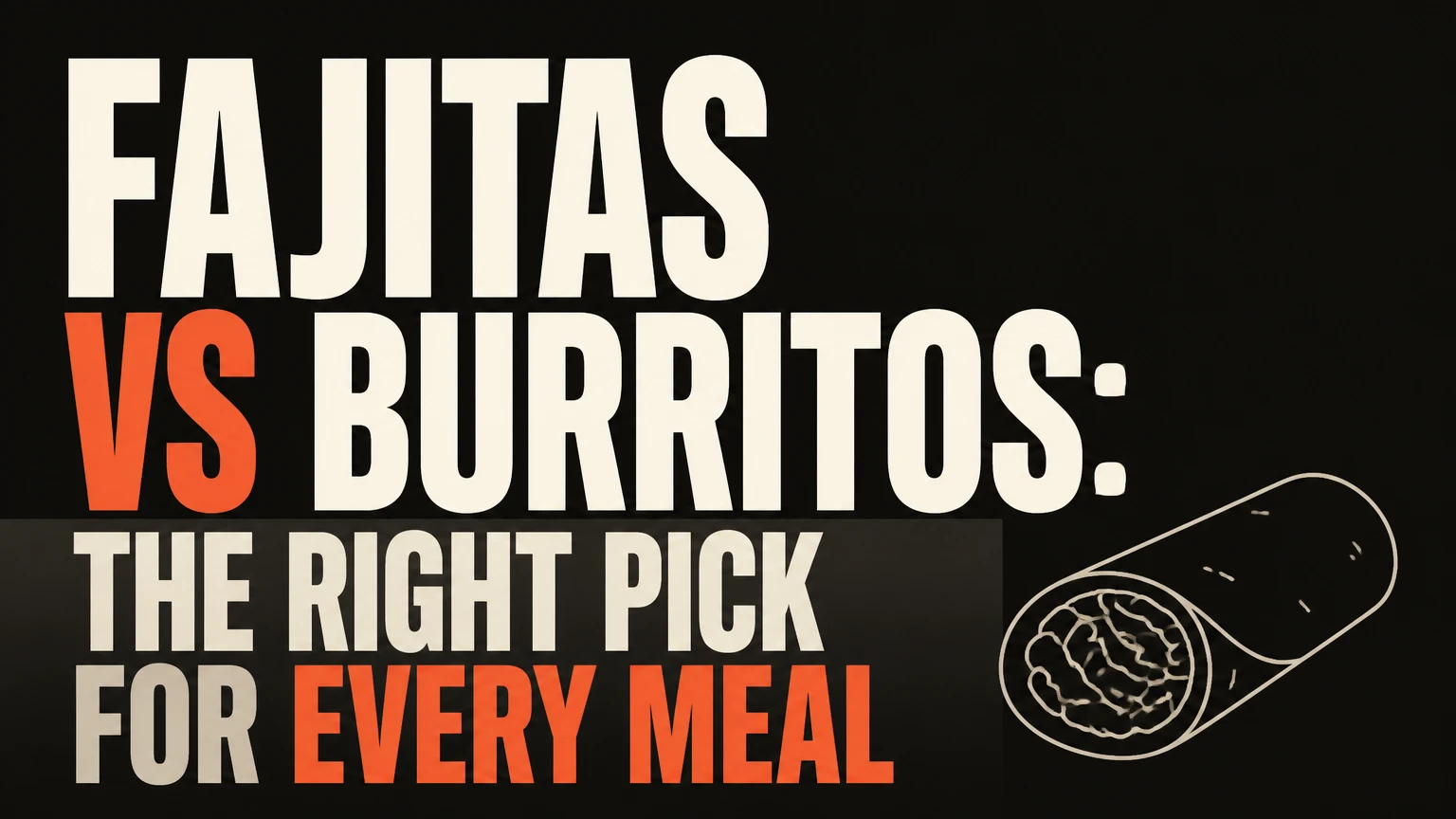
Fajitas are grilled strips of meat and vegetables served with tortillas so diners assemble individual bites, while burritos are large flour tortillas tightly wrapped around a complete filling. Choose fajitas for sizzling presentation, crisp vegetables, and shared customization; choose burritos for portability, compact portions, and a cohesive meal that travels well.
Key Facts at a Glance
- Fajitas are an open, build-your-own meal centered on grilled strips of meat, vegetables, tortillas, and condiments.
- Burritos are enclosed flour-tortilla cylinders containing a combined filling such as meat, beans, rice, cheese, and salsa.
- A typical fajita tortilla measures 6-8 inches, while a burrito tortilla commonly measures 10-12 inches or more.
- Fajitas usually take longer to serve but offer better texture control at the table.
- Burritos generally travel, refrigerate, and portion more easily than fajita platters.
- Fajitas are usually the easier choice for lower-carbohydrate ordering because the tortilla can be omitted without rebuilding the dish.
What Is the Difference Between Fajitas and Burritos?
Fajitas and burritos differ mainly in structure, service, and eating method. Fajitas arrive as separate grilled components, whereas a burrito combines those components inside one tortilla before serving.
The distinction affects almost every practical decision. Fajitas expose the seared surface of the meat and vegetables, preserve more contrast between crisp and soft ingredients, and let each diner control the ratio of filling to tortilla. Burritos compress the same broad family of ingredients into a portable format, so rice, beans, sauce, and meat mingle during eating.
The word “fajita” traditionally relates to a cut or preparation associated with skirt steak, but United States restaurant menus now use the term for chicken, shrimp, vegetable, and mixed platters. A burrito can be small and lightly filled in northern Mexico or large and heavily loaded in the United States. Menu terminology is therefore useful, but not perfectly uniform.
How Are They Built and Served?
Fajitas are cooked in components and served open. A restaurant may bring a hot skillet of sliced meat with bell peppers and onions, plus tortillas, beans, rice, salsa, guacamole, sour cream, and cheese. The diner fills a tortilla and folds it around one or two bites.
Burritos are assembled before service. The cook places a measured filling in the center of a warmed flour tortilla, folds the side edges inward, tucks the bottom edge over the filling, and rolls the package forward. The result should have a sealed bottom and a compact cylinder that can be held in one hand.
That difference is the central answer to the comparison: fajitas prioritize interaction and component texture, while burritos prioritize containment and convenience.
Fajitas vs Burritos: Master Comparison
The table below compares typical restaurant and home versions. Actual size, price, and nutrition vary with the recipe, region, and portion.
| Criterion | Fajitas | Burritos |
|---|---|---|
| Primary format | Open platter with separate components | Enclosed flour-tortilla cylinder |
| Typical tortilla diameter | 6-8 inches | 10-12+ inches |
| Core fillings | Grilled meat, peppers, onions | Meat, beans, rice, cheese, salsa |
| Typical United States price | $15-$28, often shareable | $9-$16, usually individual |
| Typical home preparation | 30-45 minutes, excluding marinade | 20-30 minutes with prepared fillings |
| Portability | Low, requires several containers | High, one foil-wrapped package |
| Texture | Charred meat, crisp-tender vegetables | Cohesive, soft, layered filling |
| Customization point | Mostly at the table | Mostly before wrapping |
How Do the Tortillas Differ?
Fajitas commonly use 6-8-inch flour or corn tortillas, while burritos require a pliable flour tortilla around 10-12 inches or larger. The larger burrito tortilla provides enough surface area to contain fillings and create overlapping folds without tearing.
Tortilla material changes the experience. Corn tortillas bring a stronger toasted-corn flavor but are more prone to cracking when overloaded. Flour tortillas stretch more readily and tolerate moist fillings, which explains their dominance in burrito preparation.
Warmth matters more for burritos than for fajitas. A fajita tortilla can be warmed in a stack and handed around the table. A burrito tortilla must be soft enough to bend around a concentrated filling, so heat it for about 10-15 seconds in a microwave under a damp towel or warm it briefly on a dry skillet.
Which Fillings Work Best?
Fajitas work best with ingredients that benefit from high heat and fast cooking. Skirt steak, flank steak, chicken thigh, shrimp, mushrooms, poblano strips, zucchini, bell peppers, and onions all suit the open format because their surfaces can brown without being buried.
Burritos work best with fillings that remain stable after mixing and wrapping. Rice, refried or whole beans, shredded chicken, seasoned beef, scrambled egg, potatoes, cheese, and thick salsa hold together more reliably than watery vegetables or large pieces of meat.
| Filling | Fajita performance | Burrito performance | Typical cooking detail |
|---|---|---|---|
| Skirt steak | Excellent char and fast slicing | Good after thin slicing | Sear about 3-5 minutes per side, depending on thickness |
| Chicken thigh | Juicy and forgiving | Excellent for batch filling | Cook to 165°F internal temperature |
| Shrimp | Excellent, rapid cooking | Good if added immediately | Usually 1-2 minutes per side |
| Bell pepper and onion | Crisp-tender when flashed | Good when softened first | Cook 5-8 minutes in a hot pan |
| Rice and beans | Optional side components | Core structural filling | Use cooled, moderately dry portions |
| Mushrooms and tofu | Strong vegetarian platter option | Good with beans or rice | Brown in batches to avoid steaming |
Which Is More Filling?
A burrito is usually more filling per individual order because its 10-12-inch tortilla encloses a dense combination of starch, protein, beans, cheese, and sauce. Fajitas can provide a similar total amount of food, but the platter often distributes that food among tortillas, side dishes, and shared portions.
A typical burrito contains approximately 1.5-3 cups of filling, depending on the restaurant. A fajita platter may provide 6-12 ounces of cooked protein, 2-4 cups of vegetables and sides, and several small tortillas, but the amount is frequently intended for one or two diners.
The practical winner depends on the hunger pattern. A burrito gives one predictable portion. Fajitas let a diner stop after protein and vegetables or continue with rice, beans, cheese, and multiple tortillas.
Winner for maximum individual fullness: burritos, especially those containing beans and rice.
Winner for adjustable fullness: fajitas, because diners control each serving.
Which Is Better for Calorie Control?
Fajitas are generally easier to modify for calorie control because the grilled protein and vegetables remain separate from tortillas, rice, cheese, and creamy toppings. A diner can eat the skillet filling without tortillas or choose one tortilla instead of several.
Burrito calories accumulate inside a fixed package. A large flour tortilla may contribute roughly 200-350 calories, while rice, beans, cheese, sauces, and meat add substantially more. Typical restaurant burritos range from about 700 to more than 1,300 calories, although recipes vary widely.
| Component | Typical portion | Approximate calorie range | Main variable |
|---|---|---|---|
| Small fajita tortilla | 1 tortilla, 6-8 inches | 50-140 kcal | Corn versus flour and thickness |
| Large burrito tortilla | 1 tortilla, 10-12 inches | 200-350 kcal | Diameter, flour weight, added fat |
| Cooked lean chicken | 4 ounces | 180-250 kcal | Cut, skin, marinade, cooking fat |
| Cooked rice | 1/2-1 cup | 100-220 kcal | Oil and serving size |
| Beans | 1/2-1 cup | 110-250 kcal | Whole versus refried preparation |
| Cheese or creamy topping | 1-3 ounces | 100-300 kcal | Quantity and type |
Calorie ranges in the table are typical planning estimates, not laboratory values for every restaurant. The United States Food and Drug Administration requires chain restaurants to provide calorie information in covered locations, making the posted menu number more reliable than a generic internet estimate.
Winner for calorie control: fajitas, when ordered with vegetables, lean protein, salsa, and a controlled tortilla portion.
How Can You Order Either Option More Lightly?
For fajitas, request grilled vegetables, lean chicken or shrimp, salsa instead of a creamy topping, and tortillas on the side. For burritos, choose beans, lean protein, and vegetables, then reduce cheese, rice, and sauce rather than removing all of the filling.
A useful practitioner rule is to change one dense component at a time. Removing rice, cheese, and beans simultaneously can make a burrito structurally dry and less satisfying, while replacing one component with extra vegetables preserves volume.
Which Is Faster to Make?
Burritos are faster when cooked fillings already exist, with assembly often taking 5-10 minutes and total home preparation around 20-30 minutes. Fajitas usually require active slicing, marinating, searing, vegetable cooking, tortilla warming, and topping setup, producing a typical total of 30-45 minutes before optional marinating time.
Fajitas can become faster when using thin chicken strips, pre-sliced vegetables, and a single hot skillet. Burritos become slower when every component starts raw, because rice, beans, protein, and tortilla preparation must finish before assembly.
How Do You Prepare Fajitas Successfully?
- Slice protein and vegetables into similarly sized strips.
- Marinate meat for 30 minutes to 4 hours with lime, garlic, oil, cumin, and chili powder.
- Heat a cast-iron skillet until very hot.
- Cook meat in a single layer, using batches if necessary.
- Rest the meat, then sauté peppers and onions until browned but slightly firm.
- Slice the meat across the grain and return it to the hot pan.
- Serve with warmed tortillas and toppings immediately.
You will know the fajitas worked when the meat has browned edges, the vegetables retain a slight bite, and the tortilla remains flexible. The United States Department of Agriculture recommends using a food thermometer rather than color alone, with poultry reaching 165°F and whole cuts of beef reaching the applicable safe minimum temperature.
How Do You Roll a Burrito Without Splitting It?
- Warm one 10-12-inch flour tortilla for 10-15 seconds.
- Place about 1-1.5 cups of filling slightly below the center.
- Keep a border of roughly 2 inches around the sides and bottom.
- Fold the left and right edges inward.
- Pull the bottom edge tightly over the filling.
- Roll forward while tucking the filling inward.
- Place the burrito seam-side down for serving or toast it briefly.
You will know the burrito is properly rolled when the seam stays closed without foil and the filling does not bulge from either end. A 12-inch tortilla can often hold approximately 1.5-2 cups, but wetter mixtures require less.
What Do Fajitas and Burritos Cost?
Fajitas often cost more at restaurants because a platter includes separate protein, vegetables, tortillas, sides, toppings, and serving equipment. Burritos usually have a lower menu price because the same components are portioned into one handheld item.
| Buying situation | Fajitas, typical price | Burritos, typical price | Value consideration |
|---|---|---|---|
| Home meal for two | $12-$25 total | $10-$22 total | Fajitas use more fresh produce; burritos use more prepared staples |
| Casual restaurant | $15-$28 | $9-$16 | Fajita platters may feed two people |
| Fast-casual restaurant | $11-$18 per bowl or plate | $9-$15 each | Burrito price is easier to predict |
| Premium restaurant | $24-$40 | $14-$22 | Fajitas may include higher-cost steak or seafood |
| Meal preparation | $2.50-$5 per serving | $2-$5 per serving | Burritos portion and freeze more efficiently |
Restaurant pricing changes by city, protein, service style, and portion. Compare the number of diners served, not only the menu price printed beside the item.
Which Is Better for Texture and Flavor?
Fajitas usually deliver stronger contrast: browned meat, crisp-tender vegetables, warm tortilla, cool salsa, and creamy toppings remain distinguishable. Burritos provide a more integrated flavor because rice, beans, meat, cheese, and salsa contact one another throughout the filling.
Fajita texture declines when the skillet sits too long, because steam softens the vegetables and the protein cools. Burrito texture declines when watery salsa, sour cream, or hot ingredients remain trapped inside the tortilla for an extended period.
What Usually Goes Wrong?
| Failure mode | Likely cause | Correction | Prevention |
|---|---|---|---|
| Tough fajita meat | Sliced with the grain or overcooked | Cut perpendicular to the fibers; rest before slicing | Mark grain direction before cooking |
| Pale, wet vegetables | Overcrowded skillet | Cook in two batches over high heat | Leave visible pan space |
| Cracked burrito tortilla | Cold or undersized tortilla | Warm a larger tortilla and reduce filling | Use 10-12-inch flour tortillas |
| Burrito seam opens | Excess filling or loose tuck | Remove 2-3 tablespoons and retighten | Keep filling below 1.5 cups |
| Soggy burrito center | Watery salsa or steaming-hot rice | Drain salsa and cool fillings briefly | Place wet ingredients between drier layers |
| Dry burrito | Too little sauce or lean filling | Add measured salsa or beans | Balance protein with moist, thick ingredients |
The most common fajita mistake is treating the pan as a storage container rather than a high-heat cooking surface. When sliced meat covers the entire skillet, released moisture lowers the temperature and prevents browning.
The most common burrito mistake is overfilling. A smaller, tightly compressed burrito eats better than a large package that tears across the center.
What Types of Burritos Should You Know?
Burrito names describe different regional and restaurant conventions, so no single filling list defines every version.
| Burrito style | Typical origin or association | Main contents | Serving format |
|---|---|---|---|
| Northern Mexican burrito | Northern Mexico | One or two fillings, such as beans or machaca | Small, thin, lightly wrapped |
| Mission burrito | San Francisco, California | Rice, beans, meat, salsa, cheese, sour cream | Large, foil-wrapped cylinder |
| Breakfast burrito | United States and northern Mexico | Eggs, potatoes, cheese, chorizo or bacon | Handheld morning meal |
| California burrito | San Diego, California | Carne asada, french fries, cheese, guacamole | Large, dense handheld meal |
| Wet burrito | United States restaurant style | Filled burrito covered with red or green sauce | Plated and eaten with utensils |
A traditional northern Mexican burrito may be much smaller than the oversized restaurant burrito familiar in the United States. Calling one version “authentic” while dismissing another overlooks the dish’s regional range.
Fajita variations also include beef, chicken, shrimp, mushroom, tofu, and poblano-based platters. The defining feature remains the grilled-strip presentation and separate assembly, not a mandatory protein.
Which Is Better for Different Situations?
The best choice depends on the meal’s physical setting and the level of control diners need. Fajitas fit shared dinners and dietary variation, while burritos fit commuting, packed lunches, and meals that must remain contained.
For a Family or Dinner Party
Choose fajitas when several people need different portions or toppings. One guest can use corn tortillas, another can skip tortillas, and a third can add rice, beans, cheese, or guacamole without requiring separate entrées.
Fajitas also create a better table experience because cooking aromas, warm skillets, and assembly happen during the meal. The limitation is logistics: expect multiple bowls, serving utensils, plates, and cleanup.
For Commuting and Packed Lunches
Choose burritos for one-handed eating, transport, and controlled portioning. Foil or parchment protects the exterior, while a tightly rolled seam reduces leaks.
Burritos are not ideal for every filling. Watery tomatoes, thin sauces, and very hot rice create steam and sogginess, so use drained salsa, thick beans, and fillings cooled for several minutes before rolling.
For Meal Prep and Freezing
Burritos generally outperform fajitas for meal preparation because each portion can be wrapped, labeled, refrigerated, or frozen. Rice, beans, cooked chicken, potatoes, and cheese reheat more consistently than fresh lettuce, sour cream, or raw tomato.
Freeze burritos without fragile cold toppings. Reheat from thawed in a microwave or covered skillet, then crisp the exterior in a dry pan for about 1-2 minutes per side.
For Lower-Carbohydrate Eating
Choose fajitas without tortillas, rice, or beans when the goal is to reduce carbohydrate intake. The grilled protein, peppers, onions, salsa, and guacamole can remain as a plated meal.
A burrito can be modified into a bowl, but that changes the dish’s defining wrapped structure. Burrito bowls preserve the filling combination while removing the tortilla, so they are a practical alternative rather than a conventional burrito.
For Vegetarian or Vegan Meals
Both formats work well with mushrooms, tofu, black beans, pinto beans, zucchini, poblano peppers, and grilled corn. Fajitas emphasize the browning and texture of the vegetables, while burritos provide protein and starch through beans, rice, tofu, and seeds.
Check the cooking surface and toppings when ordering. Shared griddles, cheese, sour cream, and butter-based sauces can change whether a menu item meets a strict dietary requirement.
Which Should You Choose?
Choose fajitas if you want grilled flavor, crisp vegetables, table interaction, flexible portions, or an easier lower-carbohydrate modification. Fajitas are the stronger choice for groups, mixed dietary needs, and diners who care about separate textures.
Choose burritos if you want a complete meal in one package, a lower individual menu price, easier transport, or reliable meal-prep portions. Burritos are the stronger choice for commuters, packed lunches, freezer cooking, and diners who prefer rice-and-beans fullness.
| User need | Recommended choice | Specific reason | Best modification |
|---|---|---|---|
| Shared dinner | Fajitas | One platter supports multiple ratios | Add tortillas and toppings separately |
| One-handed meal | Burrito | Sealed 10-12-inch flour tortilla | Use thick salsa and foil wrapping |
| Calorie control | Fajitas | Components remain separate | Skip or limit tortillas and creamy toppings |
| Freezer meal | Burrito | Compact portions reheat efficiently | Omit sour cream and raw tomato |
| Crisp vegetables | Fajitas | High-heat vegetables stay exposed | Serve skillet immediately |
| Maximum starch and protein | Burrito | Rice and beans occupy the core | Add lean protein and measured sauce |
| Dietary customization | Fajitas | Diners assemble each bite | Place all toppings in separate bowls |
| Fast assembly from leftovers | Burrito | Prepared fillings roll in minutes | Warm the tortilla before filling |
The Bottom Line
Fajitas vs burritos is fundamentally a choice between an open grilled platter and an enclosed flour-tortilla meal. Fajitas win for shared dining, texture contrast, and portion control; burritos win for portability, fullness, predictable serving, and meal preparation. Select the format that matches where you will eat and how much control you need.
Frequently Asked Questions
Are fajitas healthier than burritos?
Fajitas are often easier to make lower in calories because the diner can limit tortillas, rice, cheese, and creamy toppings. A burrito may still fit a balanced meal when built with lean protein, beans, vegetables, and controlled cheese, but the large tortilla and dense filling make portion size less visible.
Can you make a burrito with corn tortillas?
A standard large burrito usually requires a flour tortilla because flour dough stretches around a substantial filling without splitting. Corn tortillas can wrap small, lightly filled burritos when softened and layered, but they are more likely to crack than a 10-12-inch flour tortilla.
Do fajitas always contain steak?
Fajitas do not always contain steak. Beef skirt steak is historically associated with the name, but chicken, shrimp, mushrooms, tofu, and vegetables are common modern variations. The grilled-strip preparation and separate tortilla assembly matter more than the protein selected.
Can fajita fillings go inside a burrito?
Fajita fillings can go inside a burrito after the meat and vegetables are sliced into manageable pieces. Add rice, beans, or cheese for structure, drain excess liquid, and keep the total filling near 1-1.5 cups for a 12-inch tortilla to prevent tearing.
Which dish is better for children?
Fajitas are often better for children who dislike mixed textures because meat, vegetables, tortillas, and toppings remain separate. Burritos suit children who prefer predictable bites, but a smaller 8-10-inch tortilla and mild, drier fillings are easier to hold and less likely to spill.
How long do fajitas and burritos keep?
Cooked fajita and burrito fillings should be refrigerated promptly and used within the period recommended by local food-safety guidance, commonly 3-4 days for cooked leftovers kept at 40°F or below. Wrapped burritos freeze better than assembled fajita platters, especially when fresh toppings remain separate.