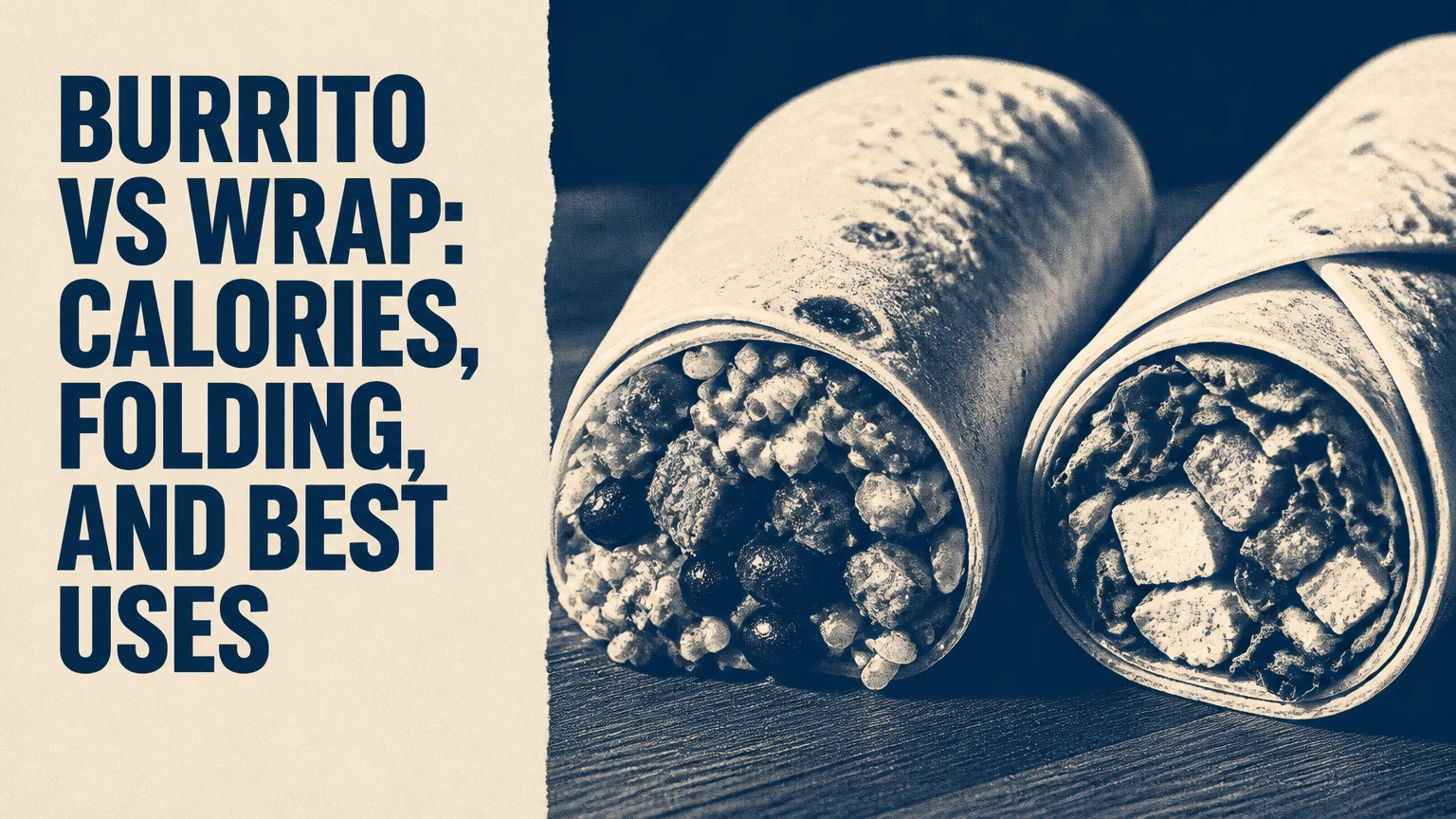
A burrito is a specific Mexican or Tex-Mex dish built around a flour tortilla and a substantial filling, while a wrap is a broad sandwich category made with flatbread or leafy greens. Burritos usually emphasize hot, cohesive fillings such as beans, rice, meat, eggs, or potatoes; wraps commonly emphasize sliced proteins, vegetables, cheese, and dressing, served cold or warm.
Key Facts at a Glance
- A burrito is defined by culinary identity and filling style, not by tortilla diameter alone.
- A wrap is a broad format that can use flour, whole-grain, flavored, gluten-free, or lettuce-based wrappers.
- Typical restaurant burritos contain about 700-1,300 calories, while typical wraps contain about 400-900 calories, depending on ingredients and sauces.
- Burrito tortillas commonly measure 10-12 inches, but traditional Mexican burritos can be smaller; wrap tortillas commonly measure 9-11 inches.
- A sealed burrito usually travels better than an open-ended wrap because the filling is enclosed on all sides.
- A wrap is often the better choice for crisp vegetables, lighter lunches, and meal preparation with dressing added later.
What Is the Difference Between a Burrito and a Wrap?
The main difference is culinary category. A burrito is a recognized Mexican food with a flour tortilla enclosing a filling, whereas a wrap is a modern Western sandwich format that places varied ingredients inside flatbread or another flexible outer layer.
Merriam-Webster defines a burrito as “a flour tortilla wrapped around a filling,” commonly including ingredients such as beans, meat, and cheese. That definition identifies the tortilla and enclosed form, but regional practice adds more detail. Traditional Mexican burritos may contain one main preparation, such as beans or a stewed filling, while large United States versions often combine rice, beans, protein, cheese, salsa, and creamy toppings.
The word wrap describes construction more than origin. A chicken Caesar wrap, turkey wrap, falafel wrap, and lettuce wrap can differ substantially in temperature, wrapper, seasoning, and nutrition while remaining wraps.
Are Burritos a Type of Wrap?
A burrito is technically a type of filled wrap because both foods enclose ingredients in a flexible sheet. Culinary usage still treats burrito as a more specific category, so calling every wrap a burrito would be inaccurate.
The distinction resembles the relationship between a sedan and a car. “Car” describes the broad group, while “sedan” identifies a narrower form. A burrito generally signals Mexican or Tex-Mex flavors, a flour tortilla, and a compact enclosed package. A wrap signals flexibility and sandwich-style assembly.
A burrito can contain lettuce and sliced vegetables, and a wrap can contain beans, rice, or hot food. Those overlaps create hybrid foods, but the menu name usually follows the dish’s culinary tradition and assembly style.
How Do Size and Structure Differ?
A typical restaurant burrito uses a 10-12-inch flour tortilla, while a typical wrap uses a 9-11-inch flatbread. Size ranges overlap, so the stronger distinction is structural: burritos are usually packed into a closed cylinder, while wraps may remain open at both ends or use an envelope fold.
| Feature | Burrito | Wrap |
|---|---|---|
| Common wrapper diameter | 10-12 inches | 9-11 inches |
| Common wrapper material | Flour tortilla | Flour, whole-grain, spinach-flavored, tomato-flavored, or lettuce |
| Typical filling weight | 350-650 grams | 180-350 grams |
| Common closure | Fully enclosed seam | Open-ended or partially enclosed |
| Moisture tolerance | High when tortilla is warm and thick | Moderate, depending on flatbread |
| Typical serving context | Hot meal or handheld entrée | Lunch, snack, or portable sandwich |
Large Mission-style burritos need a tortilla with enough extensibility to fold around dense fillings without tearing. A thin tortilla may work for a small bean burrito but fail around rice, beans, salsa, and grilled meat.
Wraps often prioritize surface area for layered ingredients. A 10-inch wrap can hold sliced chicken, lettuce, tomato, cheese, and dressing without needing the tight compression expected from a burrito.
Why Does Tortilla Preparation Matter?
Warming hydrates and softens a tortilla, reducing cracks during folding. A dry flour tortilla breaks at the fold because its starch structure has lost flexibility, while a heated tortilla bends around fillings with less stress.
For a burrito, warm the tortilla on a dry skillet for about 10-20 seconds per side, or microwave it between damp paper towels for 10-15 seconds. For a wrap, a shorter 5-10-second warming interval may be enough, especially when using a thin whole-grain flatbread.
The wrapper also affects flavor. Flour tortillas provide a neutral, elastic base. Whole-grain wraps add fiber and a nutty taste, while lettuce leaves reduce starch but provide less protection against warm, wet fillings.
How Do Burrito and Wrap Fillings Differ?
Burrito fillings usually form a hot, cohesive meal with a starch, protein, beans, vegetables, or sauce. Wrap fillings more often resemble a composed sandwich, with separate layers of protein, cheese, greens, vegetables, and a spread.
| Filling category | Burrito examples | Wrap examples | Structural effect |
|---|---|---|---|
| Starch | Rice, potatoes, beans | Couscous, quinoa, occasional rice | Increases fullness and weight |
| Protein | Grilled chicken, beef, eggs, beans | Turkey, grilled chicken, falafel, tofu | Determines density and texture |
| Vegetables | Peppers, onions, corn, cooked greens | Lettuce, tomato, cucumber, carrot | Adds moisture or crunch |
| Dairy | Shredded cheese, sour cream | Swiss, feta, Parmesan, yogurt sauce | Adds fat and binding |
| Sauce | Salsa, chili sauce, tomatillo sauce | Mayonnaise, Caesar dressing, hummus | Adds moisture and calories |
| Signature extras | French fries, guacamole, roasted vegetables | Olives, celery, herbs, pickles | Establishes regional or menu identity |
Burritos often distribute fillings in a compressed cross-section, which helps each bite contain several components. Wraps usually preserve more contrast between crisp greens, sliced protein, and dressing.
The distinction is not absolute. A breakfast wrap may contain eggs and potatoes, and a burrito may contain fresh lettuce. The filling’s arrangement and the dish’s culinary context matter more than one ingredient.
What Are the Main Types of Each Food?
Burrito styles differ mainly by region, size, temperature, and filling complexity. Wrap styles differ mainly by sandwich ingredients, wrapper material, and serving temperature.
| Style | Typical ingredients | Wrapper or finish | Typical use |
|---|---|---|---|
| Traditional Mexican burrito | Beans, guisado, or one principal filling | Small or medium flour tortilla | Regional meal |
| Mission burrito | Rice, beans, protein, salsa, cheese, sour cream | Large flour tortilla, tightly sealed | Large restaurant entrée |
| Breakfast burrito | Eggs, potatoes, cheese, beans, vegetables | Warm flour tortilla | Morning meal |
| California burrito | Grilled beef, fries, cheese, salsa, guacamole | Large flour tortilla | Hearty fast-casual meal |
| Wet burrito | Enclosed burrito with red or green sauce | Sauced and eaten with utensils | Plated entrée |
| Wrap style | Typical ingredients | Wrapper | Temperature |
|---|---|---|---|
| Deli wrap | Turkey, cheese, lettuce, tomato, mayonnaise | White or whole-wheat flour | Cold |
| Chicken Caesar wrap | Chicken, romaine, Parmesan, Caesar dressing | Flour or flavored tortilla | Cold or warm |
| Mediterranean wrap | Falafel, hummus, cucumber, feta, olives | Flatbread or flour tortilla | Room temperature or warm |
| Buffalo chicken wrap | Spicy chicken, celery, lettuce, blue cheese dressing | Flour tortilla | Warm or cold |
| Plant-based wrap | Tofu, beans, greens, vegetables, hummus | Whole-grain or flour tortilla | Cold or warm |
| Lettuce wrap | Chicken, tofu, vegetables, sauce | Boston bibb or romaine leaves | Cold or warm |
A wet burrito demonstrates why category boundaries can mislead. It begins as a handheld, enclosed burrito but becomes a fork-eaten plated dish after sauce and melted cheese are added.
Which Has More Calories?
A burrito usually has more calories than a wrap because it combines a larger tortilla with rice, beans, cheese, protein, and substantial sauces. A wrap can exceed a burrito when it contains fried protein, a large tortilla, cheese, and a generous dressing portion.
| Meal example | Typical calories | Main calorie drivers | Protein estimate |
|---|---|---|---|
| Bean and rice burrito | 650-950 kcal | Tortilla, rice, beans, cheese, sauce | 20-35 g |
| Chicken Mission burrito | 850-1,300 kcal | Tortilla, rice, beans, chicken, dairy | 40-65 g |
| Egg and potato breakfast burrito | 600-1,000 kcal | Eggs, potato, cheese, tortilla | 25-45 g |
| Turkey salad wrap | 400-700 kcal | Tortilla, turkey, cheese, dressing | 25-40 g |
| Chicken Caesar wrap | 550-900 kcal | Chicken, tortilla, Parmesan, dressing | 30-50 g |
| Falafel hummus wrap | 450-800 kcal | Flatbread, falafel, hummus, sauce | 15-30 g |
These are typical meal-building estimates, not universal nutrition values. USDA FoodData Central entries show that tortilla size, cooked protein, cheese, and sauces vary enough to change a meal substantially. A two-tablespoon dressing portion can add roughly 100-180 calories, while a large flour tortilla may contribute 200-350 calories before fillings.
The FDA requires many chain restaurants with 20 or more locations to display calorie information, so a menu value is more reliable than a generic category estimate. For a lower-calorie meal, controlling sauce, cheese, tortilla size, and fried additions usually matters more than choosing the word wrap.
Does One Have Better Nutrition?
Neither category is automatically healthier. A wrap with fried chicken and creamy dressing can contain more calories and sodium than a bean burrito, while a burrito with beans, vegetables, modest cheese, and a smaller tortilla can provide more fiber and protein than a refined-flour deli wrap.
For calorie control, choose a 9-inch whole-grain wrap, lean protein, two cups of non-starchy vegetables, and dressing measured at one tablespoon. For a more energy-dense meal, choose a burrito with beans, rice, protein, and vegetables, then adjust cheese and sauces to control total fat and sodium.
Whole-grain labeling requires attention. The phrase “spinach wrap” may describe color and flavor rather than a meaningful serving of spinach. Check the nutrition panel for fiber, sodium, and protein instead of treating wrapper color as a health claim.
What Do Burritos and Wraps Cost?
Typical United States restaurant prices range from $9-$15 for a burrito and $8-$14 for a wrap, with location, protein, portion size, and service model causing most variation. Home preparation commonly costs $2-$6 per serving for either format when ingredients are purchased in ordinary package sizes.
| Purchase situation | Burrito price | Wrap price | Typical preparation time |
|---|---|---|---|
| Home, bean-based | $1.50-$3.00 | $1.50-$3.50 | 10-20 minutes |
| Home, chicken-based | $3.00-$6.00 | $3.00-$6.00 | 20-35 minutes |
| Fast-casual restaurant | $10-$15 | $9-$14 | 5-10 minutes |
| Café or deli | $9-$14 | $8-$14 | 5-15 minutes |
| Premium restaurant | $14-$20 | $13-$19 | 15-25 minutes |
A burrito can be more filling per dollar because rice and beans increase serving weight at modest ingredient cost. A wrap may cost less when it uses sliced deli protein and raw vegetables, but premium sauces, specialty flatbreads, and packaged salad ingredients can reverse the difference.
Menu comparisons should use edible weight and included sides. A $12 wrap with a side salad may provide a different value from a $12 burrito served alone.
How Should You Fold Each One?
A burrito needs a warm tortilla, a compact filling line, side folds, and a tight bottom-to-top roll. A wrap needs a moisture barrier and either an open-ended cylinder or a closed envelope fold, depending on whether portability or presentation matters more.
Burrito Folding Method
- Warm one 10-12-inch flour tortilla for 10-20 seconds per side.
- Place 1-1.5 cups of filling in the lower center, leaving at least 2 inches at each side.
- Fold the left and right edges inward over the filling.
- Pull the bottom edge over the filling and tuck it underneath.
- Roll forward while maintaining firm pressure.
- Place the seam face down in a dry skillet for about 10 seconds if a sealed package is needed.
The filling should occupy roughly one-third of the tortilla’s surface area. You will know the fold worked when the ends remain closed after the burrito is lifted horizontally.
The common mistake is overfilling with loose rice or watery salsa. Remove excess liquid, reduce the portion, or use a second tortilla rather than forcing the seam closed.
Wrap Folding Method
- Warm a 9-11-inch flatbread for 5-10 seconds if it feels stiff.
- Spread 1-2 tablespoons of hummus, mayonnaise, dressing, or another binder, stopping 1 inch from the edge.
- Add leafy greens first, followed by 85-140 grams of protein and 1/2-1 cup of vegetables.
- Fold the bottom edge upward over the filling.
- Tuck both side edges inward and roll forward for a closed wrap.
- Slice diagonally with a sharp knife, or leave whole for transport.
Greens can reduce direct contact between wet tomato or dressing and the flatbread, although they cannot prevent sogginess indefinitely. Store dressing separately when the wrap will sit longer than several hours.
A wrap usually fails when the filling is spread too widely. Keep the ingredients in a narrow rectangle that is about 2 inches shorter than the wrapper’s width.
Which Travels Better?
A fully enclosed burrito generally travels better for 30-90 minutes because its folded ends contain loose fillings and its seam can be sealed against a skillet. A wrap travels well when its dressing is restrained and its bottom edge is folded, but open-ended versions leak more easily.
| Travel condition | Better choice | Packaging method | Main risk |
|---|---|---|---|
| Commute under 30 minutes | Burrito | Foil plus paper sleeve | Heat softens tortilla |
| Lunch after 2-4 hours | Closed wrap | Parchment plus container | Dressing migration |
| Backpack transport | Burrito | Foil, seam down | Pressure crushing |
| Outdoor warm meal | Burrito | Ventilated foil | Steam condensation |
| Desk lunch with crisp vegetables | Wrap | Container with dressing separate | Flatbread drying |
| Meal prep for two days | Wrap components | Separate sauce and vegetables | Soggy wrapper |
A hot burrito should not be sealed in airtight plastic immediately because trapped steam can soften the tortilla and create condensation. Foil allows practical handling but does not replace safe refrigeration.
Perishable fillings should be chilled promptly and kept cold during storage. The FDA Food Code uses 41°F, or 5°C, as a cold-holding benchmark for many temperature-controlled foods in food-service settings, while home handling should follow local food-safety guidance.
Which Should You Choose?
The best choice depends on meal size, texture, temperature, portability, and dietary targets rather than on a general claim that one category is superior.
Choose a Burrito for a High-Energy Meal
A burrito suits long workdays, substantial post-exercise meals, and situations requiring a dense portion in one package. Rice, beans, potatoes, eggs, and protein can supply more carbohydrate and total energy than a typical sandwich wrap.
A burrito is less suitable when you need a small snack, very crisp vegetables, or precise calorie control without weighing ingredients. Large tortillas and multiple sauces make portion size difficult to estimate.
Choose a Wrap for a Lighter Lunch
A wrap suits office lunches, cold meals, and meals built around crunchy vegetables. A 9-inch whole-grain wrapper with lean protein and measured dressing can remain within a moderate calorie range while providing more texture than a dense burrito.
A wrap is less suitable for very wet fillings, heavy rice portions, or long transport without a container. Thin flatbreads can split when refrigerated, especially after repeated handling.
Choose a Burrito for Protein and Carbohydrate Recovery
A burrito can support recovery nutrition when it combines a protein source, carbohydrate-rich ingredients, and fluids from vegetables or salsa. A practical build includes 100-150 grams of cooked chicken or beans, 3/4-1 cup of rice, vegetables, and a controlled amount of cheese.
The meal still requires attention to total energy and sodium. A restaurant burrito with large portions of cheese, creamy sauce, and seasoned fillings may be far more calorie-dense than intended.
Choose a Wrap for Meal Preparation
A wrap works well for meal prep when the components remain relatively dry and the sauce is added shortly before eating. Store the flatbread, protein, greens, and vegetables together only when high-moisture ingredients are limited.
For two-day storage, keep tomatoes, cucumber, salsa, and dressing in separate containers. Assemble the wrap in under two minutes before eating.
Common Problems and How to Fix Them
Why Does the Tortilla Crack?
A tortilla cracks when it is cold, dry, stale, or overloaded near a fold. Warm it between damp paper towels for 10-15 seconds, or heat it briefly on a skillet, then roll while it remains pliable.
A tortilla that still tears after warming may be too small for the filling. Reduce the filling by 25-30% or move to a larger wrapper.
Why Does the Bottom Become Soggy?
The bottom becomes soggy when salsa, tomato, cucumber, or dressing sits directly against the flatbread for too long. Place cheese, greens, hummus, or a dry protein layer between the wrapper and wet ingredients.
For meal prep, remove excess liquid from vegetables and use a thicker spread. Dressing stored separately provides the most reliable texture after several hours.
Why Does the Roll Unravel?
A roll unravels when the filling is too large, the side folds are too narrow, or the seam has no pressure holding it closed. Limit filling to about one-third of the wrapper’s surface, tuck the first turn tightly, and rest the package seam-side down.
For a burrito, a 10-second skillet sear can set the seam. For a wrap, parchment paper or a reusable sandwich sleeve provides additional support.
Why Do Fillings Slip Out?
Fillings slip when ingredients are cut too large or layered without a binder. Slice vegetables into strips under 1/2 inch thick, shred leafy greens, and use 1-2 tablespoons of hummus, cheese, or dressing to create cohesion.
Loose rice and whole beans are particularly difficult in an open-ended wrap. Those ingredients belong in a closed burrito fold or should be mashed into a spread.
Burrito and Wrap Alternatives
A burrito bowl removes the tortilla and preserves the rice, beans, protein, vegetables, and toppings. The bowl is easier to portion with a fork but loses the handheld portability that defines a wrapped meal.
A lettuce wrap replaces the flatbread with Boston bibb, romaine, or iceberg leaves. It reduces starch but cannot hold the same weight or moisture as a flour tortilla, so smaller portions and a plate are often necessary.
A quesadilla uses a tortilla folded around cheese and other fillings, then heated on a griddle. Its defining feature is the toasted, melted filling interface, not the fully enclosed cylindrical fold of a burrito.
| Alternative | Wrapper | Typical calories | Best use |
|---|---|---|---|
| Burrito bowl | None | 500-1,100 kcal | Fork meal and portion control |
| Lettuce wrap | Bibb or romaine | 150-600 kcal | Lower-starch snack or lunch |
| Quesadilla | Folded flour or corn tortilla | 400-900 kcal | Toasted cheese-centered meal |
| Pita pocket | Pita bread | 350-800 kcal | Stuffed Mediterranean-style meal |
| Salad bowl | Leafy greens | 250-800 kcal | Vegetable-forward meal |
These alternatives solve different problems. A bowl improves access and portion visibility, a lettuce wrap reduces wrapper starch, and a quesadilla prioritizes toasted cheese and crisp edges.
Expert Rules for Better Results
- Use the wrapper as a moisture-management tool. Put dry, structural ingredients against the flatbread and wet ingredients toward the center. This rule matters more than whether the meal is labeled burrito or wrap.
- Match filling density to tortilla diameter. A 10-inch tortilla handles roughly 1-1.5 cups of compact filling; a 12-inch tortilla can handle more, but loose ingredients still need compression.
- Do not confuse wrapper marketing with nutrition. Spinach-colored and tomato-colored tortillas may have similar calories and fiber to plain flour tortillas. Read grams of fiber and sodium per serving.
- Seal heat, not steam. A skillet-seared seam improves burrito stability, but wrapping a very hot burrito tightly can trap condensation and create a soft, torn bottom.
- Calculate the sauce separately. A measured tablespoon of sauce can change the calorie difference between two otherwise similar meals more than the choice of tortilla style.
FAQ
Can a Burrito Be Made Without Rice?
Yes. A burrito can contain beans, vegetables, eggs, grilled protein, cheese, or a stew without rice. Traditional Mexican burritos often use a smaller ingredient set than large Mission-style burritos, so rice is common in some regional and restaurant versions but is not a defining requirement.
Can a Wrap Be Served Hot?
Yes. Wraps can contain hot grilled chicken, falafel, roasted vegetables, or toasted fillings. Temperature does not determine the category, although cold sandwich-style ingredients are common in deli and lunch wraps.
Is a Burrito Always Made With Flour?
Most burritos use flour tortillas because flour provides the flexibility needed for a tight, enclosed fold. Corn tortillas are more associated with tacos and other Mexican preparations, but regional and modern variations can use different wrappers.
Which Is Easier for Children to Eat?
A small closed burrito is usually easier when the filling is compact and mild, while a half-cut wrap may work better for children who prefer cold vegetables and sliced protein. Portion diameter, filling texture, and sauce control matter more than the menu label.
Which Is Better for a Vegetarian Meal?
Either option works. A burrito can combine beans, rice, vegetables, and cheese for a substantial meal, while a wrap can combine hummus, falafel, tofu, greens, and vegetables for a lighter one. Choose the burrito for greater energy density and the wrap for more raw vegetable texture.
The Bottom Line
Burrito vs wrap is primarily a question of culinary identity, filling architecture, and eating situation. Choose a burrito for a hot, dense, fully enclosed meal with rice, beans, potatoes, or substantial protein; choose a wrap for a flexible sandwich format with crisp vegetables, varied flatbreads, and easier portion control. Neither is automatically healthier, cheaper, or more portable because ingredients and assembly determine the result.