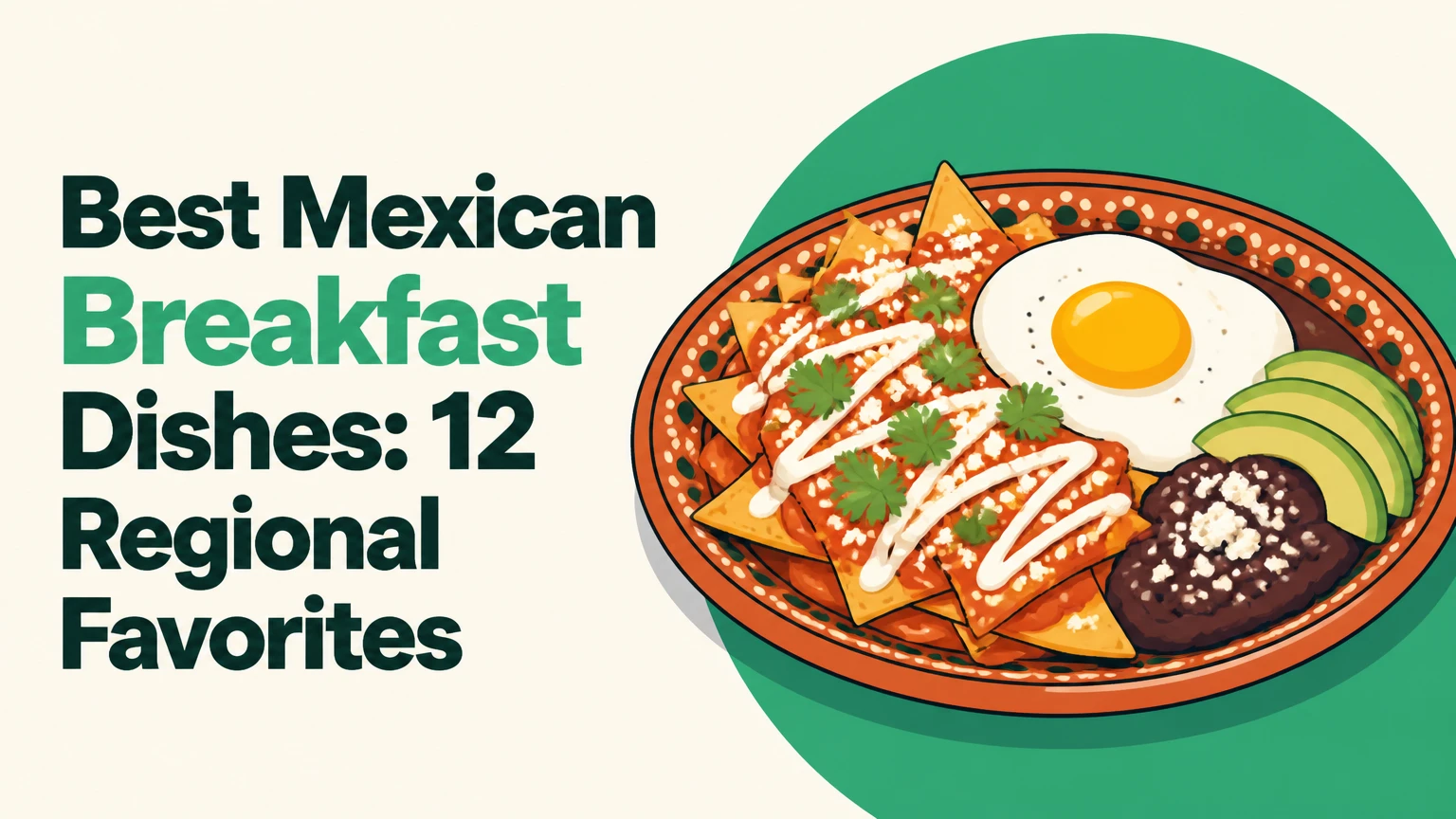
The best Mexican breakfast dishes combine corn tortillas or bread with beans, salsa, eggs, masa, or regional meat. Chilaquiles are the strongest overall choice for a classic sit-down meal, while huevos a la Mexicana suit beginners, molletes suit low-cost cooking, and tamales or a torta de tamal work best when convenience matters.
Key Facts at a Glance
- Chilaquiles are fried tortilla pieces briefly coated in red or green salsa, then finished with crema, cheese, onion, and often eggs.
- Huevos rancheros pair fried eggs and lightly fried corn tortillas with warm tomato-based ranchero salsa.
- Huevos a la Mexicana contain scrambled eggs, tomato, onion, and fresh green chile.
- Northern Mexican machacado con huevo uses shredded dried beef with eggs and usually flour tortillas.
- Molletes use a split bolillo, refried beans, melted cheese, and fresh pico de gallo.
- A typical homemade serving costs about $1.50-$5.50 in the United States, depending on eggs, cheese, and regional meat.
How We Chose the Best Mexican Breakfast Dishes
The ranking weighs cultural recognition, flavor balance, preparation reliability, regional identity, ingredient access, and suitability for different eaters. A dish ranks highly when a home cook can reproduce its defining texture and flavor without specialist equipment.
The list also separates traditional identity from restaurant popularity. A loaded breakfast burrito may be convenient in the United States, but a dish such as enfrijoladas reveals more about Mexico’s use of beans, tortillas, and salsa as a connected cooking system.
UNESCO’s 2010 description of traditional Mexican cuisine calls it “a comprehensive cultural model comprising farming, ritual practices, age-old skills, culinary techniques and ancestral community customs.” Breakfast fits that model because nixtamalized corn, beans, chiles, tomatoes, and local cooking methods connect the plate to place and household practice.
Best Mexican Breakfast Dishes Ranked
1. Chilaquiles: Best Overall
Chilaquiles are the best overall Mexican breakfast for diners who want crisp corn tortillas, salsa, beans, and eggs in one adaptable plate. The defining technique is brief coating, not prolonged simmering: chips should soften at the edges while retaining enough structure to carry toppings.
Typical details
| Attribute | Typical value | Best choice |
|---|---|---|
| Home preparation time | 20-35 minutes | Store-bought chips and prepared salsa |
| Main base | 3-4 cups tortilla chips | Thick, unsalted corn chips |
| Salsa amount | 1-1.5 cups per 4 servings | Add gradually |
| Common toppings | 2 eggs, 2 tablespoons crema | Onion, queso fresco, cilantro |
Red chilaquiles use tomato and dried chile salsa; green chilaquiles use tomatillos, green chiles, and herbs. Both work with fried eggs, shredded chicken, avocado, or beans, although excessive toppings can hide the tortilla and salsa.
The main drawback is timing. Chilaquiles lose their defining contrast after roughly 5-10 minutes in sauce, so they are poor candidates for a buffet unless the salsa and chips remain separate.
Choose this if: you want the most recognizable, customizable plated breakfast.
Skip it if: you need food that remains crisp for a long commute.
2. Huevos Rancheros: Best Classic Egg Plate
Huevos rancheros are the best choice for a traditional egg-centered breakfast with a clear separation between components. The standard plate has fried eggs on lightly fried corn tortillas, warm ranchero salsa, refried beans, and sometimes avocado or fresh cheese.
Typical details
| Attribute | Typical value | Practical target |
|---|---|---|
| Preparation time | 25-40 minutes | 15 minutes with prepared salsa |
| Eggs per serving | 2 | Sunny-side up or over-easy |
| Tortillas per serving | 2 | Fry 5-15 seconds per side |
| Salsa volume | ¾-1 cup | Enough to cover whites, not yolks |
Ranchero salsa generally combines tomato, onion, garlic, and chile. Simmering for about 10 minutes removes raw flavor and produces a spoonable sauce rather than a watery topping.
The dish is less portable than tacos and requires coordination among eggs, tortillas, beans, and salsa. It also depends on egg timing, because an overcooked yolk removes the sauce-like richness that many diners expect.
Choose this if: you want a composed breakfast with runny yolks and warm salsa.
Skip it if: you need a make-ahead meal.
3. Huevos a la Mexicana: Best for Beginners
Huevos a la Mexicana are the easiest traditional Mexican egg dish for beginners because the ingredients are inexpensive and the cooking sequence takes about 5-8 minutes after chopping. Tomato, onion, and green chile create the dish’s characteristic red, white, and green color pattern.
Typical details
| Ingredient | Quantity for 2 servings | Timing |
|---|---|---|
| Large eggs | 4 | Beat immediately before cooking |
| Tomato | 1 medium, diced | Add after onion softens |
| White onion | ¼ medium, diced | Cook 2-3 minutes |
| Serrano or jalapeño | ½-1 chile | Add with tomato |
Cook the onion first, then add chile and tomato until the tomato begins to lose its raw edge. Add beaten eggs over medium-low heat and fold slowly until barely set. Residual heat finishes the curds.
The drawback is that watery tomatoes can produce loose eggs. Roma tomatoes or drained diced tomatoes work better than very ripe salad tomatoes, especially in a crowded skillet.
Choose this if: you are cooking Mexican breakfast for the first time.
Skip it if: you want a crisp tortilla component or a saucy plated dish.
4. Machacado con Huevo: Best Northern Mexican Breakfast
Machacado con huevo is the strongest choice for a salty, high-protein northern Mexican breakfast. The dish combines rehydrated shredded dried beef with scrambled eggs, onion, tomato, chile, and flour tortillas.
Dried beef varies in saltiness, so soak or briefly rinse it before cooking when necessary, then squeeze it dry. For two servings, 60-90 grams of machacado and four eggs create a substantial filling for three or four flour tortillas.
The beef adds concentrated savory flavor and a firmer texture than fresh ground meat. Salsa, avocado, or beans help balance its salt, while large flour tortillas make the dish practical for wrapping.
The limitation is ingredient access. Machacado may be unavailable outside Mexican and border-region markets, and substituting ordinary shredded beef changes the texture and removes the dried-beef character.
Choose this if: you prefer a hearty northern-style breakfast with flour tortillas.
Skip it if: you need a vegetarian dish or a low-sodium meal.
5. Molletes: Best Budget Breakfast
Molletes are open-faced bolillo rolls spread with refried beans and melted cheese, then finished with pico de gallo. They are the best budget option because one inexpensive roll stretches a small quantity of beans and cheese into a filling meal.
Typical details
| Component | Quantity per serving | Typical U.S. home cost |
|---|---|---|
| Bolillo | 1 roll | $0.75-$1.50 |
| Refried beans | ½ cup | $0.40-$0.90 |
| Melting cheese | ¼ cup, 30-40 grams | $0.60-$1.25 |
| Pico de gallo | ¼ cup | $0.40-$1.00 |
Broil the bean-covered bread until the cheese melts and the edges crisp, usually 2-4 minutes. Add pico de gallo after broiling so its acidity and fresh texture remain distinct.
Molletes are not ideal when the bread is very soft or the beans are watery. A dry, sturdy bolillo provides a better base, while thick refried beans prevent the crumb from becoming saturated.
Choose this if: you want a low-cost breakfast under 20 minutes.
Skip it if: you avoid bread or want a high-protein plate without adding eggs.
6. Tamales: Best for Convenience and Groups
Tamales are steamed masa parcels filled with ingredients such as chicken, beef, cheese, vegetables, or sweet fillings, then wrapped in corn husks. Tamales rank highly for convenience because prepared tamales reheat well and can feed several people without last-minute skillet work.
Typical details
| Serving situation | Quantity | Reheating time |
|---|---|---|
| Light breakfast | 1 tamale | 15-20 minutes steaming |
| Standard breakfast | 2 tamales | 20-25 minutes steaming |
| Family table | 8-12 tamales | 25-35 minutes steaming |
| Microwave method | 1-2 tamales | 2-4 minutes, covered |
Atole, a warm masa-based drink, is a traditional pairing, while salsa, crema, or fruit can add contrast. Tamales are especially useful for gatherings because the filling and masa are already portioned.
Their drawback is production time. Homemade tamales commonly require several hours for preparation, assembly, and steaming, so they are better made in batches than prepared for one hurried morning.
Choose this if: you need a reheatable breakfast for a group.
Skip it if: you want a quick single-serving recipe from raw ingredients.
7. Huevos Divorciados: Best for Two Salsas
Huevos divorciados feature two fried eggs separated by beans, with one egg covered in red salsa and the other in green salsa. The dish is best for diners who want to compare contrasting chile and tomato flavors on the same plate.
Red salsa usually tastes rounder and more tomato-forward, while green salsa made with tomatillos tends toward sharper acidity. The bean line prevents the sauces from immediately blending and provides a neutral, creamy bridge.
Huevos divorciados take about 25-40 minutes when both salsas are prepared from scratch. Using one prepared salsa and one fresh salsa reduces labor while preserving the central contrast.
The drawback is coordination. Two sauces require extra cookware, and watery salsa can spread across the plate, eliminating the separation that gives the dish its name.
Choose this if: you enjoy contrasting red and green chile sauces.
Skip it if: you want the simplest possible egg breakfast.
8. Enfrijoladas: Best Vegetarian Comfort Dish
Enfrijoladas are folded corn tortillas dipped in a smooth bean sauce and filled with eggs, cheese, or vegetables. They are the best vegetarian comfort dish when the goal is a soft, savory meal rather than crisp tortilla texture.
Blend 2 cups cooked beans with ½-1 cup broth until pourable, then warm the sauce with onion, garlic, or epazote. Dip each tortilla briefly, fill it, fold it, and finish with cheese, onion, or crema.
The bean sauce supplies body and flavor, so well-seasoned beans matter more than elaborate toppings. Black beans create a deeper flavor, while pinto beans produce a milder, creamier result.
Enfrijoladas can become heavy when the sauce is too thick or the tortillas are not warmed first. They also require more assembly than huevos a la Mexicana, despite using similar pantry ingredients.
Choose this if: you want a meat-free, bean-forward Mexican breakfast.
Skip it if: you prefer crisp textures.
9. Migas: Best for Leftover Tortillas
Mexican migas combine fried or toasted tortilla strips with scrambled eggs, often with onion, tomato, and chile. Unlike chilaquiles, migas cook the tortilla pieces directly with the eggs, so the final texture is scattered, tender, and lightly crisp rather than salsa-coated.
For two servings, use four eggs and two stale corn tortillas cut into strips. Fry the strips until firm, add vegetables, then fold in the eggs and remove the pan while the curds remain slightly glossy.
Migas are economical because they turn old tortillas into a complete breakfast. Cheese, beans, avocado, or salsa can be added after cooking without changing the basic method.
The limitation is texture control. Fresh tortillas can absorb oil and become chewy, while thin strips burn quickly. Stale tortillas or pre-baked strips give more reliable results.
Choose this if: you have leftover corn tortillas and want breakfast in 15 minutes.
Skip it if: you want a saucy dish with distinct layers.
10. Breakfast Tacos and Burritos: Best for Portability
Breakfast tacos and burritos are the best portable Mexican-style breakfast when eggs, beans, potatoes, cheese, or regional meat must travel. Corn tortillas suit tacos, while large flour tortillas provide the flexibility and strength needed for a wrapped burrito.
A taco commonly uses one or two tortillas and a compact filling; a burrito uses approximately 150-250 grams of filling in a 25-30-centimeter flour tortilla. Drain salsa and beans before wrapping, because excess moisture causes tearing and leakage.
These formats are adaptable for vegetarian, dairy-free, and higher-protein diets. They also reheat more predictably than chilaquiles, especially when wet toppings are packed separately.
The drawback is that oversized restaurant burritos can become dense, difficult to eat, and disproportionately starchy. A balanced portable breakfast needs a defined filling ratio rather than every available topping.
Choose this if: you need breakfast during a commute or workday.
Skip it if: you want a carefully composed regional plate.
11. Torta de Tamal: Best Mexico City Street Breakfast
A torta de tamal, also called a guajolota, places a tamal inside a bolillo roll. It is strongly associated with Mexico City street breakfast and provides a fast, filling meal for commuters.
The bread adds structure and portability, while the tamal supplies masa and filling. Green tamales, red tamales, and mole-style fillings produce different flavor profiles, but the format remains intentionally simple.
The main drawback is density. A tamal inside bread creates a carbohydrate-heavy breakfast with limited fresh produce, so it works better as an occasional street meal than as a daily balanced plate.
Choose this if: you want a distinctly Mexico City street-food experience.
Skip it if: you prefer lighter breakfasts or need more vegetables.
12. Pan Dulce With Café de Olla: Best Sweet Breakfast
Pan dulce, including conchas and orejas, paired with café de olla is the best sweet Mexican breakfast combination. Café de olla is traditionally brewed with cinnamon and piloncillo, producing a spiced, lightly caramelized drink that complements the pastry.
This pairing requires little cooking when the bread is purchased fresh. It works well as a light morning meal or as a second breakfast after a savory dish.
The limitation is nutritional balance. Pastry and sweetened coffee provide less protein and fiber than eggs, beans, or masa filled with vegetables, so adding fruit, yogurt, or a savory side makes the meal more sustaining.
Choose this if: you want a traditional sweet start with coffee.
Skip it if: you need a high-protein breakfast.
Which Dish Has the Best Balance of Cost, Time, and Fullness?
Molletes offer the lowest typical cost, huevos a la Mexicana offer the fastest fresh preparation, and chilaquiles provide the strongest combination of flavor, flexibility, and satiety. The following figures are typical U.S. home-cooking estimates for one serving, not restaurant prices.
| Dish | Time | Typical cost | Fullness driver | Heat range |
|---|---|---|---|---|
| Huevos a la Mexicana | 10-15 min | $1.50-$3.00 | Eggs and beans | Mild-medium |
| Molletes | 15-20 min | $1.50-$3.50 | Bread, beans, cheese | Mild |
| Chilaquiles | 20-35 min | $2.50-$5.00 | Chips, eggs, beans | Mild-hot |
| Huevos rancheros | 25-40 min | $2.50-$5.00 | Eggs, tortillas, beans | Mild-medium |
| Enfrijoladas | 25-40 min | $2.00-$4.50 | Beans and tortillas | Mild |
| Machacado con huevo | 20-30 min | $4.00-$7.00 | Eggs and dried beef | Medium |
| Tamales | 15-25 min reheated | $3.00-$6.00 | Masa and filling | Mild-medium |
| Torta de tamal | 5-10 min purchased | $3.00-$6.00 | Tamal and bolillo | Mild |
What Should You Serve for Different Dietary Needs?
Mexican breakfast can accommodate vegetarian, dairy-free, gluten-free, and higher-protein preferences, but the substitutions should preserve the dish’s defining structure. Replacing every component with a generic alternative can produce a workable meal without retaining the original identity.
| Need | Best dishes | Useful adjustment | Main caution |
|---|---|---|---|
| Vegetarian | Enfrijoladas, molletes, huevos a la Mexicana | Use beans, cheese, eggs, and vegetables | Check refried beans for cooking fat |
| Dairy-free | Huevos rancheros, migas, breakfast tacos | Omit crema and cheese; add avocado | Use oil-based beans |
| Gluten-free | Chilaquiles, tamales, huevos rancheros | Choose certified corn products | Avoid flour tortillas and some packaged sauces |
| Higher protein | Machacado con huevo, huevos rancheros | Add eggs, beans, or chicken | Dried beef can be salty |
| Mild heat | Molletes, enfrijoladas, huevos a la Mexicana | Remove seeds and use mild chiles | Salsa heat varies by pepper |
| Make-ahead | Tamales, burritos, bean filling | Refrigerate components separately | Chilaquiles soften in storage |
How Spicy Are Traditional Mexican Breakfast Dishes?
Mexican breakfast dishes range from mild to hot, and the chile variety plus seed removal usually matters more than the dish name. Molletes and enfrijoladas can be nearly mild, while salsa-topped chilaquiles and huevos divorciados become hotter according to the cook’s chile selection.
For a mild plate, use roasted poblano or a small amount of jalapeño, remove seeds and inner membranes, and serve salsa at the table. Serrano produces more direct heat, while dried chiles can contribute depth without the same fresh sharpness.
How Do You Prepare the Two Most Technical Dishes?
Chilaquiles and huevos rancheros succeed when the cook controls moisture and timing. The following method uses ordinary supermarket ingredients and produces four servings.
Chilaquiles Method
- Prepare the salsa. Blend 450 grams tomatoes or tomatillos with ¼ onion, one garlic clove, and chile to taste. Simmer the mixture in one tablespoon oil for 8-12 minutes, until spoon-coating.
- Warm the chips. Use 6 cups thick corn tortilla chips, or fry six tortillas cut into wedges. Homemade chips usually take 10-15 minutes to fry and drain.
- Coat immediately. Add chips to the hot salsa and fold for 30-60 seconds. Stop when the edges soften but the centers resist slightly.
- Finish the plate. Add one fried egg per serving, 1 tablespoon crema, 2 tablespoons crumbled queso fresco, sliced onion, and cilantro.
You will know the method worked when the chips bend slightly without collapsing. The common mistake is adding all the salsa at once, which creates a wet pile; reserve ¼ cup and add it only if the chips remain dry.
Huevos Rancheros Method
- Cook the ranchero salsa. Sauté ¼ onion and one minced garlic clove, then add 450 grams chopped tomato and chile. Simmer 10 minutes.
- Fry the tortillas. Heat a thin layer of oil and cook four corn tortillas for 5-15 seconds per side. Drain them while keeping the centers flexible.
- Cook the eggs. Fry four eggs over medium heat. Cover the pan briefly if the whites need setting without flipping.
- Assemble. Place two tortillas on each plate, add beans, top with eggs, and spoon salsa around and partly over the whites.
The success checkpoint is a set white with a soft yolk and tortillas that hold their shape. The common mistake is drowning the yolks in boiling salsa, which cooks them and makes the plate watery.
What Common Mistakes Ruin Mexican Breakfast?
Mexican breakfast failures usually come from moisture, heat, or sequencing rather than unavailable ingredients. Correcting the process often improves the result more than buying a specialized product.
- Soggy chilaquiles: Toss chips in salsa immediately before serving, and use thick chips that can withstand 30-60 seconds of coating.
- Rubbery scrambled eggs: Cook over medium-low heat and remove the pan when curds are still slightly glossy.
- Bitter salsa: Garlic burns quickly. Add it after the onion has softened, or blend it into the liquid before simmering.
- Watery enfrijoladas: Reduce broth and simmer blended beans until the sauce coats a spoon.
- Torn breakfast burritos: Cool wet fillings for several minutes, drain salsa, and use a warm flour tortilla.
- Soggy molletes: Toast the cut side of the bolillo before adding beans, then broil the cheese briefly rather than baking the entire sandwich slowly.
A useful practitioner rule is to control moisture at the last possible moment. Salsa belongs on chilaquiles immediately before eating, pico de gallo belongs on molletes after broiling, and wet burrito fillings should be drained before wrapping.
Can You Make These Dishes Ahead?
Tamales, beans, salsa, and breakfast-taco fillings can be prepared ahead, but crisp tortilla dishes should be assembled at service. Refrigerated tamales typically reheat in 15-25 minutes in a steamer, while cooked beans keep their texture for about four days when chilled promptly.
| Component | Advance window | Storage | Best finishing method |
|---|---|---|---|
| Ranchero salsa | 3-4 days | Covered refrigerator container | Reheat to a gentle simmer |
| Cooked beans | 3-4 days | Airtight container | Loosen with broth |
| Tamales | 3-4 days refrigerated | Wrapped or sealed | Steam 15-25 minutes |
| Burrito filling | 3 days | Separate sealed containers | Reheat before wrapping |
| Fried tortilla chips | 1-2 days | Dry airtight container | Sauce immediately before serving |
| Pico de gallo | 1 day | Refrigerated container | Drain excess liquid |
For a crowd, prepare beans and both salsas the day before, warm tortillas shortly before serving, and cook eggs in batches. Chilaquiles should remain a made-to-order item because holding them changes their texture.
Which Mexican Breakfast Should You Pick?
Choose chilaquiles for the best overall sit-down breakfast, huevos a la Mexicana for the easiest first attempt, and molletes for the lowest-cost meal. Choose tamales for groups, breakfast tacos or burritos for portability, enfrijoladas for a vegetarian bean-centered plate, and machacado con huevo for a hearty northern-style serving.
| Situation | Recommended dish | Why it fits | Avoid when |
|---|---|---|---|
| First Mexican recipe | Huevos a la Mexicana | Five core ingredients and fast cooking | You want crisp tortillas |
| Best overall flavor contrast | Chilaquiles | Salsa, crunch, cream, beans, and egg | Food must sit longer than 10 minutes |
| Lowest budget | Molletes | Beans extend one bread roll | You avoid wheat |
| Most portable | Breakfast tacos | Compact and easy to customize | You need a formal plated meal |
| Family gathering | Tamales | Batch-friendly and reheatable | You are cooking from raw masa today |
| Mild vegetarian meal | Enfrijoladas | Beans, tortillas, and cheese provide substance | You dislike soft textures |
| Northern regional flavor | Machacado con huevo | Dried beef and flour tortillas | You need low sodium |
| Mexico City street experience | Torta de tamal | Recognizable commuter breakfast | You want a light meal |
Frequently Asked Questions
What Is a Typical Mexican Breakfast?
A typical Mexican breakfast often combines eggs, beans, corn tortillas, salsa, or bread, with regional ingredients changing the final dish. Northern areas favor flour tortillas and machacado, Mexico City is known for tamales and tortas de tamal, and many households serve eggs with fresh vegetables and beans.
Are Mexican Breakfast Dishes Healthy?
Mexican breakfast dishes can be nutritious when beans, eggs, vegetables, and corn tortillas form the foundation, although cheese, crema, frying oil, salt, and oversized portions raise energy and sodium levels. Huevos a la Mexicana and enfrijoladas offer easier vegetable and bean balance than a very large fried burrito.
What Is the Difference Between Chilaquiles and Enchiladas?
Chilaquiles use tortilla chips briefly coated in salsa, while enchiladas use softened whole tortillas filled and rolled before being covered with sauce. Chilaquiles are usually assembled quickly for breakfast, whereas enchiladas create a more structured filled dish that holds together longer.
Which Mexican Breakfast Is Least Spicy?
Molletes, enfrijoladas, and plain huevos a la Mexicana are usually the least spicy because their defining ingredients are beans, bread, eggs, and vegetables rather than hot salsa. Heat remains adjustable, so use seeded jalapeño, poblano, or table-served salsa for better control.
Can You Make Mexican Breakfast Without Eggs?
Yes. Molletes, tamales, enfrijoladas, pan dulce with café de olla, and bean-filled tacos can all be served without eggs. For a more filling egg-free plate, combine beans with tortillas or bread and add vegetables, cheese, avocado, or a substantial masa filling.
The Bottom Line
The best Mexican breakfast dishes depend on the meal’s purpose, but chilaquiles are the strongest overall recommendation because they combine corn, salsa, beans, toppings, and optional eggs with substantial regional variation. Huevos a la Mexicana deliver the simplest homemade result, molletes minimize cost, and tamales solve group-serving and make-ahead needs. Choose the dish whose texture and format match the occasion, then add salsa, beans, and tortillas with deliberate timing.