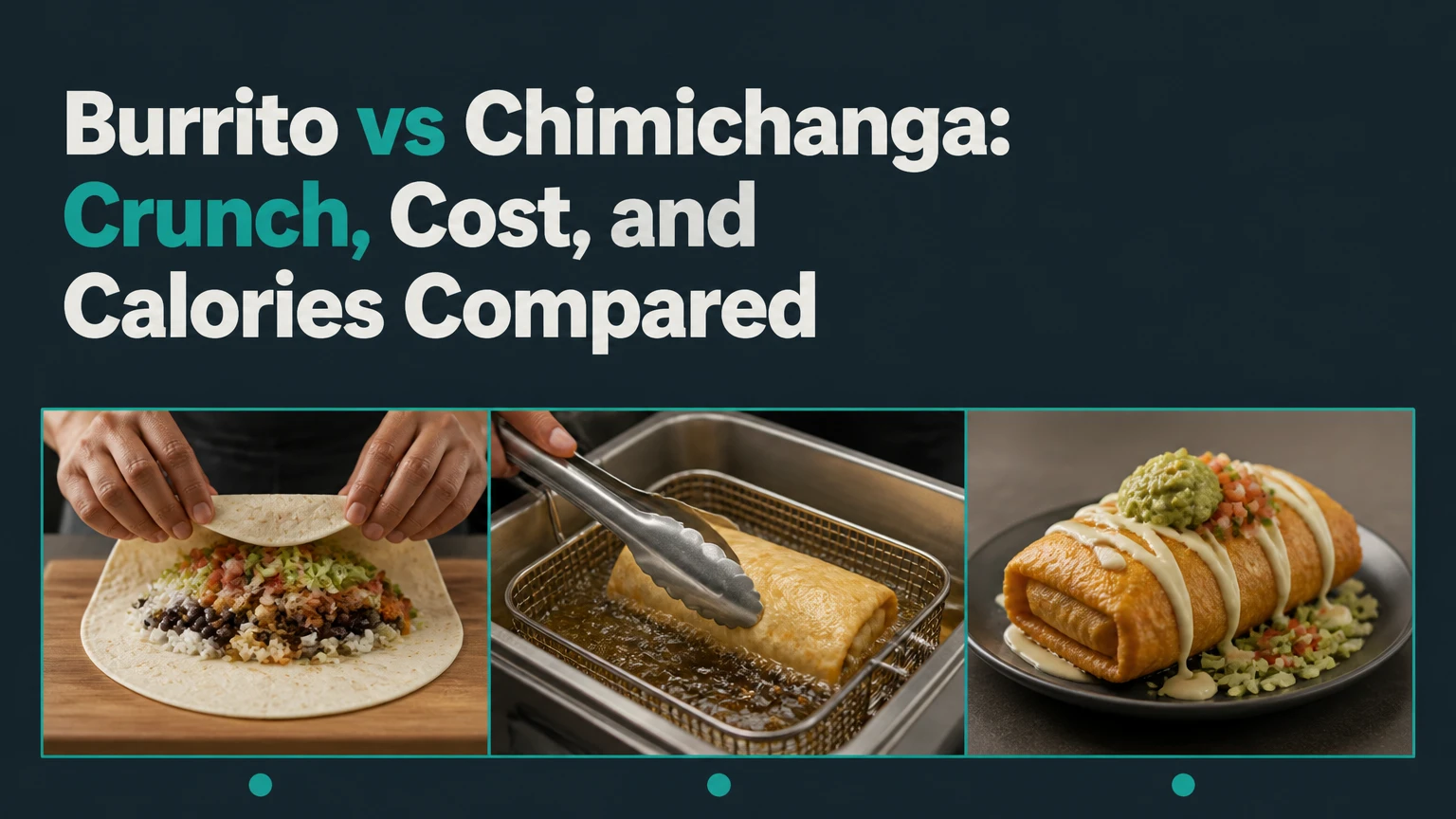
A burrito is a soft flour tortilla wrapped around a filling and served fresh, while a chimichanga is generally a filled burrito that is deep-fried until crisp. The decisive difference is the cooking method: burritos preserve a pliable tortilla and fresh toppings, whereas chimichangas create a crunchy shell, hotter interior, higher fat exposure, and usually a plated meal.
Key Facts at a Glance
- A chimichanga is usually a deep-fried burrito, not a separate type of tortilla.
- A standard burrito uses a warm, flexible flour tortilla, commonly 10-12 inches wide.
- Chimichangas require relatively dry fillings because water can cause oil splatter and a split wrapper.
- Burritos are usually more portable and easier to customize with lettuce, salsa, guacamole, and sour cream.
- Typical restaurant burritos cost less than chimichangas because frying, plating, and sauces add labor.
- Neither dish has a fixed calorie count because tortilla size, cheese, rice, beans, protein, sauces, and frying absorption vary widely.
What Is the Difference Between a Burrito and a Chimichanga?
The main difference between a burrito and a chimichanga is that the burrito remains soft, while the chimichanga is fried after assembly. Both dishes use a flour tortilla wrapped around a filling, but frying changes the exterior texture, the suitable ingredients, the serving format, and the typical energy content.
The word burrito is the Spanish diminutive of burro, meaning “little donkey.” The exact reason for the name is uncertain. Common explanations connect the rolled shape with packs carried by donkeys, although culinary historians do not treat one origin story as proven.
A chimichanga belongs primarily to Tex-Mex and Southwestern American restaurant traditions. Tucson, Arizona, receives the most familiar origin attribution, often through a story about an accidentally dropped burrito. That story is widely repeated, but competing restaurant-origin claims mean the anecdote should be treated as culinary folklore rather than settled historical fact.
| Attribute | Burrito | Chimichanga | Practical consequence |
|---|---|---|---|
| Wrapper state | Soft and pliable | Crisp, blistered, and browned | Texture determines the eating experience |
| Cooking after wrapping | None or brief griddle sear | Deep-fried, usually 2-4 minutes | Frying adds oil exposure and heat |
| Best interior | Fresh and mixed | Dense and relatively dry | Wet ingredients can rupture the shell |
| Typical serving | Handheld or plated | Plated with sauce and toppings | Chimichangas usually need utensils |
| Culinary category | Mexican and Tex-Mex | Mainly Tex-Mex and Southwestern | Regional menus use the terms differently |
Is a Chimichanga Just a Fried Burrito?
A chimichanga is best understood as a fried burrito with construction requirements tailored to hot oil. The comparison is similar to distinguishing a fresh filled pastry from the same pastry after frying: the basic architecture remains, but the cooking process changes the wrapper and limits the filling choices.
Restaurants vary considerably. Some lightly fry a burrito for a thin, crisp surface, while others fully submerge it and serve it under chile sauce or queso. A menu may call a fried item a chimichanga even when its fillings differ from the restaurant’s ordinary burrito.
How Do Construction and Cooking Differ?
Burrito construction prioritizes flexibility, volume, and ingredient contrast. A cook warms a 10-12-inch flour tortilla, places roughly 1-1.5 cups of filling below the center, folds the sides inward, tucks the lower edge, and rolls the tortilla seam-side down.
A chimichanga requires tighter engineering. The tortilla must enclose a compact filling with minimal loose edges, and the final seam must stay closed while oil surrounds the entire parcel. A toothpick can hold the fold temporarily, but it must be removed before serving.
Burrito Assembly
- Warm one 10-12-inch flour tortilla for 10-20 seconds in a microwave or briefly on a dry skillet.
- Add 1/2 cup rice, 1/3 cup beans, 3-4 ounces protein, and selected toppings.
- Keep watery salsa and sour cream away from the tortilla’s outer edge.
- Fold both sides inward by 1-2 inches.
- Pull the bottom edge over the filling, tighten the bundle, and roll forward.
- Toast the seam on a dry skillet for about 30 seconds if additional stability is needed.
The success checkpoint is a compact cylinder with no filling visible at either end. The most common error is adding more than the tortilla can compress. A 12-inch tortilla can hold a large meal, but excessive rice, cheese, and sauce create pressure points that split during rolling.
Chimichanga Assembly and Frying
- Warm a large flour tortilla until flexible but not wet.
- Add 3-4 ounces shredded chicken or beef, 1/3 cup refried beans, and 1/4 cup cheese.
- Keep tomatoes, lettuce, sour cream, guacamole, and thin salsa outside the wrapper.
- Fold the sides inward, tuck the near edge over the filling, and roll tightly.
- Place the parcel seam-side down or secure it with a wooden toothpick.
- Fry at approximately 350-375°F, or 175-190°C, for 2-4 minutes.
- Drain on a rack or paper towel, remove the toothpick, and add warm sauce afterward.
The success checkpoint is an evenly golden wrapper that feels rigid when lifted with tongs. Oil below about 350°F can produce a greasy shell because the tortilla spends longer absorbing oil before its surface crisps. Oil above the recommended range can brown the wrapper before the center becomes hot.
Which Dish Has Better Texture and Toppings?
The burrito offers greater textural range because its wrapper does not need to withstand frying. Crisp lettuce, raw onion, fresh tomato, guacamole, cool sour cream, and bright salsa can remain inside the roll without creating a cooking hazard.
The chimichanga concentrates texture into a crisp exterior and a hot, cohesive center. Melted cheese, seasoned beans, and shredded meat work particularly well because they remain stable during frying and become cohesive when heated.
| Ingredient or topping | Burrito suitability | Chimichanga suitability | Best placement |
|---|---|---|---|
| Refried beans | High, 1/3-1/2 cup | High, 1/4-1/3 cup | Inside both |
| Shredded chicken | High, 3-4 ounces | High, 3-4 ounces | Inside both |
| Fresh lettuce | High | Low before frying | Inside burrito, on top of chimichanga |
| Guacamole | High | Low before frying | Inside burrito, added after frying |
| Sour cream | High | Low before frying | Inside burrito or served on top |
| Shredded cheese | High | High | Inside both, 1/4-1/2 cup |
| Thin salsa | Moderate | Low | Use sparingly in burrito, serve afterward on chimichanga |
| Rice | High | Moderate | Inside both, but use less in a chimichanga |
Why Do Wet Fillings Cause Chimichanga Problems?
Water in salsa, tomatoes, or sour cream turns into steam during frying, increasing internal pressure and weakening the tortilla seam. The same moisture can also escape into the oil, causing splattering, a soggy wrapper, or a dangerous flare-up around the pan.
A practical rule is to use dense fillings inside the chimichanga and add wet toppings after draining. Refried beans are safer than loose beans, drained shredded meat is safer than broth-heavy stew, and grated cheese is safer than a thin cheese sauce.
Which Is Healthier, a Burrito or a Chimichanga?
A burrito is usually the lighter choice when both dishes contain comparable fillings because it avoids deep-frying. The comparison changes when the burrito is oversized and loaded with cheese, rice, sour cream, and fatty meat, while the chimichanga is small and filled with lean chicken.
The United States Department of Agriculture does not assign one universal calorie value to “a burrito” or “a chimichanga.” Nutrition databases list recipes and restaurant products with different tortilla weights, oils, fillings, and serving sizes, so menu estimates should be treated as approximate rather than laboratory-equivalent measurements.
| Typical restaurant portion | Burrito | Chimichanga | Main calorie driver |
|---|---|---|---|
| Tortilla | 220-330 kcal | 220-330 kcal | Diameter and flour weight |
| Rice and beans | 250-450 kcal | 180-350 kcal | Portion and bean preparation |
| Meat or chicken | 180-350 kcal | 180-350 kcal | Cut, sauce, and serving size |
| Cheese and creamy toppings | 100-350 kcal | 100-350 kcal | Cheese, crema, and queso |
| Frying exposure | 0 kcal added by frying | Often 100-300+ kcal | Oil retained by the shell |
| Typical total | 600-1,100 kcal | 800-1,500+ kcal | Size and topping combination |
These are typical planning ranges, not standardized nutrition facts. A burrito bowl can reduce calories by removing the tortilla, while a chimichanga can be baked or air-fried to reduce oil exposure without reproducing the exact texture of deep frying.
How Can You Make Either Dish Lighter?
For a burrito, choose a smaller tortilla, lean chicken, black beans, fajita vegetables, and fresh salsa, then reduce rice and sour cream. For a chimichanga, use a smaller tortilla, drained chicken, modest cheese, and baking or air frying instead of full submersion.
The most counterintuitive nutrition mistake is assuming “fresh” automatically means low-calorie. A large burrito with a 330-calorie tortilla, a full cup of rice, cheese, crema, and avocado can exceed a smaller fried item with restrained fillings.
What Types of Burritos and Chimichangas Exist?
Burrito names often identify region, meal occasion, or topping style. Chimichanga names more often identify the filling, sauce, or regional restaurant interpretation because the frying method already defines the core item.
| Named style | Region or context | Signature contents | Typical service |
|---|---|---|---|
| Mission burrito | San Francisco Bay Area | Rice, beans, meat, salsa, cheese, optional guacamole | Large, foil-wrapped |
| Breakfast burrito | Southwestern USA | Eggs, potato, cheese, beans, breakfast meat | Handheld, morning meal |
| California burrito | San Diego | Carne asada, fries, cheese, salsa | Large, handheld |
| Wet burrito | Mexican and Tex-Mex menus | Filled burrito covered with chile sauce and cheese | Plated with fork |
| Arizona chimichanga | Arizona-style restaurants | Shredded beef or chicken, beans, cheese | Fried and topped |
| Smothered chimichanga | Tex-Mex menus | Fried filling plus green chile or ranchero sauce | Plated and sauced |
| Baja-style chimichanga | Southwestern restaurant interpretation | Chicken or beef with creamy chile topping | Fried and heavily topped |
A wet burrito is not automatically a chimichanga. The wet burrito is usually steamed, grilled, or simply plated before sauce is added, whereas a chimichanga has a fried tortilla shell. A restaurant can combine both ideas by frying first and smothering afterward.
Which Is More Portable and Convenient?
The burrito wins portability because the soft tortilla can be wrapped in foil and eaten with one hand. The chimichanga usually needs a plate because its rigid shell sheds flakes, holds hot filling, and often arrives covered in sauce, cheese, or crema.
| Use case | Better choice | Reason | Practical limit |
|---|---|---|---|
| Commute or lunch break | Burrito | Foil wrapper contains the filling | Eat within 30-45 minutes |
| Sit-down comfort meal | Chimichanga | Crisp shell and warm sauce suit plating | Requires knife and fork |
| Fresh vegetable toppings | Burrito | Raw ingredients remain inside | Avoid excess watery salsa |
| Batch preparation | Burrito | Faster assembly and no frying | Refrigerate promptly |
| Crispy texture | Chimichanga | Frying creates a blistered shell | Best immediately after cooking |
| Child’s meal | Small burrito | Easier to portion and hold | Cut in half before serving |
A fried shell softens as steam migrates from the filling into the tortilla. For that reason, takeout chimichangas often lose their defining texture within 15-30 minutes when sealed tightly in a container.
How Much Do Burritos and Chimichangas Cost?
Typical United States restaurant prices range from $9-$14 for a standard burrito and $12-$18 for a chimichanga, although city, portion size, protein, and service style can move either item outside those bands. Chimichangas cost more when frying, side dishes, sauces, and plating are included.
| Restaurant factor | Burrito range | Chimichanga range | Why the price changes |
|---|---|---|---|
| Quick-service entrée | $8-$13 | $10-$16 | Portion and local labor |
| Full-service entrée | $12-$20 | $15-$24 | Rice, beans, sauces, service |
| Premium protein upgrade | +$2-$6 | +$2-$6 | Steak, seafood, or specialty meat |
| Guacamole or queso | +$1-$4 | +$1-$4 | Add-on portion |
| Side dish | $0-$4 | $0-$5 | Chimichangas often include sides |
| Home-cooked serving | $2-$6 | $3-$8 | Oil, tortilla, filling, and toppings |
Restaurant prices are local benchmarks, not fixed culinary standards. A large Mission burrito can cost more than a small plated chimichanga, while a fast-food frozen chimichanga can cost less than either restaurant version.
Which Should You Choose?
Choose a burrito for portability, fresh toppings, faster preparation, or more control over calories. Choose a chimichanga for a crisp exterior, melted cheese, dense savory fillings, and a plated comfort-food experience.
Choose a Burrito If You Need Lunch on the Go
A burrito is the practical winner for commuting, school lunches, and meals eaten without a table. Ask for salsa on the side if the burrito will sit longer than 30 minutes, because liquid gradually weakens the tortilla and makes the bottom seam difficult to hold.
Choose a Chimichanga for Crisp Texture
A chimichanga is the stronger choice when crunch matters more than freshness. Order it immediately before eating, and request sauces on top rather than underneath if you want the fried wrapper to remain crisp.
Choose a Burrito for Fresh Ingredients
A burrito handles lettuce, raw onion, pico de gallo, avocado, and cool dairy toppings better than a chimichanga. The fresh ingredients stay distinct instead of steaming inside a fried shell.
Choose a Chimichanga for a Restaurant Comfort Meal
A smothered chimichanga suits a sit-down meal with chile sauce, melted cheese, beans, and rice. It is less efficient for takeout because sauce and trapped steam soften the shell during transport.
Choose a Seared Burrito for Beginner Home Cooking
A seared burrito offers the easiest learning curve. The cook can correct a loose fold, reduce filling, and toast the seam without managing a deep fryer or hot oil splatter.
What Common Mistakes Ruin Each Dish?
Most burrito failures come from excess volume or poorly managed moisture. Most chimichanga failures come from loose folding, wet filling, or incorrect oil temperature.
| Failure | Likely cause | Immediate fix | Prevention |
|---|---|---|---|
| Burrito splits | More than 1.5 cups filling | Transfer to a second tortilla | Weigh or measure filling |
| Burrito turns soggy | Watery salsa contacts tortilla | Drain excess liquid | Use thick salsa or serve separately |
| Cold center | Ingredients assembled chilled | Reheat rice, beans, and protein | Keep fillings above serving temperature |
| Chimichanga unrolls | Loose envelope fold | Return seam-side down briefly | Use a toothpick before frying |
| Chimichanga turns greasy | Oil below 350°F | Raise heat and fry a test piece | Monitor oil with thermometer |
| Chimichanga burns outside | Oil near or above 400°F | Lower heat immediately | Fry at 350-375°F |
| Shell bursts | Wet filling or trapped steam | Remove carefully from oil | Use drained, compact fillings |
| Exterior softens | Covered while steaming | Drain on a rack uncovered | Add sauce just before serving |
A practitioner rule of thumb is to leave about 1.5 inches of bare tortilla around the filling. That margin gives the burrito enough material to seal and gives the chimichanga enough overlap to resist separation in oil.
Another useful rule is to judge oil readiness with a thermometer rather than visual bubbles. Bubble activity measures moisture leaving food, not the actual oil temperature, and a crowded pan can lower the temperature by 25-50°F within seconds.
Can You Bake or Air-Fry a Chimichanga?
A chimichanga can be baked or air-fried, but the result is usually drier and less uniformly blistered than a deep-fried version. Baking at about 400°F for 18-25 minutes or air frying at 375-400°F for 8-12 minutes can produce a crisp surface with substantially less oil.
Brush or spray the tortilla lightly with oil before either method. Place the seam underneath, avoid crowding, and turn the parcel once if the underside remains pale. The wrapper should reach a crisp golden color while the internal filling reaches at least 165°F when poultry is used, consistent with the United States Department of Agriculture’s food-safety guidance.
An air fryer is useful for reheating because it restores surface crispness more effectively than a microwave. A microwave heats the center quickly but leaves the shell soft.
How Should You Store and Reheat Leftovers?
Refrigerate leftover burritos or chimichangas within two hours, or within one hour when ambient temperatures exceed 90°F, following general USDA food-safety guidance. Store sauces, lettuce, guacamole, and sour cream separately whenever possible.
| Leftover method | Appliance setting | Typical time | Expected result |
|---|---|---|---|
| Burrito microwave | High power, covered loosely | 60-120 seconds | Soft wrapper, hot center |
| Burrito skillet | Medium-low, covered | 6-10 minutes | Warm center, lightly toasted shell |
| Chimichanga oven | 375°F | 12-20 minutes | Moderate crispness |
| Chimichanga air fryer | 375°F | 6-10 minutes | Best reheated crunch |
| Chimichanga microwave | High power | 60-120 seconds | Hot filling, soft shell |
Cut a refrigerated burrito in half before reheating if it is tightly packed. Smaller sections heat more evenly and reduce the risk of a cold center surrounded by overheated tortilla.
Burrito Alternatives and Related Dishes
A burrito differs from an enchilada because an enchilada is typically rolled, covered in sauce, and eaten plated, while a burrito may remain dry and handheld. A taquito is smaller and usually rolled tightly before frying, so its tortilla-to-filling ratio creates a thinner, crunchier bite.
A burrito bowl removes the tortilla and presents the same components over rice, beans, or greens. A quesadilla centers melted cheese between folded tortillas rather than enclosing a complete meal. These distinctions matter when a menu uses overlapping fillings but changes the wrapper, cooking method, or serving format.
| Dish | Wrapper format | Cooking method | Typical eating style |
|---|---|---|---|
| Burrito | Fully enclosed flour tortilla | Fresh or griddle-seared | Handheld or plated |
| Chimichanga | Fully enclosed fried flour tortilla | Deep-fried, baked, or air-fried | Plated |
| Enchilada | Rolled tortilla with open ends | Covered in sauce and baked or heated | Fork and knife |
| Taquito | Small tightly rolled tortilla | Usually fried or baked | Handheld or appetizer |
| Burrito bowl | No tortilla | Components served in a bowl | Fork |
| Quesadilla | Folded or layered tortilla | Griddled until cheese melts | Handheld or sliced |
FAQ
Is a Chimichanga Healthier Than a Burrito?
Usually no, when both dishes have similar fillings and portion sizes. Deep-frying adds oil exposure and often increases calories, while a large burrito can still be heavier if it contains extra rice, cheese, creamy toppings, and a high-fat protein. Compare portion size and toppings rather than the dish name alone.
Are Chimichangas Authentic Mexican Food?
Chimichangas are established in Tex-Mex and Southwestern American cuisine, especially in Arizona-style restaurant traditions. Their exact origin is disputed, and many Mexican regional cuisines do not treat the chimichanga as a traditional national dish. Calling the item Southwestern or Tex-Mex is more precise than assigning one uncontested origin.
Can You Put Rice Inside a Chimichanga?
Rice can go inside a chimichanga if the portion is compact and relatively dry. Use about 1/4-1/2 cup, avoid broth-soaked rice, and combine it with dense beans and shredded meat. Excess rice expands and creates pressure, so rice-heavy burritos are generally easier to fold and fry successfully.
Why Is My Burrito Falling Apart?
A burrito usually falls apart because the tortilla is too cold, the filling volume is excessive, or wet ingredients reach the seam. Warm the tortilla, limit filling to roughly 1-1.5 cups for a 12-inch wrapper, fold the sides before rolling, and place the seam underneath for 30 seconds.
Can You Freeze a Burrito or Chimichanga?
A burrito freezes more reliably when it contains cooked meat, beans, rice, and cheese without lettuce, sour cream, or guacamole. Wrap it tightly and reheat it thoroughly. A chimichanga can be frozen before frying, but thawing may add moisture, so fry or air-fry it from chilled with care and avoid a wet exterior.
Which One Should You Order?
Order a burrito when you want a customizable, portable meal with fresh toppings. Order a chimichanga when you want a crunchy shell, molten cheese, and a plated entrée with warm sauce. For a first-time comparison, choose the burrito for ingredient clarity and the chimichanga for fried texture.
The Bottom Line
Burrito vs chimichanga is primarily a comparison between a soft filled tortilla and a fried filled tortilla. The burrito wins for portability, fresh toppings, flexible fillings, and easier home preparation. The chimichanga wins for crunch, concentrated savory texture, and a sauce-forward restaurant meal. Choose according to the eating situation, not the filling list alone.