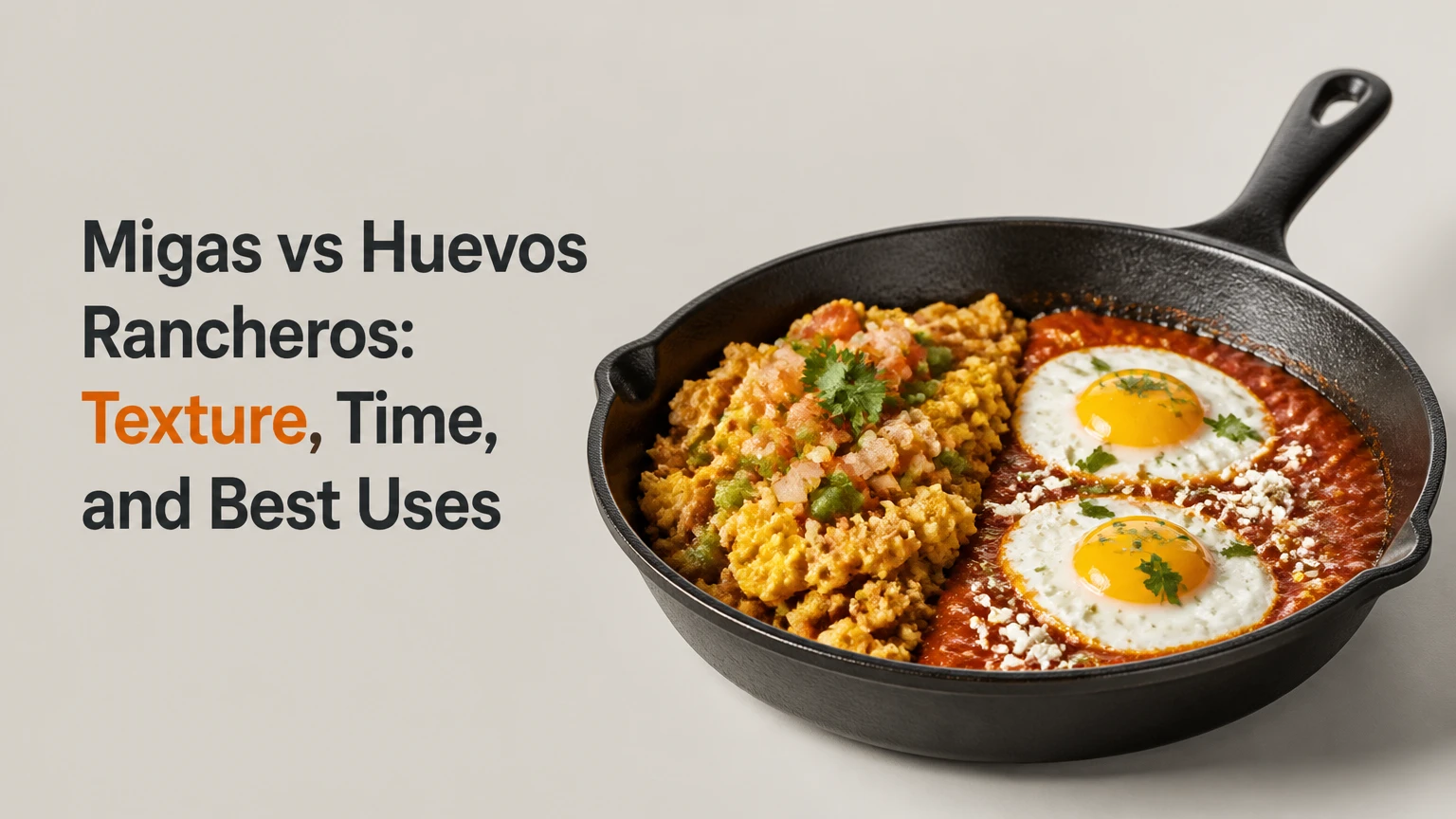
Migas are a Tex-Mex egg scramble cooked with crisp tortilla pieces, aromatics, and often cheese, while huevos rancheros are fried eggs layered over tortillas and covered with warm tomato-chile salsa. Choose migas for a fast, portable, integrated breakfast; choose huevos rancheros for a saucier plated meal with distinct tortillas, eggs, and runny yolks.
Key Facts at a Glance
Migas combine tortilla pieces and beaten eggs in one skillet, creating soft curds with embedded crisp edges.
Huevos rancheros keep the tortilla, fried egg, and ranchera salsa as separate layers until serving.
A typical home batch of migas takes 10-15 minutes; huevos rancheros usually takes 20-25 minutes.
Migas generally travel and reheat better for breakfast tacos, although excessive reheating makes the eggs firm.
Huevos rancheros need thick salsa and immediate service because liquid sauce quickly softens the tortillas.
The dishes share eggs and corn tortillas, but they are different cooking formats rather than interchangeable names.
What Is the Difference Between Migas and Huevos Rancheros?
Migas are an integrated scramble, and huevos rancheros are a layered egg-and-salsa plate. In migas, fried tortilla strips or squares enter the pan before beaten eggs, so egg proteins coat the tortilla pieces as soft curds form. In huevos rancheros, tortillas are softened separately, eggs are fried separately, and salsa is added during assembly.
The distinction affects every bite. Migas distribute onion, chile, tomato, cheese, and tortilla throughout the eggs. Huevos rancheros preserve separate textures: pliable corn tortilla, tender egg white, liquid yolk, and chunky salsa. The name migas means “crumbs” in Spanish, according to SBS Food, but regional dishes using that name are not all related to Tex-Mex breakfast.
| Attribute | Migas | Huevos rancheros | Practical consequence |
|---|---|---|---|
| Egg method | Beaten eggs, scrambled | Whole eggs, fried or poached | Migas produce curds; rancheros preserve yolks |
| Tortilla role | Fried pieces mixed into eggs | Whole tortillas under eggs | Migas are integrated; rancheros are layered |
| Sauce level | Usually little or no sauce | Warm tomato-chile salsa | Rancheros are wetter and more acidic |
| Cheese use | Common in Tex-Mex versions | Optional garnish | Migas often taste richer and saltier |
| Serving format | Bowl, plate, or breakfast taco | Plated breakfast | Migas suit portable eating |
| Best serving moment | Immediately, or within 10 minutes | Immediately after assembly | Salsa causes faster softening in rancheros |
How Do Cooking Methods Change Texture?
Migas depend on controlling moisture before the eggs enter the skillet, while huevos rancheros depend on protecting the tortilla from salsa until the last moment. Fried tortilla pieces need enough time to lose surface moisture, and ranchero tortillas need only a brief oil coating so they bend without becoming brittle.
Why Do Migas Have Crisp Edges and Soft Curds?
Migas develop their characteristic contrast when tortilla pieces are fried until golden before the eggs are added. The hot fat drives off moisture from the tortilla surface, while the egg mixture adds moisture back gradually; gentle folding prevents the pieces from dissolving completely.
Use medium-high heat for the tortilla stage, then reduce to medium when adding onion, jalapeño, and tomato. Pour in eggs only after the tomato moisture has mostly evaporated. Remove the pan when the eggs remain slightly glossy, because carryover heat will finish the curds without producing rubbery whites.
Why Do Huevos Rancheros Need Thick Salsa?
Huevos rancheros require reduced salsa because watery sauce slips beneath the tortilla and turns the base soft before the diner can cut it. A typical ranchera sauce made from crushed tomatoes, onion, serrano peppers, salt, and optional cumin should simmer 8-12 minutes until a spatula leaves a visible trail for about 2-3 seconds.
The tortilla should be flash-fried for roughly 5 seconds per side in medium-hot oil. That short contact creates a flexible surface and a thin fat barrier. Over-frying produces a hard tostada-like base, while skipping the oil leaves the tortilla vulnerable to immediate saturation.
Which Versions Are Actually Comparable?
Tex-Mex migas and classic Mexican-style huevos rancheros are the most useful comparison because both commonly use eggs, corn tortillas, chile, and tomato. Spanish or Portuguese migas are different dishes based on stale wheat bread, garlic, olive oil, paprika, and regional additions, so they should not be treated as a competing egg breakfast.
Mexico City migas, often called migas chilangas, are also a separate preparation. The dish uses stale bread in a seasoned broth, with an egg added near the end. The shared name comes from the idea of crumbs or leftover bread, not from the same tortilla-and-scramble technique.
| Version | Main starch | Egg treatment | Typical setting |
|---|---|---|---|
| Austin-style migas | Corn tortillas or tortilla chips | Scrambled into tortilla pieces | Tex-Mex breakfast taco or plate |
| Mexican-style huevos rancheros | Whole corn tortillas | Fried or poached | Plated breakfast with salsa |
| Spanish or Portuguese migas | Stale wheat bread | Often absent | Regional rustic meal |
| Migas chilangas | Stale bolillo bread | Egg added to broth | Mexico City soup-style meal |
| Huevos divorciados | Corn tortillas | Two fried eggs | One red salsa, one green salsa |
| Huevos Motuleños | Corn tortillas | Fried eggs | Yucatán breakfast with beans and toppings |
Regional language matters when ordering. “Migas” in Austin commonly signals the Tex-Mex scramble, while “migas” in Spain may bring a bread-based dish with no eggs. A restaurant menu’s ingredients are more reliable than the shared name.
Which Is Faster, Cheaper, or Lighter?
Migas are usually faster and less expensive at home because one skillet handles the tortilla, vegetables, and eggs. Huevos rancheros require separate salsa, tortilla, and egg timing, although canned tomatoes and prepared salsa can reduce the difference to about 5 minutes.
The figures below are typical estimates for home portions, not laboratory nutrition results. They assume two eggs per serving for rancheros, approximately two to four eggs for a migas batch divided into two servings, modest cheese, and no large side of beans or potatoes.
| Measure per serving | Migas | Huevos rancheros | Assumption |
|---|---|---|---|
| Home ingredient cost | $1.50-$2.50 | $2.00-$3.50 | Eggs, tortillas, vegetables, and basic toppings |
| Typical preparation time | 10-15 minutes | 20-25 minutes | Salsa made from canned or fresh tomatoes |
| Typical energy | 350-500 calories | 350-500 calories | Cheese, oil, and sides create the largest variation |
| Typical protein | 18-25 grams | 16-22 grams | Two to four eggs and optional beans |
| Typical carbohydrate | 20-35 grams | 30-45 grams | Tortillas, beans, tomato, and serving size |
| Restaurant breakfast price | $9.50-$14.50 | $9.50-$14.50 | Typical U.S. brunch pricing with side dishes |
Which Dish Is Better for Nutrition?
Neither dish is automatically lighter because oil, cheese, beans, tortilla quantity, and egg count determine most of the difference. Migas can reduce carbohydrates by using two tortillas for two servings and limiting cheese, while huevos rancheros can increase fiber and satiety through a half-cup serving of beans.
For a higher-protein plate, retain the eggs and reduce added cheese or oil rather than removing the tortilla entirely. For lower fat, bake tortilla strips at approximately 400°F for 8-12 minutes, use a nonstick skillet, and measure cooking oil instead of pouring freely.
How Do You Make Migas?
To make Tex-Mex migas, fry three stale corn tortillas cut into squares, cook onion, jalapeño, and tomato, add four beaten eggs, and fold until softly set. The full process takes about 12 minutes, and the decisive success factor is crisp tortilla pieces before the eggs enter.
Step 1: Fry the Tortilla Pieces
Cut three stale corn tortillas into approximately 1-inch squares. Heat 2 tablespoons of oil or rendered cooking fat in a 10-inch skillet over medium-high heat, then fry the pieces for 3-4 minutes.
Stir every 20-30 seconds so the edges brown evenly. Remove the pieces when bubbling slows and the surfaces feel rigid. You will know the stage is correct when a broken piece has a dry, crisp center rather than a bendable middle. Drain excess fat if the skillet contains more than a thin coating.
Step 2: Cook the Aromatics
Lower the heat to medium and add ¼ cup diced onion and one minced jalapeño. Cook for 2 minutes, then add ½ cup diced Roma tomato and cook for another 60-90 seconds.
The tomato should soften without leaving a pool of liquid. If the pan looks wet, cook for an additional minute before adding eggs. That small delay prevents the tortilla pieces from steaming inside the scramble.
Step 3: Add and Set the Eggs
Beat four large eggs with ¼ teaspoon salt and pour them over the tortilla mixture. Pull a spatula across the pan every 10-15 seconds, forming large curds rather than finely chopped pieces.
Turn off the heat when the eggs look 80-90% set and remain glossy in the center. Fold in ½ cup shredded Monterey Jack or cheddar if desired. Residual heat should melt the cheese in about 30 seconds. Serve at once, preferably inside warm flour tortillas for breakfast tacos.
| Migas variable | Standard amount | Adjustment | Result |
|---|---|---|---|
| Corn tortillas | 3 tortillas | 4-5 tortillas | More crunch and carbohydrate |
| Eggs | 4 large eggs | 5-6 large eggs | Softer, more egg-forward scramble |
| Jalapeño | 1 pepper | ½ or 2 peppers | Mild or hotter flavor |
| Tomato | ½ cup | ¼-¾ cup | Drier or juicier mixture |
| Cheese | ½ cup | 0-¾ cup | Leaner or richer finish |
| Cooking fat | 2 tablespoons | 1-3 tablespoons | Less grease or deeper frying |
How Do You Make Huevos Rancheros?
To make huevos rancheros, simmer a thick tomato and chile salsa, briefly fry two corn tortillas per serving, fry two eggs with runny yolks, and assemble immediately. A practical home version takes 20-25 minutes, with salsa thickness and egg timing determining whether the plate remains structured.
Step 1: Reduce the Ranchera Salsa
Sauté ½ diced onion and two minced serrano peppers in 1 tablespoon oil for 2 minutes. Add a 14-ounce can of crushed tomatoes, ½ teaspoon cumin if desired, and approximately ¼ teaspoon salt.
Simmer uncovered for 8-12 minutes. The salsa is ready when it coats a spoon and a spatula track remains visible for 2-3 seconds. Taste before adding more salt because tortillas, beans, and cheese may contribute additional sodium.
Step 2: Soften the Tortillas
Heat approximately ¼ cup oil in a small skillet. Dip each corn tortilla for about 5 seconds per side, then drain briefly on paper towels.
The tortilla should flex without cracking and should not have the rigid snap of a chip. For a lower-oil version, heat tortillas on a dry griddle until pliable, although the salsa will soften them more quickly because the surface lacks the same fat barrier.
Step 3: Fry and Assemble the Eggs
Fry two eggs in the same skillet, keeping the yolks runny with sunny-side-up or over-easy cooking. Place two tortillas on each plate, add refried beans if wanted, and place one egg over each tortilla.
Spoon hot salsa over the whites while leaving the yolks partly visible. Finish with cilantro and a small amount of cotija or queso fresco. Serve within 2-3 minutes of assembly, before the salsa fully penetrates the tortilla.
Which Dish Fits Your Situation?
Migas are the better choice for weekday breakfasts, breakfast tacos, and households using leftover tortillas. Huevos rancheros are the better choice for a seated brunch, diners who value runny yolks, and meals where salsa is the primary flavor rather than a finishing accent.
| Situation | Recommended dish | Why | Typical service rule |
|---|---|---|---|
| Weekday before work | Migas | One skillet and 10-15 minutes | Serve in a flour tortilla |
| Weekend brunch guests | Huevos rancheros | More attractive individual plating | Assemble plates separately |
| Portable breakfast | Migas | Scramble holds together in a taco | Wrap after 1-2 minutes cooling |
| Sauce-focused meal | Huevos rancheros | Salsa remains prominent | Keep salsa hot and thick |
| Leftover tortillas | Migas | Stale pieces fry efficiently | Cut into even 1-inch squares |
| Mild family breakfast | Either, with adjustments | Remove seeds and reduce chile | Add salsa at the table for rancheros |
| Meal preparation | Migas, with limits | Components mix more easily | Refrigerate up to 2 days |
| Crisp-texture priority | Migas | Fried pieces retain internal structure longer | Eat immediately after cooking |
For Busy Cooks
Choose migas when the complete breakfast must reach the table in under 15 minutes. Store-bought tortilla chips can replace fried tortilla squares, but add them only after the vegetables cook so the chips do not become saturated before the egg mixture sets.
For Brunch Hosts
Choose huevos rancheros when presentation and individual customization matter. Prepare the salsa up to three days ahead, warm it before serving, and fry tortillas and eggs in batches only when plates are ready.
For Diners Who Dislike Runny Yolks
Choose migas, or cook ranchero eggs over-medium and cover them with salsa. Huevos rancheros lose some of their classic yolk contrast when the yolks are firm, but the dish remains structurally different from a scramble.
How Do They Compare With Chilaquiles?
Migas scramble eggs directly with tortilla pieces, while chilaquiles simmer or toss fried tortilla chips in salsa before toppings are added. Huevos rancheros keep the tortilla whole and place a fried egg on top, so chilaquiles are the closer alternative for a sauce-heavy tortilla breakfast.
| Dish | Tortilla format | Sauce timing | Egg format | Texture at service |
|---|---|---|---|---|
| Migas | Fried squares or chips | Little or none | Scrambled into mixture | Soft curds with crisp edges |
| Huevos rancheros | Whole softened tortillas | Added during plating | Fried whole eggs | Pliable base with runny yolk |
| Chilaquiles | Chips or triangles | Tossed before serving | Fried, scrambled, or omitted | Crisp to softened, depending on timing |
| Huevos divorciados | Whole tortillas | Red and green sauces | Fried whole eggs | Two contrasting sauce profiles |
| Huevos Motuleños | Whole tortillas | Tomato-based topping | Fried whole eggs | Soft tortilla with beans and garnishes |
Order chilaquiles when salsa-soaked chips are the desired feature. Order migas when egg curds and tortilla pieces should share the same bite. These dishes overlap in ingredients but differ in moisture management.
What Common Mistakes Ruin Them?
The most damaging migas mistake is adding eggs before tortilla pieces are crisp, while the most damaging huevos rancheros mistake is using thin salsa. Both failures come from uncontrolled moisture, but the recovery differs: migas need renewed heat and crisp pieces, whereas rancheros need reduced sauce and faster assembly.
Migas Troubleshooting
- Soggy tortilla pieces: Transfer the egg mixture to one side, fry fresh tortilla pieces in the cleared area, then fold them through at the end.
- Rubbery eggs: Remove the skillet from heat immediately and fold in a tablespoon of warm salsa or cream only if the eggs are merely over-set, not dry.
- Greasy texture: Drain excess fat before adding eggs; tortilla pieces need a coating, not a deep pool, after frying.
- Bland flavor: Salt the eggs separately, add chile with the onion, and finish with a sharp cheese or fresh cilantro.
- Uneven curds: Use a wide spatula and make four or five deliberate pulls instead of constant stirring.
Huevos Rancheros Troubleshooting
- Watery salsa: Simmer uncovered until a spoon coated with sauce leaves a clean line when dragged through the pan.
- Broken tortillas: Warm them longer on a griddle or flash-fry them briefly; cold, dry tortillas crack under a fried egg.
- Hard tortilla base: Reduce frying to 3-5 seconds per side and drain immediately.
- Firm yolks: Lower the heat, cover the skillet for 30-45 seconds, and remove the eggs as soon as the whites set.
- Cold plates: Warm plates in a low oven for several minutes because cool ceramic rapidly reduces salsa temperature.
A practitioner rule of thumb is to finish the salsa before frying the eggs. Salsa tolerates holding; fried eggs and softened tortillas do not. Another useful rule is to assemble only what will be eaten within 3 minutes.
What Variations Should You Order or Cook?
Huevos divorciados add red and green salsa to separate eggs, while huevos Motuleños add beans, ham, peas, plantain, and queso fresco. Tex-Mex migas often add cheese and flour tortillas, whereas a leaner home version can use baked tortilla strips and extra tomato.
Regional Migas Adjustments
Austin-style migas commonly use yellow corn tortillas or packaged chips, Monterey Jack or cheddar, jalapeño, tomato, and onion. The result is often served in a flour tortilla as a breakfast taco.
For a lighter scramble, use two teaspoons oil, bake the tortilla strips, omit cheese, and add ¾ cup tomato and peppers. For more heat, add serrano chile or a small amount of hot salsa after the eggs set, rather than cooking all the heat into the pan.
Rancheros Adjustments
Use salsa verde instead of red ranchera sauce for a green version, or serve one red and one green egg as huevos divorciados. Black beans, avocado, queso fresco, and sliced radish pair naturally with the dish, but additions should not make the tortilla impossible to cut.
Huevos Motuleños are more substantial because beans, plantain, peas, ham, and cheese turn the breakfast into a larger plate. New Mexican interpretations may use blue corn tortillas and roasted green chile sauce, which changes both color and chile character without turning the dish into migas.
Which Should You Choose?
Choose migas when speed, portability, crisp-edged scrambled eggs, and one-pan cleanup matter most. Choose huevos rancheros when a plated presentation, thick tomato-chile salsa, distinct tortilla layers, and runny yolks matter more than preparation time.
| Priority | Winner | Selection threshold | Trade-off |
|---|---|---|---|
| Fastest breakfast | Migas | Ready in 10-15 minutes | Less visual separation |
| Best plated presentation | Huevos rancheros | Allow 20-25 minutes | More timing-sensitive |
| Best for breakfast tacos | Migas | Wrap with flour or corn tortillas | Salsa is less central |
| Best runny-yolk experience | Huevos rancheros | Fry eggs to sunny-side-up or easy | Harder to transport |
| Lowest cleanup | Migas | One 10-inch skillet | Requires careful heat control |
| Best use of stale tortillas | Migas | Fry dry, evenly cut pieces | Can become greasy |
| Best sauce customization | Huevos rancheros | Use red, green, or two sauces | Salsa must be reduced |
| Better make-ahead base | Huevos rancheros salsa | Prepare sauce 1-3 days early | Eggs and tortillas remain last-minute |
Migas are not ideal for formal brunch service when guests expect separate toppings and precise yolks. Huevos rancheros are not ideal for commuting, packed lunches, or diners who need a breakfast that can sit for 15 minutes without structural decline.
FAQ
Are migas and huevos rancheros spicy?
Migas and huevos rancheros are not inherently spicy because heat depends on jalapeño, serrano, salsa, and seed removal. Migas usually distribute chile throughout the scramble, while huevos rancheros concentrate heat in the salsa. For mild servings, remove chile seeds and offer hot sauce separately.
Can I use tortilla chips for migas?
You can use approximately 2 cups of plain, sturdy tortilla chips for migas, especially when no stale tortillas are available. Add chips after the vegetables cook, then pour in beaten eggs immediately. Commercial chips are already salted, so reduce egg salt and avoid cooking them long enough to dissolve.
Can huevos rancheros be made ahead?
The ranchera salsa can be made up to three days ahead and refrigerated in a sealed container. Cook tortillas and eggs immediately before serving because refrigeration and reheating make the tortilla limp and the egg white firm. Reheat salsa gently until steaming, then assemble within 2-3 minutes.
What sides go with each breakfast?
Migas pair well with refried beans, avocado, fruit, and a flour tortilla, while huevos rancheros pair well with beans, sliced avocado, rice, or a small salad. Keep sides moderate because tortillas, eggs, cheese, and beans can push either breakfast above 600 calories.
Are migas the same as chilaquiles?
Migas are not the same as chilaquiles. Migas cook beaten eggs directly with fried tortilla pieces, whereas chilaquiles coat tortilla chips in salsa and add eggs or other toppings afterward. Choose migas for a scramble and chilaquiles for salsa-softened chips.
The Bottom Line
Migas vs huevos rancheros is primarily a choice between an integrated scramble and a layered plate. Migas win for a 10-15 minute breakfast, breakfast tacos, leftover tortillas, and simpler cleanup. Huevos rancheros win for thick salsa, runny yolks, individual plating, and a slower brunch. Both work best when moisture is controlled and serving happens immediately.