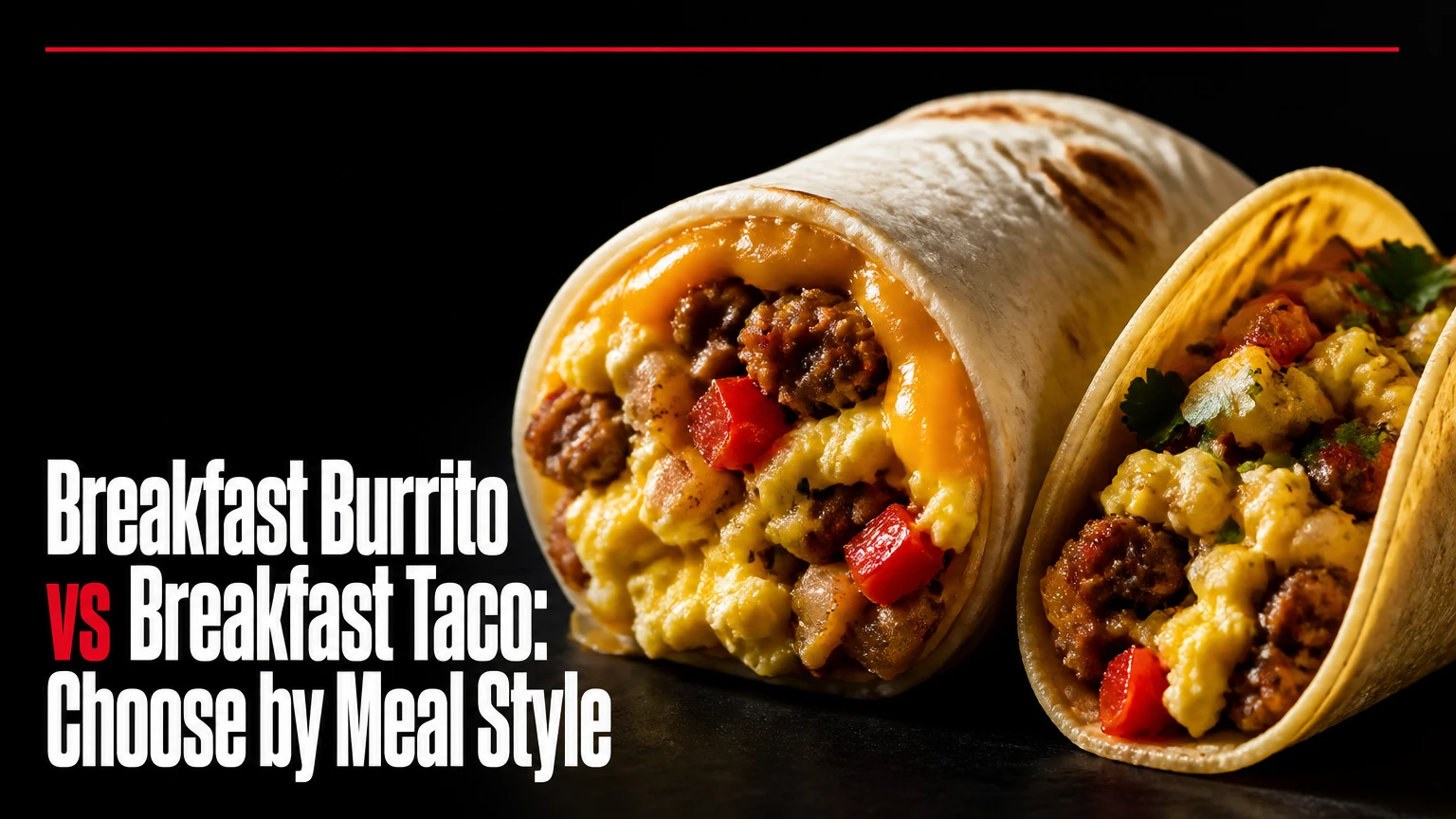
A breakfast burrito is a large, fully enclosed meal rolled in a flour tortilla, while a breakfast taco is a smaller portion folded in a soft corn or flour tortilla and left open at the top. The burrito prioritizes portability, heat retention, and fullness; the taco prioritizes visible ingredients, variety, fresh toppings, and portion control.
Key Facts at a Glance
- A typical breakfast burrito uses a 10- to 12-inch flour tortilla and provides one substantial meal.
- A typical breakfast taco uses a 5- to 6-inch tortilla, and diners commonly order two or three.
- Breakfast burritos usually hold heat longer because the filling is enclosed and compressed.
- Breakfast tacos make customization easier because each tortilla can contain a different filling combination.
- A single burrito often weighs about 350-600 grams, while one taco commonly weighs about 80-120 grams.
- Tortilla size, filling moisture, and eating context matter more than the names alone.
What Is a Breakfast Burrito?
A breakfast burrito is a sealed tortilla meal built around eggs, a starch, cheese, and optional meat or vegetables. A large flour tortilla is filled near its center, folded over the ends, and rolled into a closed cylinder that can be wrapped in paper or foil.
The enclosed format changes the eating experience. Every bite combines several ingredients, and the compact filling retains heat effectively when wrapped. That structure also creates the burrito’s main weaknesses: trapped steam can soften crisp potatoes, while excessive filling can split the tortilla.
Breakfast burritos vary widely. A compact egg-and-cheese burrito may weigh closer to 250 grams, whereas a restaurant burrito containing potatoes, beans, cheese, eggs, and a protein can exceed 600 grams. “Large” describes the format, not a fixed legal or culinary standard.
What Is a Breakfast Taco?
A breakfast taco is an individual tortilla folded around a modest amount of breakfast filling, with the top remaining open. Soft flour tortillas are common in parts of Texas, while corn tortillas are also used, especially when cooks want a more pronounced toasted-corn flavor.
The open structure keeps toppings visible and makes separate flavor combinations practical. One taco can contain eggs and cheese, another can contain beans and vegetables, and a third can carry a spicier filling. The trade-off is physical stability: wet or heavy fillings can spill from the open ends.
Breakfast tacos are usually served immediately after assembly. Fresh salsa, chopped onion, cilantro, avocado, or cheese can be added at the last moment, preserving contrasts that become muted inside a tightly wrapped burrito.
How Do Breakfast Burritos and Tacos Differ?
Breakfast burritos and breakfast tacos differ primarily in enclosure, scale, tortilla format, portioning, and eating context. A burrito is engineered as a complete portable package, whereas a taco is engineered as an open individual serving that encourages ordering several combinations.
Master Comparison
| Criterion | Breakfast burrito | Breakfast taco |
|---|---|---|
| Typical tortilla | 10-12 inch flour | 5-6 inch corn or flour |
| Typical serving | 1 large item | 2-3 individual tacos |
| Typical weight | 350-600 grams | 80-120 grams each |
| Typical calories | 700-1,100 or more | 200-350 each |
| Eating position | Standing or walking possible | Plate or seated eating preferred |
| Heat retention | About 20-45 minutes when wrapped | About 5-10 minutes in open format |
| Typical preparation | 10-15 minutes | 5-7 minutes per batch |
| Typical price | $7-$13 | $2.50-$4.50 each |
These figures are typical restaurant ranges, not universal specifications. Recipe composition changes the result substantially: a bean-and-egg taco differs nutritionally from one with cheese, potatoes, and a rich meat filling, just as a small burrito differs from an oversized café version.
Which Tortilla Is Better?
Flour tortillas generally perform better for large breakfast burritos because their gluten structure allows stretching and folding without immediate cracking. Corn tortillas offer stronger toasted flavor and may suit smaller tacos, but a dry or stale corn tortilla can fracture under wet fillings.
Tortilla choice also depends on moisture and weight. A soft flour tortilla handles beans, eggs, cheese, and potatoes more reliably, while a fresh corn tortilla works well with drier fillings and bright toppings. A taco can use either style, but a 10-inch burrito made with a small corn tortilla is structurally impractical.
| Tortilla choice | Typical diameter | Best use | Main failure risk |
|---|---|---|---|
| Small corn tortilla | 5-6 inches | Light breakfast taco | Cracking under wet filling |
| Small flour tortilla | 5-6 inches | Soft taco with beans or eggs | Soggy underside |
| Large flour tortilla | 10-12 inches | Sealed breakfast burrito | Tearing when cold |
| Extra-large flour tortilla | 13-14 inches | Oversized restaurant burrito | Dense, difficult-to-heat center |
Winner for structural reliability: large flour tortillas for burritos, and fresh small tortillas for tacos.
How Are Breakfast Burritos and Tacos Assembled?
Breakfast burritos require controlled layering and a tight fold, while breakfast tacos require smaller filling portions and immediate topping. The most important shared rule is to manage moisture before it reaches the tortilla.
Burrito Assembly
- Cook eggs until softly set, then remove them before they become dry.
- Cook potatoes separately so surface moisture does not steam the tortilla.
- Warm a 10- to 12-inch flour tortilla for about 15-20 seconds per side.
- Place cheese, potatoes, eggs, and protein in the middle third.
- Fold the left and right sides inward.
- Pull the bottom edge over the filling and roll forward firmly.
- Toast the seam for about 30 seconds if a more secure exterior is useful.
A burrito is correctly filled when the side flaps overlap easily before the final roll. If the tortilla cannot cover the filling without stretching, remove roughly 20 percent of the contents rather than forcing the wrap.
Taco Assembly
- Toast a 5- to 6-inch tortilla until warm and flexible.
- Add a narrow strip of filling down the center.
- Keep the filling height low enough for the tortilla to fold without splitting.
- Add salsa, herbs, onion, avocado, or cheese after the hot filling is in place.
- Serve immediately, with additional salsa on the side.
A taco is correctly filled when the tortilla closes around the center without needing to be pressed flat. The open ends are intentional, so sealing them would turn the food into a different format.
How Many Breakfast Tacos Equal One Burrito?
Two or three standard breakfast tacos usually approximate one substantial breakfast burrito, but the comparison depends on filling weight rather than item count. One taco weighing 100 grams provides roughly 200-350 calories, while a burrito weighing 400-500 grams often provides 700-1,100 calories.
| Meal order | Approximate food weight | Typical calorie range | Practical interpretation |
|---|---|---|---|
| 1 light taco | 80-100 grams | 150-250 | Small breakfast or snack |
| 2 standard tacos | 160-240 grams | 400-700 | Moderate breakfast |
| 3 standard tacos | 240-360 grams | 600-1,050 | Full breakfast with variety |
| 1 large burrito | 350-600 grams | 700-1,100+ | Dense single-item meal |
The equivalent order is therefore often two tacos for a moderate burrito and three tacos for a heavily loaded burrito. Comparing one taco with one burrito produces a misleading calorie and fullness result because the serving formats are intentionally different.
Which Option Is More Nutritious?
Neither format is automatically healthier because eggs, cheese, potatoes, beans, sauces, and the tortilla determine most of the nutrition. The taco format makes portion reduction easier, while the burrito can combine more protein and vegetables in one controlled package.
The calorie ranges below are typical estimates based on common ingredient portions. USDA FoodData Central entries demonstrate why ingredient-specific calculation matters: eggs, tortillas, cheese, potatoes, and prepared sausage each contribute separately, and restaurant recipes can differ in oil and serving size.
| Typical composition | Burrito estimate | One taco estimate | Main nutrition driver |
|---|---|---|---|
| Egg and cheese | 450-700 kcal | 180-280 kcal | Cheese and tortilla |
| Egg, potato, and cheese | 600-900 kcal | 220-350 kcal | Potato portion and cooking oil |
| Egg, beans, and vegetables | 500-800 kcal | 180-300 kcal | Beans, cheese, and tortilla |
| Egg, potato, cheese, and protein | 750-1,100+ kcal | 250-400 kcal | Protein, oil, cheese, total mass |
For portion control, order one taco first or request less cheese and potatoes. For higher satiety, retain beans or eggs while reducing added oil and oversized tortilla mass. The U.S. Food and Drug Administration uses 2,000 calories as a general daily reference value, but individual needs vary, so a restaurant burrito can represent a large share of a day’s intake.
Which Is Cheaper?
One breakfast taco usually costs less than one burrito, but a full taco order can equal or exceed the burrito price. The relevant comparison is a complete meal, not the menu price of one item.
| Order type | Typical unit price | Typical meal quantity | Typical meal total |
|---|---|---|---|
| Basic bean-and-cheese taco | $2.00-$3.00 | 2 tacos | $4.00-$6.00 |
| Egg-and-potato taco | $2.50-$4.50 | 2-3 tacos | $5.00-$13.50 |
| Specialty breakfast taco | $4.00-$6.00 | 2 tacos | $8.00-$12.00 |
| Large breakfast burrito | $7.00-$13.00 | 1 burrito | $7.00-$13.00 |
A burrito often offers better cost per gram of food, while tacos offer better cost control when appetite is uncertain. Restaurant location, labor, tortilla production, and premium toppings can shift these ranges considerably.
Which Regional Styles Should You Know?
Breakfast burrito and breakfast taco traditions overlap, but regional menus emphasize different fillings and sauces. Texas commonly features flour-tortilla breakfast tacos, New Mexico is strongly associated with chile-covered burritos, California menus often use substantial potato or fried-potato fillings, and Denver-style preparations commonly include ham, peppers, onions, and cheese.
| Regional or named style | Format | Defining ingredients | Service pattern |
|---|---|---|---|
| Austin-style migas | Taco | Eggs, tortilla chips, onion, tomato, chile, cheese | Open, fresh toppings |
| San Antonio bean and cheese | Taco | Refried beans, melted cheese, flour tortilla | Simple, soft, inexpensive |
| Chorizo con huevo | Taco or burrito | Spiced sausage mixed with eggs | Usually served hot |
| New Mexico smothered | Burrito | Eggs, potatoes, chile sauce, cheese | Plated, not hand-portable |
| California breakfast burrito | Burrito | Eggs, potatoes or fries, cheese, avocado, protein | Large and filling |
| Denver or Western | Burrito or plate | Eggs, ham, peppers, onions, cheddar | Savory, skillet-style |
Regional labels are useful guides, not rigid recipes. A restaurant may call a large flour-tortilla item a taco if it remains open, or call a plated chile-covered item a burrito even though it no longer functions as portable food.
Which Is Better for Different Situations?
The better choice depends on whether the priority is portability, variety, portion control, freshness, or reheating. Breakfast burritos favor transport and storage, while breakfast tacos favor immediate serving and customized combinations.
For a Busy Commute
Choose a breakfast burrito when eating with one hand matters. A tightly rolled burrito wrapped in foil or paper reduces leakage, and the enclosed filling usually stays warm longer than an open taco.
A burrito is not ideal for driving if it is oversized, heavily sauced, or poorly wrapped. Ask for salsa on the side and check that the seam is underneath before leaving.
For a Lighter Breakfast
Choose one or two breakfast tacos with controlled cheese and a corn tortilla. The smaller units let diners stop after one, add a second, or choose a filling with beans and vegetables instead of ordering a fixed large portion.
A taco is not automatically low calorie. Three cheese-heavy tacos can exceed the energy of a modest burrito, particularly when each tortilla receives oil, potatoes, and a large serving of filling.
For Variety and Fresh Toppings
Choose breakfast tacos when different flavors matter. Ordering separate tacos allows one combination with beans, one with migas, and one with eggs and vegetables, while avocado, herbs, and salsa remain visible.
The open format loses heat quickly. Tacos should reach the table within minutes of assembly, especially when they contain crisp ingredients or cool toppings.
For Meal Preparation
Choose breakfast burritos for freezing and reheating. Wrap each cooled burrito in parchment or waxed paper, add an outer foil layer, freeze promptly, and reheat in an oven or air fryer rather than leaving wet salsa inside.
Tacos are poor freezer candidates because the small tortillas dry out and the open fillings lose structure. Prepare taco components separately instead, then warm tortillas and assemble each serving fresh.
How Do You Prevent Common Failures?
The main breakfast burrito failures are sogginess, tearing, and an uneven cold center; the main breakfast taco failures are cracking, overflowing, and rapid cooling. Each problem has a predictable mechanical cause and a practical correction.
| Failure | Likely cause | Immediate correction | Prevention rule |
|---|---|---|---|
| Soggy burrito bottom | Wet salsa or steaming potatoes | Open foil for 2-3 minutes | Drain wet fillings first |
| Torn burrito | Cold tortilla or excess filling | Transfer contents to a new warm tortilla | Warm tortilla 15-20 seconds |
| Cold burrito center | Dense, chilled ingredients | Reheat at moderate heat | Use hot components of similar temperature |
| Cracked taco | Dry or stale corn tortilla | Double the tortilla | Steam or toast until flexible |
| Taco overflow | Filling exceeds center strip | Remove 25-30 percent | Keep filling below tortilla edges |
| Watery eggs | Excess liquid or overcooking | Drain before assembly | Cook eggs gently and finish early |
A counterintuitive practitioner rule is that wrapping a burrito immediately can make it colder later. Foil retains heat, but steam condenses against the tortilla and creates a wet layer, so a short venting period helps crisp components survive.
Another rule concerns salsa. Salsa inside a burrito is convenient but often damages texture during holding; salsa on the side preserves the tortilla and lets the diner control heat and moisture.
How Should You Order or Build Each One?
Order a breakfast burrito when you want a defined, complete meal with minimal assembly after purchase. Ask about tortilla diameter, potato preparation, sauce placement, and whether the item is intended to be eaten by hand.
Order breakfast tacos when you want to sample several fillings or adjust the meal size. Ask whether the tortillas are corn or flour, whether the filling is cooked to order, and whether wet toppings arrive inside or separately.
For home preparation, cook fillings in separate pans and assemble only after draining excess moisture. Cheese can act as a barrier between hot wet ingredients and the tortilla, while crisp potatoes should sit away from watery tomato or salsa.
Which Should You Choose?
Choose a Breakfast Burrito If You Need Portability
A breakfast burrito is the stronger choice for commuting, travel, packed lunches, and reheating. Select a 10- to 12-inch flour tortilla, moderate moisture, and a filling weight that allows the side flaps to overlap.
Choose Breakfast Tacos If You Want Variety
Breakfast tacos are better for sit-down meals and groups with different preferences. Two or three small portions create more flavor variation than one blended burrito and make fresh garnishes easier to add.
Choose Tacos for Portion Control
Breakfast tacos offer finer control over quantity because each serving is separate. Start with one or two, use a smaller amount of cheese, and choose beans or vegetables when you want a more filling option without a very large tortilla.
Choose a Burrito for Freezer Storage
Breakfast burritos freeze more successfully because the filling is enclosed and protected. Cool fillings before wrapping, exclude fresh salsa and avocado, label the package with the date, and reheat until the center is steaming hot.
Choose Either Format for a Vegetarian Meal
Both formats accommodate eggs, beans, potatoes, cheese, mushrooms, peppers, spinach, and avocado. Tacos provide easier ingredient separation, while burritos provide better containment for beans and soft vegetables.
Expert Rules That Improve the Result
- Match filling moisture to tortilla size. A large burrito can absorb more filling moisture than a small taco, but neither format tolerates watery ingredients held for long periods.
- Treat potatoes as a texture ingredient. Crisped hash browns or home fries provide contrast, while boiled or wet potatoes make a wrapped burrito dense and soft.
- Compare meals by total filling weight. One taco versus one burrito is not a fair nutritional comparison; use two or three tacos as the realistic equivalent.
- Separate service temperature from storage temperature. Hot tacos should be eaten immediately, while burritos can be wrapped after a brief venting period and reheated later.
- Use double tortillas selectively. Two corn tortillas improve taco strength for beans or wet eggs, but they also add calories and can mask delicate flavors.
FAQ
Are breakfast tacos always smaller than burritos?
Breakfast tacos are usually smaller per unit, with tortillas around 5-6 inches, while breakfast burritos commonly use 10-12-inch tortillas. A large order of three tacos can contain as much food as one burrito, so the meaningful distinction is the individual open serving versus the single enclosed package.
Can a breakfast burrito use a corn tortilla?
A traditional large breakfast burrito generally uses flour because flour tortillas stretch and fold more reliably at large diameters. A corn tortilla can work for a small folded burrito, but its lower flexibility increases cracking risk, especially with beans, potatoes, or wet eggs.
Are breakfast tacos healthier than breakfast burritos?
Breakfast tacos can be healthier when their smaller portions reduce cheese, oil, potatoes, or total calories. The format alone does not guarantee a better choice, because three rich tacos may contain more calories and sodium than one moderate burrito with beans, eggs, vegetables, and limited cheese.
Can I freeze breakfast tacos?
Breakfast tacos are generally poor freezer items because their small tortillas dry out and open fillings lose structure. Freeze the fillings separately, then warm fresh tortillas and add salsa, avocado, herbs, or other cool toppings after reheating.
Why does a breakfast burrito get soggy?
A breakfast burrito gets soggy when steam or liquid from salsa, tomatoes, beans, or potatoes migrates into the flour tortilla. Drain wet ingredients, crisp potatoes separately, keep salsa on the side, and vent the wrapped burrito briefly before extended holding.
Which format is easier to eat without utensils?
A properly rolled breakfast burrito is easier to eat without utensils because both ends are folded closed. A breakfast taco can be eaten by hand, but its open ends and loose toppings make a plate, napkin, or seated position more practical.
The Bottom Line
Breakfast burrito vs breakfast taco is ultimately a choice between a sealed meal and an open tasting format. Choose the breakfast burrito for portability, fullness, heat retention, and freezer preparation; choose breakfast tacos for variety, fresh toppings, smaller portions, and immediate sit-down eating. Compare the complete meal, not one taco against one burrito.