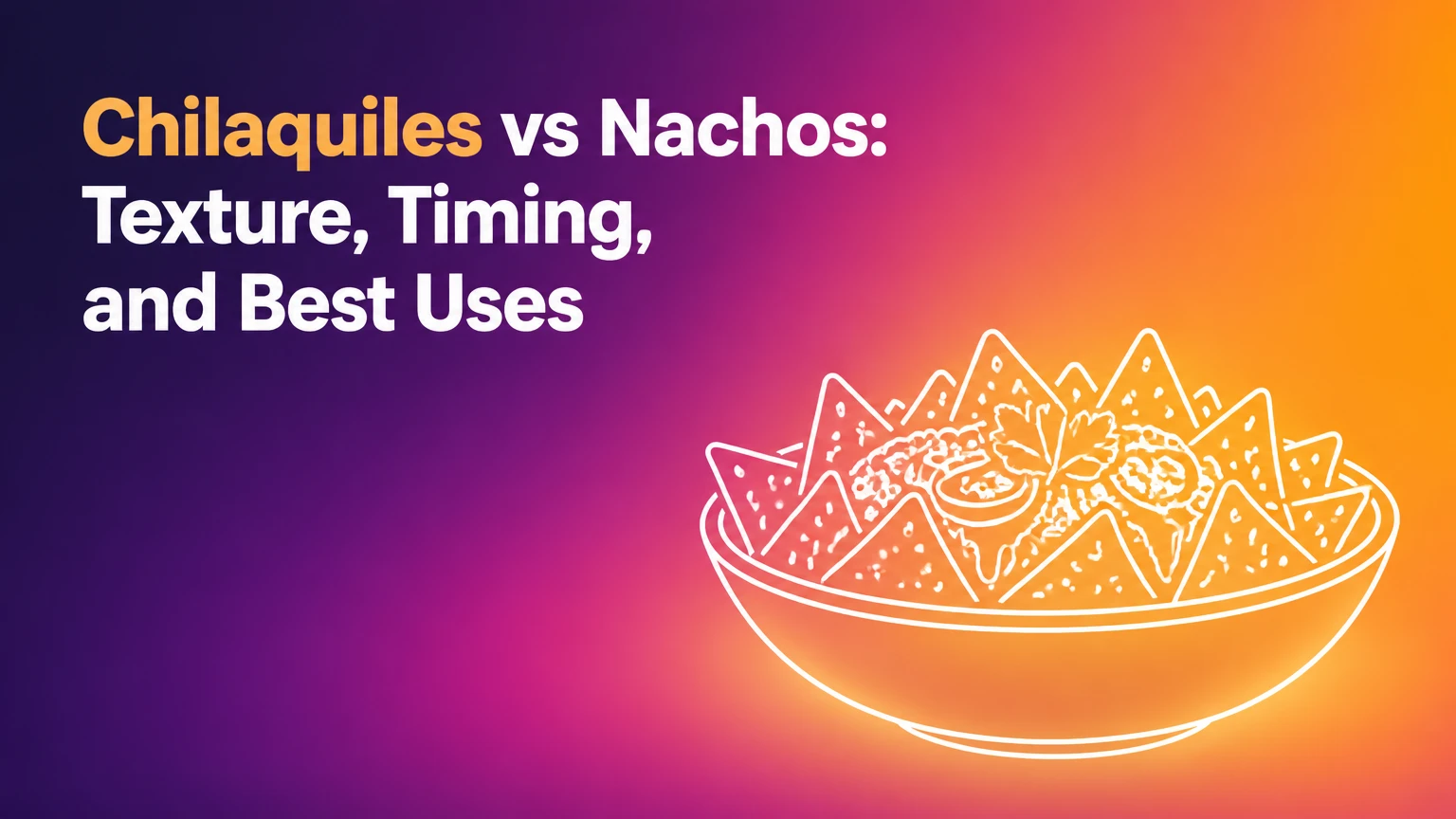
Chilaquiles and nachos both use fried corn tortillas, but they are structurally different dishes. Chilaquiles are a sauced Mexican meal in which tortilla pieces absorb salsa and become tender, while nachos are a Tex-Mex snack in which chips remain crisp beneath melted cheese and selected toppings. Choose chilaquiles for a plated meal and nachos for sharing.
Key Facts at a Glance
- Chilaquiles are fried tortilla pieces tossed with warm salsa shortly before serving.
- Nachos are tortilla chips layered with melted cheese and toppings, usually assembled on a sheet pan.
- Chilaquiles prioritize sauce penetration and tender-chewy texture; nachos prioritize crunch and structural strength.
- A typical batch of chilaquiles takes 20-30 minutes with homemade salsa, while quick nachos take 10-15 minutes.
- Chilaquiles commonly appear at breakfast with eggs, crema, cheese, and onion; nachos commonly appear as an appetizer or party food.
- The best tortilla choice depends on the goal: sturdy totopos for chilaquiles and thick restaurant-style chips for nachos.
What Is the Difference Between Chilaquiles and Nachos?
Chilaquiles are a Mexican dish built by combining fried corn tortilla pieces with salsa, whereas nachos are a layered snack built by covering tortilla chips with melted cheese and toppings. The decisive difference is not the shape of the tortilla. It is what the cooking process asks the tortilla to do.
Chilaquiles use salsa as a cooking medium. The tortillas are coated briefly for a crisp-chewy result or held longer for a softer result. Nachos use cheese as a partial moisture barrier, and toppings are added in layers so the chips can support food without collapsing.
The names also describe different culinary traditions. Chilaquiles are associated with Mexican home cooking and breakfast service. Nachos originated in northern Mexico but developed into a broad Tex-Mex restaurant and stadium format. Food historian and writer Jeffrey M. Pilcher has described nachos as an example of Mexican food adapted through borderland dining culture, rather than a direct synonym for a traditional Mexican breakfast dish.
| Criterion | Chilaquiles | Nachos |
|---|---|---|
| Primary format | Plated meal | Shareable snack or appetizer |
| Tortilla treatment | Fried, then softened with salsa | Fried and kept crisp |
| Main binding ingredient | Salsa roja or salsa verde | Melted cheese |
| Typical utensil | Fork, sometimes knife | Hands or small fork |
| Common meal period | Breakfast or brunch | Snack, lunch, party, game-day meal |
| Ideal serving window | 1-5 minutes after saucing | 3-8 minutes after baking |
| Typical quick preparation | 20-30 minutes | 10-15 minutes |
| Best portion structure | One composed plate | Wide, shallow communal tray |
How Are Chilaquiles Made?
Chilaquiles are made by frying or using sturdy tortilla pieces, warming a thick salsa, and tossing the tortillas in the sauce for a controlled period. The cook determines the final texture through tortilla density, salsa temperature, and contact time, not through the garnish added at the end.
A practical batch for two servings uses 8-10 six-inch corn tortillas, 2 cups of salsa, 1 tablespoon of cooking oil if frying aromatics, 2 eggs per person if serving breakfast-style, and approximately 60 grams of crumbled cheese. Day-old tortillas are preferable because they contain less moisture and hold their shape longer.
Chilaquiles Preparation Sequence
- Cut the tortillas. Slice 8-10 tortillas into six or eight wedges. Smaller pieces absorb sauce faster.
- Dry or fry them. Fry at a typical 175-190°C until golden and firm, usually 3-5 minutes in batches. Baked tortilla pieces need approximately 10-15 minutes at 190°C.
- Warm the salsa. Simmer 2 cups of salsa for 3-5 minutes until hot and slightly thickened. A watery salsa softens the tortillas unevenly.
- Add the tortilla pieces. Fold the totopos into the salsa for 30 seconds to 3 minutes, depending on the desired texture.
- Plate immediately. Add crema, cheese, onion, cilantro, chicken, or eggs after the sauce has coated the tortilla.
Chilaquiles are ready when the edges remain defined but the centers have taken on the color and flavor of the salsa. The dish should not resemble soup or porridge. Salsa verde usually contributes tomatillo acidity, green chile heat, garlic, and cilantro, while salsa roja typically contributes tomato sweetness and dried-chile depth.
What Are the Main Chilaquiles Styles?
Chilaquiles verdes use tomatillos and green chiles, chilaquiles rojos use tomatoes and dried or fresh red chiles, and chilaquiles divorciados divide one plate between both sauces. “Divorciados” means separated, usually with the red and green portions kept on opposite sides of the plate.
| Style | Core sauce | Typical flavor | Best topping pairing |
|---|---|---|---|
| Verdes | Tomatillo, serrano, garlic | Tart, herbal, moderately hot | Egg, crema, avocado |
| Rojos | Tomato, guajillo or ancho chile | Earthy, rounded, lightly smoky | Chicken, onion, cotija |
| Divorciados | Half red, half green | Two contrasting sauces | Refried beans between sections |
| Crisp-style | Any thick salsa, brief coating | Crisp edges, saucy surface | Fried egg and fresh onion |
| Soft-style | Any salsa, longer coating | Tender, chewy, deeply seasoned | Shredded chicken and crema |
The terms “crujiente” and “blandito” are useful texture descriptions, but they do not represent universally standardized restaurant categories. A restaurant may use either term differently, so asking for “crispy” or “soft” is clearer when ordering.
How Are Nachos Different in Construction?
Nachos are constructed in layers because melted cheese and dry chips need to distribute weight and moisture evenly. A wide, shallow sheet pan works better than a deep pile: more chips receive cheese, fewer chips remain bare, and the bottom layer is less likely to become crushed.
The original nachos are generally associated with Ignacio “Nacho” Anaya, who prepared a simple dish for diners in Piedras Negras, Mexico, in 1943. The commonly repeated account describes fried tortilla pieces with melted cheese and pickled jalapeño slices. Modern loaded nachos add beans, seasoned meat, vegetables, avocado-based toppings, and cultured dairy.
A Reliable Sheet-Pan Nacho Method
- Spread the chips. Use 120-180 grams of thick tortilla chips for two to four people. Cover a baking sheet in one broad layer.
- Add the first cheese layer. Distribute 100-150 grams of shredded Monterey Jack, cheddar, or a blend across the chips.
- Add dry fillings. Scatter drained beans, cooked chicken, sliced jalapeños, or vegetables over the cheese.
- Build a second layer. Add more chips, then another 100-150 grams of cheese and a smaller amount of fillings.
- Bake or broil. Heat at approximately 200°C for 3-5 minutes, watching continuously under a broiler.
- Finish away from heat. Add salsa, avocado, crema, sour cream, or fresh herbs after the cheese melts.
Nachos are ready when the cheese has melted across most of the exposed chips and the edges remain firm. A cheese layer placed directly on chips can slow moisture migration, but it cannot waterproof chips completely. Wet beans, salsa, and crema still shorten the crisp window.
Which Dish Has Better Texture?
Chilaquiles have the better texture for diners who want sauce-soaked, tender-chewy tortillas; nachos have the better texture for diners who want audible crunch. Neither texture is a quality ranking because the dishes pursue opposite physical results.
Tortilla density, frying level, salsa thickness, and serving delay control the result. Commercial thin chips often break down rapidly in salsa, while homemade totopos made from thick corn tortillas can remain structured for several minutes. For nachos, overly thin chips fracture under beans and cheese, especially when a mound is lifted from the center.
A useful practitioner rule is to stop saucing chilaquiles earlier than seems necessary. Carryover heat and residual salsa continue softening the tortilla after plating. For nachos, keep cold and wet toppings separate until the tray reaches the table.
| Texture goal | Chilaquiles method | Nacho method | Expected result |
|---|---|---|---|
| Maximum crispness | Toss 20-30 seconds | Bake one shallow layer | Crisp edges and limited sauce absorption |
| Crisp-chewy balance | Toss 45-60 seconds | Use two cheese-supported layers | Defined centers with tender edges |
| Soft texture | Toss 2-3 minutes | Avoid wet toppings before baking | Tender chilaquiles, unsuitable soft nachos |
| Longest holding time | Use thick totopos and thick salsa | Keep toppings separate | Approximately 5-8 minutes of useful texture |
| Better reheating | Reheat salsa and add fresh chips | Rebuild on a fresh tray | Chilaquiles reheat more reliably |
Which Is Faster and Cheaper to Make?
Quick nachos are usually faster, while chilaquiles can be cheaper when they use leftover tortillas and salsa. Typical home costs range from $3-$8 for two servings of chilaquiles and $5-$14 for a loaded nacho tray, depending on cheese, protein, and purchased ingredients.
Restaurant prices vary sharply by city, portion size, and service style. A breakfast plate of chilaquiles commonly falls around $12-$18 in United States restaurants, while nachos commonly range from $10-$22. These are typical menu ranges, not standardized prices.
| Factor | Chilaquiles for two | Nachos for two to four | Cost effect |
|---|---|---|---|
| Base ingredient | 8-10 corn tortillas | 120-180 g tortilla chips | Tortillas are usually cheaper |
| Sauce or cheese | 2 cups salsa, $1-$5 | 200-300 g cheese, $3-$8 | Cheese raises nacho cost |
| Optional protein | 225 g chicken, $3-$6 | 225 g chicken or beans, $2-$6 | Similar if using leftovers |
| Typical home total | $3-$8 | $5-$14 | Nachos vary more with cheese |
| Active preparation | 15-20 minutes | 8-12 minutes | Nachos require less cooking |
| Total elapsed time | 20-30 minutes | 10-15 minutes | Purchased chips favor nachos |
Chilaquiles become particularly economical when stale tortillas, leftover roasted chicken, and prepared salsa are available. Nachos become economical for groups when beans and vegetables replace large quantities of prepared protein, although the cheese requirement remains substantial.
Which Dish Is Better for Breakfast, Parties, or Leftovers?
Chilaquiles are better for breakfast and individual meals, while nachos are better for parties and informal sharing. Leftover tortillas favor chilaquiles, but leftover cooked fillings and a need for rapid assembly favor nachos.
Choose Chilaquiles for Breakfast
Chilaquiles pair naturally with fried or scrambled eggs, beans, crema, cheese, and sliced onion. The sauce makes a small quantity of chicken or vegetables feel integrated into a complete plate. Chilaquiles are less suitable when guests need to eat while standing or when food must remain crisp for fifteen minutes.
Choose Nachos for Groups
Nachos are easier to portion across a table because a wide tray exposes individual chips. For six people, use approximately 350-500 grams of chips, 400-600 grams of cheese, 2-3 cups of beans or cooked filling, and separate bowls of salsa and avocado-based toppings.
Choose Chilaquiles for Leftover Tortillas
Day-old corn tortillas are an intended advantage, not a defect. Frying dries them and creates a porous surface that accepts salsa without instantly dissolving. Leftover salsa can be reduced briefly before use, which improves coating and prevents a watery plate.
Choose Nachos for Fast Assembly
Nachos require no salsa simmering when prepared with purchased chips, shredded cheese, and ready-to-use fillings. The main operational risk is overloading the tray. A lower topping load produces more edible chips than a tall pile with excessive wet ingredients.
Are Chilaquiles Healthier Than Nachos?
Chilaquiles are not automatically healthier than nachos because both can contain fried corn tortillas, cheese, cream, and salty sauces. The nutritional difference depends on portion size, frying method, cheese quantity, protein, beans, vegetables, and how much prepared salsa or seasoning is used.
A typical restaurant plate of chilaquiles may contain two eggs, cheese, crema, beans, and several ounces of tortilla pieces. A loaded nacho tray may contain a larger cheese portion and more processed toppings, but a modest homemade tray can be lighter than a restaurant breakfast plate.
| Variable | Chilaquiles adjustment | Nacho adjustment | Likely effect |
|---|---|---|---|
| Tortilla base | Bake instead of fry | Use 120 g chips instead of 200 g | Less added fat and fewer calories |
| Cheese | Use 30-45 g per serving | Use 150-200 g per tray | Lower saturated fat and sodium |
| Protein | Add 75-100 g chicken or beans | Add beans before extra meat | More protein and fiber |
| Fresh toppings | Onion, tomato, herbs, avocado | Salsa and vegetables after baking | More produce and contrast |
| Sodium control | Use unsalted salsa and cheese | Drain canned beans and limit pickled items | Lower total sodium |
Neither dish is a reliable choice for someone who must strictly limit sodium without recipe control. Prepared salsa, cheese, pickled chiles, seasoned beans, and restaurant sauces can each contribute significant sodium.
What Common Mistakes Ruin Each Dish?
The most common chilaquiles mistake is using fragile chips with thin, watery salsa; the most common nacho mistake is building a tall mound with wet toppings. Both failures arise from ignoring moisture movement and load distribution.
Chilaquiles Problems and Fixes
- Mushy tortilla pieces: Reduce the salsa for 2-4 minutes and toss thicker totopos for 20-45 seconds.
- Dry centers: Use hotter salsa and allow 60-90 seconds of contact instead of adding cold sauce.
- Broken pieces: Choose dense tortilla wedges and fold gently with a wide spatula.
- Flat flavor: Season the salsa before adding tortillas, since the tortilla dilutes salt and acidity.
- Cold eggs on a hot plate: Cook eggs last and plate them immediately after saucing.
Turning off the heat before adding tortillas is useful when the salsa is already hot. The method is not universal, however. A very thick salsa may need low heat for 30-60 seconds to coat evenly.
Nacho Problems and Fixes
- Bare bottom chips: Build two shallow layers instead of one tall mound.
- Hard cheese: Serve immediately and use a cheese blend containing a good-melting cheese such as Monterey Jack.
- Soggy chips: Drain beans, bake dry fillings, and add salsa or crema after heating.
- Burned toppings: Place the tray on a middle rack or use short broiling intervals of 30-60 seconds.
- Uneven cheese: Shred cheese finely and distribute it to the edges, not only in the center.
A counterintuitive rule matters here: more toppings do not create better nachos. Once wet fillings exceed the chips’ structural capacity, the tray becomes difficult to portion and the cheese cools before the center is eaten.
What Should You Order or Cook?
Choose chilaquiles when the desired outcome is a warm, saucy breakfast with controlled tenderness. Choose nachos when the desired outcome is a crunchy, communal snack that can accommodate several toppings.
| Situation | Better choice | Specific reason | Modification |
|---|---|---|---|
| Breakfast for two | Chilaquiles | Salsa and eggs form a complete plate | Add eggs and beans |
| Game-day gathering | Nachos | One tray serves several people | Use two shallow layers |
| Stale tortillas available | Chilaquiles | Frying restores structure | Use thick salsa |
| Fifteen-minute meal | Nachos | Purchased chips reduce prep | Use shredded cooked chicken |
| Guests prefer soft food | Chilaquiles | Sauce controls tenderness | Toss for 2-3 minutes |
| Guests eat while standing | Nachos | Finger-food format travels better | Keep wet toppings separate |
| Lower-cost leftovers | Chilaquiles | Uses tortillas and leftover salsa | Add beans or vegetables |
| Maximum crunch | Nachos | Chips are protected from sauce | Serve salsa in bowls |
Chilaquiles are not a good substitute for nachos at a standing reception because each plate needs immediate service. Nachos are not a good substitute for chilaquiles when the meal depends on salsa as the primary seasoning and eggs or beans as central components.
Can You Use Tortilla Chips for Chilaquiles?
You can use tortilla chips for chilaquiles, but thick, unsalted chips produce a more controlled result than thin, airy snack chips. Add the chips to hot, reduced salsa in small batches and taste after 20-30 seconds before extending the contact time.
Restaurant-style chips made from dense corn tortillas are usually more suitable than delicate flavored chips. Salted chips can make the salsa taste harsh after absorption, so reduce added salt until the final texture is established.
How Much Food Should You Prepare Per Person?
For chilaquiles, plan on 4-5 corn tortillas, 1 cup of salsa, and 1-2 eggs per adult serving. For nachos, plan on 60-90 grams of chips and 75-100 grams of cheese per person for an appetizer, increasing the quantities when nachos are the main meal.
| Serving plan | Tortillas or chips | Salsa or cheese | Filling | Suitable use |
|---|---|---|---|---|
| Chilaquiles, light | 3 tortillas | ¾ cup salsa | 1 egg | Small breakfast |
| Chilaquiles, standard | 4-5 tortillas | 1 cup salsa | 2 eggs or 75 g chicken | Main meal |
| Nachos, appetizer | 60 g chips | 75 g cheese | ½ cup beans | Pre-meal snack |
| Nachos, main meal | 90-120 g chips | 100-125 g cheese | 100-150 g filling | Lunch or casual dinner |
These amounts assume moderate toppings and no additional side dishes. Beans, eggs, chicken, and avocado each increase satiety, while a tray built mostly from chips and cheese may require larger quantities for a full meal.
Frequently Asked Questions
Are chilaquiles just Mexican nachos?
No. Chilaquiles and nachos share fried corn tortillas, but chilaquiles are intentionally coated in salsa and served as a saucy meal, while nachos are layered around melted cheese and served as a crisp snack. The overlapping ingredients explain the comparison, but the cooking objective and serving format remain different.
Do chilaquiles have to be soft?
No. Chilaquiles can be crisp-chewy, tender, or soft depending on salsa contact time. A 20-30 second toss preserves substantial crunch, 45-90 seconds creates a balanced texture, and 2-3 minutes produces a much softer tortilla. Restaurants often have different interpretations of the preferred texture.
Can nachos be made without cheese?
Nachos can be made without dairy cheese, but the result loses the melted layer that traditionally binds toppings to the chips. Refried beans, mashed avocado, or a thick bean spread can provide adhesion, although wet ingredients should still be added shortly before serving to protect crunch.
Are chilaquiles served with eggs?
Eggs are common but not mandatory. Breakfast-style chilaquiles often include one or two fried or scrambled eggs per person, while other versions use chicken, beans, vegetables, or no additional protein. The defining feature is the tortilla pieces combined with salsa, not the egg garnish.
Why do restaurant nachos taste better than homemade nachos?
Restaurant nachos often use dense chips, finely shredded cheese, shallow tray geometry, strong seasoning, and immediate service. The largest home improvement is usually structural rather than exotic: spread the chips widely, use two modest layers, drain wet fillings, and add cold toppings after baking.
Which dish keeps better as a leftover?
Neither dish keeps its ideal texture overnight, but chilaquiles usually reheat more successfully. Store the salsa and fried tortilla pieces separately when possible, then reheat the salsa and combine it with fresh or briefly reheated totopos. Nachos tend to become limp because cheese and wet toppings remain in contact with the chips.
The Bottom Line
Chilaquiles vs nachos is a comparison between two different tortilla systems. Chilaquiles use salsa to soften fried corn tortillas into a warm, plated meal, while nachos use melted cheese and layered toppings to preserve chip structure for communal eating. Choose chilaquiles for breakfast, leftovers, and sauce-centered comfort; choose nachos for speed, crunch, customization, and groups.