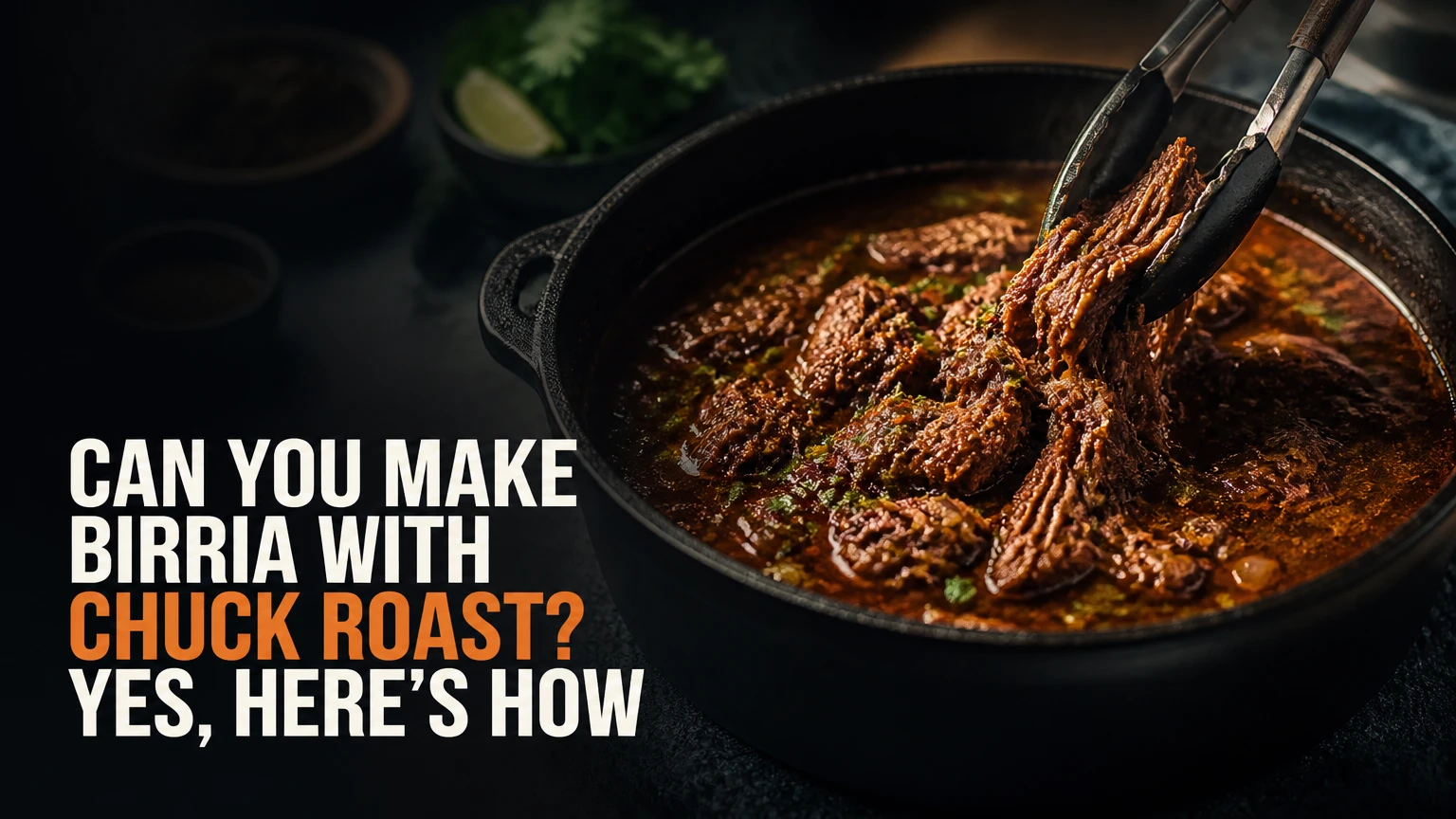
Yes, you can make birria with chuck roast, and chuck roast is one of the most reliable cuts for beef birria. Its shoulder-muscle collagen and moderate marbling withstand a long braise, producing shreddable beef and a full-bodied consommé without requiring goat or bone-in shank. Cut the roast into large pieces and cook it gently until fork-tender.
Key Facts at a Glance
- Chuck roast is suitable for birria because long braising converts its collagen into gelatin.
- A 4-pound chuck roast yields about 8-10 servings of stew or 16-20 tacos.
- Covered oven braising at 325°F usually takes 3-4 hours after searing and sauce preparation.
- Guajillo chiles provide red color and mild fruitiness, while ancho chiles add sweetness and depth.
- Straining the blended adobo removes tough chile skins and produces smoother consommé.
- The red fat separated from the broth is useful for frying tortillas for quesabirria.
Can You Make Birria With Chuck Roast?
Chuck roast makes excellent birria when the cut receives enough time to soften and enough liquid to prevent drying. Beef chuck comes from the shoulder, which contains active muscles, connective tissue, and fat; those characteristics make it unsuitable for quick cooking but effective in a covered braise.
Traditional birria developed in Jalisco and is commonly associated with goat, although beef birria, or birria de res, is now widely prepared. The finished dish may be served as a soupy stew with consommé or as shredded meat in tortillas, especially quesabirria tacos.
Chuck roast has one limitation: boneless chuck contributes less marrow flavor than shank, neck, or oxtail. A practical solution is blending chuck with one bone-in cut, but 100% chuck remains the simplest and most predictable choice for home cooking.
What Makes Chuck Roast Tender in Birria?
Collagen in chuck roast gradually dissolves into gelatin during moist cooking. Gelatin gives the broth body and helps the shredded beef feel juicy, while rendered beef fat carries chile and spice aromas through the sauce.
Texture depends on time, temperature, and moisture together. A roast can reach a high internal temperature and remain tough if collagen has not fully dissolved, so fork resistance is a better finishing test than temperature alone.
What Ingredients Do You Need?
The following formula makes approximately 8-10 servings from 4 pounds of chuck roast. Use large 3-inch pieces rather than small cubes, because small pieces lose moisture more quickly during a long braise.
| Ingredient | Quantity | Function | Practical note |
|---|---|---|---|
| Beef chuck roast | 4 lb | Main meat | Trim only thick, hard exterior fat |
| Guajillo chiles | 6 | Color and mild berry-like flavor | Remove stems and most seeds |
| Ancho chiles | 3 | Sweet, raisiny depth | Use dried poblano chiles |
| Chile de árbol | 1-3 | Heat | Add 1 for mild, 2 for medium |
| Roma tomatoes | 2 | Acidity and body | Char until blistered |
| White onion | 1 medium | Sweetness and aroma | Halve before charring |
| Garlic | 6 cloves | Savory aromatic depth | Peel after charring if needed |
| Apple cider vinegar | 2 tbsp | Brightness and balance | Add more only after tasting |
| Beef broth or water | 5-6 cups | Braising liquid | Use unsalted broth when possible |
| Mexican oregano | 2 tsp | Herbal character | Crush between your fingers |
| Ground cumin | 1½ tsp | Warm earthiness | Avoid excessive amounts |
| Black peppercorns | ½ tsp | Pepper fragrance | Blend whole |
| Whole cloves | 2 | Background spice | Too many create medicinal bitterness |
| Mexican cinnamon | 1 small piece | Warm aromatic note | Remove before blending if preferred |
| Bay leaves | 2 | Braising aroma | Add during cooking |
| Kosher salt | 2½-3 tsp, plus more | Seasoning | Adjust according to broth salt |
| Neutral oil | 2 tbsp | Searing and tortilla frying | Beef fat can replace it |
Dried Mexican chiles are the defining flavor system. Guajillo chiles usually supply color and restrained heat, ancho chiles deepen the sauce, and árbol chiles raise the heat quickly without adding much bulk.
What Can Replace Missing Chiles?
If guajillo chiles are unavailable, use dried New Mexico chiles for a similar mild red-chile profile. California chiles provide color with less intensity. Ancho chiles can be replaced with another mild dried chile, but the sauce will lose some sweetness and dark fruit character.
Avoid replacing every dried chile with ground chile powder. Powder varies widely in heat, may contain salt or additives, and does not blend into the same textured adobo. If necessary, use 3 tablespoons of a mild pure chile powder and add it directly to the aromatics.
How Do You Make Birria With Chuck Roast?
Make chuck roast birria in five stages: prepare the chiles, brown the beef, blend and strain the adobo, braise the meat, and separate the meat from the consommé. The oven method takes about 45 minutes of active work and 3-4 hours of covered cooking.
Before You Start
| Category | Requirement |
|---|---|
| Total time | 4-5 hours, including resting |
| Active time | 45-60 minutes |
| Yield | 8-10 stew servings or 16-20 tacos |
| Difficulty | Moderate |
| Main equipment | 7- to 8-quart Dutch oven, blender, fine-mesh strainer |
| Useful tools | Tongs, sheet pan, ladle, instant-read thermometer |
| Oven setting | 325°F |
| Meat size | 3-inch chuck roast pieces |
Step 1: Toast and Soak the Chiles
Remove stems and most seeds from the guajillo, ancho, and árbol chiles. Toast them in a dry skillet over medium heat for 20-30 seconds per side, turning as soon as they smell fragrant.
Transfer the chiles to a bowl and cover them with hot water for 15-20 minutes. Do not use aggressively boiling water for a long soak, because the goal is softening rather than extracting every bitter note.
You will know this step worked when the chiles bend easily and their skins feel supple. A common mistake is blackening the chiles; black patches usually create a bitter sauce that later ingredients cannot fully repair.
Step 2: Char the Aromatics
Place the halved onion, tomatoes, and garlic in the same dry skillet. Char the onion and tomatoes until they develop dark spots and softened edges, then turn the garlic frequently so it gains color without burning.
Charring adds roasted flavor and reduces the raw edge of the aromatics. The vegetables do not need to be uniformly black. Deep brown patches are useful; a completely burnt surface is not.
Step 3: Sear the Chuck Roast
Cut the chuck roast into 3-inch pieces and pat the surfaces dry. Season with about 2 teaspoons of kosher salt, then heat the oil in the Dutch oven over medium-high heat.
Sear the beef in batches for 2-3 minutes per broad side. Leave space between pieces so moisture can evaporate and browning can occur. Move the browned beef to a plate before adding the next batch.
The success checkpoint is a dark brown crust rather than a gray, steamed surface. The common mistake is crowding the pot, which lowers the pan temperature and leaves flavor on the table.
Step 4: Blend and Strain the Adobo
Add the softened chiles, charred vegetables, vinegar, oregano, cumin, peppercorns, cloves, cinnamon, and 1 cup of broth to a blender. Blend for 60-90 seconds until the mixture looks smooth and uniformly red.
Pass the sauce through a fine-mesh strainer into the Dutch oven. Press the solids with a ladle, but discard the dry fibrous residue that remains in the strainer.
Straining is more than a cosmetic step. Dried chile skins contain tough fibers that remain gritty after cooking, and removing them produces a smoother broth with cleaner flavor.
Step 5: Braise the Beef
Return the seared chuck roast and its resting juices to the pot. Add enough broth to bring the liquid about two-thirds of the way up the meat, then add the bay leaves.
Bring the liquid to a gentle simmer on the stovetop. Cover the pot and transfer it to a 325°F oven for 3-4 hours, checking after 3 hours. Turn the pieces once if the top remains noticeably above the liquid.
Chuck roast is done when a fork slides into the center with little resistance and the meat separates under gentle pressure. A typical internal temperature at that stage is approximately 195-205°F, but temperature is a guide rather than the sole test.
Step 6: Rest, Shred, and Season
Remove the beef to a tray and rest it for 15 minutes. Shred the meat into bite-sized pieces, discarding large pieces of gristle while retaining soft gelatinous sections.
Let the broth sit for 5 minutes. Skim the red-tinted fat from the surface into a heatproof bowl, then taste the consommé and adjust salt, vinegar, or water.
Mix enough consommé into the shredded beef to keep it moist without making it soupy. Keep the remaining broth separate for dipping and serving.
Which Meat Cut Works Best With Chuck Roast?
Chuck roast is the best single-cut choice for accessible birria, while a chuck-and-shank blend produces a more gelatinous consommé. Short ribs and oxtail add concentrated beef flavor and body, but they cost more and can make the broth substantially fattier.
| Cut or blend | Typical ratio | Cooking result | Best use |
|---|---|---|---|
| Boneless chuck | 100% chuck | Even shredding, moderate fat | Simplest home batch |
| Chuck and beef shank | 75:25 | More gelatin and marrow depth | Rich consommé |
| Chuck and short ribs | 70:30 | Strong beef flavor, higher fat | Special-occasion tacos |
| Chuck and oxtail | 80:20 | Very thick, sticky broth | Small premium batch |
| Chuck and lean round | 80:20 | Firmer, less succulent texture | Lower-fat preparation |
A bone-in addition is optional, not mandatory. For most cooks, properly browned chuck with a well-strained adobo gives a better result than poorly cooked mixed cuts.
Which Cooking Method Should You Use?
The oven is the strongest all-purpose method because steady covered heat tenderizes chuck roast while the Dutch oven retains enough liquid for a full broth. A pressure cooker is fastest, while a slow cooker offers convenience but produces less reduction and browning.
| Method | Active time | Cooking time | Liquid behavior | Best fit |
|---|---|---|---|---|
| Covered oven | 45-60 min | 3-4 hr at 325°F | Moderate evaporation | Best overall flavor |
| Stovetop Dutch oven | 45-60 min | 3-3½ hr | Requires heat monitoring | Cooks without an oven |
| Slow cooker low | 35-45 min | 8-9 hr | Very little reduction | Hands-off scheduling |
| Slow cooker high | 35-45 min | 5-6 hr | Very little reduction | Same-day cooking |
| Pressure cooker | 45-60 min | 50 min high pressure | Minimal reduction | Fastest tender beef |
How Do You Adapt Birria for a Pressure Cooker?
Use 1½ cups of broth rather than fully submerging the beef, and pressure-cook 4-inch chuck pieces for 50 minutes at high pressure. Allow a 15-minute natural release, then vent the remaining pressure carefully.
Sear the beef and blend the adobo first if time permits. After pressure cooking, remove the meat and simmer the broth uncovered for 10-15 minutes if the consommé tastes thin.
How Do You Adapt Birria for a Slow Cooker?
Sear the chuck roast and char the aromatics before transferring everything to the slow cooker. Cook on low for 8-9 hours or high for 5-6 hours, checking for fork tenderness at the shorter time.
Slow cookers retain moisture, so the finished broth may taste less concentrated than oven-braised birria. Reduce the strained consommé in a saucepan after removing the meat, rather than leaving the shredded beef in a hot cooker for hours.
How Do You Turn Chuck Roast Birria Into Quesabirria?
To make quesabirria, dip corn tortillas lightly in the reserved red fat, griddle them until flexible, add shredded beef and Oaxaca or low-moisture mozzarella, then fold and cook until crisp. Serve each taco with a small bowl of hot consommé.
Warm the fat over medium heat and use only enough to coat the tortilla. Excess fat can make the taco greasy and prevent even browning.
| Taco component | Typical amount per taco | Purpose |
|---|---|---|
| Corn tortilla | 1, 5-6 inches | Crisp shell |
| Reserved beef fat | ½-1 tsp | Red color and frying medium |
| Shredded birria | 2-3 tbsp | Main filling |
| Oaxaca cheese | 1-2 tbsp | Melt and stretch |
| Diced white onion | 1 tsp | Fresh sharpness |
| Cilantro | 1 tsp | Herbal contrast |
| Lime juice | ¼ tsp | Acid balance |
| Consommé | ⅓-½ cup | Dipping broth |
Cook the tacos seam-side down first so the fold sets. Flip once the underside is crisp, then serve immediately with onion, cilantro, and lime.
Birria also works as a stew. Put shredded beef in a bowl, ladle over hot consommé, and add garnishes separately so diners can control acidity and heat.
What Are the Most Common Chuck Roast Birria Problems?
Most birria failures come from excessive heat, insufficient time, poor chile handling, or incorrect broth seasoning. Each problem has a distinct visual or textural signal, so the recovery method should address the cause rather than add random ingredients.
| Problem | Likely cause | Diagnostic sign | Correction |
|---|---|---|---|
| Tough beef | Braise ended early | Fork meets firm resistance | Cover and cook 30-45 minutes longer |
| Dry shredded beef | Too little liquid or overcooking | Fibers look pale and stringy | Add consommé and reduce reheating time |
| Bitter broth | Burnt chiles or excess cloves | Acrid finish after swallowing | Dilute, add salt and acid gradually |
| Gritty sauce | Adobo was not strained | Fine particles on the tongue | Strain the broth through fine mesh |
| Thin consommé | Excess broth or slow cooker method | Liquid lacks body | Reduce uncovered after removing meat |
| Greasy tacos | Too much surface fat | Tortilla fries unevenly | Use a thin fat coating and hotter griddle |
Why Is the Chuck Roast Still Tough?
Chuck roast is usually tough because the collagen has not had enough time to dissolve, not because the meat needs a higher cooking temperature. Return the covered pot to a gentle oven or simmer and test the beef every 30 minutes.
If the liquid is boiling hard, lower the oven setting or stovetop heat. Vigorous bubbling can break the exterior fibers before the interior connective tissue softens.
How Do You Fix Bitter Birria?
Burnt chiles cause the most persistent birria bitterness. Remove any visibly scorched chile pieces before blending, and if the sauce is already cooked, dilute it with unsalted broth, then adjust salt and vinegar in small increments.
A tiny amount of sugar can soften a harsh edge, but sugar cannot erase severe burning. Starting again with gently toasted chiles is the better choice when the bitterness dominates the entire batch.
How Do You Fix Thin Consommé?
Thin consommé usually results from too much liquid or insufficient reduction. Remove the meat and bay leaves, simmer the broth uncovered for 10-20 minutes, and taste again before adding salt.
Gelatin from chuck roast thickens the broth as it cools. Do not reduce aggressively before the braise finishes, because overly concentrated liquid can become salty while the meat remains undercooked.
How Should You Scale the Recipe?
For a half batch, use 2 pounds of chuck roast, 3 guajillo chiles, 1-2 ancho chiles, 2½-3 cups broth, and a 4- to 5-quart pot. For a crowd, keep the beef pieces in a single layer or divide the recipe between two pots.
| Chuck roast | Expected servings | Guajillo chiles | Broth | Covered oven time |
|---|---|---|---|---|
| 2 lb | 4-5 | 3 | 2½-3 cups | 3-3½ hr |
| 4 lb | 8-10 | 6 | 5-6 cups | 3-4 hr |
| 6 lb | 12-15 | 9 | 7-8 cups | 3½-4½ hr |
| 8 lb | 16-20 | 12 | 9-10 cups | 4-5 hr |
Do not double the salt or vinegar automatically. Broth brands differ in sodium, and chile intensity varies by harvest and storage age. Season the blended adobo lightly, then make the final adjustment after cooking.
How Much Does Chuck Roast Birria Cost?
A typical 4-pound batch costs about $35-$65 in the United States, depending on chuck roast prices, dried chile availability, cheese, and whether broth and spices are already in the pantry. The meat usually accounts for most of the cost.
| Cost category | Typical amount | Typical range | Main variable |
|---|---|---|---|
| Chuck roast | 4 lb | $24-$40 | Local beef price |
| Dried chiles | 9-12 pieces | $4-$9 | Package size |
| Aromatics and spices | 1 batch | $3-$7 | Pantry stock |
| Broth and vinegar | 5-6 cups | $3-$8 | Packaged versus homemade |
| Tortillas and cheese | 16-20 tacos | $6-$14 | Cheese type |
| Total meal | 8-10 servings | $35-$65 | Serving style |
The stew version costs less because it does not require cheese or extra tortillas. A large batch also lowers the per-serving cost when the spices are already available.
How Do You Store and Reheat Birria?
Refrigerate cooked chuck roast birria within 2 hours in shallow containers and use it within 3-4 days. Freeze the shredded beef with enough consommé to cover it, while keeping reserved surface fat in a separate sealed container.
Cool the broth and meat quickly before refrigeration. Solidified fat can be lifted from the chilled broth and stored for later tortilla frying.
| Storage method | Container | Maximum typical time | Reheating method |
|---|---|---|---|
| Refrigerator | Shallow airtight container | 3-4 days | Covered saucepan, medium-low |
| Freezer, meat | Beef plus consommé | 2-3 months | Thaw overnight, then simmer |
| Freezer, broth | Airtight freezer container | 2-3 months | Thaw and heat gently |
| Reserved fat | Sealed jar | 1-2 weeks chilled | Melt before use |
Reheat only the portion needed for the meal. Repeated heating dries shredded beef and dulls the chile aroma.
Expert Rules for Better Chuck Roast Birria
- Use large pieces. Three-inch chunks retain moisture better than small cubes during a multi-hour braise, and they are easier to judge for tenderness.
- Season in layers. Salt the beef before searing, season the adobo lightly, and correct the consommé after cooking. This prevents salty broth when using packaged stock.
- Reduce after shredding, not before. The broth can taste thin while the beef cooks, but reducing early concentrates salt before gelatin and meat juices fully enter the liquid.
- Keep fat for tacos, not necessarily for stew. A rich stew benefits from skimming, while tortillas need a thin film of the red fat for browning and chile flavor.
- Do not chase a thermometer number. A 203°F reading does not guarantee tender chuck if the collagen has not had enough time to dissolve; the fork test determines the finish.
FAQ
Can you make birria with a chuck roast without searing it?
Yes, but searing improves the finished flavor. Chuck roast can braise successfully without browning, especially in a slow cooker, but the consommé will lack some roasted beef depth. If skipping the sear, char the onion and tomatoes carefully and reduce the finished broth briefly for greater concentration.
Should you marinate chuck roast before making birria?
A 4-12 hour marinade can deepen chile flavor, but it is optional because the adobo cooks with the beef for several hours. If marinating, keep the meat refrigerated and reserve the marinade for the pot only if it has been brought fully to a boil during cooking.
Can you use a whole chuck roast instead of cutting it?
Yes, a whole roast can be braised, but 3-inch pieces expose more surface area to the adobo and make shredding easier. A whole 4-pound roast may require 4-5 hours at 325°F, while cut pieces often finish in 3-4 hours.
Is chuck roast birria better with bone-in beef?
Bone-in beef can add marrow and gelatin, but chuck roast alone provides enough connective tissue for a rich result. Add one beef shank or a small oxtail portion when consommé body matters more than cost and convenience.
Can you make birria less spicy?
Yes, omit the árbol chiles and use six guajillos with two anchos for a mild batch. Removing chile seeds reduces some heat, although the membranes and individual chile varieties also affect intensity, so taste the blended adobo before final seasoning.
Can leftover birria be used for other meals?
Yes, leftover chuck roast birria works in rice bowls, toasted sandwiches, baked enchiladas, and noodle soup. Keep the meat moist with consommé, add fresh acid at serving, and avoid reheating the beef repeatedly because shredded fibers lose moisture quickly.
The Bottom Line
Yes, you can make birria with chuck roast, and the cut is a dependable choice for both birria stew and quesabirria tacos. Use large pieces, toast the dried chiles without burning them, strain the adobo, and braise at 325°F until the beef yields easily to a fork. Finish by skimming the consommé and saving its red fat for tortillas.