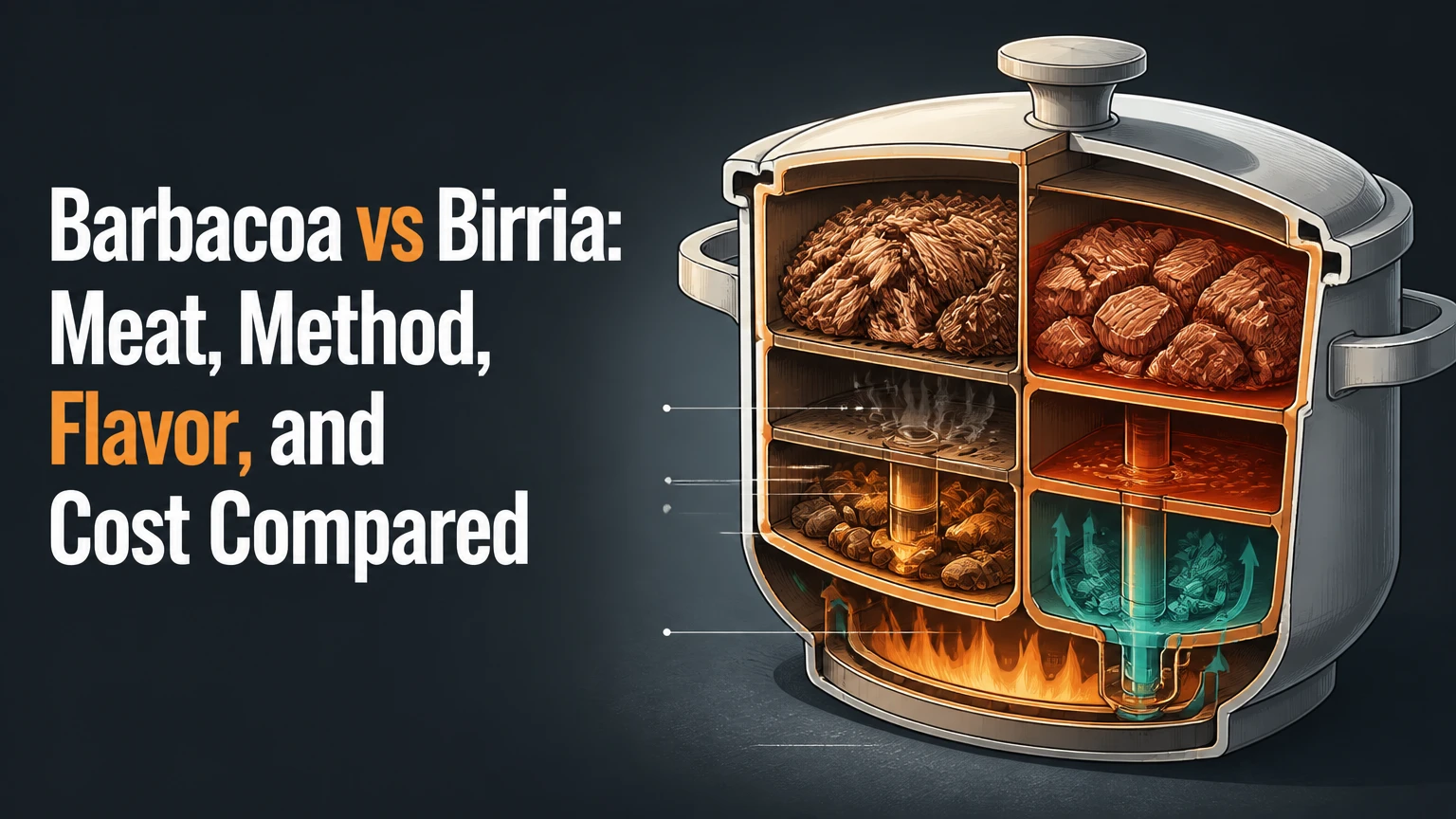
Barbacoa is primarily a slow-cooking method associated with tender meat, gentle seasoning, and, traditionally, underground or covered cooking. Birria is a Jalisco dish built around meat braised in a chile-based adobo, producing intensely seasoned meat and consomé. Barbacoa usually tastes cleaner and meat-forward; birria tastes darker, spicier, and more sauce-centered.
Key Facts at a Glance
- Barbacoa traditionally uses pit cooking or enclosed steaming, while birria uses adobo-seasoned braising or roasting.
- Barbacoa may use sheep, goat, beef head, beef cheeks, or other large cuts, depending on the region.
- Birria began as a goat preparation in Jalisco and now commonly appears as beef birria in tacos and quesabirria.
- Barbacoa seasoning is often restrained, with salt, herbs, leaves, or salsa added at service.
- Birria’s defining accompaniment is consomé, a chile-rich broth made from the cooking juices.
- Quesabirria is a birria serving style, not a separate meat species or cooking method.
What Is the Difference Between Barbacoa and Birria?
Barbacoa describes a cooking tradition centered on slow, moist heat, whereas birria describes a specific seasoned dish. The distinction matters because restaurant menus sometimes use “barbacoa” for any shredded meat and “birria” for any red chile stew, even though the traditional flavor systems are different.
The word barbacoa is linked to Indigenous Caribbean and Mesoamerican cooking traditions, but its exact historical path is debated. In Mexico, the preparation became strongly associated with large cuts or whole animals cooked in an earth oven, often with maguey leaves and aromatic herbs.
Birria is strongly associated with Jalisco, especially the Guadalajara and Cocula area. Traditional birria commonly uses goat, although beef versions became widespread in northwestern Mexico and the United States. The preparation relies on a chile adobo, acidic ingredients, spices, and long cooking until connective tissue softens.
The most useful distinction for a diner is practical: barbacoa foregrounds the meat, while birria foregrounds the interaction between meat, adobo, rendered fat, and broth.
Barbacoa vs Birria: Master Comparison
| Criterion | Traditional barbacoa | Traditional-style birria | Practical consequence |
|---|---|---|---|
| Primary identity | Cooking method and regional dish family | Specific seasoned Mexican dish | Menu labels require regional context |
| Common traditional meat | Sheep or goat | Goat, especially in Jalisco | Beef versions are modern regional adaptations |
| Main heat method | Earth oven, steamer, or covered vessel | Covered braise, oven, stovetop, or pressure cooker | Birria is easier to reproduce indoors |
| Seasoning intensity | Salt, herbs, leaves, salsa | Dried chiles, spices, garlic, vinegar, and aromatics | Birria tastes more concentrated |
| Liquid result | Meat juices or regional consomé | Red chile cooking broth called consomé | Birria is usually served with broth |
| Texture | Moist, fibrous, pull-apart meat | Soft, shreddable meat with sauce coating | Barbacoa can feel cleaner; birria feels richer |
| Typical service | By weight, in tacos, with salsa | Tacos, quesabirria, bowls, and dipping broth | Birria offers more composed street-food formats |
| Home difficulty | High for true pit cooking | Moderate with an oven or pressure cooker | Equipment changes the recommendation |
Which One Has More Flavor?
Birria generally has the more forceful flavor because dried chiles, toasted spices, garlic, acid, and rendered fat season both the meat and its broth. Barbacoa can be equally complex, but its complexity usually comes from animal flavor, smoke, herbs, texture, and salsa rather than a dense adobo.
A restrained barbacoa is not automatically bland. Sheep cooked with bones and collagen develops a deep savory character, while maguey or avocado leaves can add herbal notes. The final impact depends heavily on salsa, onion, cilantro, lime, and the quality of the meat.
Birria is more forgiving when the meat itself is ordinary because the adobo supplies much of the dish’s identity. That same strength can hide delicate lamb or goat flavor, which is why diners who enjoy pronounced meat character often prefer simply seasoned barbacoa.
Winner for bold seasoning: birria.
Winner for clean meat flavor: barbacoa.
Which One Is Spicier?
Birria is usually spicier in flavor, but traditional birria is not defined by extreme heat. Guajillo and ancho chiles provide color, fruitiness, and depth; smaller amounts of hotter chiles can raise the heat level. Barbacoa usually receives heat from table salsa rather than from the cooking liquid itself.
Spice level varies by cook and region. A birria made only with mild dried chiles may taste rich without being hot, while a barbacoa served with a roasted chile salsa can be hotter than the meat. Ask whether the heat is inside the adobo or supplied separately.
How Do the Cooking Methods Work?
Barbacoa uses enclosed moist heat that gradually converts collagen into gelatin. Birria uses the same basic tenderness principle but adds a chile adobo and cooking liquid, so the meat braises while absorbing seasoned juices.
How Traditional Barbacoa Cooks Meat
Traditional barbacoa begins with hardwood burned down to hot coals, followed by a lined pit, a vessel for steam or broth, and meat wrapped or covered with leaves. The pit remains closed for roughly 8-14 hours, depending on animal size, cut thickness, coal temperature, and sealing quality.
Maguey leaves help retain moisture and separate meat from intense radiant heat. Their aromatic contribution is real, but claims that leaf compounds reliably “chemically tenderize” the entire cut overstate the evidence. Collagen conversion, steam, time, and moderate heat do most of the tenderizing.
The classic setup may collect drippings in a pot beneath the meat. Some regional versions add chickpeas, rice, onions, herbs, or other ingredients to that broth. The practice is important, but not every barbacoa preparation produces consomé, and broth ingredients vary substantially.
How Birria Braises Meat
Birria begins with dried chiles that are briefly toasted, softened in hot water, and blended with garlic, vinegar, herbs, spices, and aromatics. The strained adobo coats the meat, and many cooks rest it for several hours or overnight before cooking.
The meat then cooks in a covered vessel at approximately 300-325°F, or at a gentle stovetop simmer, until connective tissue softens. A pressure cooker can shorten the process to about 60-90 minutes at pressure, followed by natural pressure release and texture testing.
Birria does not require the meat to be fully submerged. A shallow layer of broth allows the enclosed vessel to trap steam while the meat releases its own juices. Too much water weakens the adobo and produces broth that tastes diluted rather than concentrated.
| Cooking variable | Barbacoa, typical range | Birria, typical range | Why it matters |
|---|---|---|---|
| Preparation time | 30-90 minutes | 45-90 minutes, plus 4-24 hours marination | Birria’s marinade adds planning time |
| Cooking time | 8-14 hours | 3.5-5 hours in an oven | Cut size and bone content change timing |
| Pressure-cooker time | Rarely traditional | 60-90 minutes at pressure | Useful for weeknight beef birria |
| Oven temperature | Indirect pit heat, not standardized | 300-325°F | Covered cooking prevents moisture loss |
| Doneness range | Often 195-205°F | Often 195-205°F | Temperature guides timing, texture confirms completion |
| Texture test | Bone loosens and meat pulls apart | Fork slides through and meat shreds | Collagen conversion matters more than one number |
Which Meats Belong in Each Dish?
Barbacoa and birria overlap in meat choices, but regional tradition gives each preparation a different center of gravity. Barbacoa is strongly associated with sheep in central Mexico, while birria’s historical identity is goat from Jalisco and its modern commercial identity is often beef.
| Regional style | Meat and cut | Seasoning profile | Common service |
|---|---|---|---|
| Hidalgo barbacoa | Lamb or mature sheep, bone-in | Salt, herbs, maguey leaves | Tacos, plates, broth |
| Estado de México barbacoa | Sheep or goat | Salt, herbs, regional salsa | Weekend morning meal |
| Northern Mexican barbacoa | Beef head, cheeks, or chuck | Salt, chiles at service | Tacos and breakfast plates |
| Jalisco birria | Mature goat | Dried chile adobo and spices | Bowl with consomé |
| Tijuana-style birria | Beef chuck, shank, or short rib | Red adobo with aromatics | Tacos and quesabirria |
| Home-style birria | Chicken thighs or beef chuck | Simplified chile sauce | Pressure cooker or stovetop meal |
Is Beef Barbacoa the Same as Beef Birria?
Beef barbacoa and beef birria are not automatically the same dish. Beef cheeks or head cooked with salt and steam remain barbacoa in style, while beef chuck braised in a red chile adobo is birria, even when both preparations are shredded and placed in tortillas.
The confusion comes from modern menus and shared cuts. Beef cheek has abundant collagen and works well in either preparation, but the seasoning and broth determine the culinary identity. A restaurant may also call a heavily seasoned beef preparation “barbacoa” for familiarity with local customers.
Can Goat Be Used for Both?
Goat works exceptionally well in both preparations because its connective tissue benefits from long cooking and its distinct flavor can support strong seasoning. In barbacoa, goat often receives restrained seasoning; in birria, goat is commonly paired with chile adobo and a concentrated broth.
Mature goat can taste more pronounced than young goat. Birria’s spices balance that character, while a simple barbacoa exposes it. Diners new to goat often find birria more approachable, although the choice depends on the cook’s handling and the animal’s age.
How Do Serving Styles Change the Experience?
Barbacoa is commonly served in soft corn tortillas with chopped onion, cilantro, salsa, and lime. Birria can be served the same way, but its signature format adds consomé and often fries tortillas in the red fat collected from the cooking liquid.
Quesabirria combines birria meat, melted cheese, and a tortilla fried with seasoned fat. The crisp exterior and dipping broth create a different eating experience from a traditional barbacoa taco, where the tortilla and salsa usually keep the focus on the meat.
| Serving format | Typical filling | Broth included | Best feature |
|---|---|---|---|
| Barbacoa taco | Shredded lamb, goat, or beef | Sometimes | Meat texture and salsa contrast |
| Barbacoa plate | Meat by weight with sides | Often regional | Direct comparison of meat quality |
| Birria taco | Adobo-braised meat | Usually served separately | Rich filling with chile coating |
| Quesabirria | Birria and melted cheese | Yes, for dipping | Crisp tortilla and molten cheese |
| Birria bowl | Meat, consomé, onions, herbs | Yes | Soup-forward meal |
| Leftover birria rice | Shredded meat and broth | Incorporated | Efficient second-day use |
The red layer floating on birria broth is rendered fat colored by chile pigments. Skimming some of it for tortilla frying adds aroma and crispness, but removing all fat can make the broth taste thin. The useful approach is to reserve enough for frying while leaving some emulsified richness in the consomé.
Which Is Easier to Cook at Home?
Birria is easier for most home cooks because a Dutch oven, slow cooker, or pressure cooker can reproduce its covered braise without a pit. Authentic pit barbacoa requires outdoor space, safe fire management, suitable leaves, and a reliable method for retaining heat overnight.
A home barbacoa-style roast can still be excellent. Salt a bone-in lamb shoulder or beef cheek, add a small amount of water, cover the vessel tightly, and cook at approximately 275-300°F until the meat separates easily. The result imitates the moist cooking principle, not every feature of an earth oven.
| Home setup | Better match | Typical total time | Typical equipment cost |
|---|---|---|---|
| Dutch oven | Birria or covered barbacoa-style roast | 4-6 hours | $50-$180 vessel |
| Slow cooker | Simplified birria | 6-8 hours | $35-$120 appliance |
| Pressure cooker | Beef birria | 1.5-2.5 hours | $70-$200 appliance |
| Outdoor pit | Traditional barbacoa | 10-18 hours | $100-$500 setup |
| Covered roasting pan | Home barbacoa-style beef or lamb | 5-8 hours | $25-$100 pan |
What Does Each One Cost?
Typical United States restaurant prices range from about $18-$30 per pound for barbacoa and $14-$24 for an order of three birria tacos with consomé. Prices vary with local labor, meat costs, portion size, and whether barbacoa is sold bone-in or as trimmed meat.
In Mexico, weekend barbacoa sold by weight may cost approximately 350-600 Mexican pesos per kilogram in higher-cost or tourist markets. Birria orders commonly fall around 120-220 pesos, although regional restaurants and premium cuts can exceed those ranges.
Home cost depends more on the meat than the spices. A typical four-to-six-person pot of beef birria may use 3-4 pounds of chuck, while bone-in barbacoa requires more raw weight because bones and rendered fat reduce the final edible yield.
| Cost category | Barbacoa, typical | Birria, typical | Main cost driver |
|---|---|---|---|
| Raw meat for 4-6 people | 4-6 lb bone-in | 3-4 lb boneless or bone-in | Bone percentage |
| Home ingredient cost | $35-$80 | $30-$70 | Cut and chile availability |
| US restaurant price | $18-$30/lb | $14-$24 per three tacos | Portion format |
| Mexico restaurant price | 350-600 MXN/kg | 120-220 MXN/order | City and venue |
| Edible yield | 45%-60% bone-in | 60%-75% depending on cut | Trimming and collagen |
These are typical planning ranges, not universal prices. Restaurant menus should state whether the listed weight includes bones, tortillas, broth, and side dishes.
Which Should You Choose?
The best choice depends on whether the diner values meat character, chile intensity, convenience, or a crisp taco format. Barbacoa suits a meat-focused meal and a salsa-driven plate; birria suits diners who want a rich broth, assertive seasoning, or a home recipe that works without specialized outdoor equipment.
Choose Barbacoa If You Prefer Traditional Meat Flavor
Choose barbacoa when lamb, goat, or beef should taste recognizable beneath the seasoning. A weekend barbacoa restaurant that sells meat by weight offers the clearest way to evaluate tenderness, fat, aroma, and salsa separately.
Barbacoa is also the better choice for diners who dislike heavy chile sauces. The preparation can still be rich, especially when bones contribute gelatin to the broth, but the flavor usually remains less acidic and less spice-dense than birria.
Choose Birria If You Want Consomé and Strong Seasoning
Choose birria when the broth is part of the meal rather than an optional side. The chile adobo creates a unified flavor across the meat, cooking liquid, tortilla, and dipping sauce.
Birria also fits stronger street-food cravings. Quesabirria provides crisp edges and melted cheese, while a bowl of birria offers a softer, broth-forward format. Diners sensitive to acidity or chile heat should ask for a mild preparation and taste the consomé before adding salsa.
Choose Home Birria for Convenience
Choose home birria when you have an oven, slow cooker, or pressure cooker but no pit. Beef chuck is forgiving, dried chiles keep well, and the dish reheats effectively because gelatin restores body to the broth after chilling.
Do not choose birria when you want a fast meal from raw ingredients. Even a pressure-cooker version requires chile preparation, blending, straining, browning or seasoning, and careful fat management.
Choose Barbacoa for a Regional Food Experience
Choose traditional barbacoa when the cooking method and regional context matter as much as the final taco. A real barbacoa service may be available only on weekends because pit cooking requires long preparation and overnight heat management.
Authenticity has limits outside its original setting. A covered oven roast can honor barbacoa’s technique, but it should not be presented as identical to meat cooked in a sealed earth pit with local leaves and regional service customs.
Common Mistakes and How Do You Fix Them?
Barbacoa and birria fail for different reasons, but both require moisture control and patience. Barbacoa most often suffers from steam loss or excessive smoke; birria most often suffers from burnt chiles, diluted broth, or mishandled rendered fat.
Barbacoa Mistakes
- Loose covering: A leaking lid allows moisture to escape and produces dry meat. Seal a roasting pan with two layers of foil, then check the edges after the first hour.
- Dirty smoke: Burning wood before it becomes clean coals creates bitter smoke compounds. Use glowing hardwood coals rather than actively flaming logs.
- Too little collagen: Lean boneless meat can taste dry even when fully cooked. Use cheek, shoulder, shank, head meat, or another collagen-rich cut.
- Removing the broth too early: Opening a pit or covered vessel repeatedly releases steam and extends cooking time. Check only when the minimum expected cooking window has passed.
Birria Mistakes
- Burning the dried chiles: Blackened chile skins create bitterness that sugar cannot truly repair. Toast briefly, remove stems, and soften the chiles before blending.
- Skipping straining: Chile skins and seeds create a rough texture. Strain the blended adobo through a fine sieve before it enters the braising vessel.
- Adding excessive water: Dilution weakens both meat and broth. Begin with enough liquid to cover the vessel base, then add more only if needed.
- Discarding every drop of fat: Fat carries chile aroma and helps crisp tortillas. Reserve a small bowl for frying while keeping some richness in the consomé.
- Shredding before tenderness: A roast that resists a fork needs more time, not more force. Cover it again and cook in 20-30 minute increments.
A practitioner rule of thumb is to judge tenderness with both temperature and resistance. Meat can reach approximately 200°F and remain tough if collagen has not fully dissolved, while a smaller cut may shred below that point after prolonged moist cooking.
Are Barbacoa and Birria Healthy?
Neither dish has one fixed nutritional profile because meat, portion size, fat removal, tortillas, cheese, and broth vary. Barbacoa can be relatively simple when served with salsa and tortillas, while birria often contains more sodium and added fat from the adobo, broth, tortilla frying, and cheese.
Bone-in cuts contribute gelatin and flavor, but gelatin does not make a meal nutritionally complete. Diners managing sodium should request less salt and limit broth; diners managing saturated fat can chill the broth, remove some solidified fat, and choose leaner beef.
The practical difference is portion architecture. A plate of meat with tortillas and salsa can be lighter than a large quesabirria order with cheese and multiple cups of consomé, even when both meals use similar beef cuts.
FAQ
Is Birria Just Spicy Barbacoa?
Birria is not simply spicy barbacoa. Both use slow cooking and can produce shredded meat, but birria has a defined chile-adobo identity and is commonly served with consomé. Barbacoa is broader, covering pit-steamed or enclosed preparations whose seasoning may be limited to salt, herbs, leaves, and salsa.
Does Barbacoa Always Use Lamb?
Barbacoa does not always use lamb. Lamb or sheep is especially associated with central Mexican barbacoa, while northern versions commonly use beef head or cheeks, and other regions use goat. The word identifies a preparation tradition, so the meat should be named on the menu or requested from the cook.
Is Quesabirria the Same as Birria Tacos?
Quesabirria is a birria taco with melted cheese added, usually with a tortilla dipped in seasoned cooking fat before grilling. A standard birria taco may contain only meat, onion, cilantro, and salsa. Both use birria, but quesabirria adds cheese and a crisped tortilla texture.
Which Dish Has More Broth?
Birria usually has more intentionally seasoned broth because consomé is central to its service. Barbacoa can produce a rich broth from drippings, bones, and steam-pot ingredients, but some regional versions serve the meat without a separate soup. Ask whether the restaurant includes consomé before ordering.
Can You Use the Same Beef Cut for Both?
The same beef cut can work for both preparations, but the result will differ according to seasoning and liquid. Beef chuck, cheek, shank, and short rib provide enough connective tissue for long cooking. Salted and covered chuck resembles barbacoa-style cooking; chile-marinated chuck becomes birria.
Which Is Better for a First-Time Mexican Food Diner?
Birria is often the easier introduction because its adobo, broth, and tortilla format deliver a familiar, highly seasoned profile. Barbacoa is the better first choice for diners who want to understand the meat and regional salsa without a dense chile sauce.
The Bottom Line
Barbacoa vs birria is a comparison between a broad slow-cooking tradition and a specific adobo-based dish. Choose barbacoa for tender meat, restrained seasoning, and regional pit-cooking character. Choose birria for chile depth, consomé, crisp tortillas, and easier indoor preparation. The right choice depends on the desired flavor system, not simply the type of meat.