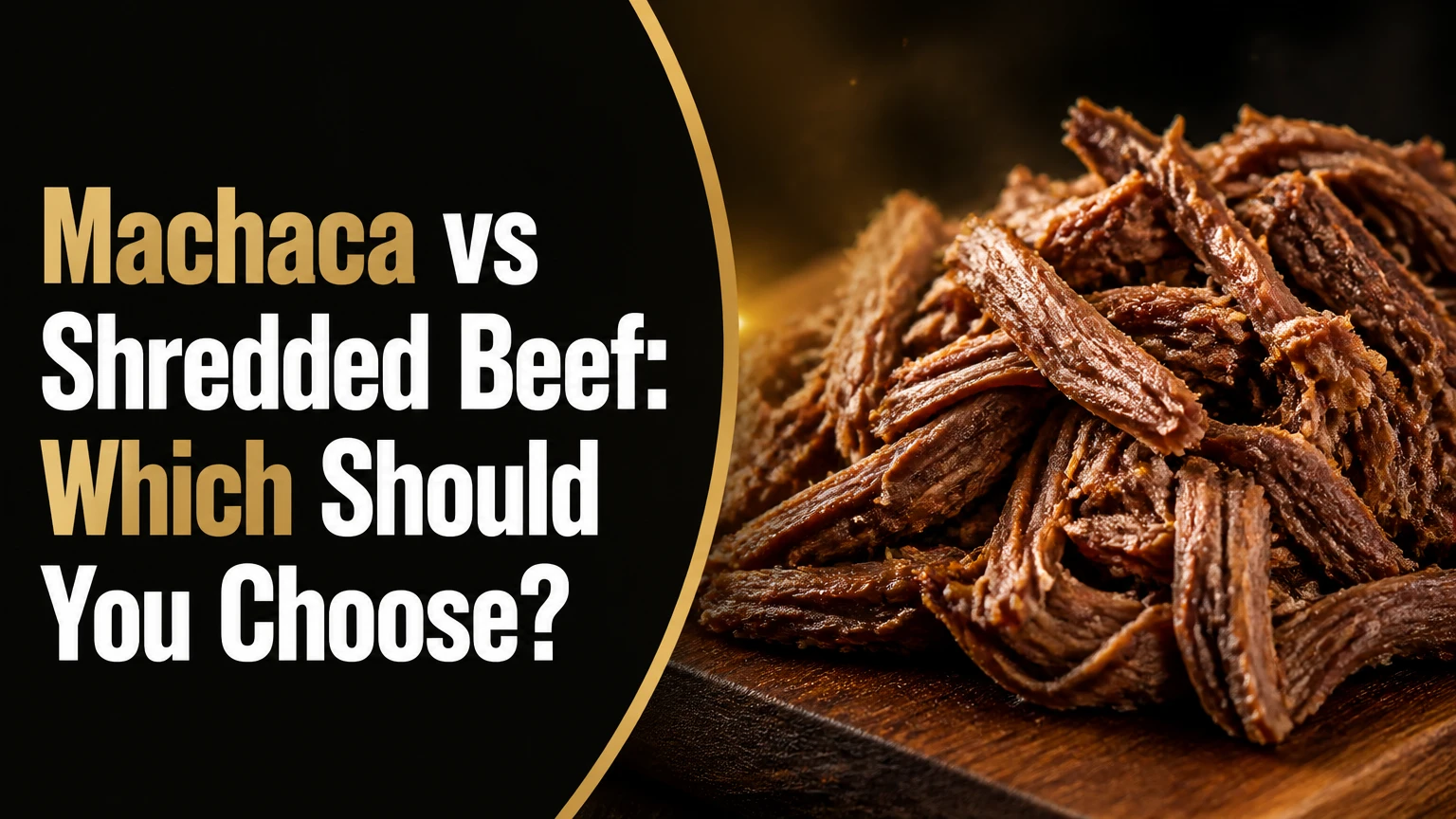
Machaca is traditionally salted, dried, and pounded beef that becomes light and intensely savory when rehydrated, while shredded beef, or carne deshebrada, is fresh beef braised until its collagen softens and the fibers pull apart. Choose machaca for concentrated flavor, eggs, portability, and quick finishing; choose shredded beef for juicy tacos, saucy fillings, and meal preparation.
Key Facts at a Glance
- Traditional machaca begins as lean beef that is salted and dehydrated before it is shredded or pounded.
- Carne deshebrada begins as fresh beef and becomes tender through moist, low-temperature cooking.
- Machaca is lighter, drier, saltier, and more concentrated than fresh shredded beef.
- One kilogram of raw beef typically produces about 300-400 grams of dried machaca or 600-750 grams of cooked shredded beef.
- Fresh shredded beef usually takes 2-4 hours by braising, while packaged machaca can finish in about 10-20 minutes.
- Machaca and shredded beef are related preparations, but they are not interchangeable without adjusting moisture, salt, and cooking time.
Machaca vs Shredded Beef: The Core Difference
The decisive difference is preservation method. Machaca uses salt and dehydration to remove water from beef, whereas carne deshebrada uses simmering liquid and heat to convert connective tissue into gelatin. That distinction controls flavor intensity, texture, storage, yield, and how each beef behaves in a tortilla or pan.
The word machaca refers traditionally to dried beef, especially in northern Mexican cooking associated with Sonora and Chihuahua. However, restaurant menus and English-language recipes sometimes use “machaca” for a fresh, braised beef dish seasoned with chiles, onion, and tomato. The label alone is therefore less reliable than the ingredient list and texture.
Carne deshebrada means shredded or pulled meat. In Mexican usage, it commonly describes fresh beef cooked in water, broth, or a chile-based sauce until the strands separate. Similar preparations appear throughout Latin America under names such as carne desmechada or shredded beef.
Master Comparison Table
| Attribute | Traditional Machaca | Fresh Shredded Beef |
|---|---|---|
| Starting condition | Salted, lean, dried beef | Raw beef, usually chuck or brisket |
| Main transformation | Moisture removal and fiber pounding | Collagen conversion during braising |
| Finished moisture | Typically below 20% before rehydration | Usually 55-70% after cooking |
| Texture | Fine, light, fibrous, slightly chewy | Juicy, tender, thick or medium strands |
| Flavor concentration | High, with salt and dried beef notes | Medium to high, depending on broth or sauce |
| Typical finishing time | 10-20 minutes after purchase | 2-4 hours by stovetop braising |
| Refrigerated life | About 3-5 days after rehydration | About 3-4 days after cooking |
| Best-known dish | Machaca con huevos | Tacos, tostadas, enchiladas, and burritos |
What Is Machaca?
Traditional machaca is beef that has been trimmed, salted, dried, and broken into shreds or flakes. The preparation developed as a preservation technique before refrigeration, so its defining feature is reduced moisture rather than a particular chile blend or beef cut.
Traditional producers often use lean cuts such as round, flank, or brisket after removing visible fat. The beef is sliced into thin sheets, seasoned, dried in moving air or a dehydrator, and then pounded or shredded. Serious Eats describes the historic process as a form of dried beef preparation, while Mexican cooking references commonly pair machaca with eggs, onion, tomato, and chiles.
Modern packaged products vary considerably. Some are fully dried and require soaking; others are semi-dried, salted, and ready to fry. Read the package directions because a product labeled “machaca” may contain dried beef, fresh cooked beef, or a blended preparation.
Is Machaca the Same as Beef Jerky?
Machaca and beef jerky both rely on dehydration, but they are designed for different uses. Jerky is usually cut into strips and eaten as a snack, while machaca is broken into small pieces and incorporated into a cooked dish.
| Product | Typical piece size | Typical use | Rehydration need | Salt expectation |
|---|---|---|---|---|
| Machaca | Fine shreds or flakes | Eggs, burritos, skillet dishes | Often 5-15 minutes | Moderate to high |
| Beef jerky | 10-20 cm strips | Snack or travel food | Usually none | Moderate to high |
| Carne seca | Thin dried sheets or strips | Regional cooking | Often required | High or variable |
| Fresh shredded beef | 2-8 cm strands | Tacos, enchiladas, stews | Not applicable | Low to moderate |
Commercial machaca should not automatically replace jerky in a snack recipe. Its smaller fibers absorb liquid quickly and can become harsh if eaten dry.
How Are the Two Beef Preparations Made?
Machaca is made by drying beef first, then softening and rehydrating it; fresh shredded beef is made by cooking raw beef in liquid until connective tissue breaks down. Machaca depends on moisture removal, while carne deshebrada depends on time, heat, and gelatin formation.
Traditional Machaca Method
- Trim the beef. Remove surface fat and silver skin from 1 kilogram of lean beef. Fat does not dry safely at the same rate as lean muscle and can shorten storage life.
- Slice thinly. Cut the beef into sheets about 3-6 millimeters thick. Thin slices dry more evenly than thick chunks.
- Season carefully. Apply salt, garlic, and optional dried chile. Commercial machaca can already be heavily salted, so reduce added salt later.
- Dry completely. Use a food dehydrator according to its meat setting and local food-safety guidance. A typical home batch takes 8-16 hours, depending on thickness and moisture.
- Break the beef apart. Pound or shred the dry pieces until they reach a fine, fluffy consistency.
- Finish with moisture. Fry onion, tomato, pepper, or broth first, then add machaca and cook for 5-10 minutes.
A dehydrator is more predictable than outdoor drying because temperature, insects, humidity, and airflow are easier to control. Home-dried meat is not automatically shelf-stable simply because it feels dry; safe preservation depends on validated drying and handling practices.
Fresh Shredded Beef Method
- Choose a connective-tissue-rich cut. Chuck roast gives the most forgiving result, while brisket and flank create different strand sizes.
- Brown the surface. Sear the beef in a heavy pot for 2-4 minutes per side. Browning adds roasted flavor but does not tenderize the interior.
- Add aromatics and liquid. Use onion, garlic, cumin, chiles, tomato, and enough broth or water to reach roughly halfway up the meat.
- Braise gently. Hold the liquid near a gentle simmer, commonly about 90-95°C, until a fork enters easily.
- Shred while warm. Pull the beef with two forks, then return it to strained cooking juices or sauce.
Tenderness depends more on connective-tissue conversion than on a clock. A 1.5-kilogram chuck roast may need 2.5-4 hours in a covered pot, 6-8 hours in a slow cooker, or about 60-75 minutes at pressure, followed by natural release.
Process and Yield Comparison
| Measure | Machaca at Home | Fresh Braised Beef |
|---|---|---|
| Raw beef quantity | 1 kg | 1 kg |
| Preparation time before cooking | 30-60 minutes | 20-30 minutes |
| Main cooking or drying time | 8-16 hours drying | 2-4 hours braising |
| Finished yield | 300-400 g dried beef | 600-750 g cooked beef |
| Added liquid | 100-250 ml for finishing | 500-1,000 ml for braising |
| Active finishing time | 10-20 minutes | 10-15 minutes shredding and saucing |
| Main equipment | Dehydrator, oven, or drying setup | Dutch oven, slow cooker, or pressure cooker |
How Do Texture and Moisture Differ?
Machaca has a dry, airy, concentrated texture because dehydration contracts and separates muscle fibers; fresh shredded beef has a moist, yielding texture because braising converts collagen into gelatin. The difference remains noticeable even after machaca is rehydrated because its fibers are finer and less plump.
Fresh beef releases water during cooking, while broth enters spaces between the fibers. Gelatin coats the meat and creates the succulent mouthfeel associated with braised beef. Machaca absorbs added liquid at the surface and can soften quickly, but it does not regain the same thick, juicy structure.
The practical consequence is important: fresh shredded beef tolerates sauce, broth, and long holding better than machaca. Machaca can become salty or pasty if submerged too long, particularly when a commercial product already contains substantial salt.
Which Beef Cut Should You Use?
Chuck roast is the strongest general-purpose cut for fresh shredded beef, while lean round or trimmed flank is more suitable for homemade machaca. Cut choice follows the preservation method: braising benefits from connective tissue, but drying requires low fat and even thickness.
| Beef cut | Best preparation | Typical fat level | Typical cooking result | Main caution |
|---|---|---|---|---|
| Chuck roast | Fresh shredded beef | 15-25% | Moist, tender strands | Requires several hours |
| Brisket flat | Both, after trimming | 8-18% | Long fibers, strong beef flavor | Can dry during braising |
| Flank steak | Machaca or quick braise | 5-12% | Fine, distinct fibers | Can become chewy when overcooked |
| Top round | Homemade machaca | 4-8% | Lean, dryable shreds | Needs careful moisture control |
| Skirt steak | Small-batch machaca | 10-20% | Strong flavor, coarse fibers | Trim fat and connective tissue |
| Rump roast | Fresh shredded beef | 8-15% | Firm, moderate strands | Needs sufficient braising time |
Which Dishes Suit Each Beef?
Machaca works best in dishes where its concentrated flavor and quick pan finish are assets, especially machaca con huevos, breakfast burritos, and dry-fried fillings. Fresh shredded beef works best where juicy strands and cooking juices matter, including tacos, enchiladas, tostadas, and sauced rice bowls.
For eggs, machaca provides enough salt and beef flavor to season the entire skillet. Add it after the vegetables soften, then taste before adding more salt. For tacos, fresh shredded beef usually gives a more satisfying bite because the tortilla receives moisture from the meat and sauce.
Application Matrix
| Dish or situation | Better choice | Typical portion | Reason |
|---|---|---|---|
| Machaca con huevos | Machaca | 40-60 g dried product per person | Salt and flavor season the eggs |
| Juicy street-style tacos | Fresh shredded beef | 75-100 g cooked beef | Moist strands suit tortillas |
| Dry breakfast burrito | Machaca | 40-60 g per person | Low moisture limits sogginess |
| Enchiladas with sauce | Fresh shredded beef | 90-120 g cooked beef | Thick strands hold sauce |
| Camping without refrigeration | Fully dried machaca | 30-50 g dry product | Low weight and no cold storage |
| Freezer meal preparation | Fresh shredded beef | 150-250 g per container | Freezes well with cooking juices |
| Quick skillet filling | Packaged machaca | 10-20 minutes | Already preserved and shredded |
| Mild family meal | Fresh shredded beef | 75-100 g cooked beef | Salt level is easier to control |
Which Is Cheaper?
Fresh shredded beef is usually cheaper per serving because ordinary chuck costs less than specialty dried machaca and retains more weight after cooking. Typical US retail prices place raw chuck around $6-$10 per pound, while packaged machaca often costs $20-$40 or more per pound, depending on drying, seasoning, and regional availability.
The price comparison needs one correction: dried meat looks expensive by weight because much of the original water has been removed. A pound of dried machaca represents roughly 2.5-3.3 pounds of raw beef before seasoning, so cost per original raw-beef equivalent is lower than the shelf price suggests.
Typical Home Economics
| Cost factor | Machaca | Fresh shredded beef |
|---|---|---|
| Typical retail price | $20-$40 per lb | $6-$10 per lb raw |
| Raw beef equivalent per finished pound | 2.5-3.3 lb | 1.3-1.7 lb |
| Electricity or fuel | $1-$4 per batch | $1-$5 per batch |
| Typical servings per finished pound | 8-12 small portions | 5-8 portions |
| Typical cost per serving | $2-$5 | $1-$3 |
| Waste risk | High if fat remains | Low if cooking liquid is saved |
Prices vary by country, butcher, and whether machaca is imported or produced locally. Homemade machaca reduces retail markup but adds dehydrator time, labor, and food-safety responsibility.
Can You Substitute One for the Other?
Machaca can replace fresh shredded beef in a skillet filling after adding broth or vegetables, but fresh shredded beef cannot replace dry machaca without changing the dish’s moisture and salt balance. Substitution works best when the recipe is flexible rather than built around a specific texture.
To replace 100 grams of cooked shredded beef with machaca, begin with approximately 35-50 grams of dried product plus 75-125 milliliters of unsalted liquid. Add liquid gradually because machaca absorbs quickly. Do not use the same salt quantity until the finished filling has been tasted.
To replace machaca with fresh shredded beef in eggs, drain the beef thoroughly and reduce other wet ingredients. The result will be softer and less concentrated, so add roasted chile, garlic, or a small amount of salt rather than cooking the beef until dry.
How Should You Store Them?
Fully dried machaca keeps longer than fresh shredded beef only when the product has been properly dried, cooled, sealed, and protected from moisture. Rehydrated machaca should be refrigerated like cooked meat, while fresh shredded beef should be chilled promptly in shallow containers.
Do not assume that commercial packaging guarantees room-temperature safety after opening. Follow the label, inspect for moisture or odor changes, and refrigerate products that are moist, semi-dried, or already cooked.
| Storage state | Container | Typical storage period | Handling rule |
|---|---|---|---|
| Sealed commercial dry machaca | Original airtight package | Follow package date, often weeks to months | Keep cool and dry |
| Homemade fully dried machaca | Vacuum bag or airtight jar | Conservative short-term storage unless validated | Refrigerate or freeze for safety |
| Rehydrated machaca | Covered shallow container | 3-4 days refrigerated | Cool promptly |
| Fresh shredded beef | Covered shallow container | 3-4 days refrigerated | Store with some cooking juices |
| Frozen shredded beef | Freezer-safe sealed container | 2-3 months for best quality | Freeze in meal-size portions |
| Opened semi-dried machaca | Airtight container | Label guidance, commonly several days refrigerated | Prevent condensation |
What Mistakes Ruin the Result?
The most common machaca failures are excessive salt, incomplete drying, and burning during reheating; the most common shredded-beef failures are aggressive boiling, insufficient cooking time, and shredding after the meat has cooled completely.
Machaca Troubleshooting
- Too salty: Soak briefly in warm water, drain thoroughly, and combine with unsalted onion, tomato, eggs, or potatoes.
- Too dry after frying: Add unsalted broth one tablespoon at a time and cover the pan for 2-3 minutes.
- Burning in the skillet: Cook vegetables first and add machaca over medium-low heat.
- Uneven homemade drying: Slice thinner pieces again or discard pieces that remain moist inside.
- Greasy or rancid flavor: The beef contained too much fat or was stored warm for too long.
Fresh Shredded Beef Troubleshooting
- Tough after the stated cooking time: Continue braising. Toughness usually means collagen has not finished converting.
- Stringy and dry: Use less heat, add cooking liquid, and shred into the sauce rather than holding the meat uncovered.
- Watery filling: Simmer the shredded beef uncovered for 5-15 minutes after shredding.
- Weak flavor: Reduce the cooking liquid separately, then return a concentrated portion to the meat.
- Shreds fall apart into mush: Cut the cooking time and shred into larger strands once fork-tender.
A practitioner rule of thumb is to judge braised beef by resistance, not by the timer. If a fork meets firm resistance, more cooking generally helps; if the meat falls apart but tastes dry, the problem is usually insufficient finishing liquid or excessive holding heat.
Which Should You Choose?
Choose machaca when portability, concentrated flavor, fast finishing, or machaca con huevos matters most. Choose fresh shredded beef when tenderness, juiciness, lower cost, or a sauced meal matters more.
Choose Machaca If You Are Making Breakfast
Machaca is the better choice for eggs because its small fibers distribute salt and beef flavor through the entire pan. Fry onion, tomato, and chile first, add the dried beef, then fold in beaten eggs after the machaca softens.
Choose Fresh Shredded Beef for Tacos
Fresh shredded beef produces a more forgiving taco filling because its cooking juices moisten tortillas and toppings. Chuck roast is the most reliable cut when the goal is tender strands rather than a dry, fine filling.
Choose Machaca for Travel
Fully dried machaca is lighter and easier to transport than cooked beef, but home-dried product requires validated preservation practices. For uncertain storage conditions, commercially packaged product with clear handling instructions is safer than improvising room-temperature storage.
Choose Fresh Shredded Beef for Weekly Meal Preparation
Fresh shredded beef freezes well when packed with a small amount of broth or sauce. Divide 150-250 gram portions into sealed containers, chill before freezing, and thaw overnight in the refrigerator.
Frequently Asked Questions
Is machaca always made from dried beef?
Traditional machaca is dried beef, but the term is not used consistently. Some restaurants call a fresh braised beef filling “machaca,” especially when it is seasoned and shredded in a northern Mexican style. Check whether the menu describes dried, rehydrated beef or fresh-cooked beef before ordering.
Is machaca spicier than shredded beef?
Machaca is not inherently spicier. Its stronger taste usually comes from salt and concentrated beef flavor, while fresh shredded beef gets heat from the sauce, chiles, or salsa added during braising. Compare the chile ingredients separately from the preparation method.
Can machaca be made without a dehydrator?
Machaca can be dried with an oven or another controlled drying method, but airflow and temperature are less uniform than with a dehydrator. Slice beef evenly, remove fat, follow tested meat-drying guidance, and refrigerate or freeze homemade product when shelf stability has not been validated.
Does fresh shredded beef have more protein than machaca?
Equal weights are misleading because machaca contains much less water. Dried machaca is more protein-dense by weight, while a normal serving of fresh shredded beef contains substantially more moisture. Sodium can also be higher in machaca, so people limiting salt should read the label.
Can I freeze machaca?
Dry machaca usually does not need freezing before its package is opened if the label identifies it as shelf-stable. Freezing is useful for homemade or opened product when storage conditions are uncertain. Rehydrated machaca should be frozen like cooked beef, preferably in portions with minimal excess liquid.
Which preparation is more authentic for machaca con huevos?
Dried machaca is the historically specific choice for machaca con huevos, particularly in northern Mexican traditions. Fresh shredded beef can produce a related egg-and-beef skillet, but it will have a wetter texture and less concentrated flavor than a preparation made with rehydrated dried beef.
The Bottom Line
Machaca vs shredded beef is primarily a comparison between dried, concentrated beef and fresh, braised beef. Machaca wins for machaca con huevos, fast skillet meals, portability, and intense flavor; carne deshebrada wins for juicy tacos, sauced dishes, lower cost, and freezer-friendly meal preparation. Use the preparation that matches the desired moisture, texture, and storage conditions.