A pupusa is a thick Salvadoran corn-masa flatbread filled before cooking, while a sope is a thick Mexican masa shell shaped with a raised rim and topped after cooking. Choose a pupusa for a cohesive, portable meal with a molten center; choose a sope for a crisp base, layered toppings, and greater customization.
Key facts at a glance
Pupusas enclose fillings such as cheese, beans, loroco, or seasoned ground meat inside the masa.
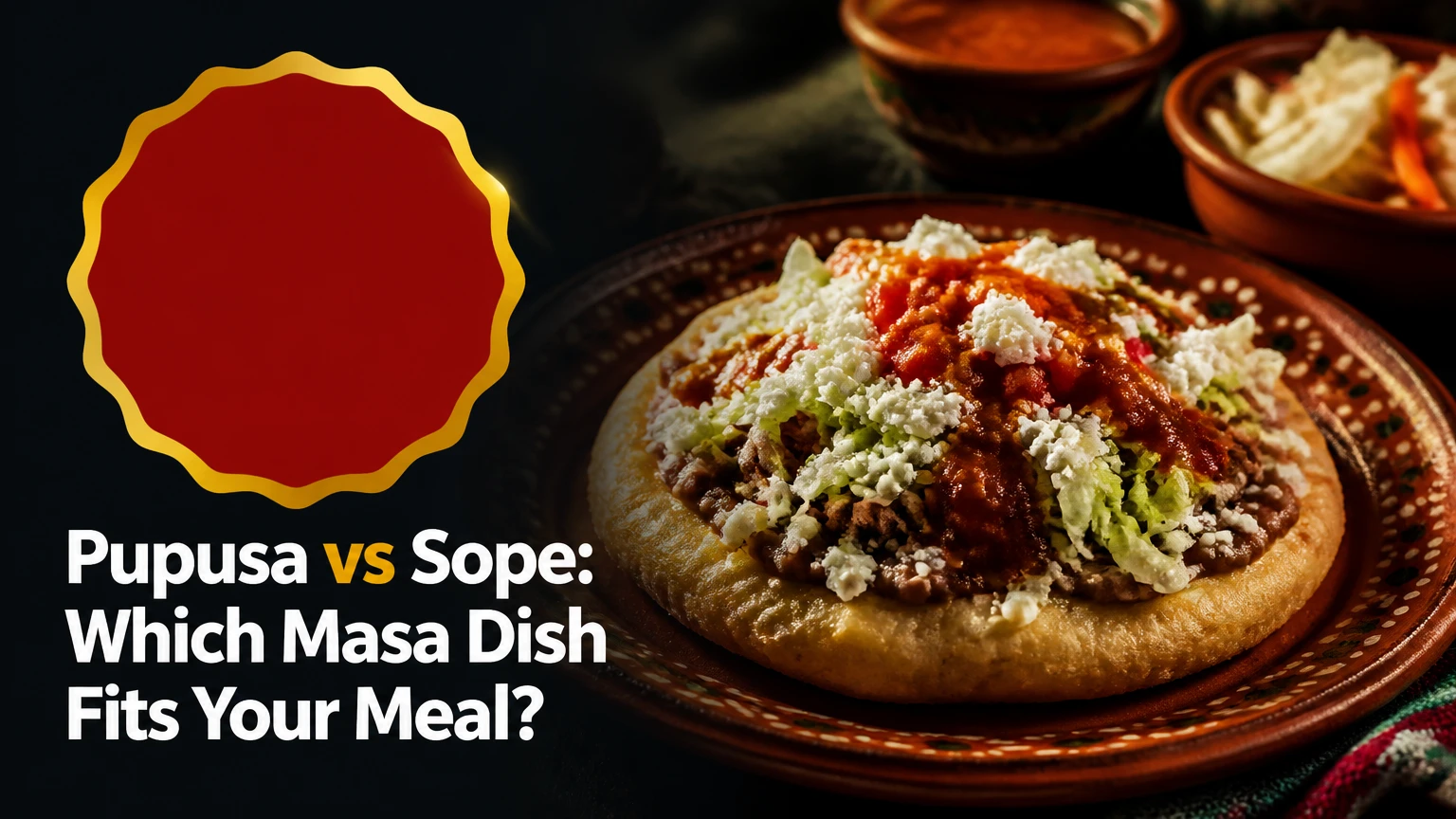
Sopes leave the masa unfilled and use a raised edge to hold beans, meat, cheese, lettuce, crema, and salsa.
Pupusas are usually cooked on a dry or lightly greased comal; sopes are commonly griddled and then lightly fried.
A typical pupusa takes about 6-8 minutes to cook, while a prepared sope shell takes about 4-7 minutes.
Pupusas are associated with El Salvador; sopes are associated with Mexico and have many regional forms.
Restaurant prices commonly range from $2.50-$5.00 per piece, depending on location, filling, and toppings.
What Are Pupusas and Sopes?
Pupusas and sopes both begin with soft corn masa, but their defining difference is where the food goes. A pupusa puts its filling inside the dough and seals it before cooking. A sope cooks the dough as an open shell, then receives its savory toppings on the surface.
Pupusas are a national dish of El Salvador and are also widely prepared in Salvadoran communities abroad. Common fillings include quesillo or another melting cheese, refried beans, loroco, and seasoned ground meat. A pupusa is traditionally accompanied by curtido, a lightly fermented cabbage relish, plus tomato-based salsa.
A sope is a Mexican antojito, or small savory preparation, made from a thick disk of masa. The edge is pinched upward while the dough is still warm, creating a shallow rim. The shell is then finished with beans, a protein or vegetable, cheese, lettuce, crema, and salsa. Regional versions may be called pellizcadas or picaditas, although preparation and toppings vary by region.
The shared corn base can make the dishes look interchangeable. Their eating mechanics are different: a pupusa protects the filling inside a single mass, while a sope supports separate layers above a fried or griddled shell.
Are pupusas and sopes the same food?
Pupusas and sopes are not the same food. They share nixtamalized corn masa and a thick, tortilla-like shape, but pupusas are sealed around a filling and sopes are open vessels for toppings.
Nixtamalization treats dried corn with an alkaline solution, traditionally limewater, then allows the kernels to be washed and ground. The process improves the dough’s handling qualities and changes the aroma and nutritional profile of the corn. Commercial masa harina is already nixtamalized and only needs water.
How Does the Assembly Change the Bite?
The assembly order determines the texture, portability, and distribution of flavor. Pupusa dough is filled, sealed, and flattened before the cooking surface sets the exterior. Sope dough is shaped first, cooked as an empty shell, and topped afterward.
| Attribute | Pupusa | Sope |
|---|---|---|
| Masa structure | Sealed around filling | Open shell with raised rim |
| Filling location | Center of the dough | On top of the cooked shell |
| Main cooking surface | Comal or griddle | Comal followed by shallow frying in many preparations |
| Typical eating method | Hands, with curtido and salsa | Plate and fork, because toppings remain exposed |
| Flavor distribution | Corn, filling, and cheese combine in each bite | Separate layers create changing bites |
| Structural risk | Filling can leak through a weak seam | Rim or shell can crack under heavy toppings |
A well-made pupusa has a tender exterior with a lightly browned surface and a hot, cohesive center. A well-made sope contrasts a crisp or firm underside, a softer interior, creamy beans, fresh garnishes, and salsa. Neither texture is inherently better; the choice depends on whether you prefer integration or contrast.
One practitioner rule matters here: a pupusa should be thin enough that the filling reaches most bites, but thick enough to prevent leaks. A sope should be thick enough to carry toppings without becoming a hard corn puck.
How Are Pupusas and Sopes Cooked?
Pupusas are normally cooked directly on a hot comal for about 3-4 minutes per side. Sopes are shaped as thick disks, partially cooked, pinched around the edge, and often shallow-fried for about 1-2 minutes per side before topping.
Making a pupusa
- Hydrate the masa. Mix 1 cup of masa harina with approximately 3/4 cup of warm water, adding water gradually until the dough feels soft and pliable.
- Rest the dough. Cover it for 10-15 minutes. Resting lets the masa absorb water evenly and reduces edge cracking.
- Form a cup. Roll a portion weighing about 50-65 grams into a ball, then press a hollow into the center.
- Add a restrained filling. Use about 1-1 1/2 tablespoons of thick cheese, beans, or a combined filling. Wet fillings create steam and weak spots.
- Seal completely. Pinch the dough over the filling, remove trapped air, and smooth the seam.
- Flatten gradually. Pat the ball into a 12-14 centimeter disk, rotating it so the center does not become paper-thin.
- Cook on a hot comal. Use medium-high heat for 3-4 minutes per side. The surface should develop brown spots while the center remains flexible.
You will know a pupusa is ready when both surfaces have scattered brown marks, the edges no longer look raw, and the filling feels hot. A split during cooking usually means the filling was too wet, the dough was too thin, or the seam was not fully closed.
Making a sope
- Portion the masa. Use approximately 55-70 grams of dough for a 10-12 centimeter shell.
- Press a thick disk. Keep the dough about 6-12 millimeters thick, depending on the regional style.
- Set the dough. Cook the disk on a hot comal for roughly 45-75 seconds per side, until it holds its shape but remains soft.
- Pinch the rim. While the disk is warm, raise the outer edge with damp fingers. A 1-1.5 centimeter rim is enough to contain toppings.
- Finish the shell. Shallow-fry in a thin layer of oil or cooking fat for about 1-2 minutes per side, or cook it entirely on the comal when using a softer, less crisp style.
- Drain and top. Spread 1-2 tablespoons of refried beans, add the main topping, and finish with cheese, lettuce, crema, and salsa.
You will know a sope is ready when the base has enough firmness to lift without bending, the rim is intact, and the interior remains tender. Over-frying is the most common quality failure because a thick shell continues to firm as it cools.
What cooking details matter most?
Masa moisture matters more than minor differences in griddle temperature. Dry dough cracks during shaping, while excessively wet dough produces weak seams, greasy shells, and soggy toppings.
| Cooking variable | Pupusa target | Sope target | Consequence of missing the target |
|---|---|---|---|
| Masa consistency | Soft, smooth, pliable | Firm enough to hold a rim | Cracking or collapse |
| Dough weight | 50-65 grams | 55-70 grams | Uneven thickness |
| Finished diameter | 12-14 centimeters | 10-12 centimeters | Poor filling ratio or weak shell |
| Resting time | 10-15 minutes | 10-15 minutes | Rough edges and poor hydration |
| Griddle heat | Medium-high | Medium-high | Pale dough or scorched exterior |
| Final cooking | 3-4 minutes per side | 1-2 minutes shallow fry | Raw center or hard shell |
Which Has More Filling and Topping Flexibility?
Sopes offer more visible customization because each shell can receive a different topping combination. Pupusas offer more controlled filling combinations because the ingredients must be balanced inside a sealed dough layer.
| Dish or variation | Base or filling | Common accompaniments | Best flavor profile |
|---|---|---|---|
| Pupusa de queso | Melting Salvadoran cheese or mozzarella | Curtido and tomato salsa | Creamy, salty, tangy |
| Pupusa de frijol | Thick refried beans | Curtido and salsa | Earthy and soft |
| Pupusa de loroco | Cheese with loroco buds | Curtido and salsa | Floral, herbal, savory |
| Pupusa revuelta | Cheese, beans, and seasoned ground meat | Curtido and salsa | Rich and cohesive |
| Pupusa de arroz | Rice-flour masa | Cheese, beans, or vegetables | Smoother and slightly crisp |
| Sope sencillo | Refried beans | Queso fresco, lettuce, salsa | Mild and textural |
| Sope de chicken | Refried beans and shredded chicken | Crema, cheese, lettuce | Savory and layered |
| Sope de chorizo y papa | Potatoes and crumbled sausage | Onion, cheese, salsa | Spiced and substantial |
| Sope de carne asada | Refried beans and grilled beef | Onion, cilantro, salsa | Charred and robust |
Loroco deserves special attention because it is strongly associated with Salvadoran cooking. The edible flower bud has a green, herbal character and is usually paired with cheese rather than used alone. Substituting spinach or a mild herb changes the result substantially, although the pupusa remains structurally correct.
Sopes are easier to adapt for mixed groups. One batch of shells can support beans and vegetables for one person, shredded chicken for another, and a simpler cheese-and-salsa version for a child. A pupusa filling must be selected before cooking, so customization happens at the dough-forming stage.
Which Is Easier to Make at Home?
Sopes are usually easier for beginners because the cook does not need to seal filling inside a thin masa wall. Pupusas demand more control over filling quantity, seam thickness, and flattening pressure, but their dough technique becomes predictable after several attempts.
| Skill or task | Pupusa difficulty | Sope difficulty | Beginner implication |
|---|---|---|---|
| Mixing masa | Low | Low | Both use the same basic dough method |
| Portioning dough | Moderate | Low | Pupusas need consistent filling space |
| Sealing | High | Not required | Pupusa seams can burst |
| Pinching rim | Not required | Moderate | Sopes must be shaped while warm |
| Managing filling moisture | High | Moderate | Pupusa fillings need a thick consistency |
| Topping and plating | Low | Moderate | Sopes need balanced layers |
| Batch consistency | Moderate | Moderate | Both benefit from weighed portions |
A beginner should start with bean or cheese sopes if finger heat is manageable, because a damaged rim can often be patched before frying. A first pupusa is more forgiving when made with a thick, cool filling and a slightly larger dough portion.
A counterintuitive kitchen truth is that smaller does not always mean easier. A small pupusa gives the cook less surface area for sealing and flattening, while a medium 12-centimeter disk gives the dough more room to spread around the filling.
How Much Do Pupusas and Sopes Cost?
Typical restaurant prices range from $2.50-$5.00 per item, with pupusa prices often lower at Salvadoran counters and sope prices rising when they include a larger portion of meat or multiple toppings. Ingredient cost at home is commonly about $0.60-$1.50 per piece before labor and equipment.
Prices vary by city, restaurant type, filling, and portion size. A cheese pupusa in a neighborhood Salvadoran restaurant may cost less than a sope topped with a substantial meat portion, while premium ingredients can reverse that relationship.
| Cost factor | Pupusa, typical range | Sope, typical range | Main price driver |
|---|---|---|---|
| Restaurant price per piece | $2.50-$4.50 | $3.00-$5.00 | Protein and local labor costs |
| Home masa cost | $0.10-$0.25 | $0.10-$0.30 | Masa harina or prepared masa |
| Home filling or topping | $0.35-$1.00 | $0.40-$1.20 | Cheese, beans, vegetables, or meat |
| Cooking fat per item | $0.02-$0.10 | $0.08-$0.25 | Shallow frying for sopes |
| Typical preparation time | 20-35 minutes | 25-40 minutes | Filling versus shell and topping work |
The sope can cost more at home when several toppings are purchased separately. Pupusas can be more economical when one filling, curtido, and salsa serve the whole batch.
Which Is Healthier?
Neither dish has a fixed calorie or nutrition profile because fillings, cooking fat, cheese, portion size, and toppings vary. A typical plain-to-moderately filled pupusa may provide about 250-400 calories, while a sope may provide about 200-450 calories before large protein portions or extra cooking fat.
A sope is not automatically lighter because it is open, and a pupusa is not automatically heavier because it is stuffed. A cheese-heavy pupusa concentrates calories inside the masa, while a bean-based sope with fresh vegetables may contain less energy per piece. A fried sope with a rich topping can exceed a modest cheese pupusa.
| Typical serving factor | Pupusa | Sope | Practical interpretation |
|---|---|---|---|
| Masa per item | 50-65 grams | 55-70 grams | Similar corn base |
| Approximate energy range | 250-400 kcal | 200-450 kcal | Recipe-dependent |
| Added cooking fat | 0-1 teaspoon | 1-2 teaspoons | Sopes are often fried |
| Common fiber source | Beans and curtido | Beans, lettuce, vegetables | Depends on topping choice |
| Main sodium source | Cheese and salsa | Cheese, prepared meat, salsa | Toppings change the total |
| Typical satiety driver | Cheese, beans, or meat inside | Beans plus protein on top | Protein and fiber matter most |
For a lighter plate, choose a bean-based version, limit added frying fat, use vegetables generously, and treat crema and cheese as measured toppings. People managing a medical diet should use the ingredient list and portion size rather than relying on the dish name.
Which Is More Portable and Filling?
Pupusas are more portable because the filling is enclosed and the surface remains comparatively clean. Sopes are often more customizable and visually substantial, but exposed toppings make them better for immediate, plated eating.
A pupusa can be wrapped in paper and eaten with minimal spilling, making it useful for a commute, picnic, or informal lunch. Curtido and salsa are usually served separately or added at the table. A sope can travel short distances, but lettuce, crema, salsa, and beans may slide from the raised shell.
Pupusa filling also creates a consistent bite from edge to center when the dough is evenly flattened. Sopes can feel more filling when layered with beans and a substantial topping, even though the shell itself may contain no filling.
Can You Freeze and Reheat Them?
Both foods can be frozen, but unfilled pupusas generally freeze more successfully than fully assembled sopes. Freeze shaped, uncooked pupusas between parchment sheets; freeze cooked sope shells separately from beans, protein, garnishes, and salsa.
| Storage method | Pupusa | Sope | Recommended use |
|---|---|---|---|
| Refrigerator, cooked | 3-4 days | 3-4 days | Short meal preparation |
| Freezer, uncooked | Up to 2 months | Not applicable for topped shells | Best pupusa batch method |
| Freezer, cooked shell | Up to 1 month | Up to 1 month | Convenient reheating |
| Reheat method | Comal, 4-6 minutes per side | Oven or skillet, 6-10 minutes | Restore surface texture |
| Toppings during storage | Curtido and salsa separate | All wet toppings separate | Prevent sogginess |
Reheat frozen pupusas on a covered comal over medium-low heat, turning them several times so the exterior does not burn before the center warms. Reheat sope shells in a skillet or 190°C oven, then add hot beans and fresh toppings immediately before serving.
What Problems Commonly Ruin Them?
The most common pupusa failures are dry masa, wet filling, weak seams, and excessive flattening. The most common sope failures are a cracked rim, an over-fried shell, overloaded toppings, and moisture trapped under the base.
| Failure | Likely cause | Immediate fix | Prevention |
|---|---|---|---|
| Pupusa bursts | Wet filling or thin seam | Reduce heat and patch only if possible | Chill filling and leave a thicker edge |
| Pupusa cracks | Dry masa | Knead in water by teaspoons | Cover dough during resting and shaping |
| Pupusa stays raw | Excessive thickness | Cook longer over lower heat | Weigh portions and flatten evenly |
| Sope rim cracks | Dough cooled before shaping | Patch with damp masa | Pinch within 30-60 seconds of cooking |
| Sope becomes hard | Excessive frying | Remove earlier and drain | Keep oil shallow and heat moderate |
| Sope turns soggy | Wet toppings or delayed service | Drain beans and serve immediately | Add salsa and crema at the table |
| Shell collapses | Under-set dough | Return it briefly to the comal | Cook until the surface holds its shape |
| Toppings slide off | Overfilled shell | Reduce each layer | Keep beans thick and spread to the rim |
A useful practitioner test is the thumbprint test. Press the edge of the masa lightly: a hydrated pupusa dough should recover without splitting, while a sope disk should remain firm enough to lift but still show slight flexibility.
Do not use a watery bean puree for either dish. For pupusas, it creates steam pressure inside the sealed dough. For sopes, it migrates into the shell and destroys the crisp-soft contrast.
What Foods Are Their Closest Alternatives?
Gorditas, tlacoyos, and arepas overlap with pupusas or sopes in ingredients or construction, but none is an exact substitute. Gorditas may be split and filled after cooking, tlacoyos are often oval and shaped around a bean filling, and arepas use a different corn process and culinary tradition.
| Food | Region commonly associated | Construction | Closest comparison |
|---|---|---|---|
| Gordita | Mexico | Thick masa disk, often split and filled | Between a pupusa and sandwich |
| Tlacoyo | Central Mexico | Oval masa form with filling inside | Structurally closer to a pupusa |
| Quesadilla de comal | Mexico | Folded tortilla with filling | Similar filling logic, thinner masa |
| Arepa | Colombia and Venezuela | Thick corn cake, split or topped | Similar shape, different dough tradition |
| Tlayuda | Oaxaca, Mexico | Large, thin toasted tortilla with toppings | Similar topping logic, much thinner |
| Taco | Mexico and broader region | Thin tortilla folded around filling | More portable, less masa per serving |
The best replacement depends on the feature you want. Choose a tlacoyo for an enclosed bean center, a gordita for a thicker filled shell, an arepa for a denser corn cake, or a taco for a thinner and more portable format.
Which Should You Choose?
Choose a pupusa when you want a compact, filling-centered meal, and choose a sope when you want crispness, visible toppings, or several combinations for one table. The decisive variables are portability, cooking confidence, topping variety, and tolerance for frying.
Choose pupusas for portability
Pupusas are the stronger choice for packed lunches, casual outdoor eating, and diners who dislike toppings falling away. Cheese-and-bean pupusas also keep a cohesive texture after a short reheating period.
Pupusas are not ideal when every diner wants a different combination unless you prepare several filling batches. Their sealed structure makes late customization difficult.
Choose sopes for parties and mixed preferences
Sopes work better for gatherings because shells, beans, proteins, cheese, lettuce, crema, and salsa can be arranged separately. Guests can build plates with different levels of spice and different topping quantities.
Sopes are less suitable for walking meals. Even a well-shaped rim cannot guarantee that wet toppings will remain stable during transport.
Choose pupusas for a softer, integrated texture
A pupusa offers a tender corn exterior and a unified filling. Cheese melts into the interior, and bean-based fillings distribute flavor through the center rather than sitting in separate layers.
Choose sopes for crispness and contrast
A sope provides a firmer base, soft masa inside, creamy beans, fresh vegetables, and salsa in distinct layers. The shell can also be cooked with less frying fat when a softer comal-style preparation is preferred.
FAQ
Are pupusas always made with corn masa?
Most pupusas use corn masa made from nixtamalized corn, but pupusas de arroz use rice flour masa. Rice-based dough produces a smoother surface and can become slightly crispier, while corn masa provides the more familiar earthy aroma and pliable texture.
Do sopes always have a raised edge?
Traditional sopes have a raised edge created by pinching warm dough, but regional preparations vary in thickness and shaping. Some related forms, including picaditas and pellizcadas, may have pinched surfaces or less pronounced rims, so the terminology is not uniform across Mexico.
Can a vegetarian eat either dish?
Vegetarians can eat either dish when the masa and cooking surface are free from animal-derived ingredients and the fillings or toppings use beans, cheese, vegetables, mushrooms, or plant-based proteins. Ask about prepared beans, since recipes differ between restaurants and may include undisclosed cooking ingredients.
Which dish is better for children?
A mild cheese or bean pupusa is usually easier for young children because the filling stays inside and the dish can be held with both hands. A simple sope can work well for children who prefer separate ingredients, but lettuce, salsa, and crema create more mess.
Can I use the same masa for pupusas and sopes?
The same corn masa can be used for both dishes, but hydration and thickness need adjustment. Pupusa dough should be soft enough to seal without cracking, while sope dough must be firm enough to hold a raised rim and withstand handling before frying.
What should I order first at a Salvadoran or Mexican restaurant?
Order a cheese or revuelta pupusa at a Salvadoran restaurant if you want to understand the enclosed filling structure, and order a simple bean sope at a Mexican restaurant if you want to taste the shell and toppings clearly. These versions reveal each dish’s defining technique without excessive toppings.
The Bottom Line
Pupusa vs sope is fundamentally a comparison between an enclosed masa meal and an open masa shell. Pupusas from El Salvador prioritize a sealed center, tender griddle-cooked dough, portability, and accompaniments such as curtido. Mexican sopes prioritize a raised rim, crisp-soft texture, visible toppings, and customization. Choose the pupusa for integrated flavor and convenient eating; choose the sope for layered texture, flexible toppings, and shared meals.