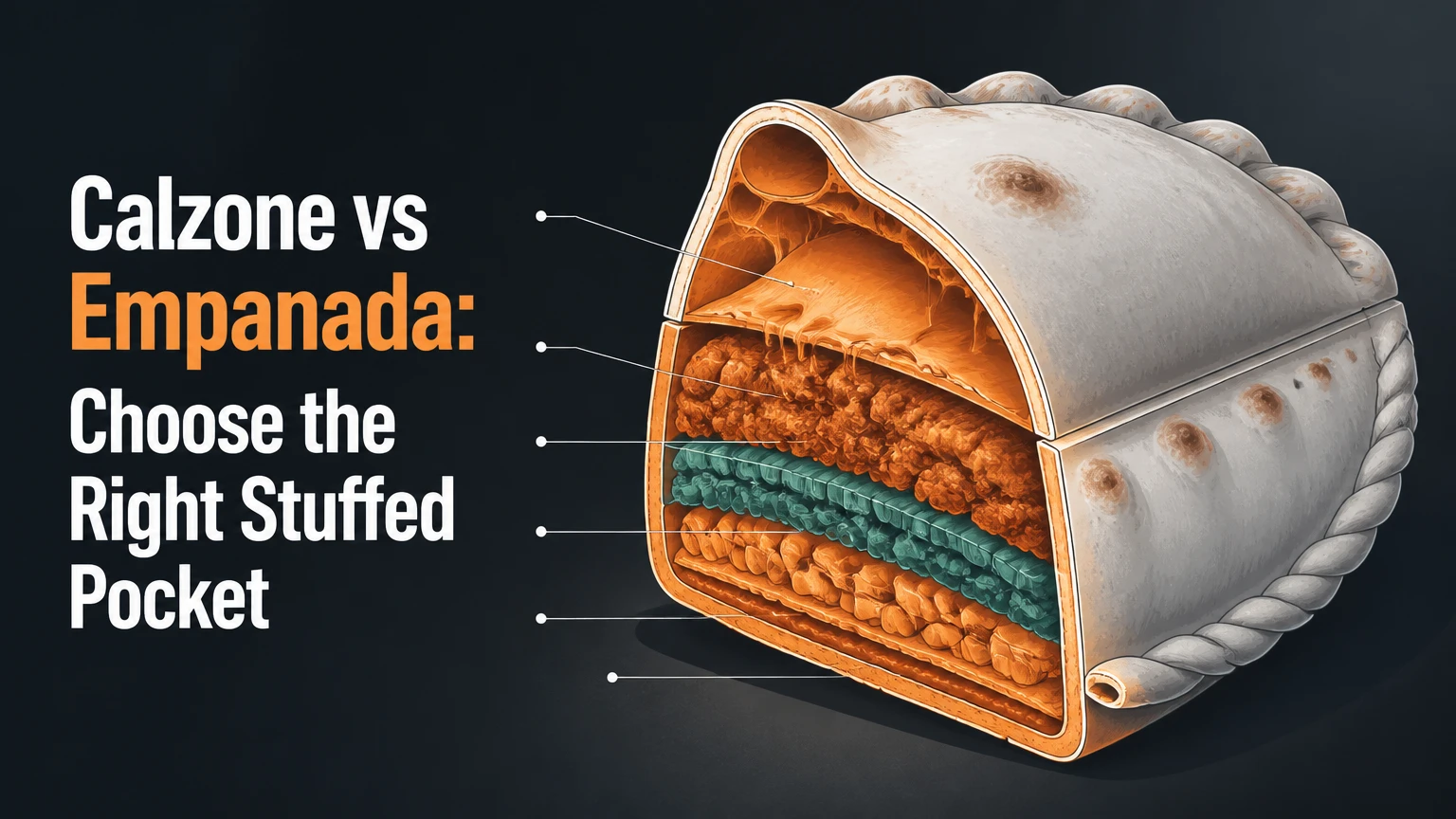
A calzone is a large Italian turnover made from leavened pizza dough and usually baked, while an empanada is a smaller pastry pocket with Iberian and Latin American traditions that may be baked or fried. Calzones are chewy, bread-like meals; empanadas are crisp, flaky, or crunchy portions built around seasoned cooked fillings.
Key Facts at a Glance
- A calzone uses yeast-risen pizza dough; an empanada commonly uses a shorter, unleavened pastry dough.
- A typical calzone weighs about 300-500 grams, while an individual empanada often weighs 50-120 grams.
- Calzones usually bake at 230-290°C for 10-20 minutes; empanadas bake at about 190-205°C or fry at about 175-185°C.
- Calzone fillings often include ricotta, mozzarella, tomato, vegetables, and cured or cooked meats.
- Empanada fillings vary by region and include beef, chicken, seafood, cheese, vegetables, fruit, and legumes.
- Calzones usually function as a complete entrée; empanadas work as snacks, appetizers, lunch portions, or several-unit meals.
What Is the Difference Between a Calzone and an Empanada?
The decisive difference is the dough tradition and eating occasion: a calzone is a folded pizza, whereas an empanada is a filled pastry. Shape alone does not identify either food, because both can form half-moons, rectangles, circles, or larger pie-like formats.
A calzone begins with a fermented dough made from flour, water, yeast, salt, and often olive oil. The dough develops gluten and gas, so baking produces a resilient crust with a chewy interior. A traditional Italian calzone may contain ricotta, mozzarella, tomato, black pepper, and regional meat fillings.
An empanada begins with a dough designed for tenderness, crispness, or flakiness rather than oven spring. Flour is combined with fat and liquid, then rolled and cut before a cooled filling is enclosed. The wrapper can contain wheat flour, corn flour, lard, butter, shortening, or oil, depending on the country and style.
| Attribute | Calzone | Empanada |
|---|---|---|
| Primary culinary tradition | Italy, especially Naples and southern Italy | Spain, Latin America, and the Philippines |
| Dough category | Yeast-risen pizza dough | Pastry, wheat dough, or corn dough |
| Typical shape | Large half-moon | Small half-moon, round, rectangle, or pie |
| Typical serving size | 300-500 grams | 50-120 grams per unit |
| Usual filling state | Cheese may be assembled cold; fillings vary | Filling is generally cooked and cooled |
| Main cooking method | High-temperature baking | Baking or deep-frying |
| Typical role | Individual entrée | Snack, appetizer, or multi-unit meal |
The categories overlap at their edges. A small baked calzone can resemble a large empanada, and a Galician empanada can be a family-sized baked pie rather than a hand-held snack. Culinary identity depends more on dough, filling conventions, and regional practice than on appearance.
How Do Dough and Texture Differ?
Calzone dough is elastic and leavened; empanada dough is generally tender and relatively thin. That structural difference explains why a calzone chews like bread while an empanada may shatter, flake, or crunch when bitten.
Calzone dough commonly uses bread flour or another moderately strong wheat flour, with roughly 55-70% water relative to flour by weight. A refrigerator fermentation of 8-24 hours can improve flavor and handling, but a 24-hour ferment is not mandatory. Same-day dough can work if the baker allows adequate proofing.
Empanada dough usually has lower gluten development because the fat coats some flour particles and the dough receives little or no kneading. A typical wheat version is rolled to approximately 2-4 millimeters, while calzone dough is often 4-8 millimeters after shaping, depending on the center and rim.
| Dough characteristic | Calzone | Wheat empanada | Corn empanada |
|---|---|---|---|
| Main flour | Bread or pizza flour | All-purpose or pastry flour | Precooked corn flour |
| Leavening | Yeast | Usually none | Usually none |
| Typical hydration | 55-70% of flour weight | 35-55% of flour weight | Mixed to a soft masa |
| Added fat | About 0-5% olive oil | About 10-30% butter, lard, or shortening | Often little added fat |
| Resting period | 2-24 hours, depending on formula | 20-60 minutes | 10-30 minutes |
| Finished wrapper thickness | About 4-8 millimeters | About 2-4 millimeters | About 2-5 millimeters |
| Texture after cooking | Chewy, airy, crisp-edged | Tender, flaky, or crisp | Dense, crunchy, and corn-forward |
The fat level does not define every empanada. Argentine doughs often use wheat flour and fat, while Colombian and Venezuelan empanadas commonly use cornmeal dough and frying. Treating all empanadas as one pastry type produces inaccurate comparisons.
How Are Calzones and Empanadas Cooked?
Calzones are normally baked on a hot surface, while empanadas are either baked or fried. Calzone baking depends on intense bottom heat to set the dough before cheese and filling moisture can soak through; empanada cooking depends on a thinner wrapper and a fully prepared filling.
For a calzone, preheat a stone, steel, or heavy tray for at least 30-45 minutes. A home oven at 245-260°C commonly requires 12-18 minutes, while a high-performance pizza oven at 400-480°C can finish a smaller calzone in approximately 90 seconds to 4 minutes. The exact time depends on dough thickness and filling volume.
Empanadas require less intense oven heat. Bake them at 190-205°C for approximately 18-30 minutes, usually after applying egg wash or oil. Frying at 175-185°C often takes 3-6 minutes, with the oil temperature recovering between batches.
| Cooking method | Calzone result | Empanada result | Typical setting | Typical duration |
|---|---|---|---|---|
| Home-oven bake | Chewy crust with browned rim | Tender or crisp pastry | 190-260°C | 12-30 minutes |
| Pizza-stone bake | Firm bottom and blistered edge | Not usually used | 245-290°C | 8-18 minutes |
| Wood-fired bake | Fast, blistered exterior | Rare for individual units | 400-480°C | 1.5-4 minutes |
| Deep-fry | Used for panzerotti rather than standard calzones | Crisp, sealed shell | 175-185°C oil | 3-6 minutes |
| Air-fryer reheating | Crisp exterior, softer center | Crisp pastry with less oil | 175-200°C | 5-12 minutes |
A calzone needs steam management. Two or three small vents prevent pressure from splitting the seam, but excessive venting can dry the cheese and allow sauce to escape. Small fried empanadas usually need no vents because their thin shell cooks quickly, although larger baked empanadas benefit from one or two openings.
What Fillings Belong in Each Pocket?
Calzone fillings favor cheese, tomato, and pizza-compatible ingredients, while empanada fillings favor concentrated, seasoned mixtures that remain stable inside a thin wrapper. The shared rule is moisture control: wet filling is the main cause of leakage and soggy crust in both foods.
Traditional Neapolitan calzone fillings may include ricotta, mozzarella, salami, cooked ham, tomato, and pepper. Modern pizzeria versions add mushrooms, spinach, roasted vegetables, chicken, or sausage, but watery ingredients should be drained or cooked first.
Empanada fillings are more regionally varied. Argentine versions often combine seasoned beef, onion, olive, egg, and cumin; Chilean versions commonly use beef, onion, and egg; Colombian and Venezuelan versions frequently combine corn dough with beef, chicken, potatoes, or cheese; Spanish Galician versions use fish, seafood, vegetables, or meat in a larger pie.
| Style | Dough and size | Representative filling | Cooking method | Typical service |
|---|---|---|---|---|
| Neapolitan calzone | Wheat pizza dough, 25-35 centimeters | Ricotta, mozzarella, tomato, salami | High-heat bake | One-person meal |
| Apulian panzerotto | Wheat dough, 10-15 centimeters | Tomato and mozzarella | Deep-fry or bake | Snack or street food |
| Argentine empanada | Wheat pastry, 12-16 centimeters | Beef, onion, olive, egg, cumin | Bake or fry | One unit or several |
| Colombian empanada | Corn masa, 10-14 centimeters | Beef or chicken with potato | Deep-fry | Snack or appetizer |
| Venezuelan empanada | Corn masa, 12-18 centimeters | Cheese, chicken, beef, or fish | Deep-fry | Breakfast or street food |
| Galician empanada | Two wheat pastry layers, tray-sized | Tuna, cod, vegetables, or meat | Bake | Sliced family dish |
A useful practitioner rule is to cool fillings below approximately 10°C before sealing pastry empanadas. Hot filling softens butter or shortening, creates condensation, and makes the seam harder to close. Calzone cheese can be cold or room temperature, but ricotta should be drained when it contains visible liquid.
How Do You Assemble Each One?
Calzones use a larger dough disc and a generous filling mound; empanadas use thin discs and a smaller portion that leaves a clean sealing margin. Assembly quality depends on removing excess air and keeping filling away from the edge.
Calzone Assembly
- Stretch a 250-350 gram dough ball into a 25-30 centimeter disc.
- Leave a 2-3 centimeter clean border.
- Add cheese and drained filling to one half, keeping the mound 2-3 centimeters thick.
- Fold the empty half over the filling.
- Press air toward the open edge, then seal with a folded or twisted rim.
- Cut two or three vents in the upper surface.
- Brush lightly with olive oil or egg wash if a darker crust is wanted.
- Bake on a preheated surface until the rim is deeply golden and the center feels firm.
The most common calzone error is overfilling. A generous-looking pocket often bursts because melted cheese expands and vegetables release water. A moderate filling layer produces a better seal and a more evenly cooked center.
Empanada Assembly
- Roll chilled dough to 2-4 millimeters.
- Cut discs 12-16 centimeters wide for standard units.
- Place 30-60 grams of fully cooled filling in the center.
- Moisten only the edge if the dough needs help sealing.
- Fold the disc into a half-moon without trapping air.
- Press firmly, then use a fork or repulgue to finish the seam.
- Chill assembled units for 15-30 minutes before baking or frying.
- Bake with egg wash or fry in oil held between 175°C and 185°C.
A repulgue is the decorative folded edge associated with many South American empanadas. It improves visual identity and can reinforce the seal, but a plain fork crimp is equally functional when the dough is properly hydrated.
How Much Time and Money Do They Require?
Empanadas usually require less elapsed time than naturally fermented calzones, but a batch of empanadas demands more individual shaping. Calzones are cheaper to produce when a kitchen already makes pizza dough, while empanadas offer better portion control and batch-freezing efficiency.
The frequently quoted 12-24-hour calzone timeframe describes a long, cold-fermented pizza dough. It is a quality option, not a universal requirement. A same-day calzone can be ready in roughly 2.5-4 hours, including mixing, proofing, filling, shaping, and baking.
| Measure | Calzone, home batch | Empanada, home batch | Commercial implication |
|---|---|---|---|
| Active preparation | 30-50 minutes | 60-120 minutes | Empanadas require more hand assembly |
| Minimum elapsed time | 2.5-4 hours | 1.5-3 hours | Same-day empanadas are simpler |
| Long-ferment option | 8-24 hours | Usually unnecessary | Calzone flavor improves with planning |
| Typical batch yield | 3-6 large units | 12-24 individual units | Empanadas suit batch production |
| Typical home ingredient cost | $2-$6 per large unit | $0.60-$1.75 per unit | Filling determines most variation |
| Typical restaurant price | $12-$22 | $3-$7 per unit | A meal may require 2-4 empanadas |
| Freezer footprint | Larger, fewer pieces | Compact, many pieces | Empanadas stack more efficiently |
Prices vary by location, filling, labor, and restaurant type. The comparison is more useful as a portion-cost model than as a fixed menu promise: one calzone commonly replaces a meal, while two or four empanadas may provide a comparable amount of food.
Which Is Healthier?
Neither food is universally healthier because dough, filling, cooking method, and portion size determine the nutritional result. A baked vegetable empanada can contain less energy than a cheese-heavy calzone, while a fried corn empanada with a dense filling can exceed a small calzone per 100 grams.
Calzones often carry more total calories per item because their dough and cheese portion are larger. Empanadas offer smaller units, which helps portion control, but frying increases absorbed oil and can raise total fat.
| Nutrition factor | Calzone | Baked empanada | Fried empanada |
|---|---|---|---|
| Typical portion basis | 300-500 grams | 50-120 grams | 50-120 grams |
| Main energy drivers | Pizza dough, cheese, oil | Pastry fat, filling | Pastry or corn dough, absorbed oil |
| Portion strategy | Eat one as the main dish | Eat 1-2 with sides | Eat 1-3 depending on size |
| Sodium risk | Cheese, cured meat, sauce | Seasoned filling, dough | Seasoned filling, dough |
| Moisture control | Drain ricotta and vegetables | Cool filling and remove liquid | Cool filling and avoid trapped steam |
| Lower-energy adjustment | Less cheese, more vegetables | Bake, use lean filling | Choose baking over frying |
For a more balanced plate, pair either option with vegetables or salad and choose water or another unsweetened drink. Ingredient labels and recipe quantities are more reliable than generic calorie claims because regional recipes differ substantially.
What Are Panzerotti and Stromboli?
Panzerotti are smaller folded turnovers associated with Apulia that are often fried, while stromboli is a rolled American-Italian filled bread rather than a sealed half-moon. Neither term should automatically replace calzone or empanada.
A panzerotto may use pizza dough and contain tomato and mozzarella, placing it closer to a calzone in dough and filling. Its smaller size and frequent deep-frying create a crisp exterior and a different eating experience.
Stromboli is usually assembled by spreading fillings over a rectangle, rolling the dough into a cylinder, and baking it with a seam. The filling runs through the roll, and marinara is commonly served alongside rather than enclosed as a central pocket.
| Food | Fold or roll | Dough family | Typical cooking | Defining feature |
|---|---|---|---|---|
| Calzone | Folded half-moon | Yeasted pizza dough | Bake | Large sealed pizza turnover |
| Empanada | Folded pocket or covered pie | Pastry or corn dough | Bake or fry | Regional filling and wrapper diversity |
| Panzerotto | Folded small turnover | Yeasted pizza dough | Often fry | Apulian small format |
| Stromboli | Rolled cylinder | Yeasted pizza dough | Bake | Long spiral or layered interior |
| Galician empanada | Two pastry layers | Wheat pastry dough | Bake | Large sliced Spanish pie |
This distinction matters when ordering. A customer expecting crisp pastry may be disappointed by a chewy pizza crust, while someone expecting a cheese-heavy pizza pocket may find a corn empanada denser and more savory.
Which Should You Choose?
Choose a calzone for a substantial pizza-style entrée and an empanada for portability, variety, or batch preparation. The better choice changes with equipment, serving size, filling, and whether the food must survive transport.
Choose a Calzone for a Pizza Meal
A calzone fits a person who wants one hot, cheese-forward entrée and already has access to a pizza oven or a well-preheated home oven. It also makes sense for a pizzeria because the same dough, cheese, sauce, toppings, peel, and oven can support production.
Calzones are less suitable for walking or long transport. Steam trapped inside softens the bottom, and a large pocket can release hot cheese when cut too soon. Resting for 5-10 minutes before eating reduces the burn risk and allows the filling to set.
Choose an Empanada for Portable Eating
Empanadas work better for lunches, picnics, catering, school events, and street-food service because each unit is self-contained. A 12-16 centimeter empanada can be wrapped individually, served at room temperature, or reheated without slicing.
Empanadas also provide broader menu variation. One batch can include beef, chicken, cheese, vegetables, and fruit, with decorative seams or labels separating flavors.
Choose Empanadas for Freezing and Meal Prep
Empanadas are the stronger freezer option because small units cool quickly, stack efficiently, and can be cooked in batches. Freeze shaped, uncooked empanadas on a lined tray until firm, then transfer them to an airtight container for up to about two months for best quality.
Bake from frozen with extra time, commonly 8-15 minutes beyond the fresh schedule, or thaw overnight in a refrigerator. Frying frozen units requires care because surface ice can cause oil splatter; thawing in a refrigerator is safer.
Choose a Calzone for a Pizza Kitchen
A calzone requires fewer new ingredients when a pizzeria already stocks pizza flour, yeast, mozzarella, ricotta, sauce, and toppings. Empanadas may require different pastry formulas, filling production, shaping labor, storage racks, and a separate frying or baking workflow.
The commercial exception is high-volume batch service. Empanadas can be portioned, frozen, and finished to order, which makes them attractive when consistent small servings matter more than shared pizza-line ingredients.
What Problems Commonly Ruin Them?
Soggy calzone bottoms usually come from excess filling moisture or insufficient bottom heat, while empanada failures usually come from hot filling, trapped air, weak seams, or overworked dough. Correcting the process is more effective than simply increasing oven temperature.
| Failure | Likely cause | Immediate fix | Prevention |
|---|---|---|---|
| Calzone bursts at the seam | Too much filling or trapped steam | Lower filling volume and rest before cutting | Leave a clean border and add vents |
| Calzone has raw center dough | Thick dough or low oven heat | Return to a 200-220°C oven until set | Preheat stone or steel thoroughly |
| Calzone bottom turns wet | Watery ricotta, tomato, or vegetables | Drain and reheat on a rack | Pre-cook and cool moist ingredients |
| Empanada opens during frying | Air pocket or weak crimp | Stop frying and reinforce future seams | Press air out before sealing |
| Empanada becomes tough | Excessive kneading or flour | Rest dough before rerolling | Mix only until cohesive |
| Empanada leaks oil or filling | Thin spot or overfilled disc | Discard unsafe oil and inspect seams | Keep filling 2-3 centimeters from edge |
| Fried shell browns too quickly | Oil above 185°C | Reduce heat and allow recovery | Use a thermometer between batches |
One counterintuitive rule matters: adding more vents does not solve a wet calzone. Vents release pressure, but they cannot remove water from ricotta, raw mushrooms, or fresh tomato; pre-cooking and draining address the actual cause.
Another practitioner rule concerns sealing. Water is not always the best adhesive for pastry because excess moisture can prevent layers from bonding. A clean, dry edge with firm pressure often seals better than a heavily moistened rim.
How Should You Store and Reheat Them?
Calzones and empanadas should be refrigerated within two hours of cooking and reheated until the center is thoroughly hot. Empanadas generally retain their texture better during storage because their fillings are smaller and their wrappers are thinner.
Cool both foods on a rack rather than directly on a flat plate. A rack lets steam escape from the underside, which reduces condensation. Refrigerate in a covered container for up to three days for best texture.
| Storage method | Calzone | Empanada | Best reheating method |
|---|---|---|---|
| Refrigerator | Up to 3 days | Up to 3 days | Oven or air fryer |
| Freezer, cooked | About 1 month for best texture | About 1-2 months | Thaw, then bake or air-fry |
| Freezer, uncooked | Possible, but dough quality varies | Excellent for shaped units | Bake from frozen or thaw safely |
| Microwave | Softens crust substantially | Softens pastry substantially | Use only when speed matters |
| Oven temperature | 180-200°C | 175-200°C | Reheat until center is hot |
| Typical reheating time | 10-20 minutes | 6-12 minutes | Turn or rotate if needed |
Cutting a calzone immediately after baking releases cheese and steam onto the plate. A short rest improves texture, but food safety still requires prompt refrigeration once the food has cooled enough to store.
FAQ
Can an Empanada Be Made With Pizza Dough?
Yes, but pizza dough creates a breadier turnover and moves the result toward a panzerotto or small calzone. Standard wheat empanada dough is usually thinner and less elastic, while corn-based empanada dough has a distinct masa texture that pizza dough cannot reproduce.
Are Calzones Always Filled With Cheese?
No. Cheese is common in Italian and pizzeria calzones, especially ricotta and mozzarella, but calzones can contain vegetables, cooked meat, mushrooms, or other fillings. A cheese-free version works when the filling has enough moisture and fat to avoid a dry interior.
Do Empanadas Always Contain Meat?
No. Empanadas may contain cheese, spinach, corn, beans, mushrooms, potatoes, seafood, fruit, or other vegetables. Regional recipes determine the filling more strongly than the generic name, so a vegetarian or sweet empanada is entirely legitimate.
Can You Bake a Traditionally Fried Empanada?
Usually, yes, although the texture changes. Baking produces a drier, lighter shell with browned pastry, while frying produces a more blistered and crisp exterior. Brush the dough with egg wash or oil and bake at approximately 190-205°C until fully browned.
Why Is My Calzone Wet Inside?
A wet calzone usually contains too much filling liquid, uses dough that is too thick, or bakes on an insufficiently heated surface. Drain ricotta, pre-cook watery vegetables, reduce sauce, use a preheated stone or steel, and rest the calzone for 5-10 minutes before cutting.
Which Is Easier for a Beginner?
Empanadas are usually easier to cook successfully because the filling is prepared first and the thinner wrapper needs less oven power. Calzones become straightforward when the cook already handles pizza dough, but fermentation, stretching, moisture control, and high bottom heat add more variables.
The Bottom Line
Calzone vs empanada is ultimately a choice between a large baked pizza turnover and a smaller regional pastry pocket. Choose a calzone for chewy dough, melted cheese, and a complete meal; choose an empanada for portability, filling variety, portion control, and efficient freezing. Both succeed when the dough matches the format and the filling is cool, concentrated, and properly sealed.