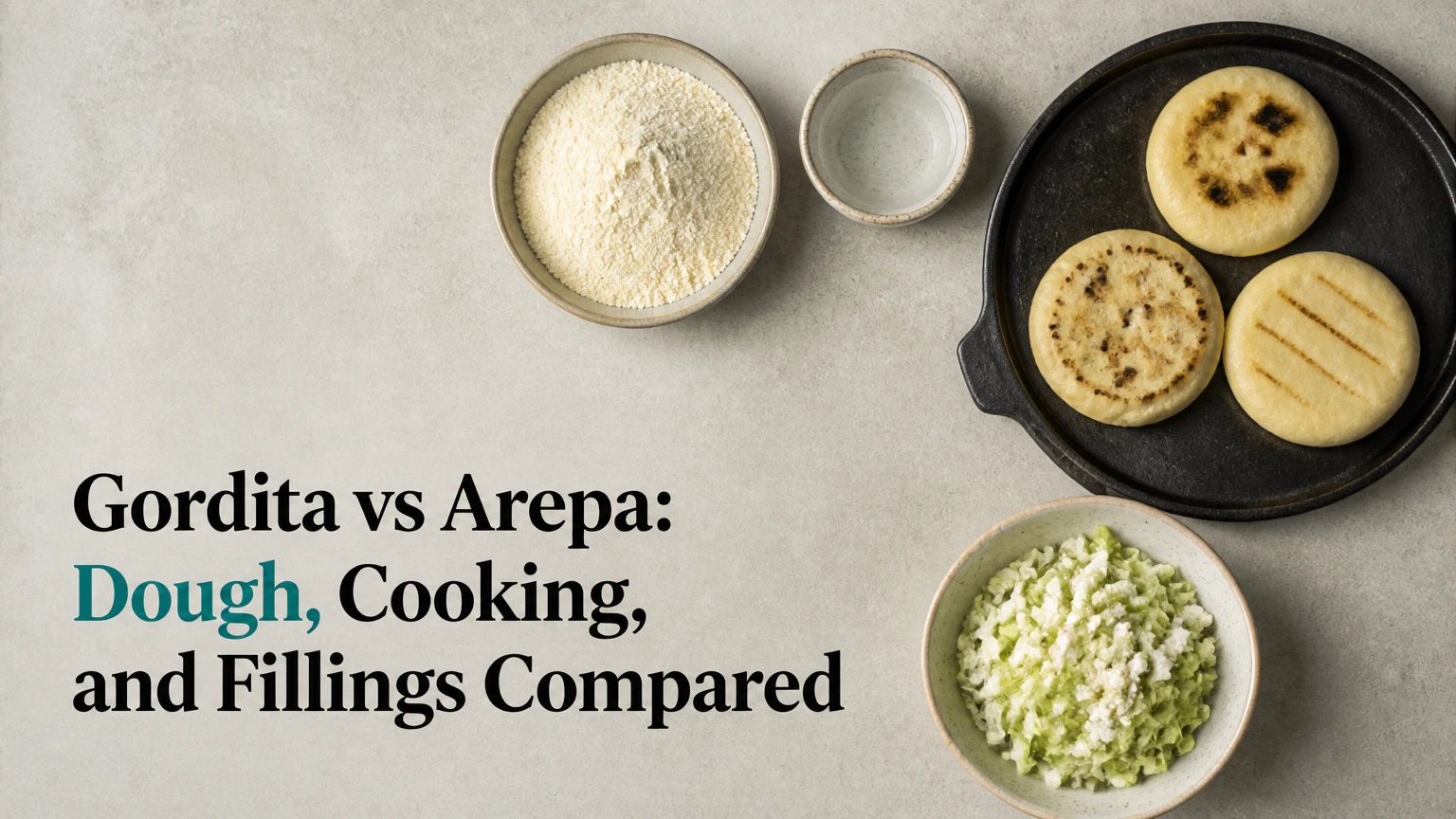
The gordita vs arepa comparison comes down to origin, corn processing, and cooking structure. A Mexican gordita usually uses nixtamalized masa harina and may develop a pocket when cooked on a comal or fried. A Colombian or Venezuelan arepa uses precooked corn flour called masarepa, forming a griddled corn cake that may be sliced for filling or served open-faced.
Key Facts at a Glance
- A gordita is Mexican, while the arepa is especially associated with Colombia and Venezuela.
- Gorditas generally use nixtamalized masa harina; arepas generally use precooked masarepa.
- Gorditas are often thinner than arepas, but regional recipes vary widely.
- A gordita may puff into a pocket, although some versions remain solid and are split or topped.
- An arepa is commonly griddled, then finished in an oven or cooked fully on the stovetop.
- Both foods are usually made from corn and can be gluten-free when the flour is certified gluten-free.
What Is the Difference Between a Gordita and an Arepa?
A gordita and an arepa are both thick corn-based cakes, but they belong to different culinary traditions and rely on differently processed corn. Gorditas come from Mexico and typically use lime-treated corn dough, while arepas come primarily from Colombia and Venezuela and use dried, precooked corn flour.
The difference affects flavor and behavior. Nixtamalized masa gives a gordita a more pronounced toasted-corn and mineral flavor, while masarepa produces a milder, cleaner corn taste. Gordita dough often aims for a thinner cake that can puff; arepa dough is commonly shaped into a thicker disk with a firm crust and tender center.
The names also describe food families rather than one fixed recipe. A fried Mexican gordita differs from a baked gordita de horno, and a Colombian cheese arepa differs from a Venezuelan Reina Pepiada. National origin is therefore a more reliable identifier than thickness alone.
Master Comparison Table
| Criterion | Mexican Gordita | Venezuelan Arepa | Colombian Arepa |
|---|---|---|---|
| Main flour | Nixtamalized masa harina | Precooked masarepa | Precooked masarepa |
| Typical diameter | 3-5 inches | 4-6 inches | 3-6 inches |
| Common thickness | 1/4-1/2 inch | 1/2-1 inch | 1/4-3/4 inch |
| Main cooking surface | Comal, griddle, or frying pan | Budare, skillet, or griddle | Griddle, skillet, grill, or fryer |
| Interior structure | Pocket, split cake, or solid center | Dense center or shallow pocket | Solid, layered, or cheese-filled center |
| Common service | Stuffed with cooked fillings | Sliced and stuffed | Topped, folded, or filled |
| Typical cooking time | 6-12 minutes, longer when fried | 12-25 minutes | 8-20 minutes |
| Typical restaurant price | $3-$7 each | $6-$14 each | $3-$10 each |
How Do Masa Harina and Masarepa Behave Differently?
Masa harina is made from corn treated with calcium hydroxide, washed, ground, and dried. Masarepa is made from corn that has been cooked, dried, and ground, but it is not the same as nixtamalized tortilla flour. The different processing methods determine hydration, aroma, browning, and structural strength.
Nixtamalization loosens the corn hull and changes the dough’s chemistry. The process improves the availability of niacin and calcium while producing the characteristic flavor associated with tortillas and many Mexican masa foods. Masarepa hydrates quickly and usually tastes sweeter or more neutral.
Neither flour is automatically interchangeable. A masa harina arepa can become gritty or overly tortilla-like, while a masarepa gordita may lack the elasticity or flavor expected from Mexican masa.
| Flour or dough | Corn processing | Water behavior | Best applications | Typical result |
|---|---|---|---|---|
| Masa harina | Lime-treated, cooked, dried, ground | Absorbs gradually | Gorditas, tortillas, sopes | Savory, flexible masa |
| Masarepa | Precooked, dried, ground | Hydrates rapidly | Arepas | Soft interior, firm crust |
| Fresh masa | Wet nixtamalized dough | Ready to shape | Fresh gorditas and tortillas | Deep corn aroma |
| Cornmeal | Dry ground corn, usually untreated | Coarser absorption | Breads and porridge | Crumbly or gritty cake |
Can You Substitute One Flour for the Other?
You can make an edible corn cake with either flour, but substitution changes the identity and texture of the dish. Use masarepa for arepas and masa harina or fresh masa for traditional Mexican gorditas whenever possible.
If substitution is unavoidable, adjust expectations rather than forcing the original method. Masarepa may need less water and a longer rest than a masa harina recipe, while masa harina may need a thinner shape and more careful cooking to avoid a dense center. Do not use ordinary cornmeal as a direct replacement without grinding it finer and testing hydration.
Which Food Forms a Better Pocket?
A gordita is more likely to puff dramatically when a thin, evenly hydrated disk meets sufficient heat, especially when the disk is transferred to hot oil after partial cooking. An arepa can form a hollow interior, but many arepas remain dense and are cut open after cooking rather than naturally inflating.
Steam creates both structures. Water inside the dough turns to vapor, and the outer layer sets quickly enough to trap pressure. A gordita depends on a thin shell and a relatively narrow moisture balance. An arepa has a thicker mass, so its center often cooks as a tender crumb rather than separating into a large cavity.
The pocket is not a defining requirement for every example. A cheese-filled gordita may be sealed before cooking, and a Colombian arepa may be served flat with butter or cheese on top.
What Does the Cooking Process Look Like?
Gorditas usually require shaping, griddle cooking, and sometimes frying. Arepas usually require mixing, a short rest, shaping, griddling, and either stovetop completion or oven finishing. The exact method depends on thickness and regional style.
| Stage | Gordita method | Arepa method | Practical checkpoint |
|---|---|---|---|
| Hydration | Masa harina plus warm water | Masarepa plus water and salt | Dough feels smooth, not sticky |
| Resting | Often 5-15 minutes | Usually 5-10 minutes | Dry patches disappear |
| Shaping | 1/4-1/2-inch disk | 1/2-1-inch disk | Edges remain sealed |
| First cooking | Comal or skillet, 2-4 minutes per side | Griddle, 4-7 minutes per side | Brown spots and firm surface |
| Finishing | Additional comal heat or frying | Low stovetop heat or 375-400°F oven | Center is cooked through |
| Opening | Slit or split after cooking | Slice horizontally after cooking | Interior is tender, not gummy |
How Do You Make a Gordita at Home?
To make four medium gorditas, combine about 2 cups of masa harina with roughly 1 1/2 cups of warm water and 1/2 teaspoon of salt, then rest the dough for 10 minutes. Shape four disks 3-5 inches wide and 1/4-1/2 inch thick, cook them on a medium-hot comal, and fry only if the recipe calls for a puffed shell.
- Mix the masa harina, salt, and water until no dry flour remains.
- Knead for 1-2 minutes, adding water by the teaspoon if cracks appear.
- Divide the dough into four balls and press each between plastic sheets.
- Cook on a dry comal for approximately 2-3 minutes per side.
- For a fried style, transfer the partially cooked disk to 350-375°F oil.
- Drain briefly, cool for several seconds, and make a side slit.
- Fill with beans, shredded chicken, stewed beef, cheese, or cooked vegetables.
You will know the dough is ready when a pressed edge stays intact without crumbling. The most common shaping error is excessive thickness, which produces a firm exterior before the center has enough steam to separate.
How Do You Make an Arepa at Home?
To make four medium arepas, mix 2 cups of masarepa with about 2 1/2 cups of water and 1 teaspoon of salt, rest the mixture for 5-10 minutes, and shape four disks 4-5 inches wide. Cook the disks on a lightly oiled skillet, then finish them over lower heat or in a 375-400°F oven if they are thick.
- Stir the water and salt together before adding the masarepa.
- Add the flour gradually and knead until the dough feels smooth.
- Cover and rest for 5-10 minutes so the flour fully hydrates.
- Divide into four portions and form disks with sealed edges.
- Griddle at medium heat for 4-7 minutes per side.
- Finish thick arepas in a 375-400°F oven for 8-15 minutes.
- Slice horizontally and fill with ingredients such as avocado chicken salad, black beans, cheese, eggs, or vegetables.
A cooked arepa should have a dry, lightly browned crust and a tender interior. A hollow sound can help judge doneness, but it is not a universal requirement because many arepas are intentionally dense.
Which Fillings and Regional Styles Matter Most?
Gorditas usually carry cooked, strongly seasoned fillings, while arepas accommodate fillings ranging from cheese and butter to complete meal combinations. The distinction is practical: gordita fillings often complement a savory masa flavor, whereas arepa fillings take advantage of a thicker shell that supports heavier ingredients.
| Food or style | Region | Shape or service | Common filling or topping | Typical eating occasion |
|---|---|---|---|---|
| Gordita de chicharrón prensado | Central Mexico | Stuffed or slit | Seasoned pressed pork-free? | Breakfast or street meal |
| Gordita de horno | Northern Mexico | Baked disk | Cheese, sugar, or spiced filling | Snack or breakfast |
| Gordita de dulce | Several Mexican regions | Sweet, griddled or baked | Piloncillo and cinnamon | Morning snack |
| Reina Pepiada | Venezuela | Sliced pocket | Chicken, avocado, and onion | Lunch or dinner |
| Arepa de huevo | Caribbean Colombia | Fried and filled | Egg and seasoned filling | Breakfast |
| Arepa con queso | Colombia and Venezuela | Open or stuffed | Fresh or melting cheese | Breakfast or snack |
| Arepa Andina | Venezuelan Andes | Wheat-flour cake | Cheese, butter, or meat | Regional breakfast |
One correction matters here: a “gordita de chicharrón prensado” traditionally contains a pressed meat filling, so it is not suitable for a meat-free diet. Vegetarian gorditas commonly use beans, squash, mushrooms, cheese, or cactus instead.
Which One Is Faster, Cheaper, or Easier?
Gorditas are usually faster when cooked only on a comal, while arepas are often easier to shape consistently because masarepa hydrates predictably. Typical homemade ingredient costs range from $0.35-$0.90 per piece, excluding fillings, and restaurant prices vary with size, location, and filling complexity.
| Measure | Gordita | Arepa | Typical practical range |
|---|---|---|---|
| Dough preparation | 10-20 minutes | 10-15 minutes | Four portions per batch |
| Resting time | 5-15 minutes | 5-10 minutes | Covered at room temperature |
| Cooking time | 6-12 minutes | 12-25 minutes | Depends on thickness |
| Plain dough cost | $0.20-$0.45 each | $0.25-$0.60 each | Grocery-store ingredients |
| Filled restaurant price | $3-$8 each | $5-$15 each | Typical North American range |
| Refrigerator storage | 1-2 days cooked | 3 days dough, 2-3 days cooked | Airtight container |
| Freezer storage | 1-2 months | 1-2 months | Wrap individually |
Prices are typical estimates, not universal market data. Restaurant portions in major United States cities can exceed these ranges, while local Mexican, Colombian, or Venezuelan markets may charge substantially less.
Which Should You Choose?
Choose a gordita for nixtamalized-corn flavor, a relatively quick comal-cooked snack, or a Mexican-style filling. Choose an arepa for predictable shaping, a sturdy carrier for moist fillings, or meal preparation because cooked arepas reheat well in a toaster oven or skillet.
Choose a Gordita If You Prefer Strong Corn Flavor
A gordita is the better choice when the dough itself should taste distinctly savory and earthy. Masa harina also connects the food to the broader Mexican masa system that includes tortillas, sopes, tamales, and huaraches.
A gordita is less suitable when you need a uniform hollow cavity every time. Puffing depends on disk thickness, moisture, surface heat, and the absence of small cracks.
Choose an Arepa If You Want Reliable Meal Prep
An arepa is the better choice for batch cooking because masarepa dough mixes quickly and cooked cakes can be chilled or frozen. A thick arepa also handles wet fillings such as beans, avocado mixtures, and sauced shredded chicken better than a fragile fried shell.
An arepa is less suitable when the desired flavor is the deep, lime-treated aroma of Mexican masa. The flour’s neutral taste usually needs salt, cheese, butter, or a strongly seasoned filling.
Choose a Gordita for a Mexican Restaurant Menu
Order a gordita when the menu identifies Mexican regional fillings and mentions masa harina, fresh masa, comal cooking, or frying. Ask whether the filling is sealed inside or added after the cake is opened, because both methods appear in Mexican cooking.
Choose an Arepa for a Colombian or Venezuelan Menu
Order an arepa when the menu lists regional names such as Reina Pepiada, arepa de huevo, arepa con queso, or arepa de choclo. Colombian and Venezuelan menus can use different fillings and textures, so the country label gives more information than the word “arepa” alone.
What Are the Most Common Cooking Mistakes?
The most common gordita failure is a dry or cracked disk, which allows steam to escape before a pocket can form. The most common arepa failure is a gummy center caused by excessive thickness, insufficient finishing heat, or premature slicing.
| Problem | Likely cause | Recovery | Prevention |
|---|---|---|---|
| Gordita cracks at the edge | Dough lacks water | Knead in 1 teaspoon warm water | Cover dough while shaping |
| Gordita stays flat | Disk too thick or heat too low | Flatten next batch and raise heat | Use a preheated comal |
| Gordita becomes greasy | Oil below 350°F | Drain and restore oil temperature | Fry small batches |
| Arepa cracks while shaping | Incomplete hydration | Rest 5 more minutes | Keep dough covered |
| Arepa center stays gummy | Cake too thick | Finish in a 375-400°F oven | Keep thickness near 1/2 inch |
| Arepa breaks during slicing | Interior undercooked | Return to low heat | Cool briefly before opening |
| Both become hard | Overcooking or uncovered cooling | Reheat with light moisture | Store airtight |
A practitioner rule of thumb is to repair dough before cooking rather than compensate with longer heat. Extra cooking can brown the exterior while leaving the structural problem unchanged.
Another counterintuitive point is that a smoking-hot pan is not always best. Excessive heat can seal or scorch the surface before the interior develops enough steam, particularly with thicker arepas. Medium heat followed by controlled finishing usually gives a more even result.
Slice both foods only after a brief rest, unless a specific puffed gordita method requires immediate venting. Cutting too early can collapse the structure, while cutting too late can tear a delicate pocket.
Are Gorditas and Arepas Gluten-Free?
Traditional gorditas and corn arepas are naturally free of wheat gluten because their primary dough contains corn flour and water. Cross-contact can occur in shared kitchens, and some commercial mixes include wheat ingredients or flavoring agents, so people with celiac disease should verify certification and ingredient labels.
The filling determines much of the dietary profile. Beans, vegetables, cheese, eggs, chicken, and avocado can fit different eating patterns, while frying increases fat and calorie density regardless of whether the dough is gluten-free. Portion size also matters more than the food name alone.
Neither dish is automatically low-calorie. A plain griddled cake with a modest filling differs substantially from a deep-fried cake loaded with cheese and a rich sauce.
Can You Reheat and Store Them?
Arepas generally reheat more predictably than fried gorditas because their thicker crust and interior tolerate toaster, oven, or skillet heat. Store cooked pieces in an airtight container for 2-3 days, or freeze individually for 1-2 months, then reheat until the center is hot.
Gorditas have a shorter ideal texture window, especially when fried. Refrigeration can make the masa firm, while uncovered storage causes rapid drying. Reheat comal-cooked gorditas in a covered skillet for several minutes, and reheat fried versions in an oven or air fryer rather than a microwave when crispness matters.
Store fillings separately when possible. Separate storage prevents steam from softening the exterior and allows each component to reach a safe serving temperature without overcooking the corn cake.
What Should You Know Before Ordering or Cooking?
The word “gordita” does not guarantee a fried item, and the word “arepa” does not guarantee a hollow pocket. Ask about flour, cooking surface, thickness, and filling method when a menu description is brief.
For home cooking, buy masa harina labeled for tortillas or gorditas, and buy masarepa labeled precooked corn flour for arepas. Do not assume every product with “corn flour” on the package will hydrate into a cohesive dough.
Fresh masa is often the best route to a richly flavored gordita, while branded masarepa offers the most predictable arepa texture. Equipment matters less than moisture control, even heating, and a properly sealed edge.
FAQ
Are Gorditas and Arepas the Same Food?
Gorditas and arepas are not the same food, although both are thick corn cakes that can be filled. Gorditas belong to Mexican cuisine and usually use nixtamalized masa, while arepas are associated with Colombia and Venezuela and usually use precooked masarepa. Their shaping, flavor, regional history, and cooking methods differ.
Which Tastes Better, a Gordita or an Arepa?
A gordita usually tastes more intensely savory and corn-forward because nixtamalized masa contributes a distinctive aroma. An arepa has a milder flavor that lets cheese, beans, avocado, eggs, or seasoned meat dominate. The better choice depends on whether you want flavorful dough or a neutral, sturdy base.
Is a Gordita Thicker Than an Arepa?
A gordita is not always thicker or thinner than an arepa because regional recipes vary. Many Mexican gorditas measure about 1/4-1/2 inch before cooking, while many filled arepas measure about 1/2-1 inch. A Colombian cheese arepa may be thinner than a Venezuelan stuffed arepa.
Can Masa Harina Make an Arepa?
Masa harina can produce a corn cake, but it will not closely reproduce a traditional arepa made with masarepa. Masa harina has been nixtamalized and develops a tortilla-like flavor and texture. Masarepa is the better choice for the characteristic arepa crust and tender interior.
Which Is More Filling, a Gordita or an Arepa?
A thick arepa is often more filling because it contains more dough and supports a larger portion of beans, cheese, avocado, eggs, or seasoned protein. A gordita can be equally substantial when fried or heavily stuffed, so serving size and filling composition matter more than the name.
Which Is Better for Beginners?
Arepas are usually easier for beginners because masarepa hydrates quickly and the dough can be shaped by hand without specialized equipment. Gorditas require more attention to thickness and moisture when the goal is a pocket. Both are approachable when the dough remains covered and the pan stays evenly heated.
The Bottom Line
The gordita vs arepa choice is primarily a choice between Mexican nixtamalized masa and Colombian or Venezuelan masarepa. Choose a gordita for deeper corn flavor and a Mexican-style stuffed cake; choose an arepa for reliable shaping, sturdy fillings, and easier meal preparation. Neither food is defined solely by a pocket, thickness, or frying method.