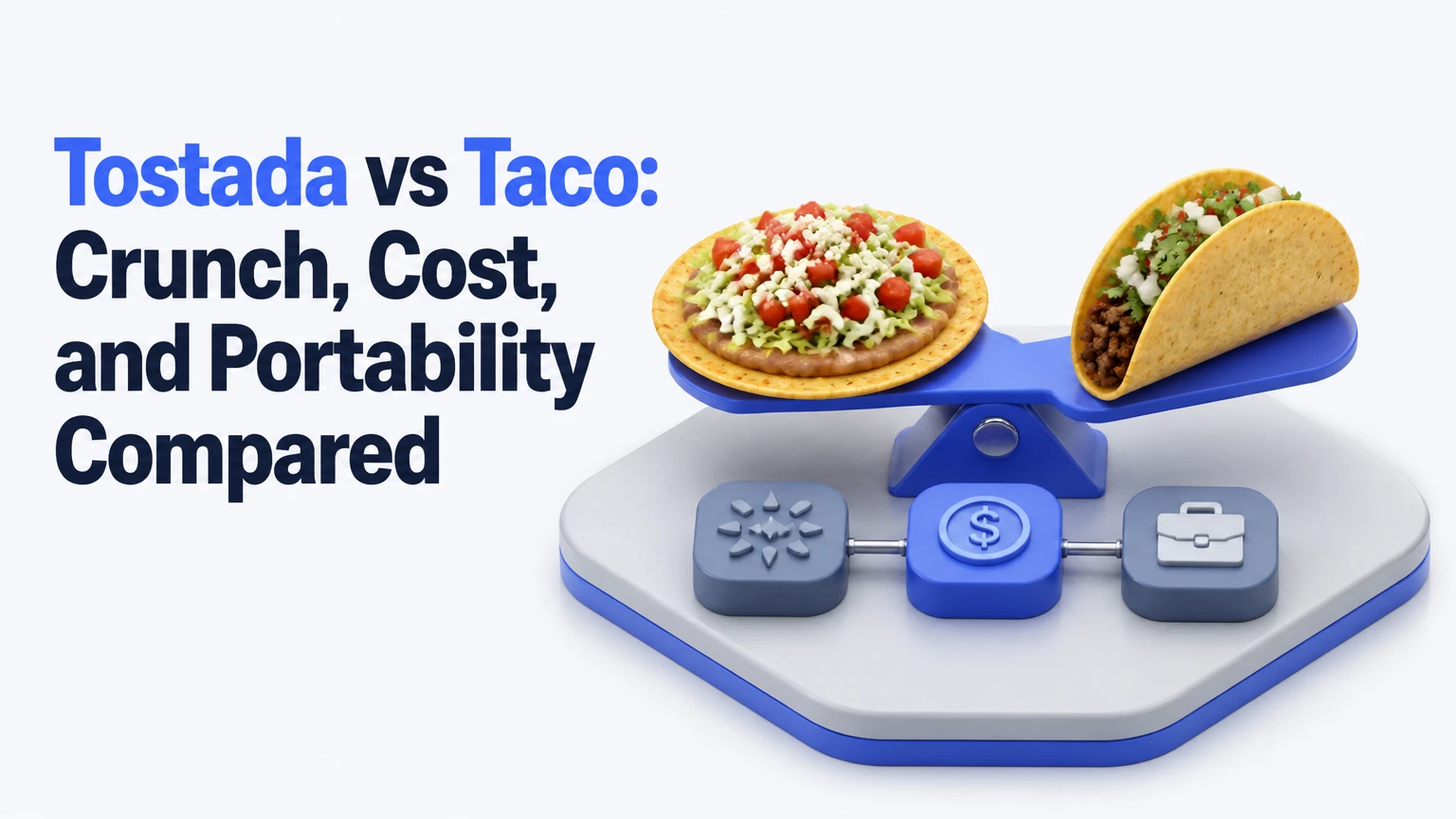
A taco uses a flexible tortilla folded around a filling, while a tostada uses a flat, crisp tortilla as an open-faced base. Choose a taco for portability, speed, and hot fillings; choose a tostada for crunch, broad toppings, and a build-your-own meal. The decisive difference is enclosure versus surface support.
Key Facts at a Glance
- A taco encloses or partially encloses its filling inside a folded tortilla.
- A tostada is a flat, toasted or fried tortilla topped from edge to edge.
- A typical taco takes about 1-3 minutes to assemble after the filling is ready.
- A typical tostada takes about 2-4 minutes to fry or bake and assemble.
- Tostadas usually offer more topping surface, but tacos travel with less mess.
- Corn tortillas are traditional for many Mexican tacos and tostadas; flour tortillas are common for several northern taco styles.
What Is the Structural Difference?
The structural difference is simple: a taco uses a fold, while a tostada uses a rigid horizontal platform. That geometry changes how fillings behave, how the dish is eaten, and how long the tortilla remains usable after assembly.
A taco’s folded tortilla creates a pocket that keeps a moderate amount of meat, beans, vegetables, or cheese together. The fold also lets a diner tilt the taco toward the mouth while the tortilla absorbs some juices. A tostada has no pocket, so its toppings must remain distributed across a flat shell.
The Spanish word tostada means toasted, and dictionary references such as Merriam-Webster identify the dish by its toasted or fried tortilla base. In practical cooking, many tostada shells are deep-fried, although baking or air-frying can produce a rigid shell with less added oil.
Master Comparison Table
| Criterion | Taco | Tostada | Typical practical result |
|---|---|---|---|
| Base shape | Folded, 10-15 cm tortilla | Flat, 12-15 cm shell | Taco contains; tostada spreads |
| Texture | Soft, chewy, or crisp | Rigid and crunchy | Tostada creates stronger crunch |
| Assembly time | 30-90 seconds per serving | 2-4 minutes per shell | Taco suits fast service |
| Typical filling load | 50-90 g | 45-75 g protein plus toppings | Tostada distributes more garnish |
| Typical home cost | $1.00-$3.00 each | $1.25-$3.50 each | Shell preparation drives tostada cost |
| Best holding window | 10-20 minutes | 5-10 minutes before softening | Both are best immediately |
| Eating method | One-handed, folded bite | Two-handed, plate-supported bite | Taco travels better |
| Main failure | Tortilla tear or leaking juices | Shell fracture or topping slide | Moisture control matters most |
These ranges are typical home and casual restaurant figures, not universal standards. Tortilla diameter, protein price, topping volume, and local restaurant pricing can change the totals substantially.
How Do Tacos and Tostadas Work as Meals?
Tacos work as modular portions, while tostadas work as layered compositions. A taco can be eaten individually, so several tacos may contain different fillings at the same meal. A tostada usually presents one complete combination of base, protein, vegetables, dairy, and salsa.
The folded format gives tacos a practical advantage with saucy fillings such as stewed beef, grilled meat with juices, or beans. The filling stays concentrated along the centerline, and a second tortilla can reinforce the bottom when the contents are heavy.
The flat format gives tostadas a visual and textural advantage. Refried beans create adhesion, shredded lettuce adds height, and crema or salsa supplies contrast. The same openness creates a limitation: liquid spreads across the entire shell instead of collecting inside a fold.
What Toppings Fit Each Format?
Taco toppings work best when they are finely cut and restrained enough to stay inside the tortilla. Tostada toppings can be broader and more layered, but every wet ingredient must be drained or applied immediately before eating.
| Component | Taco application | Tostada application | Recommended quantity |
|---|---|---|---|
| Refried beans | 1-2 tablespoons inside | 2-3 tablespoons as base | 30-45 g |
| Cooked protein | 50-75 g center-filled | 45-75 g evenly spread | 45-75 g |
| Onion and herbs | 1 tablespoon chopped | 1-2 tablespoons scattered | 10-20 g |
| Lettuce or cabbage | Small pinch | 20-30 g shredded layer | 20-30 g |
| Salsa | 1-2 teaspoons | 1-2 teaspoons in small dots | 5-10 ml |
| Crema | Optional narrow drizzle | 1 tablespoon across surface | 15 ml |
| Avocado | Slices or small cubes | Mash or thin slices for stability | 30-50 g |
| Cheese | Crumbled or shredded | Cotija or queso fresco layer | 10-20 g |
A taco tolerates a little more liquid because the tortilla forms a partial barrier. A tostada needs a thick, tacky foundation such as beans, guacamole, or a dense spread to prevent toppings from sliding across the shell.
What Types Should You Know?
Taco and tostada names often describe the filling, cooking method, or shell treatment rather than a single fixed recipe. Regional traditions vary, so the same protein can appear in several formats with different garnishes.
| Dish type | Base or method | Common filling | Typical finishing ingredients |
|---|---|---|---|
| Tacos al pastor | Soft corn tortilla, spit-cooked filling | Chile-seasoned sliced meat | Onion, cilantro, pineapple |
| Tacos de asada | Soft corn or flour tortilla | Charred sliced beef | Onion, cilantro, lime |
| Tacos de birria | Soft or fried tortilla | Slow-cooked beef or goat | Onion, cilantro, dipping broth |
| Tacos dorados | Filled tortilla, fried folded | Potato, chicken, or beans | Lettuce, cream, cheese |
| Tacos de pescado | Soft tortilla, grilled or battered fish | Fish fillet or strips | Cabbage, lime, crema |
| Tacos de canasta | Steamed, folded tortilla | Potato, beans, or stewed fillings | Salsa and pickled vegetables |
| Tostada de ceviche | Fried or baked flat shell | Citrus-cured fish or shrimp | Tomato, onion, avocado |
| Tostada de tinga | Crisp shell with bean layer | Shredded chicken in tomato-chipotle sauce | Lettuce, cream, cheese |
| Tostada de pata | Crisp shell | Chilled pickled beef foot | Lettuce, onion, crema |
| Tostada de guacamole | Crisp shell | Seasoned mashed avocado | Cotija, onion, salsa |
Tacos dorados are an important edge case because they blur the comparison. They begin as folded tacos, then become crisp through frying. They remain tacos because the filling is enclosed by a folded tortilla rather than spread over a flat shell.
A quesabirria also differs from a standard taco because cheese and griddle-frying change the tortilla’s texture. The category still depends on the folded format, not on whether the tortilla is soft at serving.
How Are They Made?
Tacos require tortilla warming, filling, and immediate garnishing. Tostadas require a rigid shell first, followed by a moisture-resistant base and evenly distributed toppings.
Taco Assembly
- Warm one corn tortilla on a dry skillet for 20-40 seconds per side, or warm two tortillas together when the filling is heavy.
- Add 50-75 grams of drained filling along the center, leaving approximately 2 centimeters of empty edge.
- Add 5-10 grams of chopped onion and herbs, then use 5-10 milliliters of salsa.
- Fold the tortilla once and serve immediately.
The tortilla is ready when it bends without cracking and develops small steam-softened spots. A dry tortilla breaks at the fold, while an overfilled taco leaks from both ends.
Tostada Assembly
- Fry a stale or fresh corn tortilla in 175-185°C oil for 90-150 seconds, turning once, until firm and lightly browned.
- Drain the shell on a rack rather than directly on paper, which can trap steam underneath.
- Spread 30-45 grams of refried beans or thick guacamole across the shell.
- Add 45-75 grams of drained protein, keeping the layer level rather than piling it at the center.
- Add cabbage or lettuce, cheese, crema, salsa, and a final garnish.
- Serve within 5-10 minutes for the strongest crunch.
Baking is a useful alternative. Brush both sides lightly with oil and bake a tortilla at approximately 200°C for 8-12 minutes, turning once, until rigid and browned at the edges.
Preparation and Holding Table
| Task | Taco timing | Tostada timing | Success checkpoint |
|---|---|---|---|
| Heat or cook base | 20-40 seconds per tortilla | 90-150 seconds frying | Base bends for taco, stays rigid for tostada |
| Add foundation | 5-10 seconds | 15-25 seconds | Beans or guacamole cover the surface |
| Add protein | 10-20 seconds | 15-30 seconds | Protein is drained and evenly placed |
| Add garnishes | 10-20 seconds | 20-40 seconds | No overloaded edge or wet pool |
| Best serving window | 10-20 minutes | 5-10 minutes | Texture remains intact |
| Typical total assembly | 1-2 minutes | 2-4 minutes | Food reaches the table immediately |
Which Is Healthier?
Neither dish is automatically healthier because nutrition depends more on cooking fat, filling, cheese, cream, and portion size than on the name of the format. A baked tostada may contain less added oil than a fried shell, while a taco can be lighter when it uses one tortilla, grilled vegetables, and a modest protein portion.
A typical homemade taco with one 25-gram corn tortilla, 60 grams of lean filling, onion, herbs, and salsa may land around 150-250 calories before substantial cheese or cream. A fried tostada with a 30-gram shell, beans, 60 grams of protein, avocado, and dairy may reach approximately 250-400 calories.
Corn tortillas are naturally gluten-free when produced without cross-contact, but diners with celiac disease should confirm preparation surfaces and packaged ingredients. Flour tortillas contain wheat and are not gluten-free.
Nutrition Variables That Matter Most
- Fried shell versus baked shell: frying can add 40-100 calories depending on oil absorption.
- Protein choice: lean grilled chicken or fish usually contributes less fat than richer stewed fillings.
- Toppings: avocado adds unsaturated fat, while cream and cheese increase saturated fat and sodium.
- Portion count: three small tacos can contain more energy than one loaded tostada.
- Sodium: prepared beans, seasoned meats, cheese, and bottled salsa can raise the total quickly.
The practical winner is the format that matches the intended portion. A single tostada is not automatically lighter than two small tacos.
Which Costs Less to Make or Buy?
Tacos usually cost less to assemble at home because they do not require a separate frying step. Tostadas can be economical when using leftover beans, vegetables, and stale tortillas, but purchased shells and larger topping portions can raise the per-serving cost.
Typical United States home costs range from $1.00-$3.00 for a simple taco and $1.25-$3.50 for a loaded tostada. Casual restaurant prices commonly range from $2.00-$5.00 per taco and $4.00-$9.00 per tostada, with location, protein, and portion size driving the difference.
| Cost factor | Taco estimate | Tostada estimate | Main price driver |
|---|---|---|---|
| Tortilla or shell | $0.15-$0.50 | $0.25-$0.90 | Store-bought shell or frying oil |
| Protein portion | $0.75-$1.75 | $0.75-$1.75 | Beef, seafood, chicken, or beans |
| Beans and vegetables | $0.20-$0.70 | $0.35-$1.00 | Tostadas use more topping surface |
| Dairy and avocado | $0.15-$0.80 | $0.30-$1.20 | Garnish quantity |
| Typical homemade total | $1.00-$3.00 | $1.25-$3.50 | Portion and shell method |
| Typical casual restaurant price | $2.00-$5.00 | $4.00-$9.00 | Local labor and presentation |
For leftover management, tostadas are especially useful when corn tortillas have dried enough to crack during folding. Frying or baking changes that weakness into a rigid shell.
Which Travels Better and Stays Crisp?
Tacos travel better because the folded tortilla protects the filling and needs less open exposure. Tostadas are poor candidates for long delivery intervals because moisture moves from beans, salsa, vegetables, and protein into the shell.
For transport, package taco shells and fillings separately whenever possible. A sealed container with hot filling creates condensation, so venting the container briefly before assembly helps preserve tortilla texture.
Tostadas can travel successfully for a party if shells, toppings, and sauces remain separate. A build-your-own station is more reliable than preassembling a tray 30 minutes before guests eat.
Delivery and Meal-Prep Comparison
| Situation | Better choice | Preparation method | Maximum practical hold |
|---|---|---|---|
| Packed lunch | Taco components separately | Reheat filling, assemble at lunch | 4-6 hours with separation |
| 20-minute car trip | Taco | Double tortilla, drain filling | About 20 minutes |
| Buffet for 10 people | Tostada station | Shells and toppings separate | 30-60 minutes before assembly |
| Leftover dry tortillas | Tostada | Bake or fry until rigid | Shells hold 1-3 days airtight |
| Saucy braised filling | Taco | Drain before folding | 10-15 minutes assembled |
| Ceviche topping | Tostada | Add immediately before eating | 5-10 minutes assembled |
Neither format is ideal for overnight assembly. Refrigeration softens fried shells and makes tortillas stiff, so store components separately.
How Do You Prevent Breakage and Sogginess?
Prevent taco breakage by warming the tortilla fully, using a second tortilla for heavy fillings, and draining wet ingredients before assembly. Prevent tostada collapse by selecting a rigid shell, applying a thin adhesive base, and limiting liquid until the final seconds.
The most common taco failure is a split along the bottom curve. Double-stacking two warm corn tortillas distributes stress, which is why many street vendors use that method for juicy or heavy fillings.
The most common tostada failure is not simply a weak shell. Uneven layers create a lever effect: a tall mound in the center applies force to a thin outer edge. Level toppings reduce that stress and make each bite more controlled.
Failure and Recovery Table
| Failure | Likely cause | Immediate fix | Prevention |
|---|---|---|---|
| Taco splits at fold | Cold or dry tortilla | Add a second warmed tortilla | Steam or heat before filling |
| Taco leaks at ends | More than 75-90 g filling | Remove excess and refold | Leave 2 cm edge clearance |
| Tostada breaks centrally | Tall, concentrated topping mound | Redistribute onto a plate | Build flat layers |
| Toppings slide off | No sticky foundation | Add beans or thick avocado | Cover most of shell with base |
| Shell turns chewy | Wet ingredients added early | Eat immediately or replace shell | Drain protein and delay salsa |
| Shell tastes greasy | Oil below 175°C | Drain on a rack | Maintain 175-185°C oil |
A practitioner rule of thumb is to treat salsa as a finishing ingredient, not a structural ingredient. Beans and guacamole can anchor a tostada; thin salsa cannot.
Which Should You Choose?
Choose a taco for portable eating, rapid service, saucy fillings, and meal preparation. Choose a tostada for maximum crunch, broad toppings, seafood combinations, and a seated meal where a plate can catch fragments.
For the Meal-Prepper
Tacos are the better choice for weekly preparation. Store cooked protein, tortillas, onions, herbs, and salsa in separate containers, then reheat the filling and assemble in under two minutes.
Tostadas work only when shells and toppings remain separate. They become less convenient if every serving requires frying, cooling, and immediate assembly.
For the Party Host
Tostadas are the better choice for a self-serve station because guests can customize beans, protein, vegetables, cheese, and salsa. Prepare 2 shells per guest, 60-90 grams of protein per guest, and 30-45 grams of beans per shell.
Use tacos when guests will stand, walk, or eat without plates. A taco bar also reduces shell breakage, but warm tortillas must be replenished in small batches.
For Delivery or Outdoor Eating
Tacos are the better choice because the folded tortilla contains loose ingredients and tolerates movement. Use two tortillas for juicy fillings, package salsa separately, and avoid filling tacos more than 15-20 minutes before eating.
Tostadas are unsuitable for walking meals. Their rigid shells fracture under pressure, and exposed toppings can fall when the base tilts.
For Seafood and Fresh Toppings
Tostadas are often the better choice for ceviche, shrimp, avocado, cabbage, and citrus-forward toppings because the broad shell gives each ingredient space. Add the seafood mixture immediately before serving so citrus and liquid do not soften the base.
Food safety still matters. Keep raw or citrus-cured seafood refrigerated at 4°C or below, use clean utensils, and serve promptly.
For Children or Mess-Averse Diners
A taco is generally easier to manage because the fold limits lateral movement. Smaller 10-12 cm tortillas, mild fillings, and drained protein reduce spills further.
Tostadas can work for children when broken into wedges and served on a plate. Whole-shell eating demands more hand control and produces more fragments.
Can a Tostada Replace a Taco?
A tostada can replace a taco when the filling is relatively dry and the diner wants extra crunch, but the two formats are not interchangeable in every meal. A tostada cannot reproduce the portability or containment of a taco, while a taco cannot provide the same broad, crisp topping platform.
Use the same cooked filling in both formats by adjusting moisture and quantity. Drain braised meat for a tostada, spread beans first, and reduce salsa. For a taco, retain enough moisture for flavor but remove excess liquid that could split the tortilla.
A practical substitution ratio is one tostada for two small tacos when the tostada carries beans, protein, avocado, vegetables, and dairy. The larger surface and heavier toppings make direct piece-for-piece substitution misleading.
What Are the Best Alternatives?
Several Mexican dishes occupy the space between a folded taco and a flat tostada. The key distinction is whether the tortilla remains soft, becomes fully rigid, or is shaped into a thicker base.
| Alternative | Structural feature | Typical diameter | Best use |
|---|---|---|---|
| Tlacoyo | Thick oval masa base | 12-18 cm | Beans or cheese with hearty toppings |
| Sope | Thick round masa rim | 8-12 cm | Saucy toppings with contained edges |
| Huarache | Long, thick masa base | 20-30 cm | Large seated meal |
| Gordita | Thick masa pocket | 10-15 cm | Stuffed filling with less leakage |
| Memela | Thin oval masa base | 12-18 cm | Beans, cheese, and simple toppings |
| Quesadilla | Folded tortilla with cheese | 15-25 cm | Melted filling and handheld eating |
A sope is often the best tostada alternative when the diner wants a raised edge to contain salsa and beans. A gordita is the better taco alternative when portability matters but a thicker masa shell is preferred.
Frequently Asked Questions
Are hard-shell tacos the same as tostadas?
Hard-shell tacos are not the same as tostadas because hard-shell tacos retain a folded or U-shaped structure, while tostadas remain flat. Both use crisp tortillas, but the taco’s raised sides help contain filling and the tostada’s open surface supports layered toppings.
Can I use flour tortillas for tostadas?
You can use flour tortillas for tostadas, although corn tortillas are more traditional and usually become crisper with a sturdier toasted texture. Flour tortillas may puff, blister, or become brittle differently, so prick large tortillas before baking and monitor them closely.
Are tostada shells always deep-fried?
Tostada shells are not always deep-fried. Baking, air-frying, dry-toasting, and pan-crisping can produce a rigid base, although deep-frying usually creates the most even crunch. A baked shell typically takes 8-12 minutes at about 200°C.
How many tacos or tostadas should one person eat?
A typical adult may eat 2-4 small tacos or 1-2 loaded tostadas, depending on tortilla diameter, protein, beans, and side dishes. A 10-12 cm street taco contains less food than a 15 cm restaurant taco, so piece counts alone are not a reliable portion measure.
Why do tostadas break when I bite them?
Tostadas break when the shell is thin, overfried, softened by liquid, or loaded unevenly. Place the tostada on a plate, support the edge with your fingers, and bite near the perimeter rather than pressing directly into the center.
Which dish is more traditional for ceviche?
Tostadas are more commonly associated with ceviche because their flat, crisp surface supports chilled seafood, avocado, cabbage, and citrus. Ceviche can appear in tacos as well, but the taco requires a soft tortilla and tighter moisture control.
The Bottom Line
Tostada vs taco is primarily a choice between a flat crisp platform and a folded tortilla enclosure. Tacos win for portability, speed, saucy fillings, and meal prep; tostadas win for crunch, layered toppings, seafood, and customizable seated meals. Choose the format that matches the filling’s moisture and the setting’s need for control.