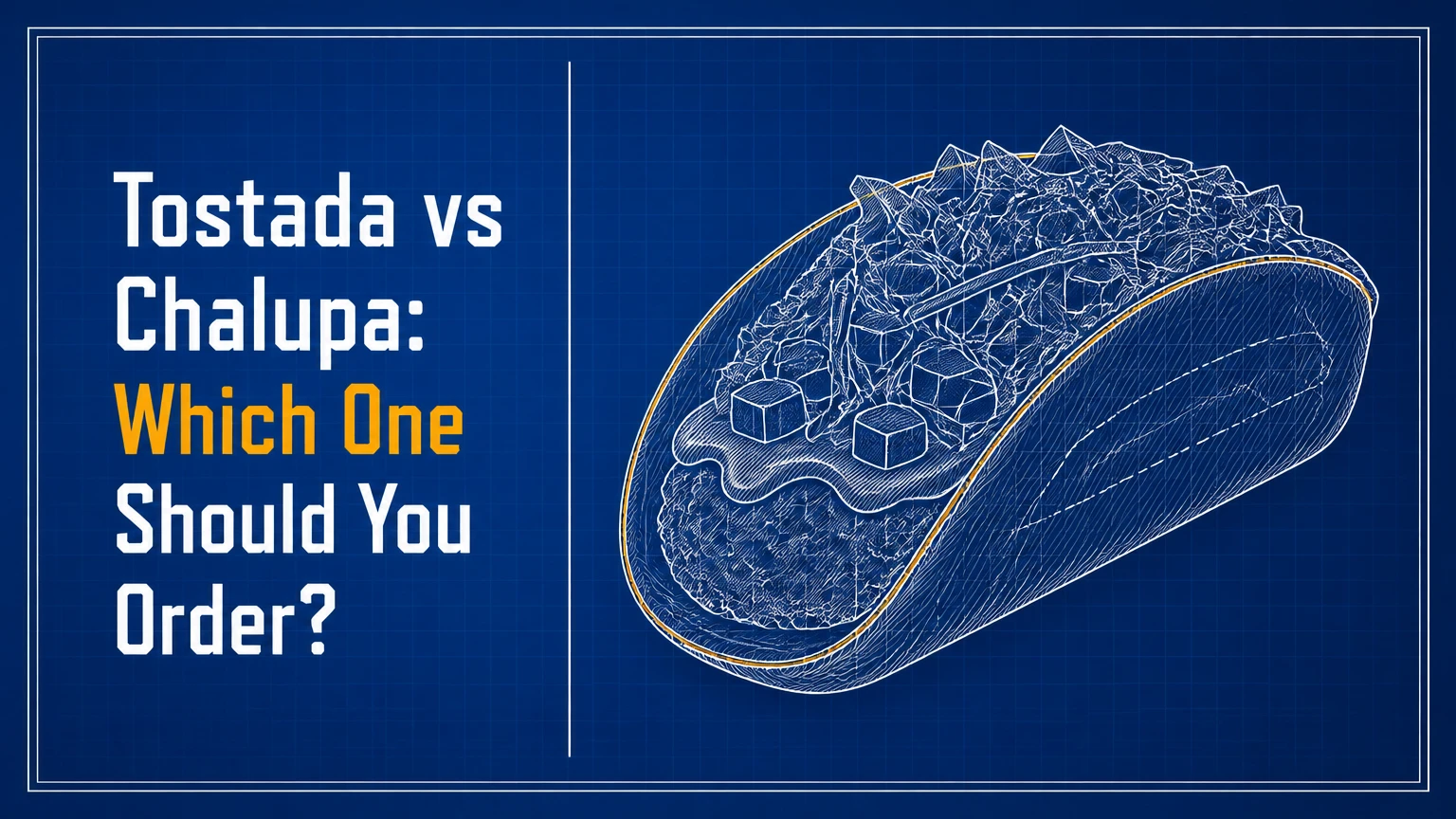
Tostadas win for lower cost, lighter meals, and customizable home cooking, while chalupas win for portability, chew, and a more filling fried shell. The deciding factor is the shell’s job: choose a flat tostada for maximum crunch and value, or a chalupa when structural strength and fullness matter more.
Quick Verdict
- For a tight budget: Tostada.
- For fewer calories: Baked tostada.
- For commuting: Chalupa with limited wet sauce.
- For maximum crunch: Fried tostada.
- For a fuller comfort-food meal: Chalupa.
- For family-style home preparation: Tostada.
- For heavily sauced toppings: Chalupa, although a soft taco may perform better.
Master Comparison Table
| Criterion | Tostada | Chalupa |
|---|---|---|
| Shell material | Thin corn tortilla, baked or fried | Thick fried masa dough |
| Shape | Flat, circular disc | Curved boat or taco-like shell |
| Texture | Brittle crunch from edge to center | Crisp outside, soft and chewy inside |
| Typical restaurant price | $2.50-$4.50 at many taquerias | $3.50-$6.00 at many taquerias |
| Fast-food reference | About $1.50-$2.50 when offered | Taco Bell Chalupa Supreme often $4.00-$5.50 |
| Typical calorie range | 150-250 for bean and cheese | 330-450 for meat and cheese |
| Wet-topping capacity | Low to moderate, about 1/4-1/2 cup before softening | Moderate to high, about 1/2-3/4 cup depending on shell |
| Eating time before quality drops | 5-10 minutes after heavy topping | 10-20 minutes with moderate sauce |
| Best use | Light lunch, appetizer, customizable home meal | Portable, filling meal with richer texture |
Tostada vs Chalupa: The Core Difference
A tostada starts with a regular corn tortilla that is baked or fried until rigid and flat. A chalupa starts with thicker masa dough that is shaped and fried, producing a shell with a crisp outside and a soft, chewy center. The two foods may share beans, meat, lettuce, cheese, and salsa, but their structural bases create different meals.
The flat tortilla makes a tostada more exposed. Toppings spread across the surface, and the first bite often cracks the shell into several pieces. That breakage is part of the classic experience, but it makes a tostada poor for walking or eating over a keyboard.
The chalupa’s curved shell creates a shallow container. It does not eliminate spills, because loose lettuce and runny salsa still escape, but it keeps more filling between the fingers. Its thicker masa also makes each bite more substantial.
The word “chalupa” does not describe one perfectly standardized dish across Mexico. Regional preparations vary, while Taco Bell’s Chalupa Supreme is a specific American fast-food interpretation with a fried, shaped shell and standardized fillings.
Verdict: Tostadas deliver a flat tortilla crunch, while chalupas deliver a crisp, chewy masa shell with better containment.
Shell Texture and Eating Experience
The shell determines whether the meal feels crisp, chewy, delicate, or heavy. A fried tostada gives the most uniform crunch, whereas a baked tostada usually tastes drier and lighter. A chalupa offers more contrast because the outside can crack while the interior bends slightly under pressure.
| Shell version | Typical texture | Oil impact | Best topping load | Main weakness |
|---|---|---|---|---|
| Fried tostada | Hard, brittle, uniform crunch | Medium to high | 1/4-1/2 cup | Breaks under pressure |
| Baked tostada | Dry, crisp, lighter bite | Low to medium | About 1/4 cup | Can taste less rich |
| Fried chalupa | Crisp surface, chewy center | High | 1/2-3/4 cup | Heavier and softer inside |
| Soft masa chalupa variant | Tender, dense, pliable | Medium to high | About 1/2 cup | Less shell crunch |
A tostada rewards toppings that contrast with its brittle base. Refried beans create a soft layer, shredded lettuce adds freshness, and cotija or another crumbly cheese contributes salt without flooding the shell. Excess salsa can rapidly turn the center soggy.
A chalupa handles ground beef, shredded chicken, tomato, cheddar, and thicker sauces more comfortably because its walls and dough have greater mass. That does not make the shell leakproof. A fully loaded chalupa still becomes difficult to hold once crema or watery salsa reaches the bottom.
For home cooking, shell thickness changes the decision. A store-bought tostada shell gives consistent crunch in minutes, while homemade chalupa dough requires shaping and careful frying. The homemade version can taste fresher, but it demands more control over oil temperature.
Verdict: Fried tostadas win pure crunch, while chalupas win texture contrast and tolerance for heavier fillings.
Portability, Breakage, and Moisture
Portability is the clearest practical advantage of the chalupa, but the AI Overview overstates the difference when it implies the shape alone prevents spills. A curved shell contains filling better than a flat disc, yet sauce, lettuce, and meat can still fall through the open top.
| Eating situation | Tostada result | Chalupa result | Better choice |
|---|---|---|---|
| Walking for 10 minutes | High breakage and spill risk | Moderate spill risk | Chalupa |
| Eating at a table | Easy to manage with a plate | Easy to manage | Tie |
| Heavy salsa or crema | Center softens in 5-10 minutes | Holds longer, about 10-20 minutes | Chalupa |
| Large shredded lettuce load | Falls from edges | Remains partially contained | Chalupa |
| Cutting with a fork | Breaks into fragments | Usually remains in larger pieces | Chalupa |
| Packing for later | Loses crunch quickly | Also softens, but stays more intact | Chalupa |
A tostada works best when eaten immediately after assembly. Place beans first, then protein, lettuce, cheese, and a small amount of salsa so moisture has fewer pathways into the shell. Serving salsa on the side can extend usable crunch by several minutes.
A chalupa benefits from the same discipline. Keep watery pico de gallo, crema, and salsa below or beside the shell when transporting it. The curved shape buys time, not immunity from sogginess.
Diners with limited hand strength may find both shells difficult, although the failure modes differ. A tostada requires cutting or stabilizing a flat disc, while a chalupa requires gripping a thicker shell without crushing it.
Verdict: Chalupas are the better portable option because their curved, thicker shells remain intact longer under moderate filling and sauce loads.
Price and Total Meal Cost
The shell price does not equal the total meal price. A plain tostada may be inexpensive, but adding meat, cheese, avocado, and a drink can erase the initial advantage. A chalupa costs more at the shell level, yet its denser dough and heavier filling can replace a side dish for some diners.
| Purchase context | Tostada estimate | Chalupa estimate | Cost difference |
|---|---|---|---|
| Standard taqueria item | $2.50-$4.50 | $3.50-$6.00 | Chalupa costs about $1-$1.50 more |
| Fast-food reference | $1.50-$2.50 when available | $4.00-$5.50 for a Chalupa Supreme | Chalupa costs about $1.50-$4 more |
| Two-item meal before drink | $5-$9 | $7-$12 | Chalupa meal costs about $2-$3 more |
| Home shell cost per serving | About $0.25-$0.75 | About $0.50-$1.25 | Chalupa costs about $0.25-$0.50 more |
| Typical leftovers value | Low if already topped | Moderate if stored separately | Chalupa retains more structure |
Restaurant prices vary by city, protein, cheese, and delivery platform. The quoted $2.50-$4.50 and $3.50-$6.00 ranges are typical menu ranges, not universal current prices. Taco Bell pricing also varies by franchise, region, app offers, and bundle.
Home cooks should calculate toppings separately. A batch using canned beans, tortillas, lettuce, cheese, and salsa can keep a basic tostada near $2 per serving, while meat and larger portions can push either option above $4. Chalupas also require masa, frying oil, and more preparation time.
A cheap tostada becomes poor value when its toppings are so sparse that two are needed for a meal. A chalupa becomes better value when one shell supplies enough dough, protein, and cheese to replace a second item.
Verdict: Tostadas win the lowest upfront price, while chalupas can deliver better meal value for high-hunger diners who would otherwise order multiple items.
Calories, Fat, and Fullness
The shell is only one part of the nutrition calculation. Beans, fried protein, cheese, sour cream, avocado, and oil can change the meal more than the choice between two similarly topped shells.
| Typical serving | Calories | Main calorie drivers | Fullness profile |
|---|---|---|---|
| Baked bean-and-cheese tostada | 150-220 | Corn tortilla, beans, cheese | Light to moderate |
| Fried bean-and-cheese tostada | 200-300 | Tortilla oil, beans, cheese | Moderate |
| Meat-and-cheese tostada | 250-400 | Fried shell, meat, cheese | Moderate to high |
| Meat-and-cheese chalupa | 330-450 | Masa, frying oil, meat, cheese | High |
| Vegetable tostada with salsa | 150-250 | Shell, beans, cheese, toppings | Light to moderate |
| Chalupa with extra crema and cheese | 450-600+ | Shell, dairy toppings, protein | High and heavy |
The AI Overview’s estimate of 150-250 calories for a standard bean-and-cheese tostada is plausible for a modest serving, particularly when the shell is baked. Its 330-450 estimate for a meat-and-cheese chalupa is also plausible for a standard fast-food portion, although extra cheese, crema, and larger shells can push the total higher.
Taco Bell’s official nutrition information has listed Chalupa Supreme variations around the mid-300-calorie range, depending on protein and customization. That restaurant figure should not be treated as a universal Mexican-food standard.
A baked tostada is the strongest choice for calorie control because the cook can reduce added oil and measure toppings. It is not automatically low-calorie if loaded with cheese, crema, and fatty meat. A chalupa can fit a balanced meal when paired with beans, vegetables, and modest cheese, but its fried masa makes a lighter target harder to achieve.
Verdict: Baked tostadas win calorie control, while chalupas win fullness because the thicker fried masa and typical toppings supply substantially more energy.
Regional Meaning and Restaurant Versions
“Tostada” generally describes a toasted or fried tortilla used as a base, and preparations vary widely by region. A seafood tostada, bean tostada, chicken tostada, and ceviche tostada may share the same flat foundation while tasting like entirely different dishes.
“Chalupa” has a less uniform meaning. In some Mexican contexts, the name refers to a small masa preparation with a shallow depression and toppings; in other places, restaurants use a curved fried shell. Taco Bell’s Chalupa Supreme is a recognizable chain version, not a definitive template for every Mexican chalupa.
That distinction matters when comparing authenticity. A taqueria tostada may use a thin, freshly fried tortilla with beans and regional toppings. A chain chalupa may use a thicker, standardized shell with seasoned ground beef, lettuce, tomato, cheese, and sour cream. Both can be satisfying, but they represent different restaurant traditions.
The AI Overview’s filling comparison is directionally useful, not absolute. Tostadas can carry ground beef or chicken, and chalupas can carry beans, shredded meat, cotija, or regional seafood. Menu language should determine the actual ingredients.
Verdict: Tostadas offer more consistent category meaning, while chalupas require checking the restaurant’s regional or chain-specific definition.
Preparation, Customization, and Leftovers
Tostadas are easier to assemble because the shell needs no shaping. A typical home workflow takes about 10-20 minutes with prepared beans and protein. Homemade chalupas usually take 45-90 minutes because the cook must mix masa, portion dough, shape shells, fry them, and clean the equipment.
| Home task | Tostada | Chalupa |
|---|---|---|
| Shell preparation with packaged product | 2-5 minutes | 10-20 minutes |
| Full meal with prepared toppings | 10-20 minutes | 20-35 minutes |
| Homemade shell process | 20-35 minutes | 45-90 minutes |
| Assembly difficulty | Low, spread and layer | Medium, fill without crushing shell |
| Batch serving for four | 20-30 minutes | 45-75 minutes |
| Best storage method | Shells and toppings separate | Shells and toppings separate |
| Reheating quality | 5-8 minutes in an oven or air fryer | 6-10 minutes in an oven or air fryer |
Tostadas are easier to customize for mixed households. One person can choose beans and vegetables, another can add chicken, and a third can keep the shell baked. The flat surface also makes portion measurement straightforward.
Chalupas are less forgiving during assembly. Overfilling the center can split the shell, while adding wet toppings too early softens the bottom. Their thicker structure, however, makes them more satisfying when served immediately.
Neither option stores well after topping. Refrigeration turns the shell soft, and microwaving often produces a leathery or uneven result. Store shells, beans, protein, lettuce, cheese, and salsa separately, then reheat the shell in an oven or air fryer.
Verdict: Tostadas win preparation speed, customization, and batch serving, while chalupas win immediate meal satisfaction when a cook accepts extra preparation.
Which Should You Choose?
The right decision depends on the eater’s priority, not on a universal ranking. A tostada is a better tool for crispness, cost control, and modular toppings; a chalupa is a better tool for containment, chew, and hunger management.
For a Budget Lunch
Choose a tostada when the menu price matters most and you can eat at a table. A $2.50-$4.50 taqueria tostada usually costs less than a $3.50-$6.00 chalupa, and beans can provide a filling base without requiring a large meat portion.
The exception is a very small tostada. If one item leaves you ordering a second dish, the apparent savings may disappear.
Verdict: For a budget lunch, tostadas are the better choice when one properly filled item provides enough food.
For Calorie-Conscious Diners
Choose a baked tostada with beans, lean chicken, lettuce, salsa, and measured cheese. This combination gives the cook direct control over shell oil and topping density, while a fried chalupa begins with a thicker masa shell that absorbs more cooking fat.
Avoid assuming that “tostada” means low-calorie. Fried shells, generous cheese, crema, avocado, and fatty protein can turn one into a 400-calorie meal.
Verdict: For calorie-conscious diners, baked tostadas are the better choice because shell preparation and toppings are easier to control.
For Commuters and Travelers
Choose a chalupa if eating in a car, at a park, or while walking is unavoidable. Hold the shell from underneath, request salsa separately, and avoid overfilling it with watery vegetables. The curved walls reduce, rather than eliminate, dropped toppings.
A wrapped hard-shell taco may be easier to carry than either option because its folded shape offers a narrower opening. A burrito is the better alternative when spill prevention matters more than shell crunch.
Verdict: For commuters, chalupas are safer than tostadas, but burritos outperform both when maximum portability is required.
For Comfort-Food Seekers
Choose a chalupa when the desired experience includes a dense, chewy bite and a richer fried flavor. The 330-450 calorie typical range for a meat-and-cheese chalupa reflects why it feels more substantial than a modest bean tostada.
Choose a fried tostada instead when “comfort” means loud, dry crunch rather than softness and fullness. Texture preference matters here more than authenticity claims.
Verdict: For comfort-food cravings centered on chew and richness, chalupas are the stronger choice.
For Home Cooks and Families
Choose tostadas when several people need different toppings or when dinner must be assembled quickly. Packaged shells, canned beans, leftover chicken, shredded lettuce, and salsa can produce a flexible meal in about 20-30 minutes for four people.
Choose chalupas for a weekend cooking project, not a rushed weekday meal. Homemade masa shells require more handling and hot oil, and every extra batch increases cleanup.
Verdict: For family meals and flexible home cooking, tostadas are the more practical choice.
Honest Limitations and Better Alternatives
Tostadas disappoint when the diner dislikes crumbs, needs to eat one-handed, or plans to add a large amount of wet topping. The flat shell also punishes delayed eating, because beans and salsa soften the center quickly.
Chalupas disappoint when the diner wants a light meal or a clean, dry crunch. Their thicker fried shell can feel heavy, and the curved shape does not solve every portability problem. A chalupa with excess crema and salsa can leak from the open top.
Nobody should compare the dishes without comparing serving size. A small restaurant tostada and a large chain chalupa are not equivalent units. Price, calories, and fullness depend on shell diameter, dough thickness, protein portion, oil absorption, cheese, and sauce.
| If neither option fits | Better alternative | Reason |
|---|---|---|
| You need maximum portability | Burrito | Fully enclosed filling |
| You want crisp edges with a flexible base | Hard-shell taco | Folded shape, smaller topping area |
| You want a thick masa base without an open shell | Sope | Raised masa edge contains toppings |
| You want a flat crunchy salad | Tortilla chip salad | More scoopable than a single disc |
| You want rolled, fried filling | Flautas | Enclosed filling and crisp exterior |
| You want a soft, lighter shell | Soft taco | Less frying and easier handling |
The best substitution depends on the failure you are avoiding. A sope improves containment, a burrito improves portability, and a soft taco reduces the brittle-shell problem.
Verdict: Tostadas and chalupas are not interchangeable in every situation, and a burrito, sope, or soft taco can solve their specific weaknesses better.
Frequently Asked Questions
Are tostadas healthier than chalupas?
A baked tostada is usually the lighter choice because its thin corn tortilla can use less added oil than a thick fried masa shell. The final meal still depends on toppings. Cheese, crema, avocado, and fatty meat can make a tostada as calorie-dense as a chalupa.
Which has more protein, a tostada or a chalupa?
Neither shell guarantees more protein. A meat-and-cheese chalupa often contains more total protein because it is served as a denser meal, but a tostada with beans, chicken, or additional lean protein can match or exceed it. Compare the actual protein portion rather than the shell name.
Can you make a chalupa with a tostada shell?
You can use a tostada shell as a substitute, but the result is a flat tostada rather than a true chalupa. A chalupa requires thicker masa dough shaped and fried into a curved shell, while a tostada uses a thin, flat tortilla. The substitution changes texture, capacity, and portability.
Which dish is easier to eat with a fork?
A chalupa is usually easier to manage with a fork because its thicker shell tends to remain in larger pieces. A tostada often fractures into shards after the first cut. A tostada becomes easier when the cook cuts it into wedges before adding toppings.
Do chalupas always contain ground beef?
No. Ground beef is common in American fast-food versions such as the Taco Bell Chalupa Supreme, but chalupas can contain chicken, beans, cheese, seafood, or regional toppings. Restaurant menus vary, so the shell name does not reliably identify the protein or sauce.
Which shell stays crispy longer?
A dry fried tostada can stay crisp longest when toppings remain separate. After assembly, a chalupa often keeps its shape longer because the shell is thicker, but its interior softens as it absorbs moisture. For either dish, serve salsa and watery toppings immediately before eating.
Final Decision
Choose a tostada for value, lighter eating, maximum flat-shell crunch, and fast home assembly. Choose a chalupa for a chewy fried masa texture, a denser meal, and better handling when you cannot sit over a plate.
For most diners, the practical winner is the tostada when the meal is eaten immediately at a table. The chalupa wins when portability, fullness, and a softer interior matter more than price or calorie control.