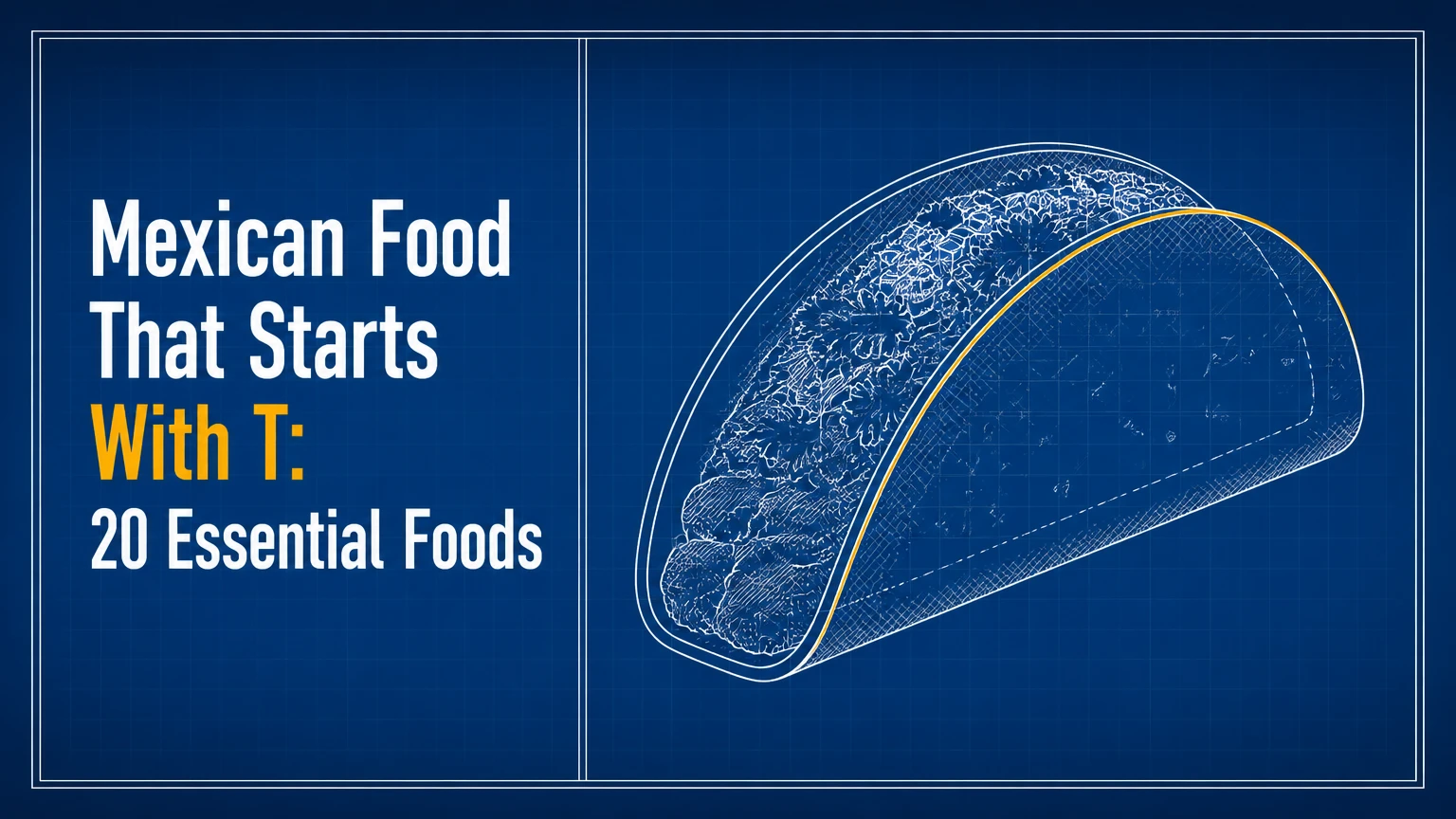
Mexican food that starts with T includes tacos, tamales, tortas, tostadas, tlayudas, tlacoyos, totopos, tetelas, tacos dorados, and several regional specialties. Tacos are filled tortillas, tamales are steamed masa parcels, and tortas are filled bread rolls. The broader group combines corn, beans, chile sauces, fresh garnishes, slow cooking, and regional technique.
Key Facts at a Glance
- Tacos use a soft or crisp tortilla as the serving structure, with fillings ranging from grilled meat to beans, seafood, mushrooms, and cactus.
- Tamales contain seasoned masa and a filling wrapped in corn husks or leaves, then steamed until the dough firms.
- Tortas are Mexican sandwiches usually built on a bolillo, telera, or regional birote roll.
- Tostadas use a flat, crisp tortilla as a base for beans, shredded meat, seafood, vegetables, or salsa.
- Tlayudas are large Oaxacan tortillas spread with beans and layered with toppings before being toasted.
- Tlacoyos are oval masa cakes commonly filled with beans or cheese and finished with cactus, salsa, and fresh cheese.
What Mexican Foods Start With T?
The most recognizable Mexican foods beginning with T are tacos, tamales, tortas, tostadas, tlayudas, tlacoyos, totopos, tetelas, tacos dorados, and tejuino. The first six are complete dishes, while totopos are usually a snack or garnish and tejuino is a regional fermented corn beverage.
| Food | Basic structure | Typical serving style | Common region or context |
|---|---|---|---|
| Taco | Small tortilla plus filling | Handheld, 2-4 per meal | Nationwide |
| Tamal | Masa, filling, and wrapper | Unwrapped at the table | Nationwide |
| Torta | Bread roll plus layered filling | Handheld sandwich | Nationwide |
| Tostada | Crisp tortilla plus topping | Eaten with a fork or hands | Coastal and urban Mexico |
| Tlayuda | Large toasted tortilla plus beans and toppings | Shared or folded | Oaxaca |
| Tlacoyo | Thick oval masa cake | Served from a comal | Central Mexico |
| Totopo | Fried or toasted tortilla triangle | Snack, garnish, or soup topping | Nationwide |
| Tetela | Triangular filled masa parcel | Served with salsa and cheese | Puebla and Oaxaca |
| Taco dorado | Rolled or folded fried taco | Topped after frying | Nationwide |
| Tejuino | Corn-based regional beverage | Chilled in a cup | Western Mexico |
The letter T covers several different culinary systems. Some foods are portable, some are plated, and others are ingredients made from tortillas. That distinction matters when a menu lists “T foods” without explaining whether the item is a complete meal.
How Do Tacos Work?
Tacos work by balancing a flexible tortilla, a concentrated filling, a moist sauce, and fresh toppings. A corn tortilla supplies structure and toasted corn flavor; the filling contributes protein or vegetables; salsa, lime, onion, and herbs add acidity, heat, moisture, and contrast.
Traditional corn tortillas begin with nixtamalized maize, meaning dried corn treated with calcium hydroxide and water before grinding. The process improves dough handling and makes niacin more available for absorption. The masa is pressed into a thin round and cooked on a comal, often in under two minutes.
A practical street-style taco often uses two small tortillas when the filling is juicy or heavy. The inner tortilla holds the filling, while the second reduces tearing. A taco should be assembled shortly before eating because steam and salsa soften the tortilla quickly.
Which Taco Styles Should You Try?
Taco styles differ more by cooking method and region than by topping choice. Al pastor uses marinated meat shaved from a vertical trompo; barbacoa uses long, moist cooking; carnitas uses slowly cooked meat; and tacos de canasta soften inside a covered basket.
| Taco style | Main technique | Typical filling | Texture and flavor |
|---|---|---|---|
| Al pastor | Vertical spit cooking | Chile-marinated meat, onion, pineapple | Charred edges, sweet acidity |
| Barbacoa | Slow steaming or pit cooking | Beef or lamb | Soft fibers, rich cooking juices |
| Carnitas | Slow cooking in rendered fat | Tender meat with browned edges | Crisp outside, moist center |
| De canasta | Basket steaming | Potato, beans, or chicharrón | Soft, oily, highly seasoned |
| De asada | Grilling over high heat | Thin beef steak | Smoky, browned, fresh toppings |
| De pescado | Frying or grilling seafood | Fish, cabbage, lime | Crisp, light, acidic |
| De nopales | Grilling or sautéing | Cactus paddles | Slightly tart, firm, vegetable-forward |
Regional identity changes the entire taco. Sonoran tacos may use large flour tortillas and grilled beef, while Mexico City taquerías commonly use smaller corn tortillas. Baja-style fish tacos often pair fried fish with cabbage and a creamy sauce, whereas Yucatecan versions may use achiote-seasoned fillings and pickled onion.
What Are Tamales Made Of?
Tamales are steamed parcels made from masa, a seasoned corn dough, wrapped in a corn husk or leaf around a savory or sweet filling. The wrapper holds moisture and shape while steam cooks the masa, producing a tender, sliceable texture that should pull cleanly from the casing.
Masa is commonly mixed with broth, salt, and a fat such as lard or vegetable shortening. The dough needs enough aeration and moisture to avoid a dense result, but excessive liquid can create gummy tamales. A typical home batch takes 2-4 hours because preparation, assembly, steaming, and resting all require time.
Corn husks suit many central Mexican tamales. Banana leaves create a softer, more aromatic exterior and are especially associated with Oaxacan and southeastern preparations. The wrapper is not normally eaten.
Which Tamale Varieties Are Common?
The best-known tamale varieties are red, green, Oaxacan, sweet, and regional leaf-wrapped styles. Red tamales usually contain meat in a dried-chile sauce, while green tamales use tomatillos, green chiles, or herbs for a brighter flavor.
| Tamale type | Wrapper | Filling or seasoning | Typical profile |
|---|---|---|---|
| Rojo | Corn husk | Meat with red chile sauce | Deep, earthy, moderately spicy |
| Verde | Corn husk | Chicken with tomatillo sauce | Tart, herbal, bright |
| Oaxaqueño | Banana leaf | Mole with chicken or vegetables | Broad, rich, aromatic |
| Dulce | Corn husk | Sugar, fruit, raisins, or coconut | Soft, sweet, lightly floral |
| Rajas | Corn husk | Chile strips and cheese | Creamy, smoky, vegetarian-friendly |
| Yucateco | Banana leaf | Seasoned meat with achiote | Savory, citrusy, aromatic |
A tamal is ready when the masa separates from the wrapper without leaving wet paste behind. Steamers vary, so the often-cited 60-90 minute cooking time is a starting point rather than a guarantee. Large or tightly packed batches can require 90-120 minutes.
The float test is useful before assembly, but it is not a scientific doneness test. Whipped masa that floats in water may still need more broth or salt, and some traditional doughs are intentionally denser. Taste a small cooked piece before assembling the full batch when possible.
What Is a Mexican Torta?
A Mexican torta is a filled sandwich made with a sturdy bread roll, usually a bolillo, telera, or birote. The bread is sliced lengthwise and layered with beans, meat, cheese, avocado, onion, pickled chile, lettuce, or sauce, depending on the regional style.
Bolillos are crusty and compact, while telera rolls are flatter and softer with visible scoring. Guadalajara’s torta ahogada traditionally relies on a firm birote that can absorb chile-tomato sauce without collapsing immediately. Bread choice therefore changes the eating experience, not merely the appearance.
A torta is filling and portable, but wet fillings create a storage problem. Assemble a torta ahogada immediately before eating, and keep sauces separate from a packed lunch unless the roll is specifically designed for soaking.
Which Torta Styles Are Most Distinctive?
Torta ahogada is the most regionally specific style, while torta de milanesa, torta de tamal, and torta Cubana represent broader urban sandwich traditions. Names vary by city, and a Cubana in one taquería may contain a different combination from one served elsewhere.
| Torta style | Bread or structure | Signature components | Best eating situation |
|---|---|---|---|
| Ahogada | Firm birote | Meat filling, chile-tomato sauce | Immediate, seated meal |
| De milanesa | Bolillo or telera | Breaded cutlet, avocado, beans | Hearty lunch |
| Cubana | Large telera | Several meats, cheese, egg, beans | Very large appetite |
| De tamal | Bolillo | One tamal inside bread | Fast breakfast |
| Pambazo | Chile-softened bread | Potato, chorizo-style sausage, lettuce | Street-food meal |
| De pierna | Bolillo or telera | Seasoned sliced meat, avocado | Packed lunch |
The torta de tamal is especially carbohydrate-heavy because it combines bread with masa. It is convenient for commuters but less suitable when the goal is a light meal. Torta ahogada is also difficult to transport because the sauce changes the bread’s texture within minutes.
What Other Mexican Foods Start With T?
Tlayudas, tlacoyos, tostadas, totopos, tetelas, and tacos dorados expand the list beyond the three globally famous foods. These dishes show how Mexican cooks transform the same core ingredients, especially maize, beans, chile, cheese, and fresh produce, into different textures and meal formats.
| Food | Shape or base | Common toppings or filling | Regional association |
|---|---|---|---|
| Tlayuda | Large, thin toasted tortilla | Beans, cheese, cabbage, meat | Oaxaca |
| Tlacoyo | Oval thick masa cake | Beans, cactus, cheese, salsa | Central Mexico |
| Tostada | Flat crisp tortilla | Seafood, tinga, beans, lettuce | Nationwide |
| Totopos | Fried tortilla triangles | Salsa, beans, guacamole | Nationwide |
| Tetela | Triangular masa parcel | Beans, cheese, chile sauce | Puebla and Oaxaca |
| Taco dorado | Rolled fried tortilla | Chicken, potato, lettuce, crema | Nationwide |
| Tacos de canasta | Soft basket-steamed tacos | Potato, beans, chicharrón | Mexico City |
| Tamal de cazuela | Masa baked in a dish | Meat, sauce, or vegetables | Regional home cooking |
A tlayuda is not simply a Mexican pizza. Its toasted tortilla, asiento, bean spread, quesillo, cabbage, and salsa create a distinct Oaxacan dish, and toppings vary between street vendors and restaurants. A tlacoyo is thicker and softer, with a sealed masa filling that contrasts with the crisp surface created on the comal.
Tostadas demand a different eating technique from tacos. The rigid tortilla supports wet toppings, but it can fracture under pressure. Spread beans first when available because they create a base that helps anchor shredded ingredients and seafood.
Tacos, Tamales, or Tortas: Which Is Best?
Tacos are the best choice for variety and immediate eating, tamales are best for batch cooking and portability, and tortas are best for a large, bread-based meal. The right choice depends on texture, appetite, transport time, dietary needs, and whether the diner wants a regional specialty.
| Decision factor | Tacos | Tamales | Tortas | Tostadas |
|---|---|---|---|---|
| Typical meal quantity | 2-5 pieces | 1-3 pieces | 1 sandwich | 2-3 pieces |
| Eating time | 5-15 minutes | 10-20 minutes | 10-20 minutes | 10-15 minutes |
| Portability | Moderate | High | High when dry | Low to moderate |
| Texture | Soft or crisp | Tender and steamed | Crusty and layered | Rigid and crunchy |
| Typical Mexico price | MXN 15-45 each | MXN 20-50 each | MXN 50-120 each | MXN 25-70 each |
| Main failure risk | Torn tortilla | Dense masa | Soggy bread | Broken base |
| Best first choice | Al pastor or asada | Verde or dulce | Milanesa | Bean or seafood |
Prices are typical street and casual-restaurant ranges in Mexico, not fixed national prices. Tourist districts, premium seafood, imported ingredients, and major-city inflation can move prices substantially. International restaurant prices often reach USD 12-25 for three tacos and USD 15-25 for a torta.
A useful practitioner rule is to order tacos when the kitchen is busy and turnover is high. Fresh tortillas and rapidly moving fillings reduce the chance of dried meat or softened bases. Tamales are often better early in the day, when the steamer has been replenished and the wrappers remain moist.
How Can You Order T Foods for Different Diets?
Vegetarian diners can choose tlacoyos with bean filling, rajas tamales, bean tostadas, nopales tacos, or cheese-filled tetelas. Gluten-sensitive diners can usually choose corn-based tacos, tamales, tostadas, and tlacoyos, but they should ask about shared fryers, flour tortillas, seasoning blends, and bread-based sauces.
| Dietary situation | Strong choices | Confirm before ordering | Avoid or modify |
|---|---|---|---|
| Vegetarian | Tlacoyo, rajas tamal, nopales taco | Lard, meat broth, shared grill | Meat-filled tamales |
| Gluten-sensitive | Corn taco, tamal, tostada | Flour tortillas, fryer, sauces | Torta, flour taco |
| Dairy-free | Bean tostada, salsa taco, vegetable tamal | Cheese, crema, butter | Rajas with cheese |
| Lower-fat meal | Nopales taco, bean tlacoyo, salsa tostada | Added oil and fried toppings | Fried taco, rich torta |
| Child-friendly | Mild bean taco, sweet tamal | Chile level and raw onion | Very hot salsa |
| High-protein meal | Chicken taco, seafood tostada, egg torta | Portion size and added cheese | Plain totopos alone |
Mexican food does not become vegetarian merely because it contains beans. Refried beans may include animal fat, and tamal masa may use broth. Ask directly for vegetable oil and vegetable broth when dietary compliance matters.
How Are These Foods Prepared at Home?
Home cooks can make the most reliable T foods by controlling moisture, heat, and timing. Tacos require hot, flexible tortillas; tamales require properly hydrated masa and steady steam; tostadas require a dry crisp base; and tlayudas require low, even toasting.
Preparing Tacos
- Warm corn tortillas on a dry comal for 20-40 seconds per side.
- Cook the filling separately, then chop or portion it into 30-60 gram servings.
- Add one or two tortillas according to the filling’s moisture.
- Finish with onion, cilantro, salsa, and lime immediately before serving.
You will know the tortillas are ready when they bend without cracking and show small steam pockets. The common mistake is holding cooked tortillas uncovered, which allows them to dry within minutes.
Preparing Tamales
- Soak corn husks in hot water for 30-60 minutes until flexible.
- Mix masa with broth, salt, and fat until spreadable.
- Spread approximately 60-90 grams of masa over the smooth side of each husk.
- Add 25-40 grams of filling, fold the sides inward, and secure the lower tip.
- Steam upright for 60-120 minutes, then rest for 15-20 minutes.
You will know tamales are ready when the masa peels away cleanly. The common mistake is opening the steamer repeatedly, which releases heat and extends cooking time.
Preparing Tostadas and Tlacoyos
Bake or fry tortillas until fully crisp before adding wet toppings to tostadas. For tlacoyos, seal the bean filling completely inside the masa and cook on a moderately hot comal until both surfaces develop brown spots.
What Are the Common Problems With T Foods?
The most common problems are torn tortillas, dense tamal masa, soggy tostadas, and collapsed tortas. Each failure comes from a mismatch between moisture and structure, so the fix usually involves changing heat, draining, resting, or serving order.
| Problem | Likely cause | Immediate fix | Prevention |
|---|---|---|---|
| Taco tortilla cracks | Tortilla is cold or dry | Reheat under a covered cloth | Warm in small batches |
| Tamal is dense | Under-aerated or dry masa | Add broth and mix thoroughly | Test texture before assembly |
| Tamal stays gummy | Undercooking or excess liquid | Steam 15-30 minutes longer | Leave space between parcels |
| Tostada breaks | Base is thin or overloaded | Serve toppings in smaller layers | Spread beans first |
| Torta becomes soggy | Sauce added too early | Drain filling and toast bread | Pack sauce separately |
| Tlayuda burns | Comal heat is excessive | Lower heat and rotate | Toast gradually |
| Salsa overwhelms food | Too much sauce at once | Add lime or fresh garnish | Serve salsa in a separate bowl |
One expert-level distinction matters: softness is not always failure. Tacos de canasta are intentionally soft because basket steaming changes the tortilla texture. A diner expecting crispness may misjudge the dish unless the cooking method is understood.
Another practical rule concerns tamales. Resting after steaming is part of cooking, not dead time. The masa continues to set as excess surface moisture dissipates, which explains why an immediately opened tamal can seem undercooked even after adequate steaming.
Where Should You Start With Mexican T Foods?
Start with tacos if you want the clearest introduction to Mexican regional flavors, choose tamales for a steamed masa experience, and order a tlayuda or tlacoyo when regional maize traditions matter more than portability. Tostadas suit diners who prefer crunch, while tortas suit those seeking a substantial sandwich.
For a first meal, order two tacos with different fillings, one mild salsa, and one regional side. For a group, combine tamales, tostadas, and tacos because the textures remain distinct. For a quick breakfast, a tamal or torta de tamal is practical, though the latter is especially filling.
The best food-tour choice is location-specific. Seek tlayudas and tetelas in Oaxaca, torta ahogada in Guadalajara, and tacos de canasta in Mexico City. Names travel widely, but the bread, chile blend, tortilla size, and cooking method often change outside their home region.
Frequently Asked Questions
Is Mexican Food That Starts With T Mostly Corn-Based?
Most famous examples are corn-based, including tacos, tamales, tostadas, tlayudas, tlacoyos, totopos, and tetelas. Tortas use wheat bread, and some regional beverages or desserts use other grains and ingredients. Corn remains central because nixtamalized masa is flexible enough for steaming, griddling, frying, and baking.
Which T Food Is Easiest for Beginners?
Tacos are usually easiest for beginners because diners can choose fillings, control salsa, and eat a small portion. Bean tacos, grilled chicken tacos, or nopales tacos offer straightforward flavors. Tostadas are also accessible, but their crisp bases require more careful handling and can break under heavy toppings.
Are Tamales Served for Breakfast?
Tamales are commonly eaten for breakfast in Mexico, especially with coffee or a warm corn-based drink. Vendors often sell them in the morning because tamales can be steamed in large batches and held warm. A tamal inside a bread roll is another breakfast option, although it is substantially heavier.
What Is the Difference Between a Tostada and a Taco?
A tostada uses a flat, crisp tortilla as a base, while a taco uses a soft or folded tortilla around its filling. Tostadas support wet toppings such as seafood or shredded chicken, whereas tacos are designed for handheld eating and usually require less topping volume.
Are Tlayudas Gluten-Free?
Traditional tlayudas are made from corn masa and are generally gluten-free, but preparation still requires verification. Cross-contact can occur on shared comals, in fryers, or through sauces and toppings. Diners with celiac disease should ask whether wheat flour, shared cooking surfaces, or packaged seasoning is involved.
What Does the Letter T Represent in Mexican Cuisine?
The letter T represents multiple techniques rather than one ingredient. Tacos fold tortillas, tamales steam masa, tortas layer fillings in bread, tostadas crisp tortillas, and tlacoyos shape filled masa cakes. UNESCO described traditional Mexican cuisine in 2010 as “a comprehensive cultural model” built around farming, ritual, and culinary practices.
The Bottom Line
Mexican food that starts with T includes far more than tacos, tamales, and tortas. Tostadas, tlayudas, tlacoyos, tetelas, totopos, tacos dorados, and regional specialties reveal how Mexican cooks adapt corn, bread, beans, chile, fillings, and fresh garnishes to different textures and occasions. Choose tacos for variety, tamales for steamed masa, tortas for a substantial meal, and regional foods such as tlayudas or torta ahogada for a stronger sense of place.
Title tag: Mexican Food That Starts With T: 20 Foods to Try
Meta description: Compare tacos, tamales, tortas, tlayudas, and 15 more T foods by region, texture, price, diet, and preparation time before ordering.