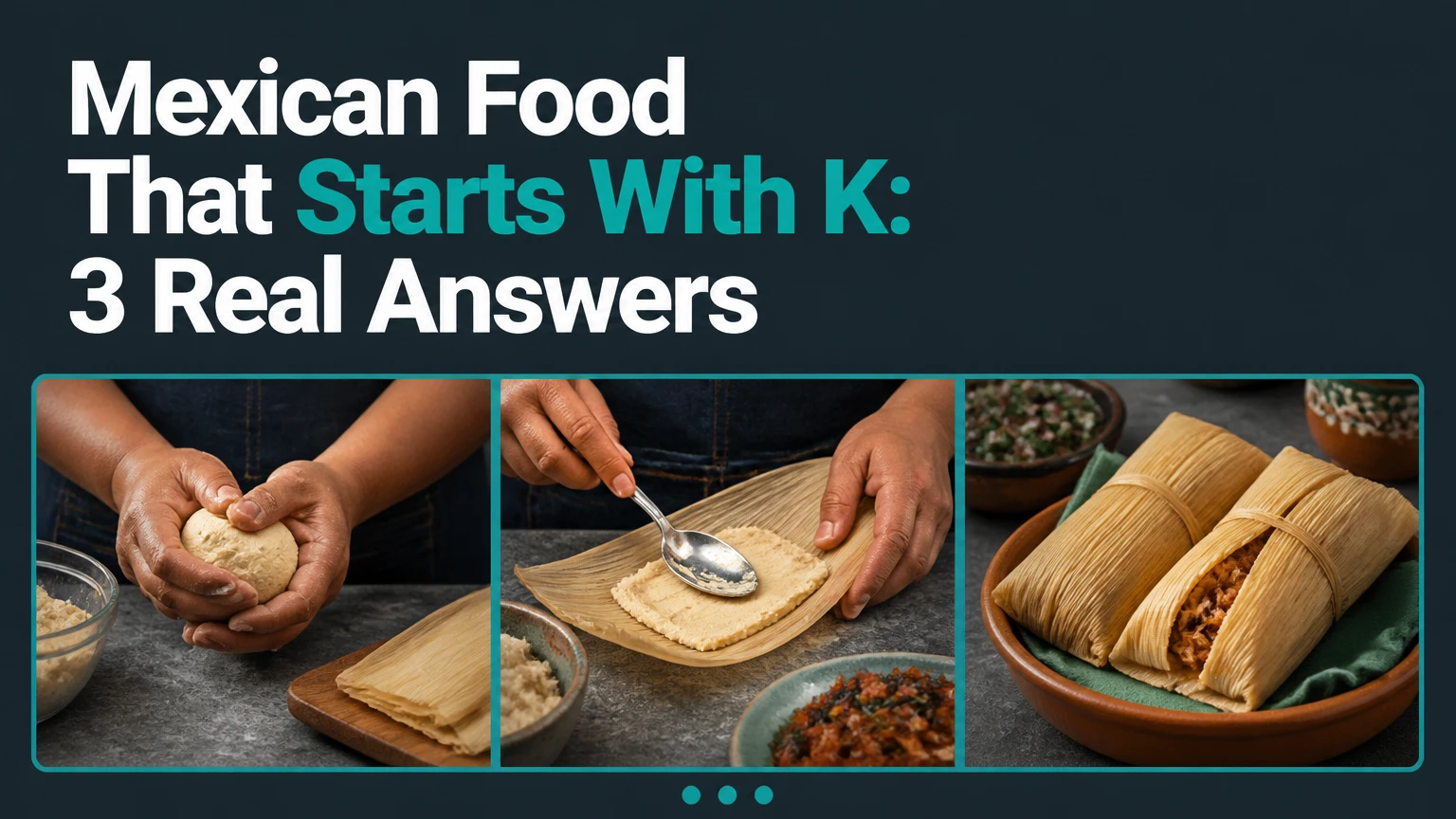
The most recognizable Mexican food or beverage names beginning with K are Kahlúa, keto Mexican food, and Kiri or Quiri. Kahlúa is a Mexican-origin coffee beverage, keto Mexican food is a modern low-carbohydrate adaptation, and Kiri is a rare regional fruit beverage associated with Jerez, Zacatecas. None is a universally recognized traditional Mexican dish.
Key Facts at a Glance
Kahlúa originated in Veracruz, Mexico, in 1936, and is a sweet coffee-based adult beverage rather than a meal.
Keto Mexican food is a dietary adaptation, usually replacing corn tortillas, flour tortillas, rice, or beans with lower-carbohydrate alternatives.
Kiri and Quiri are regional spellings associated with Jerez de García Salinas, Zacatecas, but recipes and availability are not standardized nationally.
The letter K is uncommon in inherited Mexican food vocabulary, so many K results come from commercial names, foreign loanwords, or contemporary diet terminology.
A cheese-shell taco typically contains fewer carbohydrates than a corn-tortilla taco, but it has a different texture, higher fat content, and more dairy.
Kahlúa product strength, sugar, calories, and pricing vary by market, so the bottle label is more reliable than a generic online figure.
What Mexican Food Starts With K?
The strongest answers are Kahlúa, keto Mexican food, and Kiri or Quiri, although they do not belong to the same culinary category. Kahlúa is a branded Mexican-origin beverage, keto Mexican food describes a low-carbohydrate cooking style, and Kiri is a highly regional fruit-based drink whose name and recipe may vary.
Traditional Mexican culinary vocabulary contains relatively few native words beginning with K because Spanish itself historically used C, not K, for many sounds now represented by K in other languages. Mexican Spanish does use K in imported terms, personal names, brands, and modern commercial language. That explains why a letter-based food list produces unusual results.
The query also creates a classification problem. “Food” may mean any edible or drinkable item, but a strict dish list would exclude Kahlúa and Kiri. A careful answer should therefore label each result instead of presenting three unrelated items as equivalent entrées.
Why Are K Entries Unusual in Mexican Cuisine?
K entries are unusual because the letter K usually signals a loanword, brand name, regional spelling, or modern label rather than an old Indigenous or Spanish dish name. Common Mexican foods such as caldo, camote, chayote, enchiladas, pozole, tamales, and tortillas do not qualify alphabetically, even though they are more established culinary references.
| Name | Category | Mexican connection | Strict food-list status |
|---|---|---|---|
| Kahlúa | Branded coffee beverage | Origin associated with Veracruz | Beverage, not dish |
| Keto Mexican food | Dietary cooking style | Uses Mexican flavors and recipes | Adaptation, not single food |
| Kiri or Quiri | Regional fruit beverage | Associated with Jerez, Zacatecas | Local beverage name |
| Kabob | Grilled dish format | May appear at fusion restaurants | Not traditionally Mexican |
| Kimchi | Fermented vegetable dish | Korean culinary origin | Not Mexican |
| Katsu | Breaded cutlet style | Japanese culinary origin | Not Mexican |
Is Kahlúa Mexican Food?
Kahlúa is not Mexican food in the narrow sense of a prepared dish, but it is a Mexican-origin coffee beverage associated with Veracruz. The brand’s official history places its creation in Mexico in 1936, and its familiar flavor profile combines coffee, sweetness, and vanilla-like notes.
Kahlúa belongs in a broad answer because many alphabet food searches include beverages and branded culinary products. It should not, however, be described as a traditional Indigenous recipe or as a representative meal from Veracruz. The distinction matters for cultural accuracy.
Kahlúa is commonly used in mixed beverages, coffee service, and desserts. Its sweetness means that a small measured portion can change the sugar content of an otherwise moderate recipe. Anyone tracking carbohydrates, calories, or dietary restrictions should consult the specific bottle because formulations differ across markets and product lines.
What Is Kahlúa Made From?
Kahlúa’s recognizable profile comes from coffee, sweetener, and a cane-based distilled component, with vanilla contributing aromatic depth. The exact recipe, production details, and nutrition figures are commercial specifications, so claims about roasting level, resting time, or ingredient percentages should not be generalized across every bottle.
The Kahlúa brand identifies Mexico as its origin and connects the product with coffee-growing regions. Veracruz is especially important to the brand story because the state has a long coffee-growing history, although a product’s country of origin does not mean every ingredient comes from one locality.
A practical serving is usually measured in millilitres rather than poured freely. Typical retail listings place a 30 ml serving near 90 calories, but sugar and energy values can change by market. Treat those figures as reference points, not universal nutrition data.
| Kahlúa attribute | Typical reference | Why it matters |
|---|---|---|
| Origin | Veracruz, Mexico | Establishes Mexican provenance |
| Brand creation date | 1936 | Appears in official brand history |
| Common serving | 30 ml | Useful for nutrition and recipe scaling |
| Typical energy | About 90 calories per 30 ml | Verify the local label |
| Typical retail price | USD $20-$35 per 750 ml | Varies by country and taxes |
| Main flavor | Coffee and sweet vanilla notes | Works best with cream, chocolate, or ice |
Which Kahlúa Version Fits Each Use?
Kahlúa Original is the general-purpose choice for coffee service and classic dessert recipes, while stronger or flavored versions are better selected according to the recipe rather than their marketing name. Product availability differs by country, so the bottle label should determine strength, sugar, and serving information.
| Product type | Typical flavor | Typical strength range | Best practical use |
|---|---|---|---|
| Original | Sweet roasted coffee | About 16%-20% | Coffee, cream-based mixes, desserts |
| Higher-strength version | More concentrated coffee | Around 30%-35% in some markets | Small servings and stronger mixes |
| Vanilla flavor | Coffee with vanilla | Market-dependent | Ice cream and baked desserts |
| Salted caramel flavor | Coffee, caramel, salt | Market-dependent | Chocolate desserts and chilled coffee |
| Chili chocolate flavor | Cocoa, spice, coffee | Market-dependent | Spiced dessert applications |
A common mistake is assuming that “Especial” has identical specifications everywhere. Retailers and regional labels may use different product names, strengths, or availability rules. Check the front and back labels before substituting one version for another.
How Should Kahlúa Be Stored?
An unopened Kahlúa bottle is generally best kept upright in a cool, dark cupboard, while opened-bottle quality depends on storage conditions and the product’s formulation. Refrigeration is not always required, but heat, sunlight, and repeated temperature changes can damage flavor and appearance.
Avoid storing the bottle in a freezer. The lower strength and high sugar content can produce a thick texture or partial freezing, making accurate pouring difficult. Discard the contents if the smell changes sharply, visible mold appears, or the liquid develops an unexplained separation that does not resolve after gentle movement.
What Is Keto Mexican Food?
Keto Mexican food is a modern low-carbohydrate adaptation of Mexican-style meals, not a separate traditional regional cuisine. The approach keeps ingredients such as grilled meat, eggs, seafood, cheese, avocado, salsa, cilantro, lime, and chile while reducing tortillas, rice, beans, sweetened sauces, and other carbohydrate-dense staples.
A keto label describes a nutrition strategy, not an authenticity ranking. A cheese-shell taco may fit a person’s carbohydrate target, but it does not recreate the elasticity, aroma, or toasted-corn flavor of a nixtamalized tortilla. The best choice depends on whether the priority is carbohydrate control, traditional texture, convenience, or dairy avoidance.
People following medically prescribed diets should calculate the complete meal rather than assume every Mexican ingredient is low in carbohydrates. Refried beans, corn, flour, rice, sweet corn, sweet sauces, and large portions of onion or tomato can materially change the total.
Which Ingredients Replace Tortillas and Rice?
Keto Mexican cooking commonly replaces tortillas with lettuce leaves, cheese shells, egg-based wraps, or commercially produced low-carbohydrate tortillas. Cauliflower rice, sautéed cabbage, zucchini, and shredded lettuce can replace rice or provide bulk, but each substitute changes texture and moisture.
| Traditional component | Lower-carbohydrate substitute | Typical portion | Main trade-off |
|---|---|---|---|
| Corn tortilla | Cheese shell | 20-30 g cheese | Crisp and rich, not pliable |
| Flour tortilla | Egg wrap | 1 large wrap | Softer, more fragile |
| White rice | Cauliflower rice | 150 g cooked | Less starchy and more moist |
| Tortilla chips | Baked cheese crisps | 25-30 g cheese | Higher fat and dairy |
| Refried beans | Seasoned mushrooms | 100-150 g | Less creamy and less filling |
| Rice bowl base | Shredded cabbage | 100-150 g | Crunchier and lighter |
Net carbohydrates are calculated by subtracting fibre from total carbohydrates, but labels and serving sizes vary. A meal advertised as under 5 grams of net carbohydrates can exceed that amount when salsa, dairy, avocado, and sweetened seasoning are added.
How Do You Make Cheese-Shell Keto Tacos?
To make cheese-shell keto tacos, bake or pan-cook 20-30 grams of shredded cheese in a 10-12 cm circle, remove it when the edges turn light golden, and shape it over a utensil for 30-60 seconds. The decisive factor is removing the cheese before it becomes dark and bitter.
- Heat the cooking surface. Set a non-stick skillet to medium-low or heat an oven to about 190°C.
- Form the shell. Place one measured portion of shredded Monterey Jack, cheddar, or a blend into a thin circle.
- Cook the cheese. Continue for about 2-4 minutes, until the centre bubbles and the edge lightly browns.
- Drain briefly. Transfer the cheese to a paper-lined plate for 10-15 seconds.
- Shape immediately. Drape it over a rolling pin, wooden spoon handle, or taco mould.
- Cool completely. Allow 30-60 seconds for the shell to firm before filling.
The shell worked when it holds a curved shape without collapsing under a modest filling. The most frequent failure is overcooking, which creates a bitter flavour and a brittle shell. Use less filling than for a corn tortilla because melted cheese breaks under excess moisture.
What Fillings Work Best in Keto Mexican Meals?
Keto-compatible fillings usually combine a protein, a non-starchy vegetable, a measured fat source, and a salsa without added sugar. Grilled chicken, beef, eggs, shrimp, mushrooms, avocado, cabbage, cucumber, and leafy herbs offer more control than prepared fillings with unknown thickeners.
| Filling | Typical portion | Approximate carbohydrate concern | Best shell pairing |
|---|---|---|---|
| Grilled chicken | 100-150 g | Minimal before sauce | Cheese shell or lettuce |
| Scrambled eggs | 2 large eggs | Low, excluding additions | Egg wrap |
| Sautéed shrimp | 120 g | Low, excluding glaze | Lettuce cup |
| Mushrooms with chile | 120 g | Moderate from vegetables | Cheese shell |
| Avocado | 50 g | Fibre-containing, portion-sensitive | Lettuce cup |
| Fresh salsa | 30-45 g | Tomato and onion add carbohydrates | Any substitute |
Keto Mexican food is not automatically healthier. Cheese shells may reduce starch while increasing saturated fat and sodium, and restaurant sauces may contain sugar. Portion control remains necessary.
What Is Kiri or Quiri?
Kiri, sometimes written Quiri, is reported as a highly regional fruit-based beverage associated with Jerez de García Salinas in Zacatecas. The name, spelling, fruit choice, sweetener, and preparation can vary by household or local seller, so Kiri should not be presented as a nationally standardized Mexican recipe.
Descriptions commonly connect Kiri or Quiri with crushed or macerated fruit such as peach or quince, a sweetener such as piloncillo, and a local cane-based fermented beverage. Because published culinary documentation is limited, claims about a universal formula, exact strength, fixed aging period, or standard market price are unreliable.
That uncertainty is part of the answer. A traveller may encounter the term in Jerez while finding no bottle or menu item under the same name elsewhere in Mexico. Asking the vendor which fruit and preparation were used is more reliable than relying on a single spelling.
Where Is Kiri Served?
Kiri is most plausibly encountered in Jerez and nearby parts of Zacatecas, particularly through local festivals, household preparation, or small regional markets. It is difficult to source internationally because it lacks the distribution system, standardized packaging, and broad recognition associated with national Mexican products.
| Kiri attribute | Reported range or description | Confidence note |
|---|---|---|
| Main location | Jerez de García Salinas, Zacatecas | Strong regional association |
| Alternative spelling | Quiri | Local usage may differ |
| Fruit examples | Peach or quince | Recipe varies |
| Sweetener | Piloncillo or honey | Household-dependent |
| Preparation | Fruit maceration or infusion | Not nationally standardized |
| Availability | Local and seasonal | Rare outside Zacatecas |
Kiri is therefore best treated as a regional cultural lead, not a guaranteed restaurant order. Visitors should ask whether the drink is freshly made, what fruit it contains, and how it has been stored.
How Do the K Mexican Food Answers Compare?
Kahlúa is easiest to source, keto Mexican food is easiest to prepare, and Kiri or Quiri offers the strongest regional discovery value. The three answers differ in kind: one is a branded beverage, one is a dietary framework, and one is a local beverage name.
| Option | Category | Typical access | Typical preparation | Main flavor or function |
|---|---|---|---|---|
| Kahlúa | Branded coffee beverage | International retailers | Ready to serve | Sweet coffee |
| Keto tacos | Adapted main meal | Home kitchens and restaurants | 15-30 minutes | Savoury, spicy, rich |
| Keto bowl | Adapted main meal | Home kitchens and restaurants | 20-35 minutes | Fresh, savoury, filling |
| Kiri or Quiri | Regional fruit beverage | Mainly Jerez and Zacatecas | Variable, often advance preparation | Fruity and sweet |
| Cheese crisps with salsa | Adapted snack | Easy to make at home | 10-15 minutes | Crisp, salty, spicy |
Which K Entry Is Most Authentic?
Kiri or Quiri has the strongest claim to regional Mexican cultural identity, Kahlúa has the clearest documented Mexican commercial origin, and keto Mexican food has the weakest claim to traditional authenticity because it is a modern dietary adaptation.
“Authentic” needs a defined standard. If the standard is a locally associated tradition, Kiri ranks highest. If the standard is a widely documented Mexican-origin product, Kahlúa is easier to verify. If the standard is a traditional meal structure, none of the three is as representative as tacos, mole, pozole, or tamales.
What Should You Choose?
Choose Kahlúa when the search is really about a Mexican-origin coffee beverage, choose keto Mexican food when carbohydrate reduction controls the decision, and seek Kiri or Quiri when regional travel and local food history matter most. Do not substitute any of these for a traditional Mexican dish without explaining the category.
| User situation | Best choice | Reason | Important limitation |
|---|---|---|---|
| Alphabet food activity | Kahlúa | Recognizable K name | Beverage, not meal |
| Low-carbohydrate dinner | Keto taco or bowl | Flexible ingredients and portions | Texture differs from tortillas |
| Regional food travel | Kiri or Quiri | Strong Zacatecas connection | Difficult to verify elsewhere |
| Dessert preparation | Kahlúa coffee flavour | Pairs with chocolate and cream | Sugar varies by product |
| Dairy-free meal | Lettuce-wrap keto bowl | Avoids cheese shells | Requires careful sauce selection |
| Traditional Mexican cuisine study | None of the three | They do not represent core dish categories | Choose a wider dish list |
What Is the Safest Interpretation of the Query?
The safest interpretation is that the searcher wants a Mexican-associated edible item beginning with K, not necessarily a canonical dish. Present Kahlúa, keto Mexican food, and Kiri or Quiri with category labels, then explain that the letter constraint produces fewer traditional examples than letters such as C, T, E, or P.
Common Errors With K Mexican Food Searches
The most common error is treating every K result as a traditional dish. Search lists often merge brands, diets, regional beverages, and foreign foods because alphabetical queries reward word matching rather than culinary classification.
- Calling keto Mexican food a traditional cuisine: Label it as a contemporary adaptation.
- Calling Kahlúa a dish: Describe it as a Mexican-origin coffee beverage.
- Treating Kiri and Quiri as identical everywhere: Confirm the local spelling and recipe.
- Using generic nutrition figures: Check the exact product label and serving size.
- Assuming every salsa is keto: Inspect added sugar, fruit, corn, and thickening ingredients.
- Overfilling cheese shells: Keep fillings drier and smaller than tortilla-taco portions.
- Using damaged fruit for regional drinks: Freshness and clean equipment matter more than a claimed aging period.
- Confusing Mexican-inspired food with Mexican cuisine: Identify the dish’s actual origin and adaptation history.
A useful practitioner rule is to classify first and rank second. Alphabetical relevance does not prove culinary importance.
Frequently Asked Questions
Are there any traditional Mexican dishes that begin with K?
Very few nationally recognized traditional Mexican dishes begin with K in English or Spanish. Kahlúa is a Mexican-origin branded beverage, while Kiri or Quiri is a regional name with limited documentation. Most famous Mexican dishes use other initial letters, including tacos, tamales, quesadillas, enchiladas, mole, pozole, and chilaquiles.
Is Kahlúa made in Mexico?
Kahlúa is historically associated with Mexico, and the brand identifies Veracruz as part of its origin story. Current manufacturing, ingredient sourcing, and product specifications can vary by market, so a bottle label provides the most precise information for the country of production, strength, ingredients, and nutrition.
Is keto Mexican food low in carbohydrates?
Keto Mexican food can be low in carbohydrates when tortillas, rice, beans, sweetened sauces, and sugary drinks are limited. The final amount depends on portions and ingredients. A cheese-shell taco may reduce starch but often increases fat, sodium, and dairy compared with a corn-tortilla taco.
How do you spell the regional Kiri beverage?
The regional beverage may appear as Kiri or Quiri, depending on the source or local usage. Because the name is not nationally standardized, confirm the spelling with the seller or community describing it. Fruit, sweetener, preparation, and availability may also differ between households.
Can children eat foods listed under K?
Keto tacos and other low-carbohydrate meal adaptations can be served to children when they contain balanced ingredients and are not used to impose an unsuitable restrictive diet. Kahlúa and similar adult beverages are not appropriate for children. Kiri recipes also require ingredient and preparation checks before serving.
What should I search for if I want real Mexican dishes instead?
Search by dish category rather than forcing the letter K. Useful searches include Mexican corn dishes, Mexican soups, regional Zacatecan food, Veracruz coffee traditions, Mexican breakfast dishes, and traditional Mexican street food. Those queries produce more representative results than an alphabet-only list.
Conclusion
The best answer to mexican food that starts with k is a qualified list: Kahlúa is a Mexican-origin coffee beverage, keto Mexican food is a modern low-carbohydrate adaptation, and Kiri or Quiri is a rare regional fruit beverage linked with Zacatecas. None is a standard traditional Mexican dish, so category labels are essential for an accurate answer.