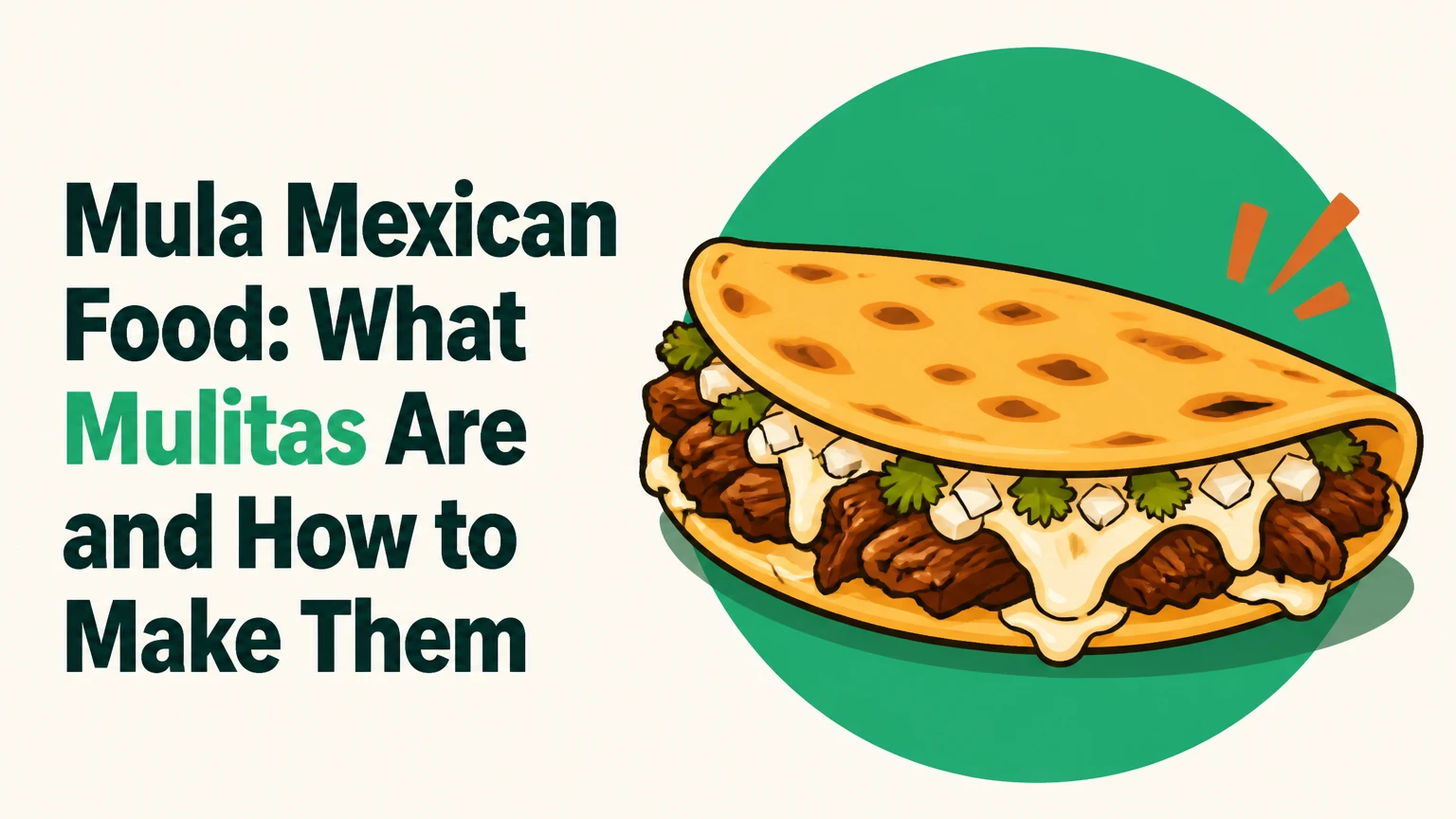
Mula Mexican food usually refers to a mulita, a Mexican tortilla sandwich made with two tortillas, melted cheese, and a cooked filling such as carne asada, al pastor, birria, or chicken. The tortillas are griddled until crisp while the cheese binds the filling, and fresh salsa, onion, cilantro, guacamole, and lime are usually added after cooking.
Key Facts at a Glance
- A mulita uses two tortillas with cheese and filling between them.
- “Mulita” means “little mule,” while “mulitas” is the common plural form.
- Tijuana-style taquerías commonly prepare mulitas with grilled meat and corn tortillas.
- Queso Oaxaca, queso Chihuahua, Monterey Jack, and low-moisture mozzarella all melt effectively.
- A home-cooked mulita typically takes 15-25 minutes, including ingredient preparation.
- A typical individual mulita contains approximately 350-550 calories, depending on tortilla size, cheese, meat, and cooking fat.
What Is Mula Mexican Food?
Mula Mexican food is a crisp, cheese-filled tortilla sandwich commonly called a mulita in English-language menus and mulitas when ordering more than one. The basic construction combines two corn tortillas, a layer of melting cheese, a cooked filling, and another layer of cheese before the sandwich is toasted on a comal or skillet.
The dish is strongly associated with northern Mexican street-food traditions and Tijuana taquerías, although restaurants in Mexico and the United States use the name somewhat differently. Some vendors use small corn tortillas, while others use larger tortillas; some include cheese on both sides of the filling, while others make a simpler cheese-and-meat sandwich.
The name does not guarantee one fixed recipe. A restaurant may call a birria-filled version a mulita, while another may reserve the term for grilled steak. The defining feature is the two-tortilla, griddled sandwich structure.
What Does “Mulita” Mean?
“Mulita” is commonly translated as “little mule,” and “mulitas” is its plural. The food name refers to the compact, load-bearing shape of the sandwich, although the exact historical explanation varies by source and region.
The Four Structural Layers
| Layer | Typical ingredient | Function | Common quantity |
|---|---|---|---|
| Bottom shell | 1 corn tortilla | Crisp outer base | 4-6 inches |
| First binder | Oaxaca or Jack cheese | Anchors the filling | 20-30 g |
| Center filling | Chopped steak or shredded meat | Provides flavor and substance | 60-90 g |
| Top shell | 1 corn tortilla | Creates the sandwich lid | 4-6 inches |
Fresh toppings usually belong on the plate rather than inside the cooking stack. Watery salsa and guacamole soften the tortillas quickly, particularly when the mulita sits for more than five minutes.
How Does a Mulita Become Crisp?
A mulita becomes crisp when moderate heat drives surface moisture from the tortillas while a small amount of oil, lard, or rendered meat fat promotes browning. Medium or medium-low heat, roughly 325-375°F on a surface thermometer, gives the cheese time to melt before the corn starches burn.
The tortilla should contact the hot cooking surface directly. A light coating of fat creates browned blisters, but excessive fat can make the sandwich greasy and prevent an even crust. A heavy spatula press improves contact, yet pressing too hard can force cheese and juices out through the edges.
Cheese placement also controls texture. Cheese on both interior tortilla faces creates a seal around the filling, while keeping wet garnishes outside prevents steam and liquid from weakening the crust.
Comal, Skillet, or Griddle?
| Cooking surface | Best use | Heat behavior | Typical batch |
|---|---|---|---|
| Carbon-steel comal | Traditional stovetop cooking | Heats quickly, needs seasoning | 2-4 mulitas |
| Cast-iron skillet | Home cooking | Holds steady heat | 1-2 mulitas |
| Electric griddle | Family batches | Broad, adjustable surface | 4-6 mulitas |
| Outdoor flat-top | Taquería-style service | High recovery between orders | 6 or more |
A cast-iron skillet is the most forgiving home option because its heat remains stable after cold tortillas and filling are added. Preheat for 4-6 minutes, then reduce the burner if the first tortilla darkens before the cheese softens.
Which Fillings Work Best?
Carne asada is the classic practical choice because finely chopped grilled steak has a relatively dry surface and strong savory flavor. Birria produces the richest result, but its broth and rendered fat require extra draining or the tortilla can become soft before the cheese melts.
| Filling | Preparation | Flavor profile | Moisture control |
|---|---|---|---|
| Carne asada | Chop grilled steak into 0.5-inch pieces | Charred, citrus-seasoned | Drain juices before assembly |
| Al pastor | Chop cooked chile-marinated sliced meat | Savory, mildly sweet | Use browned pieces, not excess marinade |
| Birria | Shred braised beef or goat | Rich, chile-forward | Drain meat; use broth for dipping |
| Chicken | Grill or shred thigh or breast | Mild, adaptable | Avoid watery sauce inside |
| Mushrooms and beans | Sauté mushrooms; use drained beans | Earthy, savory | Cook mushrooms until liquid evaporates |
For a reliable home version, use 60-90 grams of filling per 4-6-inch tortilla pair. More filling makes flipping difficult and traps steam in the center.
Cheese Selection
Queso Oaxaca melts into long strands and has a mild dairy flavor. Queso Chihuahua melts smoothly with a slightly fuller taste. Monterey Jack is the easiest supermarket substitute, while low-moisture mozzarella adds stretch but less traditional flavor.
| Cheese | Melt behavior | Moisture level | Practical role |
|---|---|---|---|
| Queso Oaxaca | Stretchy, even melt | Moderate | Traditional-style choice |
| Queso Chihuahua | Smooth, cohesive melt | Moderate | Richer Mexican option |
| Monterey Jack | Fast, creamy melt | Moderate | Accessible substitute |
| Low-moisture mozzarella | Very stretchy | Low | Useful blend component |
| Aged cheddar | Strong flavor, oily when overheated | Low | Blend at 25-40% maximum |
A blend of 60% Monterey Jack and 40% low-moisture mozzarella gives good coverage and stretch. Avoid fresh mozzarella because its water content can steam the tortillas.
How to Make Mulitas at Home
This home method produces two crisp mulitas in about 20 minutes, including preparation, with approximately 10-12 minutes of active cooking. The most important success factor is controlling moisture: cooked filling should be warm and relatively dry, while salsa and guacamole should be served separately.
Before You Start
| Requirement | Typical specification |
|---|---|
| Yield | 2 individual mulitas |
| Total time | 15-25 minutes |
| Active cooking | 8-10 minutes |
| Equipment | 10-inch skillet or flat griddle |
| Tortillas | 4 corn tortillas, 4-6 inches |
| Cheese | 80-120 g shredded or pulled |
| Filling | 120-180 g cooked meat or vegetables |
| Fat | 1-2 teaspoons oil or lard |
Step 1: Prepare the Filling
Chop or shred the cooked filling into pieces no larger than 0.5 inch. Warm 120-180 grams in a dry skillet until surface moisture evaporates, then remove excess liquid before assembly.
You will know the filling is ready when it is hot but not wet enough to leave a puddle in the pan. The common mistake is using meat directly from broth or salsa without draining it.
Step 2: Warm the Tortillas
Heat the skillet over medium for 4-6 minutes. Warm each tortilla for 10-15 seconds per side, then keep them covered with a clean towel so they remain flexible.
Flexible tortillas bend without splitting when the sandwich is moved. Cold tortillas often crack at the edge, while overheated tortillas become brittle before the filling is added.
Step 3: Build the First Mulita
Add 0.5 teaspoon oil or lard to the skillet. Place one tortilla down, scatter 20-30 grams of cheese over it, add 60-90 grams of filling, then add another 20-30 grams of cheese before placing the second tortilla on top.
Keep the filling at least 0.5 inch from the tortilla edge. The exposed border gives melted cheese room to seal the sandwich instead of spilling onto the pan.
Step 4: Griddle Until the Base Browns
Cook the assembled mulita for 2-3 minutes without moving it. Press gently with a spatula for 5-10 seconds at a time until the underside develops golden spots and the lower cheese layer begins to melt.
The base is ready when the tortilla slides as one piece and feels firmer than a soft taco. A blackened surface indicates excessive heat, not better crispness.
Step 5: Flip and Finish
Slide a wide spatula underneath the center and turn the mulita in one controlled motion. Cook the second side for another 2-3 minutes, adding a few drops of oil only if the pan is dry.
The finished sandwich should have a crisp exterior and fully softened cheese at the center. If the tortillas brown while the cheese remains firm, lower the heat and cover the skillet for 20-30 seconds.
Step 6: Garnish and Serve
Transfer the mulita to a board and rest it for 30-60 seconds. Cut it into halves or quarters, then add chopped onion, cilantro, salsa, guacamole, and lime at the table.
Resting briefly lets the cheese stabilize without allowing the crust to steam for long. Serve immediately for maximum contrast between the brittle tortilla and soft filling.
How Much Does a Mulita Cost?
A typical taquería mulita costs approximately $3.50-$7 in the United States, while ingredient cost for a home-cooked version commonly falls near $1.50-$3.50 per serving before labor. Price changes most with the filling, local rent, tortilla size, imported cheese, and whether a plate includes sides.
| Setting | Typical price | Typical size | Usually included |
|---|---|---|---|
| Mexican street stand | $3.50-$5.50 | 4-5 inches | Salsa and lime |
| Neighborhood taquería | $5-$9 | 5-7 inches | Salsa, onion, cilantro |
| Birria-focused restaurant | $7-$13 | 5-7 inches | Consomé dip |
| Home preparation | $1.50-$3.50 ingredient cost | 4-6 inches | Toppings priced separately |
Calorie estimates also vary widely. A small cheese-and-chicken mulita may contain about 350-450 calories, while a large steak or birria version cooked with fat can reach 550-750 calories.
Mula Versus Quesadilla, Vampiro, and Taco
A mulita is a two-tortilla sandwich, a quesadilla is usually folded, a vampiro uses a crisp open tortilla base, and a taco normally leaves the filling exposed between one folded tortilla. Restaurant terminology varies, so structure is more reliable than the menu name.
| Food | Tortilla structure | Cheese position | Typical texture | Common filling |
|---|---|---|---|---|
| Mulita | Two tortillas, stacked | Inside on both sides | Crisp outside, soft center | Asada or birria |
| Quesadilla | One tortilla, folded | Inside the fold | Soft to toasted | Cheese, mushroom, meat |
| Vampiro | One crisp tortilla | Melted on top | Hard, toasted base | Grilled meat |
| Taco | One tortilla, folded or open | Optional | Soft or lightly charred | Meat, fish, vegetables |
| Tostada | One flat fried tortilla | Usually under toppings | Rigid and crunchy | Beans, seafood, meat |
Which Option Is Best for Each Situation?
| Situation | Best choice | Reason | Main limitation |
|---|---|---|---|
| Walking while eating | Mulita | Closed structure limits spills | Can feel heavy |
| Maximum fresh toppings | Taco | Open surface holds garnish | Less structural stability |
| Extra crunch without a sandwich | Vampiro | Toasted base stays rigid | Toppings remain exposed |
| Simple cheese preparation | Quesadilla | Fewer layers and faster assembly | Less filling capacity |
| Brothy shredded filling | Mulita | Cheese and tortillas contain meat | Requires moisture control |
A mulita is usually the better choice when a diner wants a crisp, filling handheld meal. A taco is better when fresh salsa, herbs, and texture contrast matter more than a sealed exterior.
How to Order a Mulita
Order by naming the filling first, then specify the number of mulitas and any toppings you want separately. “Una mulita de asada, con cebolla y cilantro” requests one steak mulita with onion and cilantro, while “con salsa aparte” asks for salsa on the side.
At a taquería, ask whether the dish uses corn or flour tortillas, which cheese is available, and whether birria meat is dipped in rendered cooking juices before grilling. These details affect texture and richness more than the menu label.
A typical order includes salsa, lime, onion, and cilantro, but guacamole may cost extra. For a first visit, one mulita plus one taco gives a better comparison than ordering several rich sandwiches.
Dietary and Ingredient Considerations
Traditional-style mulitas made with certified 100% corn tortillas can fit a gluten-free diet, but diners must verify fillings, seasoning blends, shared cooking surfaces, and cheese additives. A restaurant that also grills flour tortillas may have cross-contact even when the tortilla itself contains no wheat.
For a vegetarian version, combine sautéed mushrooms, drained beans, roasted peppers, and Oaxaca-style cheese. For a dairy-free version, omit cheese and use a well-drained bean and vegetable filling, although the result loses the binding function that normally holds the sandwich together.
Lower-fat preparation uses lean chicken, less cheese, and a lightly oiled nonstick skillet. The tortilla will still crisp, but it may develop fewer browned blisters than one cooked with a small amount of lard or oil.
Common Problems and Fixes
| Problem | Likely cause | Immediate fix | Prevention |
|---|---|---|---|
| Soggy tortilla | Wet filling or garnish inside | Regriddle uncovered | Drain meat and serve toppings outside |
| Cracked tortilla | Cold, dry tortilla | Warm 10-15 seconds per side | Keep tortillas covered |
| Burned shell | Heat above medium | Lower heat; use fresh tortillas | Preheat, then cook steadily |
| Firm cheese center | Thick filling or low heat | Cover 20-30 seconds | Use 40-60 g cheese total |
| Filling spills out | Overfilled sandwich | Remove excess before flipping | Keep filling 0.5 inch from edge |
| Greasy crust | Too much fat | Rest on a rack briefly | Use 0.5 teaspoon per sandwich |
The counterintuitive rule is that a wetter birria filling often needs less cooking fat, not more. The broth already supplies moisture and flavor, while additional fat can turn the tortilla soft at the edges before the center is hot.
Storage and Reheating
Refrigerate cooked mulitas within two hours in a shallow container and eat them within three to four days. Reheat them in a dry skillet over medium-low heat for 2-3 minutes per side, or in a 375°F oven for 8-12 minutes.
An air fryer at 375°F for 4-6 minutes can restore exterior crispness effectively, but microwaving alone makes corn tortillas leathery because trapped steam cannot escape. Add fresh salsa and guacamole only after reheating.
The Bottom Line
Mula Mexican food is best understood as a crisp, two-tortilla sandwich built around melted cheese and a cooked filling. Mulitas reward dry, finely chopped ingredients, moderate griddle heat, and fresh toppings added after cooking; they are less suitable for very wet fillings or long holding times.
For the most dependable home result, use two 4-6-inch corn tortillas, 40-60 grams of melting cheese, 60-90 grams of drained filling, and 2-3 minutes of cooking per side. Choose carne asada for a classic grilled profile, birria for richness, or mushrooms and beans for a meat-free alternative.
Frequently Asked Questions
Are mulitas the same as tacos?
Mulitas and tacos share tortillas and common fillings, but their structures differ. A taco usually has one tortilla folded around an exposed filling, while a mulita places cheese and filling between two tortillas and grills the entire sandwich. A mulita therefore has a crisper, more sealed exterior and greater cheese coverage.
Can I make a mulita with flour tortillas?
Yes, although corn tortillas are more common in many Tijuana-style preparations. Flour tortillas create a softer, more flexible sandwich with less toasted corn flavor, and larger flour tortillas can hold more filling. Use medium heat because flour tortillas brown faster than thick corn tortillas.
Why are mulitas sometimes called quesadillas?
Both foods contain tortillas, cheese, and optional meat, so some restaurants use overlapping names. The practical distinction is shape: a quesadilla is generally folded from one tortilla, while a mulita uses two separate tortillas. Regional menus may ignore that distinction, making the ingredient list worth checking.
Can I use leftover roast chicken or beef?
Leftover roast chicken or beef works well when chopped finely and reheated until surface moisture disappears. Avoid meat covered in thin gravy or watery sauce unless you drain it first. Add extra seasoning only after tasting, because leftovers may already contain salt from their original preparation.
Do mulitas always contain cheese?
Most restaurant mulitas contain cheese because melted cheese binds the tortillas to the filling and defines the familiar texture. A dairy-free cook can make a tortilla-and-vegetable version, but the sandwich will be less cohesive and may require careful flipping or a lighter filling.
What salsa goes best with a mulita?
A roasted red chile salsa pairs well with steak and birria, while a bright green tomatillo salsa cuts through rich cheese and slow-cooked meat. Serve 1-2 tablespoons on the side rather than inside the sandwich. This preserves the crisp shell and lets diners control heat and acidity.