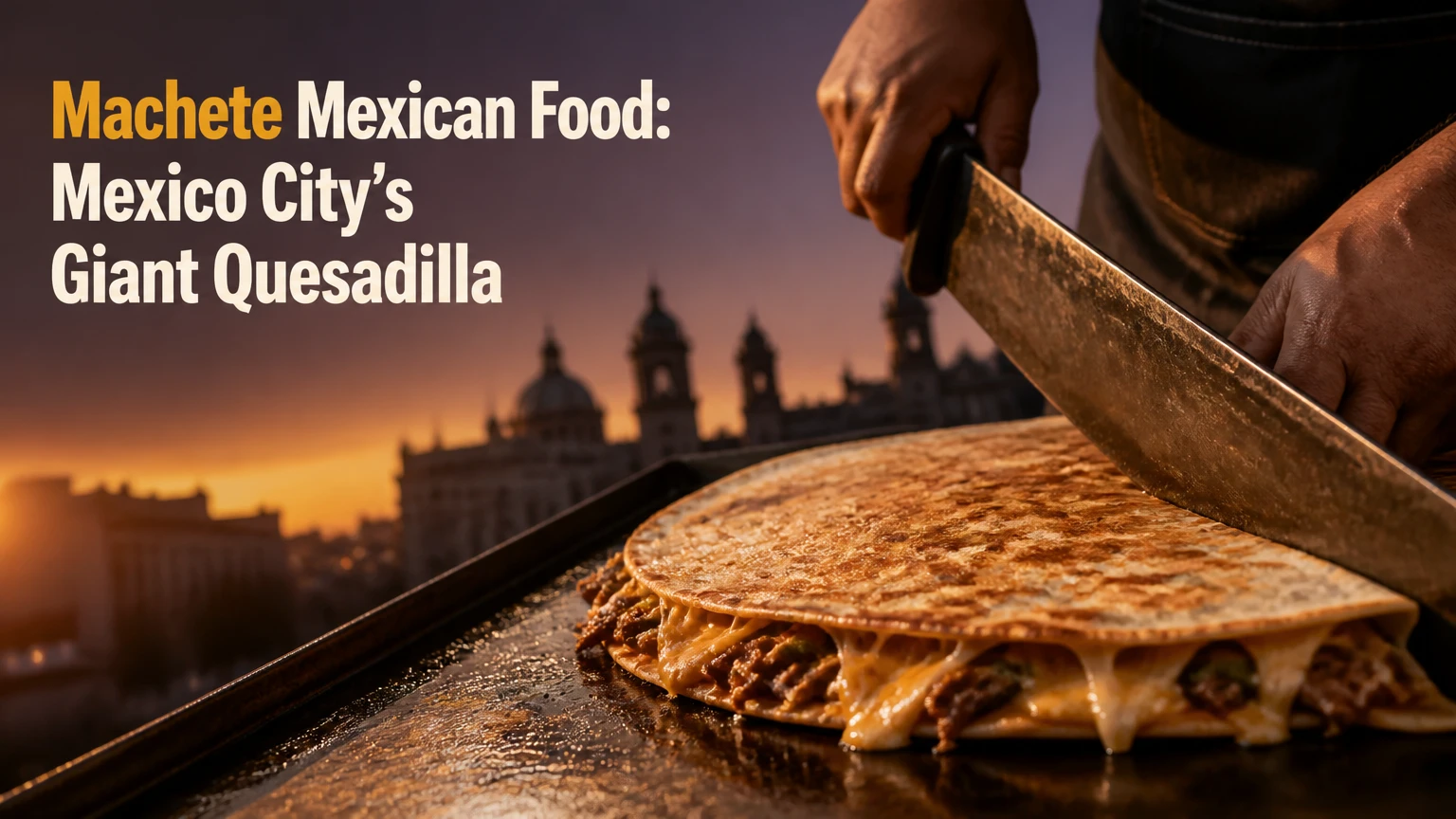
Machete Mexican food is a Mexico City street specialty made from a long, thin sheet of fresh corn masa, folded around melted cheese and savory fillings. Usually measuring about 50-70 centimeters, a machete resembles a giant quesadilla, but its raw masa is stretched or pressed before cooking rather than starting as a small, pre-cooked tortilla.
Key facts
A machete is typically 50-70 centimeters long and weighs about 500 grams to more than 1 kilogram with fillings.
The dish uses fresh nixtamalized corn masa cooked on a hot comal.
Oaxaca cheese, called quesillo in Mexico, is a common melting cheese, but fillings vary by vendor.
A machete usually feeds one very hungry adult or two moderate diners.
Typical Mexico City prices are about MXN 70-150, while international restaurant prices are often USD 15-30.
Machetes are strongly associated with Mexico City, although the exact first vendor or invention is not universally documented.
What Is a Machete in Mexican Food?
A machete is an oversized, elongated masa preparation that functions as a folded street-food meal. Vendors cook a stretched corn-masa oval or ribbon on a comal, add cheese and stewed ingredients, fold it lengthwise, and brown it until the outside is flexible, crisp, and spotted.
The name comes from the food’s long shape, which resembles a machete blade. The resemblance is visual, not culinary: a machete contains no blade-shaped ingredient and has no connection to meat-cutting tools beyond its form.
The dish is most closely linked with Mexico City’s fondas, mercados, and street stalls. Some accounts associate it with neighborhoods in the capital and particular specialist vendors, but the exact origin story differs by source. A careful description should therefore say “Mexico City specialty” rather than claim a single confirmed inventor.
A conventional quesadilla begins with a round tortilla, commonly 12-20 centimeters across. A machete begins with a much larger portion of masa, so the preparation behaves more like a thin masa ribbon folded around a filling than a scaled-up handheld taco.
Why Is It Called a Machete?
The machete’s name refers to its elongated, blade-like profile and unusually large dimensions. Most examples are long enough to require two hands, a large plate, or cutting into portions before serving.
Vendors do not follow one universal shape standard. Some produce a narrow, straight ribbon, while others make a broad oval with tapered ends. The center normally carries most of the cheese and stew, and the ends may become noticeably crispier because they contain less filling.
How Is a Machete Made?
A machete is made by hydrating fresh corn masa, shaping a large portion into a long sheet, cooking that sheet on a hot comal, adding warmed fillings, and folding it before the cheese fully melts. The decisive technical variable is masa hydration: dry dough cracks, while wet dough sticks and tears during transfer.
What Ingredients Does the Masa Need?
Traditional masa requires nixtamalized corn masa, water, and salt. A practical home quantity for one large portion is 220-300 grams of masa, 15-30 milliliters of water as needed, and approximately 1 gram of salt.
Nixtamalized masa has been treated with an alkaline solution, traditionally calcium hydroxide, then washed and ground. That process changes the corn’s aroma, improves dough handling, and contributes calcium and a characteristic tortilla flavor. Commercial masa harina can work, but it should be mixed and rested according to its package directions before shaping.
The dough should feel soft and pliable without leaving paste on the fingers. A useful test is to press a small piece between plastic sheets. If the edge shows many dry cracks, add water in 5-milliliter increments. If the dough smears onto the plastic, incorporate a small amount of masa harina or allow it to rest briefly.
What Happens on the Comal?
The masa sheet cooks first until its surface becomes opaque and the underside releases naturally. A vendor then places cheese and heated stew over the center or one side, folds the sheet lengthwise, and returns the folded machete to the comal until the cheese melts and the exterior develops brown spots.
A 5-8 minute total cook time is typical for an assembled order, though the exact time depends on masa thickness, griddle temperature, filling temperature, and queue volume. A commercial comal may be around 200-250°C at the cooking surface, but vendors judge readiness by release, browning, and sound rather than a thermometer.
The common online claim that every machete requires a specialized rectangular press is too strong. Some stalls use long presses or plastic-lined manual pressing, while others stretch the masa by hand, use a rolling pin, or press it in stages on the comal. The required feature is a sufficiently large cooking surface, not one particular tool.
What Fillings Go in a Machete?
Machete fillings range from shredded chicken and pressed crackling stew to squash blossoms, mushrooms, sausage with potatoes, and combinations of several ingredients. Quesillo is common because its stringy structure melts well, but cheese choice and filling availability depend on the vendor.
| Filling | Main ingredients | Flavor and texture | Moisture risk |
|---|---|---|---|
| Tinga de pollo | Shredded chicken, tomato, chipotle, onion | Smoky, savory, moderately juicy | Medium |
| Chicharrón prensado | Pressed crackling, guajillo sauce | Rich, dense, slightly gelatinous | Medium |
| Huitlacoche | Corn fungus, onion, epazote | Earthy, mushroom-like, soft | High |
| Flor de calabaza | Squash blossom, onion, epazote | Delicate, herbal, tender | Medium |
| Picadillo | Ground beef, potato, carrot, tomato | Savory, lightly sweet, crumbly | Medium |
| Chorizo con papas | Spiced sausage, diced potato | Salty, fatty, hearty | Low to medium |
| Mushrooms | Cultivated mushrooms, onion, herbs | Umami-rich, chewy, earthy | High |
| Refried beans | Beans, fat, salt, seasoning | Creamy, dense, stabilizing | Low |
What Is a Combinado Machete?
A combinado is a machete containing two or more fillings in one order. Vendors may allow two, three, or four selections, although a crowded filling list can make the masa difficult to fold and the flavors harder to distinguish.
Good combinations balance texture and moisture. A relatively dry filling such as chorizo con papas pairs well with a wetter preparation such as tinga, while refried beans can create a stable layer between the masa and a juicy stew. Three fillings are usually more manageable than four.
For a first order, tinga with quesillo gives a familiar balance of smoky sauce, shredded meat, and melted cheese. Huitlacoche with squash blossom provides a more vegetable-forward profile. Chicharrón prensado with a mild filling works for diners who prefer a rich, concentrated center.
| Combination | Flavor balance | Typical cheese need | Best use |
|---|---|---|---|
| Tinga and quesillo | Smoky, savory, creamy | 80-120 g | First tasting |
| Chorizo and potatoes | Spiced, salty, hearty | 70-100 g | Very hungry diner |
| Huitlacoche and squash blossom | Earthy, herbal, delicate | 90-130 g | Vegetarian order |
| Chicharrón prensado and beans | Rich, dense, earthy | 60-90 g | Strong savory flavor |
| Tinga, mushrooms, and quesillo | Smoky, umami, creamy | 90-130 g | Mixed texture |
| Steak and chorizo | Grilled, spiced, rich | 70-110 g | Meat-heavy combinado |
How Big Is a Machete?
A typical machete is 50-70 centimeters long before or after folding, although vendors may serve smaller versions. The finished weight commonly ranges from 500 grams to more than 1 kilogram, depending on masa thickness, cheese quantity, and the number of fillings.
| Attribute | Typical value | What changes it | Practical consequence |
|---|---|---|---|
| Length | 50-70 cm | Vendor style and dough portion | Difficult to eat whole |
| Masa portion | 220-300 g | Thickness and target size | Heavier corn flavor |
| Cheese | 70-130 g | Filling choice and vendor | More stretch and richness |
| Finished weight | 500 g-1.2 kg | Masa, fillings, cheese | Often shareable |
| Comal time | 5-8 minutes | Heat and filling temperature | Queue speed varies |
| Eating time | 15-30 minutes | Size and serving method | Ends may cool first |
A large machete is not automatically better. More masa can produce dry tapered ends, while excessive cheese can leave the center greasy and difficult to lift. The best examples maintain a thin, cooked shell with enough filling to make each section substantial.
How Many People Does One Machete Feed?
One full machete generally feeds one very hungry adult or two average diners when accompanied by salsa, vegetables, or another small dish. A group should order based on the number of fillings wanted, not only the nominal length, because two shorter machetes offer more variety and stay warmer than one oversized order.
Ask the vendor to cut the machete crosswise into four or six sections when sharing. Cutting it after folding is cleaner than attempting to divide the raw masa before cooking.
How Much Does Machete Mexican Food Cost?
In Mexico, a typical machete costs about MXN 70-150, with higher prices for larger portions, premium fillings, tourist districts, or multiple meat selections. In the United States and Canada, restaurant versions commonly cost about USD 15-30 or the local equivalent because labor, rent, imported ingredients, and portion size increase the menu price.
| Market or setting | Typical price | Portion expectation | Main price driver |
|---|---|---|---|
| Mexico City neighborhood stall | MXN 70-110 | One large portion | Basic fillings |
| Mexico City specialist shop | MXN 110-150 | Large, multi-filling portion | Size and quesillo |
| Tourist-area restaurant | MXN 140-220 | Plated portion | Rent and service |
| United States restaurant | USD 15-25 | One large machete | Labor and ingredients |
| Canada restaurant | CAD 20-35 | One large machete | Imported masa and overhead |
| Delivery order | Local menu price plus fee | May arrive cut or boxed | Packaging and delivery |
Prices change frequently, so menu listings and vendor boards are more reliable than old travel articles. A low price does not necessarily mean a smaller item, because local stalls may use less cheese and simpler stews than restaurants serving international customers.
Machete vs. Quesadilla, Huarache, and Tlacoyo
A machete is the largest and most shareable of these masa-based foods, while a standard quesadilla is easier to eat and a huarache or tlacoyo provides a thicker base. The choice depends on portability, filling volume, masa thickness, and whether the food is folded or served open.
| Food | Base shape | Typical size | Serving structure | Best reason to choose |
|---|---|---|---|---|
| Machete | Long oval or ribbon | 50-70 cm | Folded over fillings | Variety and sharing |
| Quesadilla | Round tortilla | 12-20 cm | Folded | Portable individual meal |
| Huarache | Thick oval | 20-30 cm | Usually open-faced | Toppings over dense masa |
| Tlacoyo | Oval, often bean-filled | 15-20 cm | Open-faced | Strong masa and bean center |
| Gringa | Flour tortilla, round | 15-25 cm | Folded | Crisp cheese and grilled filling |
Is a Machete Just a Giant Quesadilla?
A machete is related to a quesadilla but is not simply a regular quesadilla enlarged. The masa portion, elongated shaping, cooking sequence, and filling capacity create a different eating experience, with more edge exposure and a greater contrast between crisp exterior and soft center.
Some vendors and diners use “giant quesadilla” as a practical explanation for visitors. That comparison is useful, but it hides the role of fresh masa and the dish’s street-stall presentation.
Which Alternative Is Better for Takeout?
A standard quesadilla is usually better for walking or short-distance takeout because its compact shape retains heat and needs fewer utensils. A machete suits a seated meal, group order, or destination meal where the dramatic size and multiple fillings matter more than portability.
A huarache is a better choice for diners who prefer toppings spread across the surface. A tlacoyo is more suitable when the diner wants a smaller, thicker masa item with a built-in bean filling.
How Should You Order a Machete?
Order a machete by specifying the fillings, cheese preference, salsa level, and whether the vendor should cut it for sharing. Ask which fillings are freshly heated, whether the cheese is quesillo, and whether the cooking surface uses animal fat if dietary restrictions matter.
A practical order sequence is:
- Choose one filling for a simple first tasting or two to three for a combinado.
- Request quesillo, another melting cheese, or no cheese.
- Ask for mild, medium, or hot salsa separately when heat tolerance is uncertain.
- Confirm whether the machete will be cut into sections.
- Ask for a clean cooking area if avoiding meat residue or animal fat.
- Eat the crisp ends first if the center will be shared later.
Vegetarian diners should ask about the stew, cooking fat, and shared comal rather than relying on the filling name alone. Squash blossom and mushroom fillings may be meat-free while still sharing a surface used for other preparations.
Machetes are generally made with corn masa and are naturally gluten-free when the vendor uses uncontaminated ingredients. Cross-contact can occur through flour tortillas, breaded foods, seasoning blends, or a shared work surface, so people with celiac disease should ask specific preparation questions.
What Can Go Wrong When Making a Machete?
The most common machete failures are cracked masa, sticking during transfer, wet filling, cold centers, and uneven browning. Each problem has a mechanical cause, so correction depends on changing hydration, heat, filling temperature, or handling rather than simply cooking longer.
| Failure | Likely cause | Visible symptom | Corrective action |
|---|---|---|---|
| Cracked edge | Masa too dry | Splits during pressing | Add water in 5 ml increments |
| Sticking sheet | Excess moisture or cool comal | Masa tears on release | Rest dough and raise heat |
| Soggy underside | Watery filling | Soft, damp center | Drain stew and add cheese barrier |
| Cold interior | Chilled filling overloaded | Brown shell, cool center | Warm filling before assembly |
| Burnt exterior | Heat too high or repeated flipping | Dark spots before melt | Lower heat and cover briefly |
| Broken fold | Sheet too thin or moved early | Filling escapes | Wait for natural release |
A cheese-first layer can protect the masa from wet stew, but it is not a substitute for draining the filling. Excess liquid eventually softens the shell and makes the machete difficult to lift.
The most important handling rule is to wait for the first side to release naturally. Scraping beneath partially cooked masa often creates a tear that becomes much larger when the long sheet is folded.
Can You Make a Machete at Home?
You can make a smaller home version with a comal or large griddle, plastic sheets, a rolling pin, and 220-300 grams of hydrated masa. A household 30-centimeter pan cannot reproduce the full street-stall length, so a 25-35 centimeter version is more practical and easier to flip safely.
Use moderate-high heat, divide the dough if necessary, and avoid filling all the way to the tapered edges. Warm the stew separately, keep the cheese in a thin even layer, and support both ends with wide spatulas during the fold.
Do not force a 70-centimeter version onto a small burner. Uneven heat produces a raw center and burned ends, while the oversized sheet becomes difficult to transfer without tearing.
How Should You Store and Reheat Leftovers?
Store leftover machete in a sealed container in the refrigerator within two hours of serving, then reheat it on a dry skillet or comal over medium heat for 3-5 minutes per side. A microwave softens the masa and can heat the center unevenly, so it works best only for a short covered preheat before skillet finishing.
For the best texture, separate salsa and watery toppings before refrigeration. Reheating a heavily sauced portion directly in a covered container traps steam and turns the exterior leathery.
A food thermometer should show 74°C at the center when reheating filled leftovers. Discard food left at room temperature for more than two hours, or more than one hour in very hot conditions, rather than trying to restore safety through high heat.
Where Is Machete Mexican Food Most Common?
Machetes are most strongly associated with Mexico City, especially specialty stalls and casual eateries that have enough griddle space for elongated masa. Similar oversized masa preparations may appear elsewhere, but the name, format, and vendor tradition are less standardized outside the capital.
International restaurants often adapt the dish by shortening it, serving it on a platter, adding familiar fillings, or using a standard commercial tortilla press. Those changes do not automatically make the food inauthentic, but they can alter the masa-to-filling ratio and cooking texture.
Availability is highly local. Search menus for “machete,” “machete quesadilla,” or “machetes de masa,” then inspect recent photos because restaurants may use the term for different shapes.
Expert Rules for a Better Machete
Experienced cooks follow several rules that are easy to miss in short descriptions:
- Heat the filling before assembly. A hot stew reduces the time needed to melt the cheese and prevents the shell from over-browning while the center remains cold.
- Protect the masa from liquid. Cheese, beans, or a drained filling should form a barrier, because free liquid penetrates the still-tender corn layer.
- Treat the ends as a separate texture. Tapered ends cook faster, so experienced vendors avoid overloading them and often serve them crisp.
- Use fewer fillings for better flavor. Two compatible fillings usually create a clearer result than four unrelated ingredients packed into one center.
- Support the whole length. Long food breaks under its own weight; two spatulas or a wide tray are safer than lifting from one end.
The dish is also a poor choice for fast walking, long transport, or diners who dislike rich portions. A regular quesadilla provides better portability, while a tlacoyo provides a smaller serving with a stronger masa presence.
Frequently Asked Questions
Is a machete spicy?
A machete is not inherently spicy because the masa and cheese contain no chile by definition. Heat usually comes from the filling, such as chipotle tinga, or from salsa added after cooking. Request salsa separately when ordering so the tortilla remains crisp and the spice level stays adjustable.
Does a machete contain meat?
A machete may contain meat, but meat is optional. Common choices include shredded chicken, ground beef, sausage, and chicharrón prensado, while squash blossom, huitlacoche, mushrooms, beans, and cheese support vegetarian versions. Ask about cooking fat and shared surfaces if avoiding all animal-derived ingredients.
What cheese is used in a machete?
Quesillo, also called Oaxaca cheese, is the most characteristic melting cheese for many machetes. Its pulled-string structure melts smoothly without becoming as firm as aged cheese. Vendors may substitute mozzarella, asadero, Chihuahua cheese, or another local melting cheese, especially outside Mexico.
Is a machete eaten with utensils?
A machete can be eaten by hand when served in a manageable section, but its length and filling make a plate, knife, and fork more practical. Vendors commonly fold, cut, or wrap the item for serving. For groups, request four to six crosswise pieces before the food reaches the table.
How is a machete different from a sincronizada?
A machete uses a long sheet of corn masa, while a sincronizada generally uses two flour tortillas layered with cheese and a sliced filling. The two foods share melted-cheese logic, but their dough, shape, cooking method, and typical portion size are different.
Can a machete be made without cheese?
A machete can be made without cheese, although the filling may be less cohesive and the masa less protected from moisture. Request beans or a relatively dry vegetable filling as a stabilizing layer, and ask the vendor to cook the item carefully so the filling does not escape during folding.
The Bottom Line
Machete Mexican food is a Mexico City-associated street specialty built from a long sheet of fresh corn masa, melted cheese, and one or more savory fillings. Expect roughly 50-70 centimeters of food, a 5-8 minute cooking time, and a portion large enough for one hungry diner or two moderate diners. Choose two compatible fillings, ask for salsa separately, and have the machete cut for sharing when portability and clean eating matter.