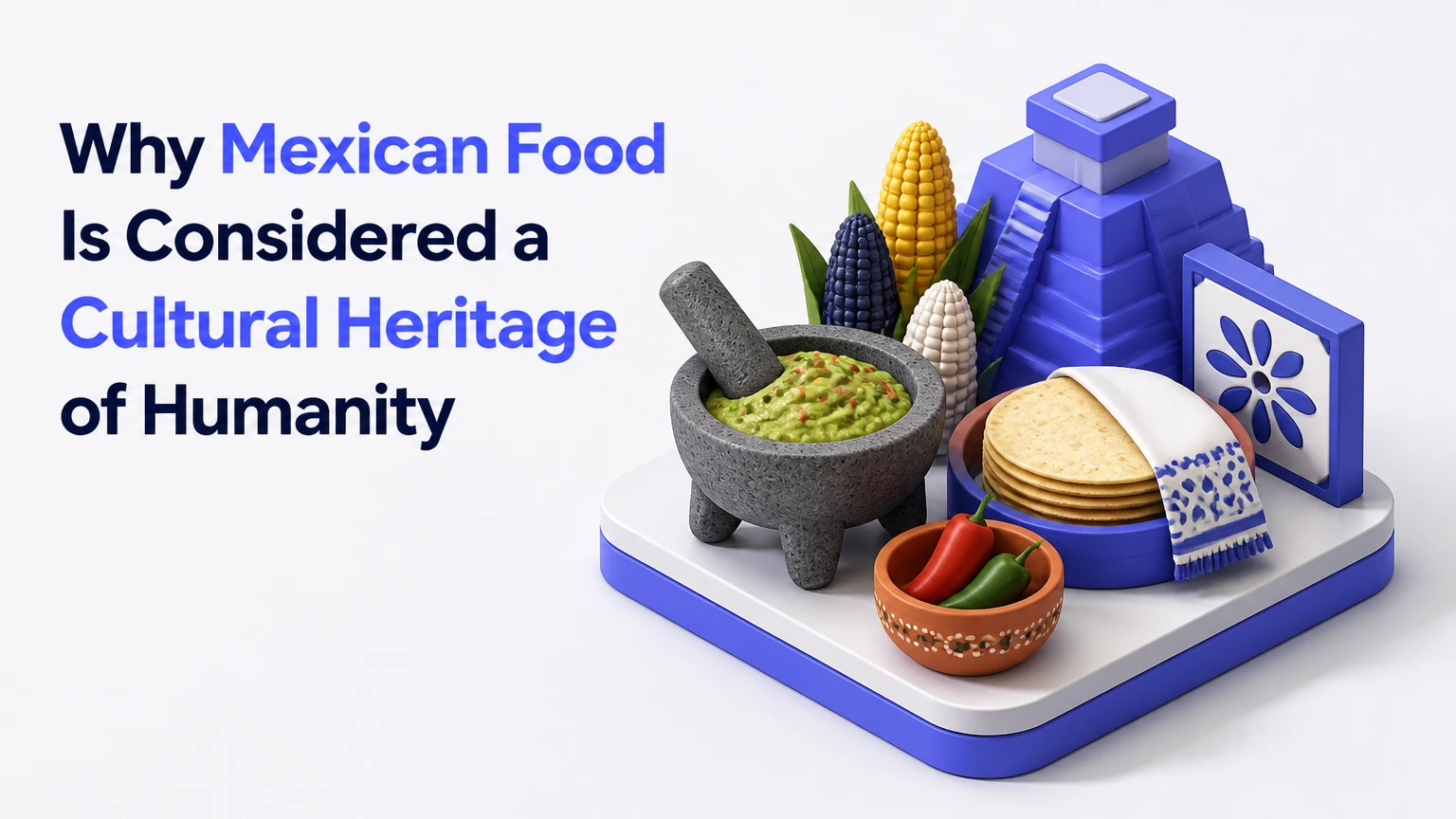
Mexican food is considered a cultural heritage of humanity because UNESCO recognized traditional Mexican cuisine as a living cultural system, not merely a collection of recipes. The system connects maize farming, the milpa, nixtamalization, cooking tools, ritual meals, ecological knowledge, and community cooperation across generations.
Key Facts at a Glance
- UNESCO inscribed Traditional Mexican Cuisine on the Representative List of the Intangible Cultural Heritage of Humanity in 2010.
- The official element is titled “Traditional Mexican cuisine: ancestral, ongoing community culture, the Michoacán paradigm.”
- Mexican culinary heritage includes agriculture, food processing, cooking, ritual, community organization, and cultural transmission.
- The milpa commonly combines maize, beans, squash, and additional local crops, although its composition varies by region.
- Nixtamalization uses an alkaline solution to process maize into masa suitable for tortillas, tamales, and other foods.
- UNESCO recognition does not certify every Mexican dish, restaurant, or modern adaptation as traditional heritage.
Why Did UNESCO Recognize Mexican Cuisine?
UNESCO recognized traditional Mexican cuisine because communities continue to practice and transmit an interconnected food culture rooted in Indigenous Mesoamerican knowledge. The nomination centered on the Michoacán paradigm, where farming, harvesting, preparation, cooking, ritual use, and communal eating operate as parts of one cultural model.
UNESCO’s description calls traditional Mexican cuisine “a comprehensive cultural model” that includes farming, ritual practices, age-old skills, culinary techniques, and ancestral community customs. That wording explains the designation’s scope. The heritage is found in relationships among people, land, crops, tools, meals, and ceremonies.
The 2010 inscription followed Mexico’s effort to present cuisine as living heritage rather than national branding. UNESCO’s Representative List is intended to increase visibility and encourage safeguarding. It does not create a legal rule that freezes recipes in one approved form.
What exactly did UNESCO protect?
UNESCO protected the continued practice of a cultural system, especially the knowledge and social practices associated with traditional cuisine in Michoacán. The designation does not mean that Michoacán contains the only authentic Mexican food, nor does it rank one regional style above another.
The official case identifies elements such as maize cultivation, preparation of foods based on maize, traditional cooking methods, and collective participation. Women frequently hold central roles as cooks and transmitters, while farmers, seed keepers, craftspeople, market sellers, and family members also sustain the system.
This distinction matters. A tortilla made in a factory may resemble a household tortilla, but resemblance alone does not establish heritage. Heritage depends on knowledge, continuity, community recognition, and the social context in which food is made and used.
What Does Intangible Cultural Heritage Mean?
Intangible cultural heritage consists of living knowledge, practices, expressions, skills, and traditions that communities recognize as part of their identity. Mexican cuisine fits that category because its most important components are learned and performed, including seed selection, grinding, seasoning, cooking, serving, and ceremonial sharing.
A stone tool can be preserved in a museum, but the knowledge of how to use a metate belongs to intangible heritage. A written mole recipe records ingredients, yet it cannot fully transmit roasting judgment, grinding texture, local substitutions, or the occasion for serving the dish.
UNESCO’s framework also requires community involvement. External observers may document a tradition, but communities must identify the practice as their heritage. The designation therefore concerns people and continuity rather than an abstract idea of culinary purity.
| Heritage feature | Mexican cuisine example | Why the feature matters |
|---|---|---|
| Knowledge | Selecting maize for tortillas or tamales | Transfers practical judgment between generations |
| Technique | Nixtamalizing kernels with lime | Changes maize texture, nutrition, and usability |
| Social practice | Preparing food for communal festivals | Converts cooking into reciprocal community work |
| Material culture | Comal, metate, molcajete, clay vessels | Connects skills to tools and local craft traditions |
| Identity | Regional dishes and Indigenous foodways | Expresses belonging to a place and community |
| Continuity | Children learning household preparation | Keeps the tradition adaptable and active |
How Does the Milpa Shape the Cuisine?
The milpa shapes Mexican cuisine by producing a complementary group of crops and by teaching farmers how food, soil, water, animals, and seasonal cycles interact. Maize supplies the main carbohydrate, beans contribute protein and nitrogen fixation, and squash shades soil, while other plants vary according to local ecology.
The familiar maize-bean-squash combination is a useful model, not a rigid recipe for every field. Chilies, quelites, tomatoes, amaranth, herbs, fruit trees, and other crops may join the system. Farmers adapt planting patterns to altitude, rainfall, soil, and local seed varieties.
The milpa also affects flavor. Fresh young maize, dried kernels, squash blossoms, beans, herbs, and wild greens enter different preparations during the year. A food culture built around seasonal availability naturally develops preservation methods, including drying, salting, fermenting, and storing seeds.
Why does the milpa matter beyond farming?
The milpa matters because agricultural decisions determine which ingredients remain available and which culinary skills remain useful. When farmers preserve local maize, cooks can maintain regional tortilla colors, aromas, textures, and dough behavior that standardized grain may not reproduce.
Mexico contains many recognized maize races, but counts vary according to classification method and whether researchers count races, varieties, or farmer-maintained types. Claims of exactly 64 varieties should therefore be treated as a commonly cited classification figure, not a permanent inventory.
The agricultural system also carries ethical knowledge. Farmers exchange seed, coordinate labor, respond to drought, and judge harvest timing. Those activities connect food security with cultural memory, making the milpa one reason Mexican cuisine qualifies as a broad heritage system.
How Does Nixtamalization Transform Corn?
Nixtamalization transforms dry maize by cooking and soaking it in an alkaline solution, traditionally made with lime, then washing and grinding the softened kernels into masa. The process loosens the hull, improves dough formation, changes flavor, and increases the bioavailability of niacin.
A typical household or commercial sequence follows five stages:
- Clean and select the kernels. Remove debris and damaged grain.
- Cook in lime water. Simmer maize with a small amount of calcium hydroxide; the exact quantity depends on the maize and local practice.
- Steep the cooked grain. Resting commonly lasts overnight, although shorter and longer schedules occur.
- Wash and rub the nixtamal. Remove loosened pericarp and excess lime without stripping away all surface material.
- Grind the kernels. Use a metate, molino, or industrial mill to produce cohesive masa.
The useful checkpoint is texture. Properly processed kernels become tender enough to grind while retaining enough structure for a pliable dough. Excess lime can create a sharp flavor and weakened texture; insufficient treatment can leave gritty, cracking masa.
What does nixtamalization change nutritionally?
Nixtamalization can release bound niacin, increase calcium content, reduce some mycotoxins, and improve the amino-acid and mineral usability of maize-based meals. The size of each effect varies with maize type, lime concentration, cooking time, soaking conditions, and washing intensity.
The process also solves a practical problem. Untreated maize does not naturally form the cohesive, extensible dough needed for a tortilla. Alkaline treatment changes the pericarp and starch properties enough to make hand shaping and cooking possible without wheat gluten.
The often-repeated claim that nixtamalization increases calcium by exactly 750 percent is too broad for general use. Calcium gain depends on the amount absorbed from the alkaline bath and the amount removed during washing, so a single percentage cannot describe every masa.
| Nixtamalization stage | Typical condition | Observable result |
|---|---|---|
| Kernel selection | Whole dried maize, cleaned | Even cooking and fewer defects |
| Alkaline cooking | Lime water, simmered 20-60 minutes | Softened outer skin and altered starch |
| Resting | Commonly 8-12 hours | Hydrated, tender nixtamal |
| Washing | Several rinses, hand rubbing | Reduced hull and excess lime |
| Grinding | Metate or molino | Cohesive masa with maize aroma |
| Cooking masa | Comal or steamer | Tortilla, tamal, tlacoyo, or related food |
Which Regional Cuisines Are Part of the Heritage?
Mexican culinary heritage includes many regional food systems rather than one national flavor profile. Oaxaca, Michoacán, Puebla, Yucatán, Veracruz, the northern borderlands, and Pacific coastal regions use different crops, cooking environments, Indigenous traditions, and historical influences.
The following examples show how regional identity works. They are representative, not an exhaustive list of Mexico’s cuisines.
| Region | Representative foods | Ingredients and techniques | Cultural context |
|---|---|---|---|
| Oaxaca | Mole negro, tlayudas, tamales | Dried chiles, hoja santa, stone grinding, comal cooking | Zapotec, Mixtec, and other regional foodways |
| Michoacán | Corundas, uchepos, carnitas | Local maize, steaming, copper cazos, fresh produce | Central to the UNESCO paradigm |
| Puebla | Mole poblano, chiles en nogada | Chiles, nuts, fruit, spices, layered grinding | Indigenous and colonial culinary interaction |
| Yucatán | Cochinita pibil, panuchos, sopa de lima | Achiote, sour citrus, banana leaves, pit cooking | Maya food knowledge and tropical ecology |
| Veracruz | Fish dishes, tamales, rice preparations | Coastal seafood, maize, herbs, plant leaves | Gulf Coast and Indigenous-Afro-European exchange |
| Northern Mexico | Flour tortillas, grilled meats, dried chile dishes | Wheat, beef, wheat milling, open-fire cooking | Arid climate and ranching history |
| Pacific Coast | Seafood stews, aguachile, maize foods | Fresh seafood, citrus, chilies, coastal produce | Maritime environments and local markets |
Mexican cuisine developed through exchange as well as continuity. Indigenous maize, beans, squash, chiles, tomatoes, cacao, and herbs encountered introduced crops, animals, fats, grains, and cooking practices after the sixteenth century. A dish can therefore contain layered histories without losing its Mexican cultural identity.
Which Techniques Carry Knowledge Across Generations?
Traditional techniques carry knowledge because they require sensory judgment that recipes rarely quantify. A cook learns how a comal sounds when heated, how a chile smells before it burns, how masa feels when sufficiently hydrated, and how a sauce changes as it reduces.
Tools provide another transmission route. The comal supports tortilla and chile preparation; the metate produces a particular grinding rhythm and texture; the molcajete creates crushed rather than blended sauces; clay pots moderate heat; and pit ovens connect food with earth, leaves, smoke, and collective labor.
| Technique or tool | Main foods | Typical labor or time | Knowledge being transmitted |
|---|---|---|---|
| Comal cooking | Tortillas, chiles, seeds | 2-5 minutes per tortilla batch | Heat control and turning judgment |
| Metate grinding | Masa, spices, sauces | 20-60 minutes per batch | Texture, pressure, and hydration |
| Molcajete grinding | Salsas and spice pastes | 10-25 minutes per serving bowl | Order of ingredients and crushing |
| Pit cooking | Barbacoa-style preparations | 8-24 hours including cooking | Wrapping, heat, moisture, and timing |
| Leaf steaming | Tamales and related foods | 60-120 minutes steaming | Masa consistency and packing |
| Copper-cazo cooking | Regional fried preparations | 1-4 hours | Heat management and batch control |
Food knowledge is often embodied rather than written. Children may first participate by washing maize, folding leaves, grinding spices, or shaping masa, then gradually assume decisions that affect the final dish.
How Much Labor Does Heritage Cooking Require?
Traditional Mexican cooking may require 30 minutes for a simple salsa or several days for a festival mole, depending on ingredient preparation, batch size, equipment, and the number of people helping. Labor includes shopping, fuel collection, grinding, cleaning, cooking, serving, and preserving leftovers.
Published national price benchmarks for household heritage cooking are difficult to establish because regional markets and ingredients differ substantially. The figures below are typical planning ranges, not UNESCO measurements or fixed Mexico-wide prices.
| Preparation | Typical active labor | Total elapsed time | Typical ingredient cost in Mexico |
|---|---|---|---|
| Fresh salsa and tortillas | 45-90 minutes | 1-2 hours | MXN 40-120 for a household batch |
| Nixtamal and masa | 1-2 hours | 10-16 hours | MXN 25-60 per kilogram of maize-based masa |
| Tamales | 3-6 hours for a group | 5-10 hours | MXN 250-700 for 20-30 tamales |
| Regional mole | 4-10 hours | 8-24 hours | MXN 400-1,500 for a family or event batch |
| Festival meal | 1-3 days across several cooks | 1-3 days | MXN 150-400 per guest, highly variable |
| Daily fonda meal | 2-4 hours | Same day | MXN 70-180 per serving, location dependent |
The shared labor is part of the heritage. A large celebration may distribute tasks among relatives and neighbors, reducing the burden on one cook while reinforcing obligations that continue after the meal.
How Does Traditional Mexican Cuisine Differ From Tex-Mex?
Traditional Mexican cuisine and Tex-Mex are related but distinct culinary traditions. Mexican regional cuisines usually preserve local maize, chile, herb, and cooking practices, while Tex-Mex developed in the United States through Mexican American communities, border exchange, industrial food supply, and local preferences.
Neither category is automatically better. Tex-Mex has its own history and cultural legitimacy, while UNESCO’s inscription concerns traditional Mexican cuisine as described in the Mexican nomination.
| Criterion | Traditional Mexican cuisine | Tex-Mex cuisine |
|---|---|---|
| Common tortilla base | Nixtamalized maize in many regions | Maize and wheat tortillas, depending on dish |
| Cheese pattern | Fresh or regional cheeses in measured roles | Melted cheese often used as a central topping |
| Seasoning structure | Regional chiles, herbs, seeds, spices | Chiles, cumin, commercial spice blends, cheese |
| Typical service setting | Home, market, ceremony, local restaurant | Restaurants, family meals, fast-casual settings |
| Historical center | Mexican regions and Indigenous communities | Texas and Mexican American border communities |
| Heritage classification | UNESCO-recognized traditional system | Separate regional tradition, not the UNESCO element |
Calling Tex-Mex “inauthentic” erases its own history. The useful comparison asks which tradition a dish belongs to and what cultural practices produced it.
What Are the Main Pressures on Mexican Food Heritage?
The main pressures include industrial maize standardization, migration, reduced access to farmland, water stress, changing labor patterns, low returns for small farmers, and the replacement of handmade processes with cheaper commercial products. These pressures affect both ingredients and the time available to transmit skills.
Climate change adds uncertainty. Drought, heat, irregular rainfall, and changing pest patterns can reduce harvest reliability, particularly for farmers maintaining local seed stocks. Urbanization can also separate younger generations from fields, markets, and household preparation.
Heritage status does not guarantee survival. UNESCO recognition creates visibility and encourages safeguarding, but communities still need land access, fair prices, training, seed exchange, and respect for local control over cultural knowledge.
Who keeps the tradition alive?
Traditional cooks, farmers, market vendors, millers, tortilla makers, artisans, families, and community organizations keep Mexican culinary heritage alive. Women have often carried household and ceremonial cooking knowledge, although men and women participate across farming, commerce, milling, and professional kitchens.
The term cocinera tradicional commonly refers to cooks recognized for preserving regional food knowledge. Recognition can support livelihoods, but outside institutions should avoid extracting recipes or presenting community knowledge without consent or compensation.
Migration creates a complicated outcome. Mexican communities abroad may substitute ingredients, use electric equipment, or shorten preparation times, yet still preserve language, ritual meals, flavor memory, and family teaching. Adaptation can maintain continuity rather than destroy it.
What Mistakes Weaken a Traditional Preparation?
The most damaging mistakes are using untreated corn for masa, burning dried chiles, misjudging hydration, and treating regional recipes as interchangeable. These errors change texture and flavor because traditional preparations depend on chemical processing, sensory timing, and local ingredient behavior.
1. Using ordinary cornmeal
Ordinary cornmeal is not a direct substitute for nixtamalized masa. Tortillas made from untreated meal often crack because the grain lacks the altered starch and pericarp properties produced by alkaline processing.
Use fresh masa from a tortillería or flour explicitly labeled nixtamalized corn flour. Hydrate gradually, rest the dough for 15-30 minutes, and adjust with small additions of water.
2. Burning dried chiles
Burned chiles produce harsh bitterness that sugar or extra liquid cannot fully remove. Toast dried chiles briefly, often 10-30 seconds per side, then remove stems and seeds according to the recipe before soaking.
A fragrant chile is ready. A blackened chile is usually beyond recovery.
3. Making masa too dry
Dry masa cracks at the edges when pressed, while overly wet masa sticks and produces weak tortillas. A practical test is to press a ball between plastic sheets: the edge should remain smooth rather than splitting into radiating cracks.
Resting helps hydration equalize. Add water by teaspoons, not large pours.
4. Treating all regional dishes as one cuisine
A Yucatecan preparation, an Oaxacan mole, and a northern wheat tortilla do not share identical ingredient rules. Substituting ingredients may be sensible outside Mexico, but the result should be described as an adaptation rather than a universal traditional version.
5. Ignoring food safety
Fresh masa, cooked maize, sauces, and filled tamales require temperature control. Refrigerate perishable foods within two hours, use clean water, and reheat cooked dishes thoroughly. Heritage status does not make unsafe storage acceptable.
How Can Visitors Support the Living Tradition?
Visitors can support Mexican culinary heritage by buying from local markets, paying traditional cooks fairly, choosing regional foods in their place of origin, and asking permission before recording demonstrations or copying recipes. Oaxaca and Michoacán offer especially strong opportunities to encounter community-based food practices, although every region has its own traditions.
Look for municipal markets, neighborhood fondas, local mills, seasonal festivals, and workshops led by cooks or farmers. Ask who produced the maize, whether a preparation is regional, and how payment reaches the people doing the work.
Visitors should avoid treating “authenticity” as a performance test. A cook may use a modern mill, a gas burner, or a commercial ingredient while preserving the cultural logic of the dish. The relevant question is whether knowledge and community meaning remain active.
How Can Home Cooks Respect the Heritage?
Home cooks can begin with nixtamalized masa, a comal, whole dried chiles, and a regional recipe taught by a reliable Mexican source. Start with tortillas, a salsa, or tamales before attempting a complex mole, because basic preparations reveal hydration, heat, and chile-handling errors clearly.
A cast-iron comal retains heat well, while a tortilla press improves consistency but does not replace hand judgment. Fresh masa has a short usable window, so keep it covered and refrigerated if it will not be cooked immediately.
Respect also requires accurate naming. A recipe adapted for available ingredients can be delicious and meaningful, but labeling its regional origin and substitutions prevents the false impression that one household version represents all Mexican cuisine.
Frequently Asked Questions
Is Mexican food the oldest cuisine in the world?
No authoritative institution ranks Mexican food as the world’s oldest cuisine. Mexican culinary traditions contain very old agricultural and processing knowledge, including maize cultivation and nixtamalization, but cuisines develop through continuous exchange. UNESCO recognized continuity and cultural integration, not a competition for the oldest national cuisine.
Why is corn so important in Mexican culture?
Corn is important because it supplies staple foods, structures the milpa, supports local seed systems, and appears in daily meals and ceremonies. Maize is also embedded in Indigenous histories and worldviews. Tortillas, tamales, atole, pozole, and many other foods depend on specific maize varieties and processing practices.
Does UNESCO recognize tacos as cultural heritage?
UNESCO did not separately inscribe tacos as the recognized heritage element. UNESCO inscribed Traditional Mexican Cuisine: Ancestral, Ongoing Community Culture, the Michoacán Paradigm, in 2010. Tacos may express that broader tradition, but a single dish is not equivalent to the entire cultural system.
Is Mexican cuisine healthy because it is heritage?
Heritage status does not determine healthfulness. Mexican cuisine includes nutrient-dense beans, maize, vegetables, herbs, fruits, and seeds, alongside preparations that may be high in sodium, fat, or refined ingredients. Health depends on the ingredients, portions, cooking method, and overall dietary pattern.
Can modern Mexican restaurants preserve culinary heritage?
Yes. Modern restaurants can preserve heritage when they maintain meaningful regional knowledge, credit communities, use traditional techniques where relevant, and support farmers and cooks. Innovation does not automatically break continuity. The strongest examples explain what has changed and which cultural practices remain.
The Bottom Line
Mexican food is considered a cultural heritage of humanity because traditional Mexican cuisine joins agriculture, maize processing, cooking techniques, ritual, social cooperation, and identity into a living system transmitted by communities. UNESCO’s 2010 inscription recognizes that system, especially the Michoacán paradigm, rather than declaring every Mexican dish unchanged or universally traditional. The answer to why Mexican food is considered a cultural heritage of humanity lies in continuity, community ownership, ecological knowledge, and daily practice.