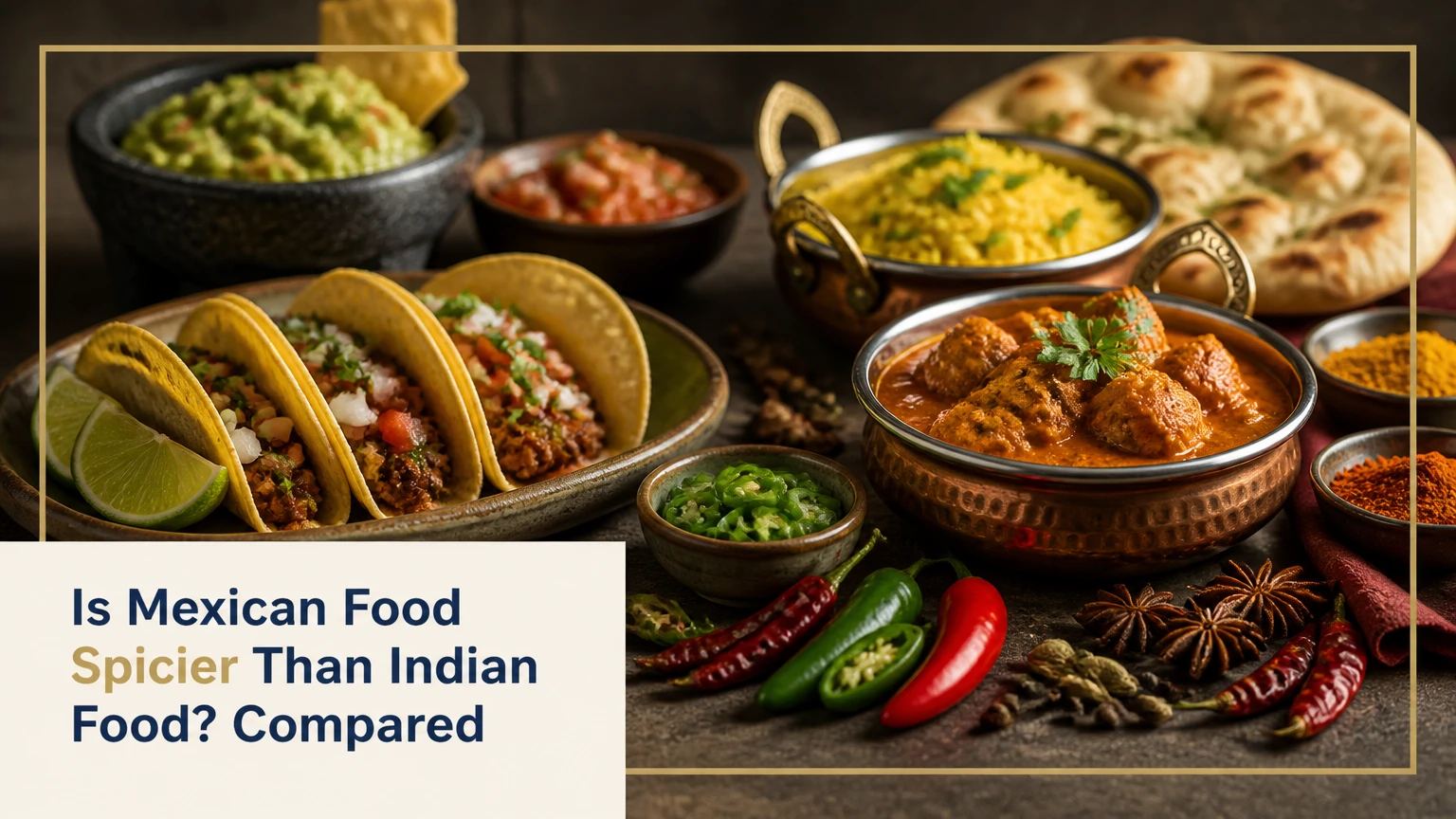
Indian food is generally perceived as spicier than Mexican food because many Indian dishes layer chile heat with black pepper, ginger, and mustard throughout a sauce or rice dish. Mexican food can deliver greater peak heat in dishes using habanero or very hot salsa, while its everyday heat is often easier to control at the table.
Key Facts at a Glance
- Indian food is not universally hotter than Mexican food; regional recipes and chile quantities determine the result.
- Mexican cuisine often concentrates heat in fresh salsa, pickled chiles, or a garnish that diners can add separately.
- Indian cuisine commonly distributes chile, pepper, ginger, and aromatic spices through a cooking fat, gravy, or rice preparation.
- Scoville Heat Units measure capsaicin concentration in a pepper or product, not the average heat of an entire cuisine.
- Habanero-based Mexican dishes can exceed the heat of many mild Indian curries.
- Milk, yogurt, or another dairy food usually relieves capsaicin burn more effectively than water or citrus juice.
Which Cuisine Is Usually Hotter?
Indian food is usually hotter in perceived, sustained intensity, whereas Mexican food often produces sharper, more localized chile heat. The comparison changes when a Mexican dish contains habanero or a very hot salsa, or when an Indian dish uses mild Kashmiri chile and a large amount of dairy.
A diner eating a creamy korma may experience almost no capsaicin, while aguachile with habanero can be intensely hot. Conversely, a restaurant curry prepared with a generous chile paste may remain hot through every bite, unlike a taco served with salsa on the side.
The best overall answer is therefore conditional: Indian cuisine is often spicier across the full meal experience, but neither cuisine wins every dish-level comparison.
Quick Verdict by Diner
| Diner profile | Better starting point | Typical order | Reason |
|---|---|---|---|
| Very low heat tolerance | Mexican food | Tacos with salsa on the side | Heat can remain separate from the main filling |
| Aromatic spice seeker | Indian food | Korma or biryani | Cardamom, cumin, coriander, and ginger can add flavor without extreme chile |
| Acid and fresh chile fan | Mexican food | Salsa verde or aguachile | Lime, herbs, and fresh chile create immediate brightness |
| Gradual heat enthusiast | Indian food | Jalfrezi or regional curry | Chile and spice are distributed through the sauce |
| High-heat chile enthusiast | Either cuisine | Habanero salsa or ghost chile curry | Individual preparation matters more than cuisine label |
What Does “Spicy” Mean in Food?
Food scientists distinguish pungency from the aromatic taste commonly called spice. Capsaicin creates burning heat, piperine creates black-pepper bite, and gingerol creates ginger’s warm, sharp sensation; these compounds overlap in perception but do not produce identical effects.
Capsaicin activates TRPV1 receptors, the same heat-sensitive nerve pathway that responds to damaging temperatures. The brain interprets that signal as burning even when the food itself is not dangerously hot. The International Association for the Study of Pain describes capsaicin as a chemical irritant that activates nociceptors, the nerves involved in detecting potential tissue damage.
Black pepper’s piperine and fresh ginger’s gingerol can make an Indian dish feel warmer or more pungent, but they do not automatically multiply its Scoville rating. Mustard compounds create another nasal, volatile sensation that differs from capsaicin’s lingering mouth burn.
| Sensation | Main compound or mechanism | Common food source | Perception |
|---|---|---|---|
| Chile burn | Capsaicin activating TRPV1 receptors | Habanero, serrano, red chile | Mouth and throat heat |
| Pepper bite | Piperine | Black pepper | Sharp, dry warmth |
| Ginger heat | Gingerol and related compounds | Fresh ginger | Warm, aromatic pungency |
| Mustard heat | Isothiocyanates | Mustard seed | Fast nasal sting |
| Acidic brightness | Citric acid and other acids | Lime, tomato, vinegar | Tartness, not capsaicin heat |
Why Can Two Dishes With the Same Chile Feel Different?
Two dishes with similar chile varieties can feel different because serving size, fat, acidity, temperature, and texture change how the heat reaches the mouth. A thin chile sauce can strike quickly, while a fatty curry may distribute capsaicin across the palate and prolong the afterburn.
Capsaicin dissolves readily in oils and fats. A dish with oil, cream, coconut, nuts, or cheese can carry capsaicin efficiently, although those ingredients may also spread or soften the sensation depending on concentration. Lime adds brightness and can make a salsa taste more intense, but acid does not chemically neutralize capsaicin.
How Is Heat Built Into Mexican and Indian Food?
Mexican food commonly makes heat modular. A cook may prepare a relatively mild filling, then offer salsa, pickled chile, fresh serrano, or a hot table sauce separately, allowing the diner to control the dose.
Indian food more often integrates heat into a masala, gravy, rice mixture, or tempering oil. This technique makes the dish’s flavor more uniform and can create a longer-lasting sensation, although many Indian recipes use little chile and focus on aroma instead.
Mexican Heat Patterns
Mexican cuisine uses fresh and dried chiles as both flavor ingredients and heat sources. Jalapeño contributes green vegetal notes, chipotle contributes smoke, árbol chile contributes a dry sharpness, and habanero contributes intense fruity heat.
Heat may enter during marination, roasting, blending, braising, or finishing. Salsa placement matters: a mild taco with two teaspoons of habanero salsa can become hotter than the same taco with no salsa.
| Mexican ingredient or dish | Typical chile association | Typical heat range | Heat behavior |
|---|---|---|---|
| Poblano chile | Poblano | 1,000-2,000 SHU | Mild, earthy, roasted |
| Jalapeño salsa | Jalapeño | 2,500-8,000 SHU | Fresh, immediate, adjustable |
| Serrano salsa | Serrano | 10,000-23,000 SHU | Brighter and sharper |
| Salsa de árbol | Árbol chile | 15,000-30,000 SHU | Dry, direct, persistent |
| Habanero sauce | Habanero | 100,000-350,000 SHU | Fruity, high, lingering |
Scoville values vary by cultivar, growing conditions, ripeness, and laboratory method. The ranges above are typical pepper references, not guaranteed values for a restaurant sauce or finished dish.
Indian Heat Patterns
Indian cuisine includes an enormous range of regional preparations. A tempering may introduce whole spices into hot oil, while ground chile, ginger, garlic, and other ingredients enter a masala base; a finishing blend can add aroma after cooking.
The method distributes flavor, but distribution does not prove high heat. Kashmiri chile is commonly valued for color and mild fruitiness, while some regional preparations use much hotter varieties. A creamy sauce can also contain chile without tasting aggressively hot because dairy, nuts, and starch alter the balance.
| Indian dish or style | Common heat profile | Typical heat level | What controls the result |
|---|---|---|---|
| Korma | Creamy, aromatic | Mild, often below 2,000 SHU | Dairy, nuts, low chile dose |
| Butter chicken | Tomato, dairy, aromatic | Mild to medium | Chile powder and cream ratio |
| Biryani | Rice, aromatic, variable | Mild to medium | Fresh chile, marinade, regional recipe |
| Jalfrezi | Fresh chile, tomato, onion | Medium to hot | Green chile quantity |
| Vindaloo | Acidic, chile-forward | Medium to very hot | Chile type, paste dose, regional style |
| Ghost chile curry | Direct, extreme chile | Very hot, potentially above 100,000 SHU | Bhut jolokia or other superhot chile |
The claim that every vindaloo is built with ghost chile is inaccurate. Many versions rely on dried red chile or cayenne, and restaurant labels such as “hot” are not standardized. Ghost chile, also called bhut jolokia, can exceed 1,000,000 SHU in some tested examples, but its presence depends on the recipe.
Which Dishes Are Mild, Medium, or Hot?
Mexican and Indian cuisines both contain mild, medium, and very hot dishes, so dish selection is more useful than a national ranking. Diners should ask which chile is used, whether the sauce is mixed into the dish, and whether the kitchen can serve it separately.
| Heat category | Mexican examples | Indian examples | Ordering note |
|---|---|---|---|
| Mild | Tacos al pastor, enchiladas suizas, poblano-based dishes | Korma, malai kofta, mild butter chicken | Request no hot salsa or mild chile |
| Medium | Chilaquiles with salsa verde, barbacoa, mole poblano | Biryani, jalfrezi, rogan josh | Ask for medium chile and sauce separately |
| Hot | Habanero aguachile, habanero salsa, chile-heavy sauces | Hot vindaloo, Madras-style curry, chile-rich regional dishes | Confirm the actual chile variety |
| Extreme | Large serving of habanero salsa | Ghost chile curry or phaal-style curry | Order only when the kitchen confirms ingredients |
Mole poblano is often described as complex rather than fiercely hot. Its dried chiles, nuts, spices, and chocolate-like bitterness create depth, but many restaurant versions contain modest capsaicin.
Aguachile can be much hotter because raw seafood is dressed with lime, fresh chile, herbs, and a concentrated chile liquid. Lime makes the flavor vivid; it does not remove the capsaicin.
Does Indian Food Always Taste Hotter?
Indian food does not always taste hotter than Mexican food. Northern Indian dishes frequently emphasize dairy, nuts, wheat, and aromatic spice, while some southern, northeastern, or coastal preparations use more fresh chile, but regional averages cannot describe every meal.
Restaurant adaptation adds another variable. Menus in the United States, the United Kingdom, and other countries often separate “medium” and “hot” levels according to local customers rather than a national culinary standard. A family kitchen may also reduce chile for children while preserving the original spice structure.
Mexican food varies just as sharply. Central Mexican dishes may use dried chile for color and flavor, while Yucatán-style preparations often feature habanero, and northern dishes may emphasize roasted chile, flour tortillas, or grilled meats with salsa served separately.
What Is the Biggest Regional Difference?
The biggest regional difference is the role of the chile in the finished dish. Mexican cooks often treat salsa as a distinct condiment, while many Indian cooks incorporate chile into the base, but both traditions include exceptions.
Goan, Andhra, Chettinad, and some northeastern Indian cuisines can be very hot. Yucatán and coastal Mexican cooking can also be intensely chile-driven. Comparing “Indian food” with “Mexican food” without naming a region creates a false precision that the recipes cannot support.
How Does the Scoville Scale Help?
The Scoville scale helps compare pepper varieties, but it cannot produce a trustworthy average heat score for Mexican or Indian cuisine. Finished dishes contain different quantities of pepper, liquid, fat, starch, and other ingredients, so a pepper’s SHU cannot be transferred directly to a plate.
Modern laboratory testing commonly uses high-performance liquid chromatography to measure capsaicinoids, while the original Scoville organoleptic test depended on human dilution judgments. The American Chemical Society notes that Scoville ratings are estimates and can vary because pepper samples differ.
| Chile | Common cuisine use | Approximate SHU range | Relative heat |
|---|---|---|---|
| Kashmiri chile | Indian gravies and marinades | 1,000-2,000 | Mild |
| Poblano | Mexican roasting and stuffing | 1,000-2,000 | Mild |
| Jalapeño | Mexican salsa and pickles | 2,500-8,000 | Mild to medium |
| Serrano | Mexican salsa and garnish | 10,000-23,000 | Medium |
| Habanero | Mexican hot sauces | 100,000-350,000 | Very hot |
| Bhut jolokia | Indian superhot preparations | 500,000-1,000,000-plus | Extreme |
A dish with 1,000 SHU measured at the pepper level may feel hotter than a dish labeled 5,000 SHU if the first dish delivers more sauce per bite or lacks fat and starch. SHU is a useful ingredient reference, not a complete eating-experience score.
Which Cuisine Offers Better Heat Control?
Mexican food usually offers better heat control for diners who want to adjust each bite. Salsa, pickled jalapeño, sliced serrano, and hot sauce can remain separate from the main food, while an integrated Indian curry is harder to reduce after cooking.
Indian restaurants still offer practical control. Diners can request mild preparation, choose a dairy-based dish, add rice or bread, and order yogurt on the side. The request works best when “mild” is paired with a specific instruction such as “no fresh green chile” or “very little chile powder.”
How Should a Beginner Order?
A beginner should choose a mild base, keep the hot condiment separate, and add a small measured amount after tasting. This approach works in either cuisine because it controls dose rather than relying on vague menu labels.
| Goal | Mexican order | Indian order | Control method |
|---|---|---|---|
| Nearly no burn | Cheese quesadilla with mild salsa | Korma with rice | Keep chile separate |
| Aromatic flavor | Mole with mild salsa | Butter chicken or malai kofta | Ask for low chile |
| Fresh brightness | Tacos with salsa verde | Vegetable curry with yogurt | Add condiment by teaspoon |
| Moderate heat | Serrano salsa on tacos | Jalfrezi, medium | Request medium, not hot |
| Maximum heat | Habanero aguachile | Ghost chile curry | Confirm pepper before ordering |
A practical restaurant rule is to treat “medium” as an unreliable label. Ask for the named pepper, the sauce’s position in the dish, and whether the cook can provide a sample or separate portion.
What Does Each Cuisine Cost and How Long Does It Take?
Typical casual restaurant meals cost about $8-$20 for Mexican food and $12-$28 for Indian food in many United States markets, but city, portion size, service style, and location change those ranges. Preparation often takes 5-15 minutes for assembled Mexican dishes and 20-60 minutes for an Indian curry made from a cooked sauce base.
These are typical market estimates, not universal prices. Indian dishes may require more mise en place, including toasted spices, a blended onion base, a tempering step, and simmering, while tacos and quesadillas can be assembled quickly when fillings are ready.
| Meal or preparation | Typical price | Active preparation | Main time variable |
|---|---|---|---|
| Mexican tacos | $8-$18 | 5-15 minutes | Filling and queue length |
| Mexican aguachile | $14-$25 | 10-20 minutes | Seafood and chile preparation |
| Indian curry with rice | $12-$28 | 20-60 minutes | Sauce reduction and simmering |
| Indian biryani | $14-$30 | 45-120 minutes | Marination and rice steaming |
Cost and cooking time do not indicate heat. A fast salsa can be hotter than a slow curry, and a mild curry can require more labor than a superhot sauce.
How Do You Cool Capsaicin Burn?
Dairy is usually the most effective immediate food-based relief for capsaicin burn because casein helps remove capsaicin from receptor surfaces. Whole milk, yogurt, lassi, sour cream, or a dairy-based side generally works better than water, citrus juice, or a carbonated drink.
Water does not dissolve capsaicin well and may spread the compound across the mouth. Rice, bread, tortillas, and other starches can physically remove some residue and provide a less intense food surface, but sugar and acid should not be described as chemical neutralizers.
A Practical Relief Sequence
- Stop eating the hot component and breathe normally.
- Take small sips of whole milk or eat plain yogurt.
- Use rice, bread, or tortillas to collect remaining sauce.
- Rinse with water only after the dairy or starch has reduced the coating.
- Avoid rubbing the eyes, then wash hands with soap.
Medical attention is appropriate for breathing difficulty, swelling, persistent vomiting, chest pain, or severe symptoms. A mouth burn from food is usually temporary, but concentrated extracts and superhot peppers can cause more serious reactions.
What Are the Most Common Comparison Mistakes?
The most common mistake is treating “spice” as a single measurable property. Heat, pungency, aroma, acidity, bitterness, and fragrance contribute differently to a diner’s experience.
A second mistake is assigning one heat score to an entire national cuisine. Published SHU values describe peppers and tested products, not standardized servings across thousands of recipes.
A third mistake is assuming visible chile pieces represent all the heat. In an Indian gravy or Mexican adobo, capsaicin may already be dispersed through oil and blended sauce, so removing the pepper fragments changes little.
Expert insight: Heat distribution often matters more than peak pepper rating. A lower-SHU sauce mixed evenly through a full serving can feel more persistent than a hotter garnish used in a small quantity.
Expert insight: Acidity changes contrast, not capsaicin concentration. Lime can make a chile taste brighter and more aggressive, but it does not neutralize the burn.
Expert insight: “Indian hot” and “Mexican hot” are restaurant instructions, not regulated standards. The most reliable question is, “Which pepper and how much of it goes into the serving?”
Which Should You Choose?
Choose Mexican food when you want adjustable heat, fresh acidity, roasted chile flavor, or a mild meal with optional salsa. Choose Indian food when you want layered aromatics, a sustained sauce-based heat, or a meal where spice remains integrated into the cooking.
Mexican food is the safer first choice for a diner with uncertain tolerance because the hottest component is often served separately. Indian food is the stronger choice for someone who values cumin, cardamom, ginger, mustard, and toasted spice structure even when the chile level is moderate.
For maximum heat, compare named dishes rather than cuisines. A habanero Mexican sauce can exceed a mild Indian curry, while a ghost chile Indian preparation can exceed most everyday Mexican meals.
FAQ
Is Mexican Food Healthier Than Indian Food?
Neither cuisine is automatically healthier. Nutritional value depends on portion size, cooking fat, sodium, vegetables, legumes, dairy, grains, and preparation method. Bean-based dishes, vegetable curries, grilled fillings, and fresh salsas can fit balanced meals, while fried foods, creamy sauces, and oversized portions increase calories in either tradition.
Which Cuisine Uses More Different Spices?
Indian cuisine generally uses a wider range of dried aromatic spices in a single preparation, including cumin, coriander, turmeric, cardamom, cinnamon, cloves, and mustard seed. Mexican cuisine also has a deep spice vocabulary, but many dishes center more strongly on chile variety, herbs, tomato, onion, toasted seeds, and acidity.
Can I Ask an Indian Restaurant to Make Curry Mild?
Yes, but specify the change. Ask for low chile, no fresh green chile, and mild preparation, then order yogurt or rice alongside the curry. “Mild” may reduce capsaicin while preserving aromatic spices, although a restaurant may use a pre-made sauce that limits customization.
Is Salsa the Main Source of Heat in Mexican Food?
Salsa is a major source of heat in many Mexican meals, but it is not the only one. Chiles may also appear in marinades, adobo sauces, stews, fillings, pickles, and roasted preparations. A dish with no salsa can still be hot when the cooking sauce contains concentrated chile.
Why Does Indian Food Sometimes Feel Hot After the Meal?
Indian food can feel hot after the meal because capsaicin remains in fats and sauces, while black pepper, ginger, and mustard add separate pungent sensations. A distributed sauce exposes more of the mouth to heat over time than a small garnish, which can make the finish seem longer.
Is Mexican Food Spicier Than Indian Food?
Indian food is generally more continuously spicy because heat is often integrated into sauces, masalas, and rice dishes, but Mexican food can be hotter in individual preparations. The deciding factors are the pepper variety, quantity, serving size, cooking fat, regional recipe, and whether the chile arrives separately.
The Bottom Line
The answer to is Mexican food spicier than Indian food is usually no when comparing typical meal-wide intensity, because Indian cooking more often distributes chile and pungent spices throughout the dish. Mexican food has a broader range of condiment-controlled heat and can produce a higher peak with habanero or other hot chiles. Choose by dish and pepper, not by cuisine stereotype.