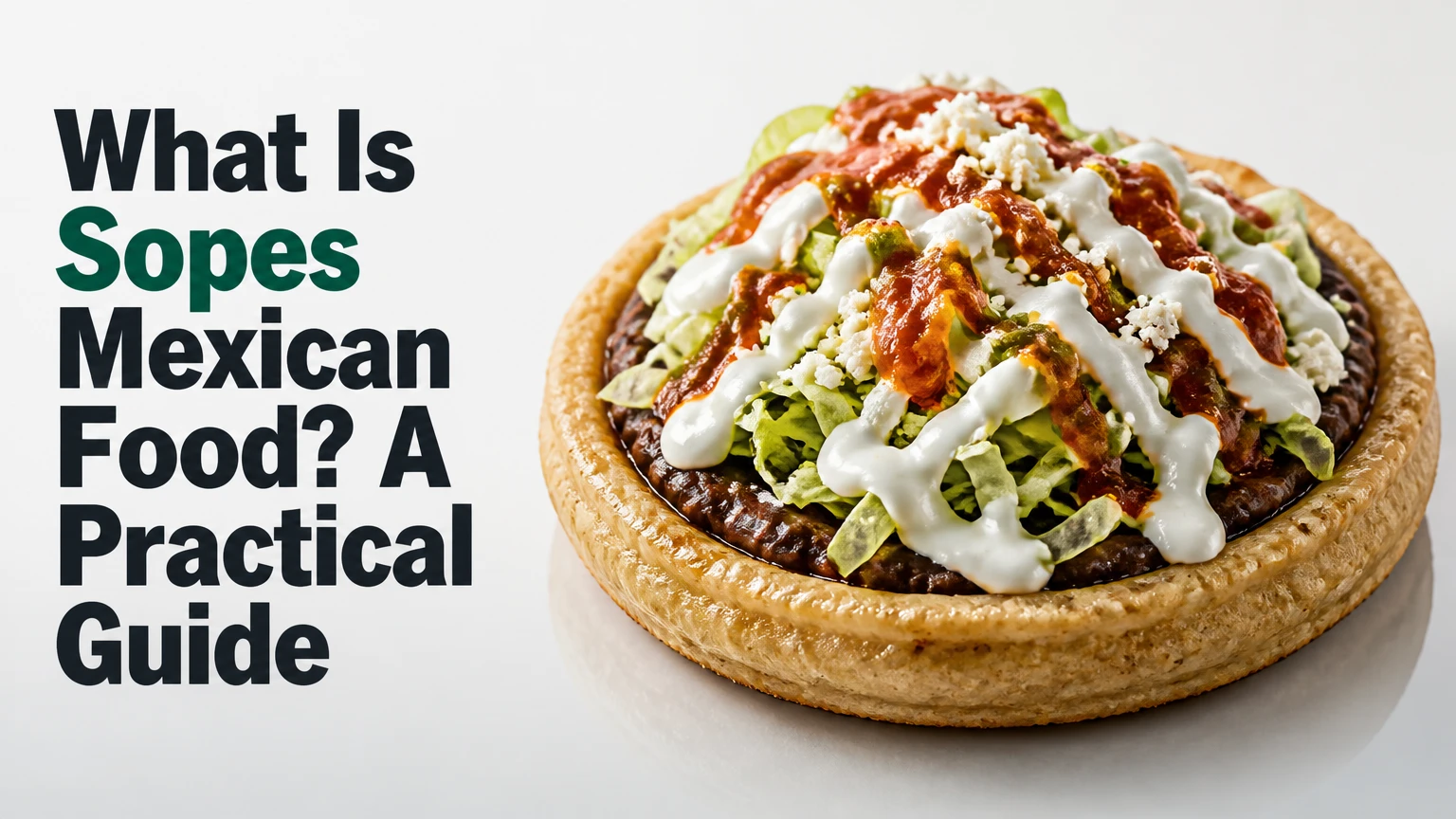
Sopes are traditional Mexican antojitos made from thick, cooked corn masa discs with hand-pinched raised edges that hold beans, meat or vegetables, cheese, crema, lettuce, and salsa. A sope has a tender interior and lightly crisp exterior, making it sturdier than a tortilla but softer and thicker than a tostada.
Key Facts at a Glance
- A sope is the singular form; sopes is the plural.
- Sopes use corn masa made from nixtamalized corn or instant masa harina.
- A typical sope base is approximately 6-8 millimeters thick.
- The raised rim is pinched while the masa is still warm, creating a shallow edible bowl.
- Refried beans usually form the first topping layer because they help shield the masa from wet salsa.
- Sopes are traditionally served fresh as antojitos, breakfast foods, snacks, or part of a larger Mexican meal.
What Is a Sope?
A sope is a small, thick corn-masa base with an upturned edge and savory toppings. The word sope refers to one piece, while sopes describes two or more. In Mexico, the dish belongs to the broad family of antojitos, a category that includes small, masa-based foods prepared for snacks, breakfasts, street meals, and casual gatherings.
Sopes are associated especially with central and southern Mexico, although recipes vary widely by state, town, household, and vendor. The corn foundation connects sopes to Mexico’s long nixtamalized-corn tradition, but the exact modern form and name developed through regional cooking practices rather than one universally documented recipe.
Rick Bayless has described “perfectly made sopes, hot off the griddle” as “about the best thing a person can eat.” The observation captures the defining appeal: fresh sopes combine toasted corn aroma, a soft center, crisp edges, creamy beans, and bright toppings in one bite.
How Is a Sope Constructed?
A sope has four functional parts: the masa base, the raised rim, the bean layer, and the finishing toppings. The base must be thick enough to remain tender after cooking, while the rim must be high enough to contain beans, salsa, and juices without turning the dish into a deep pocket.
| Part | Typical specification | Culinary function |
|---|---|---|
| Masa disc | 6-8 mm thick | Provides a soft, sturdy corn foundation |
| Raised rim | About 6 mm high | Holds beans, salsa, and moist fillings |
| Refried beans | 1-2 tablespoons | Adds flavor and slows moisture absorption |
| Main topping | 2-3 tablespoons | Supplies protein, vegetables, or both |
| Garnish | 1-2 tablespoons total | Adds freshness, acidity, creaminess, or salt |
The shape explains why sopes are often eaten from a plate. A sope is more stable than a flat tostada, but the toppings still make it too open and substantial for clean one-handed eating.
What Are Sopes Made Of?
Sopes are made from corn masa, water, and salt, then cooked and usually finished with oil or another cooking fat. Common toppings include refried beans, shredded chicken, seasoned beef, sausage, mushrooms, cactus, roasted poblano strips, lettuce or cabbage, Mexican crema, crumbled Cotija, and salsa.
The Masa
Fresh masa from a tortilleria gives sopes a pronounced corn fragrance and a slightly more supple texture. Instant masa harina, including products such as Maseca, is more convenient and works well when mixed with warm water until it resembles soft playdough.
The dough should hold together without feeling sticky. If the edge cracks while shaping, add water one teaspoon at a time. If the dough feels wet and clings to plastic, knead in a small amount of masa harina.
Sopes made with properly nixtamalized corn masa are naturally free of wheat gluten. However, packaged masa harina, refried beans, cheese, and prepared toppings can be exposed to gluten during processing, so people with celiac disease should verify labels and cross-contact procedures.
The Toppings
Traditional toppings are flexible rather than fixed. A vendor may use one filling, while a home cook may combine beans, shredded chicken, cheese, salsa, and vegetables.
| Topping category | Examples | Typical amount per sope | Texture contribution |
|---|---|---|---|
| Beans | Pinto, black, or refried beans | 1-2 tbsp | Creamy and dense |
| Meat or poultry | Tinga chicken, shredded beef, sausage | 2-3 tbsp | Savory and substantial |
| Vegetables | Nopales, mushrooms, rajas, potatoes | 2-3 tbsp | Tender, earthy, or smoky |
| Fresh garnish | Lettuce, cabbage, onion, cilantro | 1-2 tbsp | Crisp and fresh |
| Dairy | Crema, Cotija, queso fresco | 1-2 tbsp | Salty or creamy |
| Sauce | Salsa roja, salsa verde, chipotle sauce | 1-2 tsp | Acidic, spicy, and moist |
Layering matters. Beans should usually touch the fried masa first, followed by the main filling, then fresh garnishes, cheese, crema, and salsa.
How Is a Sope Cooked?
A traditional home method cooks the masa first on a dry comal, shapes the warm disc, and then fries or griddles it until the exterior firms. The most important variables are dough hydration, base thickness, quick pinching, and moderate frying heat.
How Do You Make Sopes?
The following method makes approximately 10 medium sopes and takes about 35-45 minutes, including shaping and cooking. A tortilla press helps produce even bases, but a flat plate or small skillet can press the dough if necessary.
Before You Start
| Requirement | Typical amount or setting |
|---|---|
| Masa harina | 2 cups, about 240 g |
| Warm water | 1 1/4-1 1/2 cups, added gradually |
| Salt | 1/2 teaspoon |
| Refried beans | 1 1/2-2 cups |
| Cooking oil | 1/2-1 cup for shallow frying |
| Comal or skillet | Medium-high heat |
| Frying temperature | About 175°C, or 350°F |
| Finished yield | 10 sopes |
| Typical cost | $8-$15 for a batch, excluding specialty equipment |
Step 1: Mix and Rest the Masa
Combine the masa harina and salt, then add warm water gradually while mixing by hand. Knead for 2-3 minutes, cover the dough with a damp towel, and rest it for 10 minutes.
The dough is ready when a small ball flattens without ragged cracks. A dry dough produces broken rims, while excessive water creates bases that stick and deform.
Step 2: Divide the Dough
Separate the dough into 10 portions of approximately 45-50 grams each. Roll each portion into a smooth ball and keep the remaining balls covered.
Uniform portions produce even cooking. Large bases require more topping but take longer to cook through.
Step 3: Press Thick Discs
Place one dough ball between two sheets of plastic and press it into a round disc approximately 7 millimeters thick and 9-10 centimeters wide. Do not press the dough as thin as a tortilla.
The center should remain thick enough to support beans and filling. A thin disc becomes brittle after frying and loses the soft interior that distinguishes a sope.
Step 4: Cook the Disc on a Comal
Place the disc on a dry, preheated comal or cast-iron skillet. Cook for about 60-90 seconds on the first side and 45-60 seconds on the second side, turning when the disc releases naturally.
The surface should show light toasted spots, but the center must remain flexible. Overcooking at this stage dries the masa before the rim can be shaped.
Step 5: Pinch the Warm Rim
Remove the disc and pinch the outer edge upward with your thumb and fingers while the masa remains warm. Rotate the disc as you work, forming a continuous rim about 5-6 millimeters high.
Work through one disc at a time. If the edge cools, it becomes more likely to crack; a clean, damp towel can protect your fingers while retaining heat.
Step 6: Fry or Griddle the Shaped Base
Heat a thin layer of oil to approximately 350°F. Fry each sope for 60-120 seconds per side, turning once, until the outside becomes golden and firm.
A properly cooked base feels crisp at the edge but yields slightly in the center. Drain it briefly on a rack or paper towel before topping.
Step 7: Warm the Beans and Prepare Fillings
Warm the refried beans until spreadable, and keep cooked fillings hot. Shredded chicken, seasoned beef, mushrooms, cactus, potatoes, and poblano strips all work well when excess liquid has been removed.
Wet fillings can soften the masa within minutes. Drain braised meat and vegetables before assembly.
Step 8: Assemble and Serve Immediately
Spread 1-2 tablespoons of beans over each base, leaving the raised rim visible. Add the main filling, then finish with lettuce or cabbage, cheese, crema, and a measured spoonful of salsa.
Serve sopes while warm. Fresh assembly preserves the contrast between crisp exterior, tender center, creamy beans, and bright toppings.
Which Regional Styles Should You Know?
Regional names do not always describe identical foods, and local usage can overlap. Sopes Tapatíos, pellizcadas, picadas, and garnachas share the broader idea of cooked masa with toppings, but their shape, sauce, cooking method, and regional identity differ.
| Style | Common association | Base or method | Typical toppings |
|---|---|---|---|
| Sopes Tapatíos | Guadalajara, Jalisco | Often sauced or prepared with a regional fried base | Potatoes, sausage, salsa, cheese |
| Pellizcadas | Veracruz and Oaxaca | Larger pinched masa, often simply cooked on a comal | Salsa, onion, fresh cheese |
| Picadas | Veracruz | Thick masa with the rim pinched around salsa | Red or green salsa, onion, cheese |
| Garnachas | Isthmus of Tehuantepec | Small, thick, fried masa rounds | Minced meat, pickled cabbage, salsa |
| Sopes | Central and southern Mexico | Thick disc with raised edge, fried or griddled | Beans, meat, vegetables, garnishes |
The word pellizcada relates to pinching, while picada can refer to a sauced, pinched masa preparation. Names are not interchangeable in every region, so a restaurant menu may use the local term rather than the broad category “sope.”
Which Toppings Work Best?
The best sope topping depends on whether the goal is a rich meal, a lighter breakfast, or a vegetarian plate. Beans and a concentrated filling create the most stable base, while watery stews should be drained before serving.
| Eating style | Recommended combination | Preparation note | Typical flavor profile |
|---|---|---|---|
| Classic | Refried beans, shredded chicken, lettuce, crema, Cotija | Keep chicken lightly sauced | Savory, creamy, fresh |
| Spicy | Beans, sausage, potato, salsa roja, onion | Brown sausage and drain excess fat | Smoky and chile-forward |
| Vegetarian | Black beans, mushrooms, rajas, queso fresco | Cook vegetables until their liquid evaporates | Earthy and mildly sweet |
| Plant-based | Refried beans, nopales, mushrooms, cabbage, avocado | Use plant-based crema or omit dairy | Fresh, tangy, and earthy |
| Breakfast | Beans, scrambled egg, potato, salsa verde | Serve two smaller sopes | Soft, savory, and bright |
Rajas con crema combines roasted poblano strips, dairy cream, and often corn. Nopales contribute a pleasantly firm texture when cooked until their excess moisture has evaporated. Chicharrón in green salsa adds a soft, sauce-absorbing filling, but it should be spooned on shortly before serving.
How Are Sopes Different From Related Mexican Foods?
Sopes differ from related masa foods mainly through their raised rim and thick, open structure. Tostadas are thin and flat, tlacoyos are usually oval and stuffed, huaraches are elongated, and gorditas are thicker preparations that may be split or filled.
| Food | Shape | Typical thickness | Main structural feature | Eating experience |
|---|---|---|---|---|
| Sope | Round | 6-8 mm | Pinched raised rim | Crisp edge, soft middle, open toppings |
| Tostada | Round | About 2-3 mm | Flat fried disc | Brittle and fully crunchy |
| Tlacoyo | Oval | 10-15 mm | Filling inside masa | Dense, chewy, grilled or griddled |
| Huarache | Long oval | 8-12 mm | Foot-shaped masa base | Large, soft, lightly crisped |
| Gordita | Round | 12-20 mm | Thick base, often opened | Pillowy and more handheld |
| Memela | Oval or round | 5-8 mm | Thin masa with simple topping | Toasted, saucy, and less heavily loaded |
A sope is the better choice when you want substantial toppings without the complete brittleness of a tostada. A tostada offers more crunch, while a gordita works better when portability matters.
Are Sopes Healthy or High in Calories?
Sopes can fit many eating patterns, but fried masa, beans, cheese, crema, and rich fillings make a typical serving energy-dense. A practical portion is two medium sopes with beans and vegetables, while three heavily topped sopes can function as a full meal.
| Component | Typical portion | Approximate energy range |
|---|---|---|
| Fried masa base | 1 medium sope | 120-180 calories |
| Refried beans | 2 tbsp | 35-70 calories |
| Shredded chicken | 2 tbsp | 40-70 calories |
| Cheese and crema | 1 tbsp each | 50-90 calories |
| Salsa and lettuce | 2 tbsp total | 5-20 calories |
| Fully topped sope | 1 medium piece | 250-430 calories |
These are typical kitchen estimates, not standardized nutrition data. Oil absorption, base size, filling quantity, and bean preparation can change the result substantially.
For a lighter plate, use smaller bases, griddle them with a thin oil coating, choose beans and vegetables, and keep cheese or crema measured. Removing every rich component can make the dish dry, so retaining one creamy element often gives better texture and satisfaction.
How Much Do Sopes Cost?
A homemade sope typically costs about $0.80-$1.50 per finished piece when masa harina, beans, and everyday toppings are purchased at standard grocery prices. Restaurant and street-vendor pricing commonly falls between $3 and $6 per piece in the United States, with regional and location-based variation.
| Setting | Typical price | Serving size | Main cost driver |
|---|---|---|---|
| Homemade, bean and vegetable | $0.80-$1.20 each | 2-3 pieces | Toppings and cooking oil |
| Homemade, meat-filled | $1.10-$1.80 each | 2-3 pieces | Chicken, beef, or sausage |
| Casual restaurant | $3-$6 each | 2-3 pieces | Labor and prepared fillings |
| Street vendor | $2-$5 each | 2-4 pieces | Location and topping quantity |
| Catered platter | $4-$8 each | 3-6 pieces | Service, transport, and garnish |
Prices should be treated as typical ranges rather than fixed national rates. Fresh masa from a tortilleria may cost more than packaged flour, but it can reduce mixing time and improve texture.
Why Do Homemade Sopes Fail?
Homemade sopes most often fail because the masa is too dry, the discs are too thin, the warm rim is shaped too slowly, or the frying temperature is low. Each problem has a recognizable symptom and a specific correction.
| Symptom | Likely cause | Immediate fix | Prevention |
|---|---|---|---|
| Rim cracks during pinching | Dry or cool masa | Knead in warm water and pinch faster | Keep dough covered |
| Base turns hard | Overcooking or excessive frying | Reduce comal and frying time | Use 350°F oil |
| Base absorbs oil | Oil below 325°F | Reheat oil before next batch | Fry small batches |
| Toppings slide off | Rim too low or filling too wet | Drain filling and use less salsa | Build a 5-6 mm rim |
| Masa sticks to plastic | Dough too wet | Add masa harina gradually | Use measured water |
| Bottom becomes soggy | Salsa added too early | Assemble immediately before eating | Spread beans first |
A counterintuitive rule matters here: a sope does not become better because it is fried until completely rigid. The ideal texture depends on preserving moisture inside the masa while setting only the exterior.
Another practitioner rule is to prepare every topping before frying the final batch. Hot sopes lose their best texture while waiting for lettuce, cheese, or salsa to be chopped.
Can Sopes Be Baked or Reheated?
Sopes can be baked or air-fried, but those methods produce a drier, less traditional texture than shallow frying. For reheating, use a dry skillet or 375°F oven before adding toppings, because microwave heating softens the masa and makes the rim chewy.
Baking and Air-Frying
For a lower-oil version, cook and pinch the bases, brush them lightly with oil, and bake at 400°F for approximately 8-12 minutes, turning once. An air fryer usually takes 4-7 minutes at 400°F, depending on base thickness and equipment.
The result is practical but not identical to a fried sope. Baking emphasizes toasted corn flavor and reduces surface oil, while frying produces a more defined crisp exterior.
Storage and Freezing
Store un-topped cooked bases in an airtight container for up to three days in the refrigerator. Freeze them in a single layer, then transfer them to a sealed bag for up to one month; reheat directly from frozen in a skillet or oven.
Do not freeze assembled sopes. Beans, salsa, lettuce, and crema release moisture at different rates, so freezing them together damages texture.
The Bottom Line
What is sopes Mexican food? Sopes are thick, open-faced Mexican antojitos built from pinched corn-masa bases, usually layered with refried beans, a savory filling, fresh garnishes, cheese, crema, and salsa. The defining feature is the raised rim, which separates sopes from flat tostadas and stuffed or elongated masa dishes.
For the most traditional texture, use hydrated masa, keep the base 6-8 millimeters thick, pinch the rim while warm, fry at about 350°F, and assemble immediately. Sopes are best when the corn base remains tender inside and crisp outside.
Frequently Asked Questions
Are sopes the same as Mexican tacos?
No. Tacos use a thin tortilla folded around a filling, while sopes use a thick, open masa base with a raised rim. Sopes hold toppings on top rather than enclosing them, and their texture combines a tender center with a crisp exterior.
Are sopes always fried?
No. Many sopes are finished in oil, but some regional or home versions are cooked primarily on a comal. Baking and air-frying also work, although they create a drier surface and less pronounced fried flavor than traditional shallow frying.
Do you eat sopes for breakfast?
Yes. Sopes are commonly served for breakfast, lunch, snacks, and casual dinners. Breakfast versions often use beans, egg, potatoes, salsa, cheese, or sausage, while later meals may feature chicken, beef, cactus, mushrooms, or stewed vegetables.
Can you make sopes without a tortilla press?
Yes. Press each dough ball between sheets of plastic with a flat plate, skillet, or heavy cutting board. Apply even pressure until the base reaches about 7 millimeters, then smooth uneven edges before placing the disc on the comal.
Can sopes be made ahead?
Yes. Cooked, untopped sope bases can be refrigerated for three days or frozen for about one month. Reheat the bases until crisp, then add beans and toppings immediately before serving to prevent moisture from softening the masa.
What salsa is best on sopes?
Salsa roja and salsa verde are both suitable. Salsa roja usually contributes deeper chile and tomato flavor, while salsa verde adds sharper acidity from tomatillos. Use a small amount first, then add more at the table so the base remains firm.