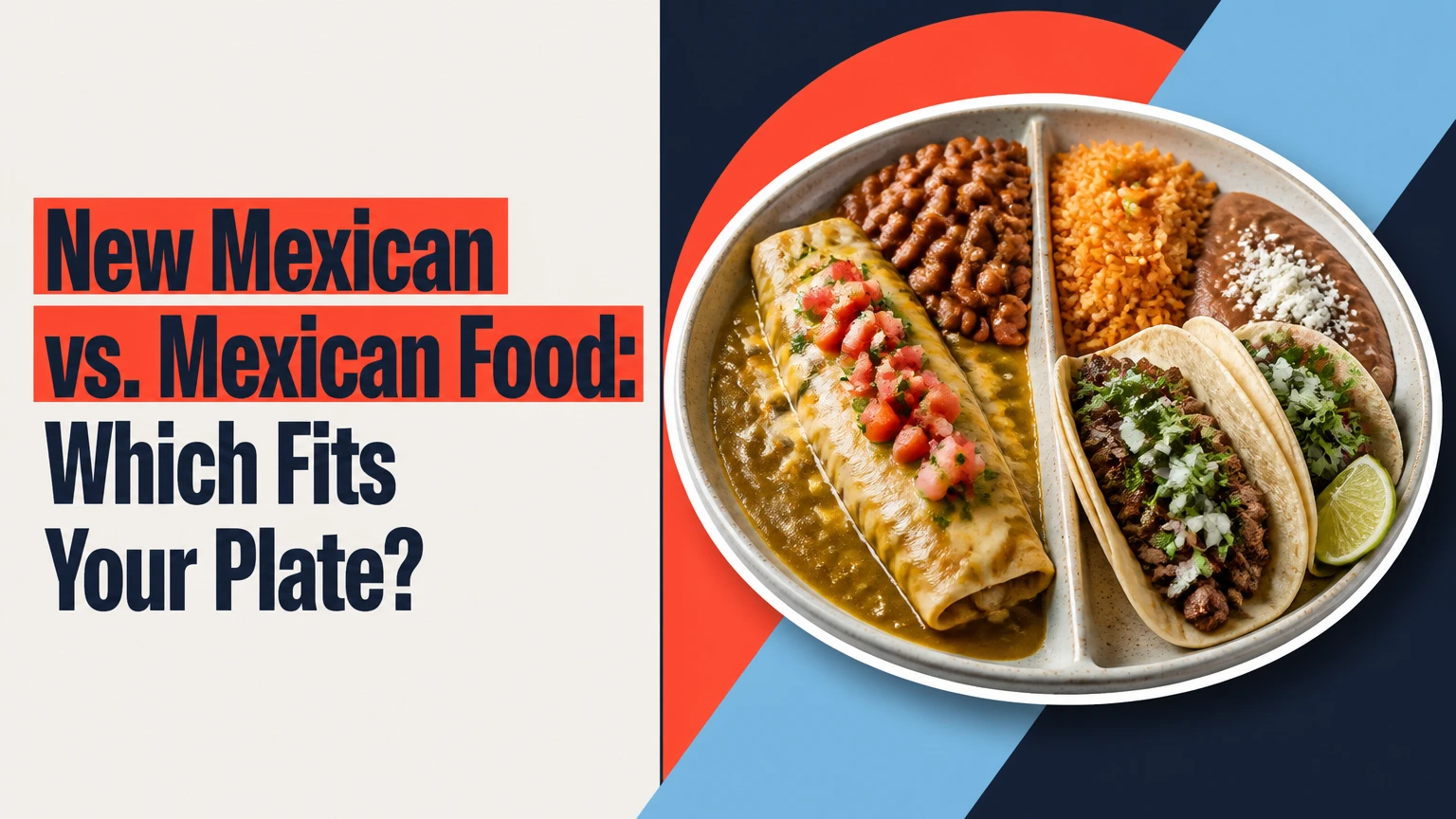
New Mexican food is a regional cuisine from New Mexico, while Mexican food describes the diverse cuisines of Mexico’s many regions. Both use corn, beans, chile, and Spanish-language culinary terms, but New Mexican cooking centers on local red and green chile, while Mexican cooking draws on hundreds of regional ingredients, techniques, and flavor systems.
Key Facts at a Glance
- New Mexican cuisine is a distinct regional food tradition shaped by Pueblo, Hispano, Mexican, and later American influences.
- Mexican cuisine includes regional styles such as Oaxacan, Yucatecan, Pueblan, Veracruz, Sonoran, and Jaliscan cooking.
- New Mexican red chile usually comes from dried New Mexico-type pods; green chile usually comes from roasted, chopped green pods.
- Mexican green salsa commonly gets its acidity from tomatillos, whereas New Mexican green chile is usually pepper-forward and roasted.
- Mexican enchiladas are commonly rolled, while New Mexican enchiladas are often stacked, although both formats occur in both cuisines.
- “Christmas” on a New Mexico menu means ordering both red and green chile on the same dish.
What Is the Difference Between New Mexican and Mexican Food?
The central difference is culinary geography. Mexican food represents numerous cuisines across Mexico, whereas New Mexican food developed around the Rio Grande Valley, Pueblo agriculture, Hispano settlements, trade routes, and ingredients suited to New Mexico’s high-desert environment.
The comparison becomes misleading when “Mexican food” means one generic restaurant style. A Yucatecan cochinita-style dish, an Oaxacan mole, a Sonoran flour-tortilla meal, and a Pueblan pipián can differ as much from one another as any of them differs from New Mexican cooking.
UNESCO listed traditional Mexican cuisine as Intangible Cultural Heritage in 2010, describing it as “a comprehensive cultural model comprising farming, ritual practices, age-old skills, culinary techniques and ancestral community customs and manners.” The designation applies to a living, diverse system, not a single national menu.
New Mexican food has its own identity because the chile plant became the organizing ingredient. Red chile and green chile appear in sauces, stews, breakfast plates, burgers, enchiladas, beans, and vegetable dishes. That repeated use creates a recognizable flavor vocabulary.
Is New Mexican Food Mexican Food?
New Mexican food is Mexican-American regional food with Indigenous and Hispano foundations, but it is not interchangeable with the cuisines of Mexico. New Mexico was part of Mexico from 1821 to 1848, and cultural exchange continued across the border, yet local agriculture and centuries of regional adaptation produced a separate food identity.
| Attribute | Mexican cuisine | New Mexican cuisine |
|---|---|---|
| Geographic scope | 32 Mexican states and many regional traditions | New Mexico, especially the Rio Grande corridor |
| Culinary formation | Indigenous, Spanish, African, Asian, and local influences | Pueblo, Hispano, Mexican, Native, and United States influences |
| Primary sauce identity | Salsas, adobos, moles, pipianes, recados | Red chile and green chile |
| Common tortilla emphasis | Corn tortillas in much of Mexico, with regional flour use | Corn, flour, blue corn, and fry bread depending on dish |
| Typical plate structure | Tacos, regional stews, antojitos, soups, rice, beans | Chile-covered plates, enchiladas, burritos, beans, potatoes |
| Signature ordering language | Salsa choice varies by region and restaurant | Red, green, or Christmas |
Why Does Chile Define New Mexican Cooking?
Chile defines New Mexican cooking because the pepper often functions as the main sauce, seasoning, and vegetable at once. In Mexican cuisines, chiles also carry major importance, but they are distributed across many species, preparation methods, and regional recipes rather than one dominant New Mexico menu vocabulary.
New Mexico’s green chile is generally harvested while green, roasted over flame, peeled, chopped, and simmered with aromatics. Red chile comes from mature pods that are dried and rehydrated or ground into powder. A restaurant’s sauce may be smooth, chunky, thin, thickened, mild, or intensely hot.
The New Mexico No. 9 breeding line, developed at New Mexico State University in the early twentieth century, helped establish the modern New Mexico chile family. “Hatch chile” is widely used as a place-associated name, although Hatch is a community and growing region, not one single pepper variety. Varieties such as NuMex Big Jim, Sandia, Barker, and Lumbre differ in size, flavor, and heat.
| Chile style | Typical form | Typical heat range | Main sensory effect | Common New Mexican use |
|---|---|---|---|---|
| Green chile | Roasted, peeled, chopped | About 1,000-10,000 SHU | Herbaceous, smoky, vegetal | Stew, eggs, burgers, enchiladas |
| Red chile pods | Dried, rehydrated, blended | About 1,000-10,000 SHU | Earthy, fruity, deep | Sauce, enchiladas, adovada |
| Jalapeño | Fresh or pickled | About 2,500-8,000 SHU | Bright, grassy, sharp | Mexican salsa, escabeche, toppings |
| Serrano | Fresh | About 10,000-23,000 SHU | Green, clean, hotter | Salsa verde, pico de gallo |
| Habanero | Fresh or dried | About 100,000-350,000 SHU | Floral, tropical, intense | Yucatecan sauces and hot salsas |
Scoville Heat Units measure capsaicinoid concentration in the pepper, not the heat of a finished serving. A mild green chile sauce can feel substantial because a cup of sauce contains a large amount of pepper, while a tiny habanero salsa can taste hotter despite being used sparingly.
Red, Green, or Christmas: What Should You Order?
Order red chile for a deeper, dried-fruit flavor; green chile for roasted, fresh-pepper character; and Christmas for both sauces on one plate. Heat varies by harvest and restaurant, so “green” is not automatically mild and “red” is not automatically hotter.
| Order term | What arrives | Flavor direction | Best first dish |
|---|---|---|---|
| Red | Red chile sauce or stew | Earthy, rounded, dried-fruit notes | Red enchiladas |
| Green | Roasted green chile sauce or stew | Smoky, vegetal, sharper | Green chile stew |
| Christmas | Red and green together | Two sauces in one meal | Enchilada plate |
| Mild | Lower-heat chile batch | Pepper flavor with less burn | Breakfast burrito |
| Hot | Higher-heat chile batch | Stronger capsaicin impact | Chile stew or enchiladas |
A useful restaurant question is, “Is the green chile tomatillo-based or roasted New Mexico chile?” In New Mexico, the answer is usually roasted pepper. At a Mexican restaurant outside New Mexico, “green sauce” commonly means salsa verde built around tomatillos.
How Do Sauces, Herbs, and Spices Compare?
Mexican sauces use a broader set of flavor structures, including raw salsas, cooked salsas, adobos, pipianes, recados, and moles. Tomatillos contribute acidity to many green sauces, while dried chiles, seeds, nuts, spices, fruit, and sometimes cacao create complexity in mole traditions.
New Mexican chile sauces usually put the pepper first. Garlic, salt, onion, and oregano may support the sauce, and some cooks add flour or another thickener, but the exact formula varies by household and restaurant. Cumin is not a universal prohibition, although many traditional New Mexican chile specialists omit it because its warm, savory profile can push the sauce toward a Tex-Mex taste.
Claims that New Mexican cooking completely excludes lime, avocado, or cilantro are too absolute. Those ingredients were historically less central in many northern New Mexico foodways, but contemporary cooks and restaurants use them, particularly in fusion dishes, garnishes, and dishes influenced by broader Mexican cooking.
| Flavor component | Mexican cuisine example | New Mexican cuisine example | Practical consequence |
|---|---|---|---|
| Acidity | Lime, tomatillo, sour orange, vinegar | Usually less prominent in chile gravy | Mexican sauces often taste sharper |
| Dried chile | Ancho, guajillo, pasilla, chipotle | New Mexico red pods | Both can be earthy, but the chile families differ |
| Fresh chile | Serrano, jalapeño, habanero | Roasted New Mexico green chile | Roasting changes aroma and texture |
| Herbs | Cilantro, epazote, hoja santa, Mexican oregano | Mexican oregano, oregano, local household variations | Herb profiles vary by region and recipe |
| Spice blends | Cumin, clove, cinnamon, achiote, black pepper | Garlic, salt, oregano, variable household seasoning | New Mexican sauces often taste simpler and more pepper-centered |
| Thickening | Masa, seeds, nuts, bread, reduced vegetables | Flour roux, reduction, blended chile flesh | Texture differs by recipe and cook |
Which Dishes Show the Difference Most Clearly?
Enchiladas provide the clearest side-by-side example. Mexican enchiladas are often made by softening corn tortillas in sauce, filling them, rolling them, and adding toppings. New Mexican enchiladas are frequently stacked flat, layered with cheese and red or green chile, and sometimes finished with a fried egg.
The formats overlap. Rolled enchiladas exist in New Mexico, and stacked enchiladas exist in Mexican regional cooking. The sauce, tortilla treatment, filling, and serving context matter more than shape alone.
Carne adovada is a New Mexican preparation in which cubes of meat are marinated and slow-cooked in red chile. Mexican adobo is a much broader category that may use different dried chiles, vinegar, herbs, spices, and cooking methods. Similar names do not indicate identical recipes.
| Dish category | Mexican preparation | New Mexican preparation | Typical service |
|---|---|---|---|
| Enchiladas | Rolled corn tortillas with regional sauce | Stacked corn or blue-corn tortillas with red or green chile | Cheese, onion, sometimes egg |
| Hominy stew | Pozole with hominy, meat, broth, and fresh garnishes | Posole with hominy and chile-centered broth | Garnishes vary by household |
| Chile-braised meat | Adobo or regional braise with varied chile and acid | Carne adovada with red New Mexico chile | Rice, beans, tortillas |
| Stuffed pepper | Chile relleno with battered or unbattered pepper | Green chile relleno, often cheese-filled | Chile sauce or chile gravy |
| Vegetable dish | Nopales, esquites, calabaza, or regional vegetables | Calabacitas with squash, corn, onion, and green chile | Side dish or vegetarian plate |
| Breakfast dish | Chilaquiles, huevos rancheros, tamales | Eggs with red or green chile, potatoes, beans, and tortillas | Breakfast plate or burrito |
New Mexican posole often emphasizes the chile broth and hominy, while Mexican pozole frequently arrives with cabbage, radish, onion, oregano, and lime at the table. Neither pattern is universal, and family recipes can combine both approaches.
Are the Tortillas and Side Dishes Different?
New Mexican meals commonly pair chile with pinto beans, potatoes, cheese, and flour tortillas, although corn and blue corn remain important. Mexican meals more often foreground nixtamalized corn tortillas, but northern Mexican cuisines also have strong flour-tortilla traditions.
Nixtamalization cooks dried corn with an alkaline solution before grinding it into masa. The process improves dough handling and changes the corn’s aroma, texture, and nutritional profile, including niacin availability. New Mexican blue-corn tortillas use a regional corn tradition and often have a denser, earthier flavor.
| Component | Mexican cuisine | New Mexican cuisine | Important exception |
|---|---|---|---|
| Beans | Black beans, pinto beans, regional varieties | Pinto beans, often slow-cooked | Mexican northern cooking also favors pinto beans |
| Rice | Tomato-seasoned rice, white rice, regional rice dishes | Rice appears, but potatoes often carry more plate space | Restaurants may offer Spanish-style rice |
| Potatoes | Common in tacos, stews, and home cooking | Papitas are common with breakfast and chile plates | Potatoes are not exclusive to New Mexico |
| Squash and corn | Calabaza, esquites, and regional vegetable dishes | Calabacitas with squash, corn, onion, and green chile | Recipes vary widely by household |
| Bread and dough | Bolillos, pan dulce, churros, tortillas | Flour tortillas, sopaipillas, biscochitos | Sopaipillas also exist elsewhere |
| Garnishes | Lime, onion, cilantro, cabbage, radish | Cheese, onion, lettuce, tomato, chile | Modern menus freely cross-pollinate |
Sopaipillas are fried, hollow pastries commonly served with honey in New Mexico, while biscochitos are anise-flavored shortbread cookies associated with New Mexican Hispano tradition. Churros and tres leches cake belong to broader Mexican and Spanish-speaking dessert traditions, although restaurants may serve all of these items together.
Which Cuisine Is Hotter and More Filling?
Neither cuisine has a single heat level. Mexican cooking can range from nearly mild to extremely hot because pepper choice, seed removal, salsa quantity, and regional habits vary. New Mexican meals can feel hotter because chile sauce is served by the cup over the main food rather than by the spoonful as a table condiment.
New Mexican plates are often heavier because cheese, beans, potatoes, flour tortillas, and thick chile sauces appear together. Mexican food can be equally substantial, especially in dishes such as birria, tamales, mole, tortas, and regional stews, but many street foods offer smaller portions with sharper fresh garnishes.
| Eating factor | Mexican food, typical range | New Mexican food, typical range | Decision effect |
|---|---|---|---|
| Street taco price in United States | $2.50-$5 each | Less common as a defining format | Mexican style is easier for small meals |
| Casual breakfast or burrito | $8-$16 | $7-$15 | Similar entry cost in many cities |
| Sit-down entrée | $14-$28 | $14-$30 | Location and meat choice dominate price |
| Home preparation time | 30 minutes to 2 days | 30 minutes to 1 day | Mole and nixtamalization extend Mexican projects |
| Main sauce quantity | 2-6 tablespoons per item | 1/4-1 cup per plate | New Mexican chile has a larger sensory role |
| Typical fullness | Snack to full plate | Full plate, often with sides | New Mexican meals suit hearty appetites |
These are typical United States ranges, not fixed prices. Santa Fe, Albuquerque, Mexico City, Los Angeles, and a small rural town can have very different menu economics.
How Long Do These Foods Take to Make?
A quick salsa or green chile dish can take 30-60 minutes, while mole, fresh masa, or a large batch of red chile requires extended preparation. New Mexican green chile becomes practical in 45-90 minutes when frozen roasted chile is available, while red chile sauce usually takes 60-120 minutes including stem removal, simmering, and blending.
| Preparation | Main labor | Typical active time | Typical total time |
|---|---|---|---|
| Fresh Mexican salsa | Chop, roast, or blend ingredients | 15-30 minutes | 15-30 minutes |
| Mexican salsa verde | Roast tomatillos and peppers, blend, simmer | 25-40 minutes | 30-45 minutes |
| New Mexican green chile stew | Chop vegetables, simmer roasted chile | 30-45 minutes | 60-90 minutes |
| New Mexican red chile sauce | Toast or rinse pods, simmer, blend, strain | 35-60 minutes | 60-120 minutes |
| Fresh masa | Nixtamalize, rinse, grind, hydrate | 2-4 hours active | 12-24 hours |
| Mole | Roast, grind, fry, blend, and simmer | 6-10 hours | 1-2 days |
The annual green-chile harvest creates a distinctive preservation cycle. In southern New Mexico, households and businesses commonly buy large sacks during late summer, roast the peppers, remove skins, and freeze portions for later use. A 40-pound sack is a bulk-buying example, not a required household quantity.
What Are the Biggest Cooking and Ordering Mistakes?
The most common mistake is treating every green sauce as the same product. Tomatillo salsa verde is acidic and often fluid; New Mexican green chile is usually roasted pepper flesh cooked into a sauce or stew. Substituting one for the other changes the dish’s identity, not merely its color.
A second mistake is judging authenticity by one ingredient. New Mexican cooks disagree about roux, cumin, tomatoes, cilantro, and sauce thickness because regional and family recipes differ. A better test is whether the dish’s technique and flavor balance make sense within its stated tradition.
Four Fixes That Improve the Result
- Too much cumin in red chile: Prepare a fresh batch without cumin and blend it into the first batch gradually. Extra garlic, oregano, and salt cannot fully erase a dominant cumin flavor.
- Bitter red sauce: Discard scorched pods and simmer fresh rinsed pods with water, garlic, and salt. Toasting should warm the aroma, not blacken the skin.
- Watery green chile: Reduce the sauce uncovered for 10-20 minutes, or blend a small portion of the peppers to release natural body.
- Unexpected heat: Dilute with unsalted broth, potatoes, beans, or additional roasted mild chile. Sugar masks heat briefly but can damage the sauce’s balance.
A practitioner rule is to taste the chile before committing the whole pot. Harvest maturity, growing conditions, and storage can move heat far beyond what a variety label predicts.
Which Should You Choose?
Choose Mexican food when you want maximum regional variety, fresh acidic garnishes, corn-based street foods, or a dish tied to a specific area such as Oaxaca, Puebla, Yucatán, or northern Mexico. Choose New Mexican food when you want chile-forward comfort food, smoky roasted peppers, stacked enchiladas, breakfast burritos, or red-and-green sauce on one plate.
| Diner situation | Better starting choice | Order or cook | Reason |
|---|---|---|---|
| First-time visitor to New Mexico | New Mexican | Christmas enchiladas | Samples both signature chile styles |
| Fresh, bright flavors | Mexican | Salsa verde, tacos, or ceviche-style regional dish | Lime, tomatillo, herbs, and raw garnishes lead |
| Cold-weather comfort | New Mexican | Green chile stew with beans | Hot chile broth and hearty sides satisfy |
| Regional food researcher | Mexican | Oaxacan mole or Yucatecan recado | Shows how much Mexican cuisine varies |
| Heat-sensitive diner | Either, after asking | Mild chile or salsa on the side | Pepper intensity varies by batch |
| Vegetarian diner | Either | Calabacitas or bean-and-cheese enchiladas | Both traditions offer meat-free options |
| Fast weeknight meal | Mexican | Tacos with purchased tortillas | Assembly can take under 30 minutes |
| Slow weekend project | Either | Mole or red chile sauce | Roasting, grinding, and simmering reward time |
New Mexican food is not the best choice for someone seeking a light meal with minimal cheese or sauce, although lighter vegetable plates and bean dishes exist. Mexican food is not automatically healthier or less filling, because fried foods, large portions, rich sauces, and cheese occur throughout both traditions.
FAQ
Is New Mexican Food the Same as Tex-Mex?
New Mexican food and Tex-Mex are separate regional cuisines. Tex-Mex commonly emphasizes beef, flour tortillas, cumin-seasoned fillings, yellow cheese, and chili con carne, while New Mexican food centers on red and green chile, pinto beans, blue corn, enchiladas, and local chile preparations. Restaurants can combine elements, but the traditions have different histories.
What Does Green Chile Mean in Mexico?
In Mexican cooking, green chile can refer to a fresh green pepper, a salsa made with tomatillos, or a regional preparation whose ingredients depend on location. In New Mexico, green chile usually means roasted New Mexico-type peppers cooked into a sauce or stew. Ask about tomatillos when ordering outside New Mexico.
Can You Make New Mexican Food Without Hatch Chile?
You can approximate New Mexican food with another New Mexico-type pepper, Anaheim pepper, poblano, or a mixture of mild green peppers, but the aroma and heat will change. Frozen roasted chile is usually a better substitute than raw supermarket peppers because roasting supplies the characteristic smoky texture.
Is Red or Green Chile Better?
Red and green chile are different rather than universally better. Red chile offers dried, earthy, rounded flavor, while green chile brings roasted, vegetal sharpness. Order Christmas when choosing is difficult, provided the restaurant offers both sauces on the same plate.
Does Mexican Food Always Use Corn Tortillas?
Mexican food does not always use corn tortillas. Northern Mexican regions have long traditions of flour tortillas, and wheat bread, tostadas, masa dishes, and other starches also appear across Mexico. Corn remains foundational because nixtamalized masa supports tortillas, tamales, sopes, and many other preparations.
What Is the Best First New Mexican Dish?
A Christmas enchilada plate is the most informative first dish because it compares red and green chile in one meal. Add pinto beans and a sopaipilla if you want the classic restaurant pattern, but request mild chile if you do not know your heat tolerance.
The Bottom Line
New Mexican vs Mexican food is a comparison between one distinctive regional cuisine and a large family of national regional cuisines. Mexican food offers wider variation in sauces, chiles, garnishes, and cooking techniques; New Mexican food offers a more concentrated identity built around roasted green chile, dried red chile, beans, potatoes, tortillas, and comfort-oriented plates. Choose Mexican food for regional exploration, or choose New Mexican food for a chile-centered meal.