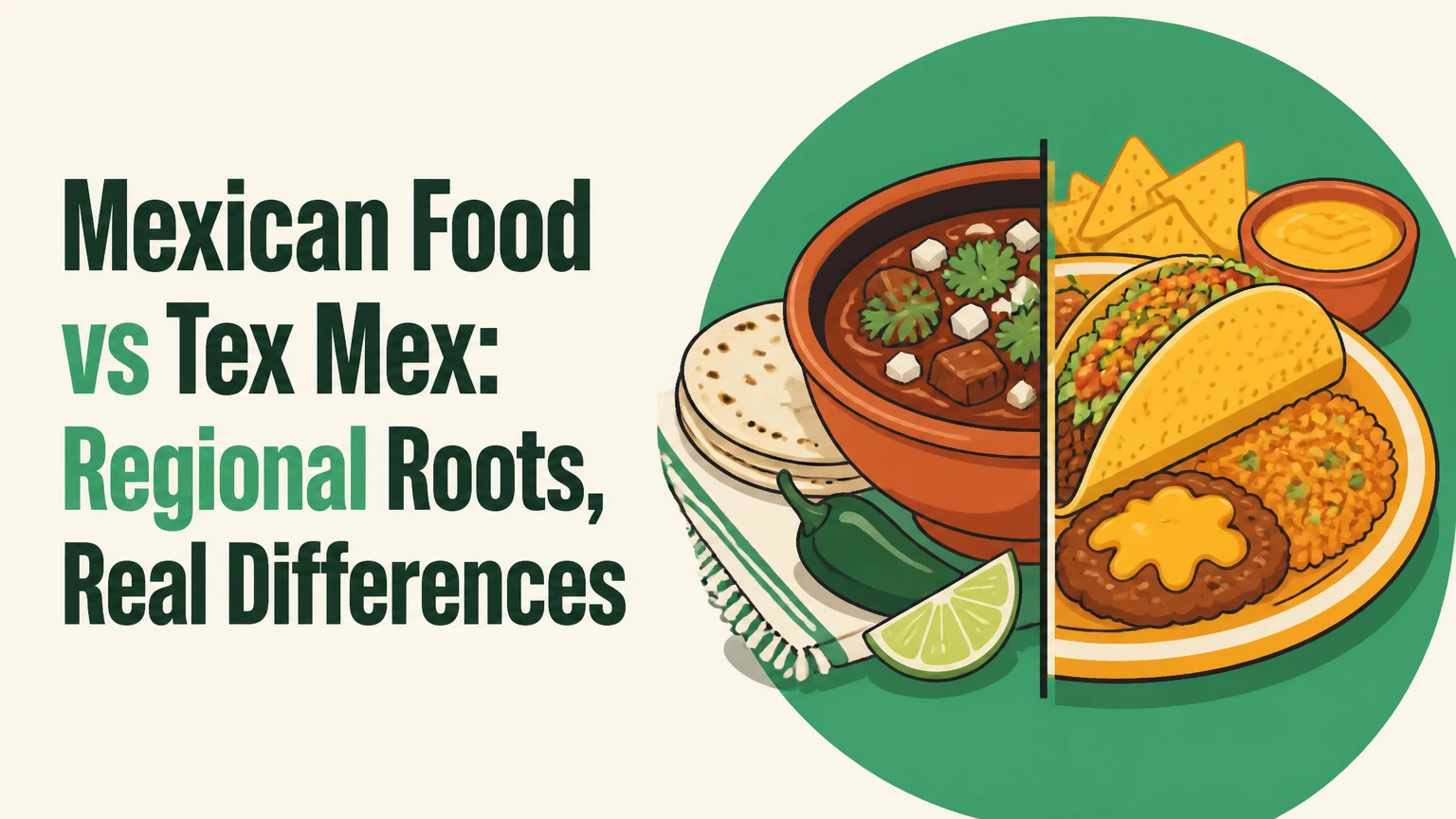
Mexican food is a diverse group of regional cuisines from Mexico, while Tex-Mex is a Mexican-American cuisine that developed mainly in Texas through Tejano cooking and locally available ingredients. Mexican cooking commonly emphasizes regional chile sauces, nixtamalized corn, and varied traditions; Tex-Mex more often features wheat tortillas, beef, cumin-seasoned fillings, chili gravy, and melted cheese.
Key Facts at a Glance
- Mexican food varies by region, with Oaxaca, Puebla, Yucatán, Veracruz, Jalisco, and northern Mexico using different ingredients and techniques.
- Tex-Mex originated from Tejano communities in Texas and is a distinct regional cuisine, not merely a simplified version of Mexican food.
- Nixtamalized corn tortillas are central to many Mexican dishes, while large wheat tortillas are especially associated with northern Mexico and Tex-Mex.
- Tex-Mex commonly combines beef, refried beans, yellow or Monterey Jack-style cheese, cumin, flour tortillas, and chili gravy.
- Mexican cuisine can use cumin, wheat, melted cheese, and beef, so no single ingredient proves that a dish is or is not Mexican.
- The best choice depends on the dish, region, dietary needs, budget, and whether you prefer layered chile flavor or rich, cheesy comfort food.
What Is the Difference Between Mexican Food and Tex-Mex?
The main difference is culinary geography and development: Mexican food comes from Mexico’s many regional food traditions, whereas Tex-Mex developed in Texas from Tejano home cooking, Mexican techniques, and United States ingredients. The cuisines overlap heavily, but their typical tortilla choices, sauces, seasoning patterns, and restaurant formats differ.
“Mexican food” is an umbrella term. A seafood dish from Veracruz, a mole from Oaxaca, a stew from northern Mexico, and a Yucatecan achiote preparation may share ingredients while tasting entirely different. Calling one flavor profile “authentic Mexican” erases that regional range.
Tex-Mex is also a legitimate cuisine with its own history. The term describes food shaped by the Texas-Mexico border, San Antonio’s Mexican-American communities, ranching culture, railroads, commercial food production, and later restaurant standardization. The distinction is cultural and historical, not a ranking of quality.
Master Comparison Table
| Decision factor | Regional Mexican food | Tex-Mex cuisine |
|---|---|---|
| Culinary origin | Mexico’s regional traditions, including Oaxaca and Yucatán | Tejano and Texas border cooking |
| Common tortilla | Corn, often 10-15 cm for tacos | Flour, often 20-30 cm for burritos and fajitas |
| Typical chile use | Fresh, dried, smoked, fermented, or pickled chiles | Jalapeño, cayenne, and blended chili powder |
| Common seasoning | Mexican oregano, epazote, cilantro, achiote, toasted spices | Cumin, garlic, black pepper, chili powder |
| Frequent cheese style | Queso fresco, Cotija, Oaxaca, Asadero | Cheddar, Monterey Jack, American-style melting cheese |
| Common bean presentation | Whole pot beans or lightly mashed beans | Refried beans, often smooth and spreadable |
| Typical plate structure | Tortillas, protein, salsa, vegetables, regional sides | Protein, rice, beans, cheese, chili gravy, flour tortilla |
| Typical preparation | Comal cooking, braising, grinding, pit or oven roasting | Grilling, skillet cooking, frying, baking, assembly-line service |
Where Did Mexican Food and Tex-Mex Come From?
Mexican cuisine developed from Indigenous Mesoamerican food systems, Spanish colonial ingredients, African influences, Asian trade routes, and local ecological conditions. Tex-Mex developed later in Texas, where Tejano cooks adapted familiar foods to regional cattle, wheat, dairy, and commercial ingredients.
The milpa system, which traditionally combines maize, beans, squash, and other crops, shaped the nutritional and agricultural foundation of Mexican cooking. Nixtamalization made maize more workable and improved its nutritional value by making niacin more available. The process also created the aroma and elasticity associated with masa.
UNESCO inscribed traditional Mexican cuisine on its Representative List of the Intangible Cultural Heritage of Humanity in 2010. UNESCO describes it as “a comprehensive cultural model comprising farming, ritual practices, age-old skills, culinary techniques and ancestral community customs.” That recognition applies to a living cultural system, not one fixed restaurant menu.
Tex-Mex formed through contact and adaptation. San Antonio’s chili con carne tradition, border-region flour tortillas, beef cookery, canned goods, and restaurant service models all influenced the cuisine. The cuisine became widely recognizable in the United States during the twentieth century, when standardized menus made combination plates, crunchy tacos, queso, and chili gravy familiar nationwide.
Is Tex-Mex Authentic?
Tex-Mex is authentic to its own cultural history because Tejano cooks and Texas communities created and maintained it. The word “authentic” should identify a dish’s lineage, technique, and setting rather than imply that one cuisine is morally superior.
A Tex-Mex cheese enchilada with chili gravy does not need to imitate an Oaxacan mole to be legitimate. Conversely, a restaurant should not label a cumin-heavy beef combination plate as representative of every Mexican region.
How Do Ingredients Differ?
Ingredient differences are tendencies, not legal rules. Regional Mexican cooking includes flour tortillas, beef, cumin, dairy cheese, and refried beans, while Tex-Mex may use corn tortillas, fresh chiles, Mexican herbs, and hand-ground sauces.
Tortilla and Starch Choices
Corn tortillas made from nixtamalized masa are strongly associated with Mexican tacos, tostadas, enchiladas, and antojitos. Their earthy flavor and small diameter suit fillings that remain relatively restrained, such as grilled meat, stewed vegetables, beans, or seafood.
Flour tortillas dominate many Tex-Mex burritos and fajitas because wheat dough stretches around larger fillings. Northern Mexican states, including Sonora and Chihuahua, also have important flour-tortilla traditions, so flour alone cannot classify a dish as Tex-Mex.
Crunchy U-shaped taco shells are strongly associated with United States commercial Mexican food and Tex-Mex restaurant culture. They are convenient and texturally distinct, but they do not represent the full range of either cuisine.
| Starch or tortilla | Typical size | Common use | Important qualification |
|---|---|---|---|
| Corn tortilla | 10-15 cm | Tacos, enchiladas, tostadas | Common across many Mexican regions |
| Flour tortilla | 20-30 cm | Burritos, wraps, quesadillas | Also traditional in northern Mexico |
| Tostada shell | 12-15 cm | Crisp seafood or bean base | Usually flat and fried, not U-shaped |
| Hard taco shell | 12-15 cm | Ground-beef tacos | Widely associated with US restaurant formats |
| Masa for tamales | Variable | Wrapped steamed fillings | Texture differs from a pressed tortilla |
Cheese and Beans
Mexican cheese choices vary by region and function. Queso fresco adds a cool, crumbly finish; Cotija contributes salt and firmness; Oaxaca and Asadero melt into strands. Tex-Mex menus often use cheddar, Monterey Jack, processed American-style cheese, or blends designed to melt smoothly over large portions.
Bean presentation also changes the eating experience. Frijoles de la olla are whole beans cooked in a seasoned broth, while refried beans are cooked beans mashed and reheated with fat. Both styles exist in Mexico, but smooth refried beans appear especially often on Tex-Mex combination plates.
| Ingredient | Regional Mexican expression | Tex-Mex expression | Texture and flavor result |
|---|---|---|---|
| Fresh cheese | Queso fresco, Cotija | Cheddar, Jack, processed melting cheese | Crumbly and salty versus creamy and stretchy |
| Melting cheese | Oaxaca, Asadero | Monterey Jack or cheese blend | Light strands versus broad coverage |
| Pinto beans | Whole pot beans | Smooth refried beans | Brothy and spoonable versus dense and spreadable |
| Black beans | Whole, seasoned, or mashed | Less common on classic combo plates | Earthy and firm |
| Rice | Regional tomato, herb, or plain rice | Seasoned red rice with combo plates | Side dish varies by restaurant |
| Fat | Lard, vegetable oil, regional cooking fats | Vegetable oil, lard, butter, beef-derived cooking fats | Changes richness and browning |
Chiles, Herbs, and Seasoning
Mexican sauces often build flavor by combining chiles with charred vegetables, herbs, seeds, nuts, spices, or fruit. Ancho, guajillo, pasilla, chipotle, poblano, and habanero each contribute different levels of sweetness, smoke, fruitiness, or heat.
Tex-Mex seasoning commonly uses ground cumin, chili powder, garlic, black pepper, and salt. The flavor arrives more directly because the spice blend is often bloomed in fat or mixed into a meat filling rather than ground into a long-cooked regional paste.
Cumin is not forbidden in Mexican cooking. Northern Mexican dishes, adobos, stews, and some meat preparations use it. The useful rule is narrower: do not assume cumin belongs in every salsa, guacamole, or braise.
| Flavor element | Mexican cooking tendency | Tex-Mex cooking tendency | Practical effect |
|---|---|---|---|
| Guajillo chile | Dried, fruity, mild to medium | Less common in standardized menus | Adds red color and raisin-like depth |
| Chipotle | Smoked dried jalapeño | Used in some modern sauces | Adds smoke and moderate heat |
| Mexican oregano | Herbal, citrus-like | Sometimes included | Supports chile and tomato sauces |
| Cumin | Regional and dish-specific | Frequent in meat and gravy seasoning | Adds warm, earthy flavor |
| Cilantro | Fresh finishing herb | Common in pico de gallo and toppings | Adds green, citrus-like aroma |
| Epazote | Bean and regional herb preparations | Uncommon in mainstream menus | Adds resinous, distinctive aroma |
How Are Mexican and Tex-Mex Sauces Built?
Mexican chile sauces usually gain complexity from toasting, soaking, grinding, and frying ingredients, while Tex-Mex chili gravy usually gains body from a roux, broth, and dry spices. The first method emphasizes ingredient transformation; the second emphasizes a smooth, pourable gravy.
Mexican Salsa or Mole Workflow
A typical dried-chile salsa begins by lightly toasting selected chiles, soaking them until pliable, and blending them with charred tomato, onion, and garlic. The blended mixture is then strained when a smoother texture is wanted and fried briefly to integrate the flavors.
Moles extend the process by adding ingredients such as seeds, nuts, spices, dried fruit, or chocolate, depending on the regional recipe. A home version may take 60-180 minutes, while ceremonial or restaurant batches can require several hours.
- Toast dried chiles for 10-30 seconds per side.
- Soak them for 15-20 minutes.
- Char vegetables until the skin blisters.
- Blend with soaking liquid in small additions.
- Strain for a smooth sauce.
- Fry the paste for 10-20 minutes.
- Adjust salt, acidity, thickness, and heat.
A common failure is burning the chiles. Blackened chile skins turn bitter quickly, so discard severely burned pieces instead of trying to hide them with sugar or extra liquid.
Tex-Mex Chili Gravy Workflow
Tex-Mex chili gravy generally starts with a fat-and-flour roux. Dry chili powder, cumin, garlic, salt, and black pepper are incorporated before beef or vegetable broth is whisked in gradually, producing a smooth sauce that coats enchiladas and combination plates.
- Heat 2 tablespoons of fat over medium heat.
- Whisk in 2 tablespoons of flour for 1-2 minutes.
- Add 1-2 tablespoons of chili powder and ½ teaspoon of cumin.
- Whisk in 2 cups of broth gradually.
- Simmer for 15-20 minutes.
- Strain or blend if a completely smooth texture is preferred.
The checkpoint is a sauce that coats a spoon without tasting floury. Lumps usually result from adding broth too quickly, while a greasy surface indicates excess fat or insufficient whisking.
How Do Familiar Dishes Compare?
The same dish name can describe different preparations across regions and restaurants. Tacos, enchiladas, quesadillas, beans, and fajitas are useful comparisons, but the cooking method matters more than the label alone.
| Dish | Common Mexican preparation | Common Tex-Mex preparation | Main sensory difference |
|---|---|---|---|
| Taco | Small corn tortilla, single filling, onion, cilantro, lime | Flour or crisp shell, seasoned beef, lettuce, tomato, cheese | Focused filling versus layered toppings |
| Enchilada | Rolled tortilla dipped in chile sauce, regional filling | Rolled tortilla covered in chili gravy and melted cheese | Chile complexity versus creamy, savory coverage |
| Quesadilla | Corn or flour tortilla with a regional filling and cheese | Large flour tortilla with abundant melted cheese | Flexible regional format versus larger portion |
| Fajita | Grilled strips may appear in northern Mexican cooking | Sizzling grilled strips with onions, peppers, tortillas, sides | Table presentation and platter format |
| Burrito | Strongly associated with northern Mexican cooking | Large flour tortilla with rice, beans, meat, and cheese | Northern regional roots versus expanded filling format |
| Rice and beans | Preparation changes by state and household | Standardized combination-plate sides | Regional variation versus predictable pairing |
Are Fajitas Mexican or Tex-Mex?
Fajitas have Mexican and Texan border roots, but the modern sizzling restaurant platter is strongly associated with Tex-Mex. The word originally referred to a specific cut of beef skirt steak, while restaurants later turned it into a presentation involving grilled strips, onions, peppers, tortillas, and side dishes.
That history makes fajitas a useful example of culinary overlap. A grilled meat filling in a flour tortilla can fit northern Mexican cooking, while the sizzling cast-iron platter, cheese, sour cream, and standardized sides signal a Tex-Mex restaurant format.
What Does Each Cuisine Cost and How Long Does It Take?
Typical casual prices range from $2-$6 per taco in Mexico and $10-$20 for a Tex-Mex combination plate in the United States, while complex regional Mexican dishes often cost more because grinding, braising, and ingredient preparation require additional labor.
Prices vary by country, city, restaurant type, and exchange rate. The figures below are practical 2025 planning ranges, not universal prices.
| Meal format | Regional Mexican typical price | Tex-Mex typical price | Typical service time |
|---|---|---|---|
| Street taco | 30-80 MXN each | $3-$6 each in US-style venues | 5-15 minutes |
| Fast-casual plate | 100-220 MXN | $10-$16 | 10-20 minutes |
| Sit-down entrée | 220-550 MXN | $16-$30 | 20-40 minutes |
| Premium grilled platter | 350-700 MXN | $22-$40 | 25-45 minutes |
| Mole or slow braise | 250-600 MXN | $16-$30 when offered | 2-24 hours of prior preparation |
Tex-Mex often feels faster because fillings can be cooked in batches and assembled to order. A ground-beef filling may take 15-25 minutes, while a restaurant’s chili gravy and beans are held for service.
Traditional regional dishes can require more advance work. Barbacoa, mole, confit-style meat, tamales, and some braises may involve 4-24 hours of preparation, even when the final plate reaches the table within 15 minutes.
Which Cuisine Is Healthier?
Neither cuisine is automatically healthier; nutritional quality depends on portion size, frying, sodium, cheese quantity, cooking fat, and the selected protein. Mexican regional menus often make it easier to choose corn tortillas, seafood, vegetables, and whole beans, while Tex-Mex portions more often combine refined starches, cheese, creamy toppings, and salty sauces.
A diner seeking a lighter meal can choose grilled seafood, ceviche, aguachile, vegetable stews, salsa, whole beans, and corn tortillas. Food safety matters for raw seafood, so ceviche and aguachile should come from a reputable kitchen with reliable cold storage.
Tex-Mex can also fit a balanced meal. Choose grilled fajita filling, beans, pico de gallo, lettuce, one tortilla, and a modest amount of cheese instead of a fried shell, queso dip, sour cream, rice, and a large flour tortilla together.
| Dietary concern | More practical order | Ingredient to monitor | Useful modification |
|---|---|---|---|
| Gluten avoidance | Corn-tortilla tacos or rice-and-bean plate | Flour tortillas and flour-thickened gravy | Confirm shared fryers and sauce ingredients |
| Lower sodium | Grilled filling with fresh salsa | Chili gravy, cheese, canned beans | Request sauce and cheese separately |
| Lower saturated fat | Seafood, vegetables, grilled meat | Fried shells and heavy cheese | Choose whole beans and salsa |
| Higher protein | Grilled meat or seafood with beans | Large rice-and-cheese portions | Add beans and reduce extra starch |
| Dairy avoidance | Salsa, guacamole, beans, corn tortillas | Queso, sour cream, cheese | Verify marinades and bean preparation |
| Vegetarian meal | Mushroom, cactus, bean, or vegetable tacos | Meat-based beans or stock | Ask how beans and rice are cooked |
What Mistakes Cause the Biggest Differences?
The biggest home-cooking mistakes are misclassifying regional ingredients, burning dried chiles, overusing cumin, and treating melted cheese as a substitute for sauce development. Correcting the cooking process matters more than buying a product labeled “authentic.”
- Adding cumin to every Mexican dish: Use cumin when the regional recipe calls for it, especially in northern Mexican or Tex-Mex preparations. Omit it from recipes where chile, herb, toasted seed, or citrus flavor should lead.
- Microwaving corn tortillas uncovered: Heat tortillas on a dry comal or skillet for about 20-30 seconds per side, then hold them in a towel so steam keeps them flexible.
- Burning dried chiles: Toast until fragrant and pliable, not black. A bitter chile paste cannot be fully repaired.
- Using raw flour in chili gravy: Cook the roux for 1-2 minutes before adding broth. Floury aroma means the starch did not cook sufficiently.
- Overheating cheese sauce: American-style melting cheese or sodium citrate helps stabilize a queso sauce. High heat can still separate fat from liquid.
- Treating toppings as decoration: Onion, cilantro, lime, pickled vegetables, and salsa change acidity, aroma, and perceived richness. Add them according to the dish rather than piling on every topping.
A practical rule is to decide the cuisine before seasoning the filling. Corn tortillas, chile paste, and fresh herbs point toward a regional Mexican direction; flour tortillas, chili powder, cumin, and melted cheese point toward a Tex-Mex direction.
Can a Dish Be Both Mexican and Tex-Mex?
A dish can contain influences from both traditions, especially in border regions, family kitchens, and contemporary restaurants. Culinary categories describe lineage and technique, so a flour-tortilla taco with regional Mexican salsa may be Mexican-inspired, Tex-Mex, or a hybrid depending on its community and preparation.
Restaurant menus frequently combine categories for customer familiarity. A menu may offer al pastor tacos, queso dip, fajitas, mole, burritos, and combination plates without belonging neatly to one culinary tradition.
The most accurate approach is specific naming. Describe the dish as “Tex-Mex cheese enchiladas with chili gravy,” “Oaxacan-style mole,” “northern Mexican flour-tortilla tacos,” or “border-style grilled meat tacos.” Specific language communicates more than the broad label “authentic.”
Which Should You Choose?
Choose regional Mexican food for regional variety, chile-based sauces, corn tortillas, seafood, vegetable dishes, and preparations where the ingredients remain distinct. Choose Tex-Mex for large flour tortillas, beef-centered fillings, chili gravy, melted cheese, refried beans, combination plates, and predictable group dining.
Choose Regional Mexican Food If You Want Complex Chile Flavor
Order mole, tinga, cochinita pibil, adobos, pozole, regional tamales, or seafood preparations when layered sauce development matters more than cheese volume. Ask which state or region the menu represents, because a Yucatecan dish and an Oaxacan dish may use entirely different flavor systems.
Choose Tex-Mex If You Want Comfort and Convenience
Order cheese enchiladas with chili gravy, fajitas, crispy tacos, burritos, queso, refried beans, and combination plates when you want rich textures and easy customization. Tex-Mex works especially well for groups because diners can choose different fillings while sharing rice, beans, salsa, and cheese-based sides.
Choose a Northern Mexican Menu If You Want the Middle Ground
Northern Mexican cooking can bridge the categories through flour tortillas, grilled meats, beans, roasted chiles, and wheat-based preparations. This choice is useful when you want traditional Mexican regional identity without assuming every Mexican dish uses a corn tortilla.
Choose a Hybrid Restaurant Carefully
A hybrid menu is not automatically low quality, but dish labels should provide enough detail to set expectations. Ask whether the enchiladas use chile sauce or chili gravy, whether beans contain animal fat, whether tortillas are corn or flour, and whether salsa is made from dried chiles or a packaged base.
The Bottom Line
Mexican food vs Tex Mex is a comparison between a broad family of regional Mexican cuisines and a distinct Texas-born Mexican-American cuisine. Regional Mexican cooking generally offers greater geographic variation and more sauce-building traditions, while Tex-Mex emphasizes flour tortillas, beef, cumin, chili gravy, melted cheese, and generous combination plates.
Neither category is inherently better. Choose the regional Mexican dish when origin, chile complexity, corn masa, or ingredient specificity matters most; choose Tex-Mex when you want accessible seasoning, large portions, melted cheese, and fast group-friendly service.
Frequently Asked Questions
Is Mexican food always spicier than Tex-Mex?
Mexican food is not always hotter than Tex-Mex. Mexican cooks use chiles for aroma, color, acidity, smoke, sweetness, and heat, and many regional dishes are mild. Tex-Mex chili powder and jalapeño toppings can also be hot. Ask for the chile type and preparation instead of judging heat by cuisine label.
Do Mexican cooks use yellow cheese?
Mexican cooks do use yellow and other melting cheeses, especially in northern regions, border communities, quesadillas, and contemporary cooking. Queso fresco, Cotija, Oaxaca, and Asadero are more useful examples of Mexican cheese traditions, but yellow cheese alone does not prove that a dish is Tex-Mex.
Are burritos Tex-Mex?
Burritos have strong northern Mexican roots, particularly because flour tortillas are traditional in parts of northern Mexico. Tex-Mex restaurants expanded the format with larger tortillas and fillings such as rice, refried beans, seasoned beef, cheese, lettuce, and sour cream, so the modern burrito can belong to either tradition.
Is chili con carne Mexican food?
Chili con carne is most closely associated with Texas and Tex-Mex culinary history, although it developed in a region shaped by Mexican and Tejano foodways. Recipes vary widely, and the dish should not be used as a complete representation of Mexican cuisine.
How can I identify a regional Mexican restaurant?
Look for a named state, city, or regional specialty, such as Oaxacan mole, Yucatecan cochinita pibil, Puebla-style dishes, Veracruz seafood, or Michoacán carnitas. Menus that explain chile varieties, masa preparation, cooking methods, and regional origins usually provide more precise culinary context than generic labels alone.
Can I make Tex-Mex with Mexican ingredients?
You can make Tex-Mex with Mexican ingredients, because the cuisines share chiles, beans, tortillas, onions, tomatoes, and cooking methods. The final style depends on proportion and technique. A flour tortilla, cumin-seasoned filling, chili gravy, and melted cheese will read as Tex-Mex even when the chiles and herbs come from Mexico.